This content is for informational and educational purposes only and does not constitute financial advice. Always do your own research. Not financial advice (NFA).
👀 Today’s Stories at a Glance
🚩 BofA Warns of Market Top: Seven of ten top-signal indicators have triggered, and the bank’s strategist is telling clients to take profits.
📈 Citi Raises Target to 8,100: Citi lifted its S&P 500 target to 8,100 on a one-time AI spending boom.
💥 Intel Lands Google Chip Order: Intel shares jumped 13% on a Google order for over 3 million custom chips, due 2028.
🎯 Marvell Earns S&P 500 Spot: Marvell shares jumped 14% on confirmation it joins the S&P 500 on June 22, forcing index buying.
🤖 OpenAI Files to Go Public: OpenAI filed a confidential listing form but signals it may stay private a while longer.
💊 Side Effects Sink Zealand Pharma: Shares fell as much as 25% after its weight-loss drug showed high dropout rates from gastrointestinal problems.
💵 Money Funds Top $8 Trillion: US money-market fund assets passed $8 trillion for the first time, paying around 3.3% near risk-free.
🛢️ China Keeps Oil Under $100: A sharp drop in Chinese crude buying has absorbed the supply shock keeping oil below $100.
🧠 One Big Thing
Three stories in today's edition point at the same risk from different angles: concentration. Citi notes the fastest-growing names now produce about 45% of S&P 500 earnings, Bank of America warns the cap-weighted index has become the crowded trade, and Marvell's forced inclusion on June 22 mechanically adds more AI weight to a benchmark most investors treat as diversified. The thread the body left separate: every passive S&P 500 holder is quietly getting longer a handful of AI names whether they intend to or not. The trade is knowing your real exposure. Equal-weight or selective single names may offer similar upside with less crowding risk.
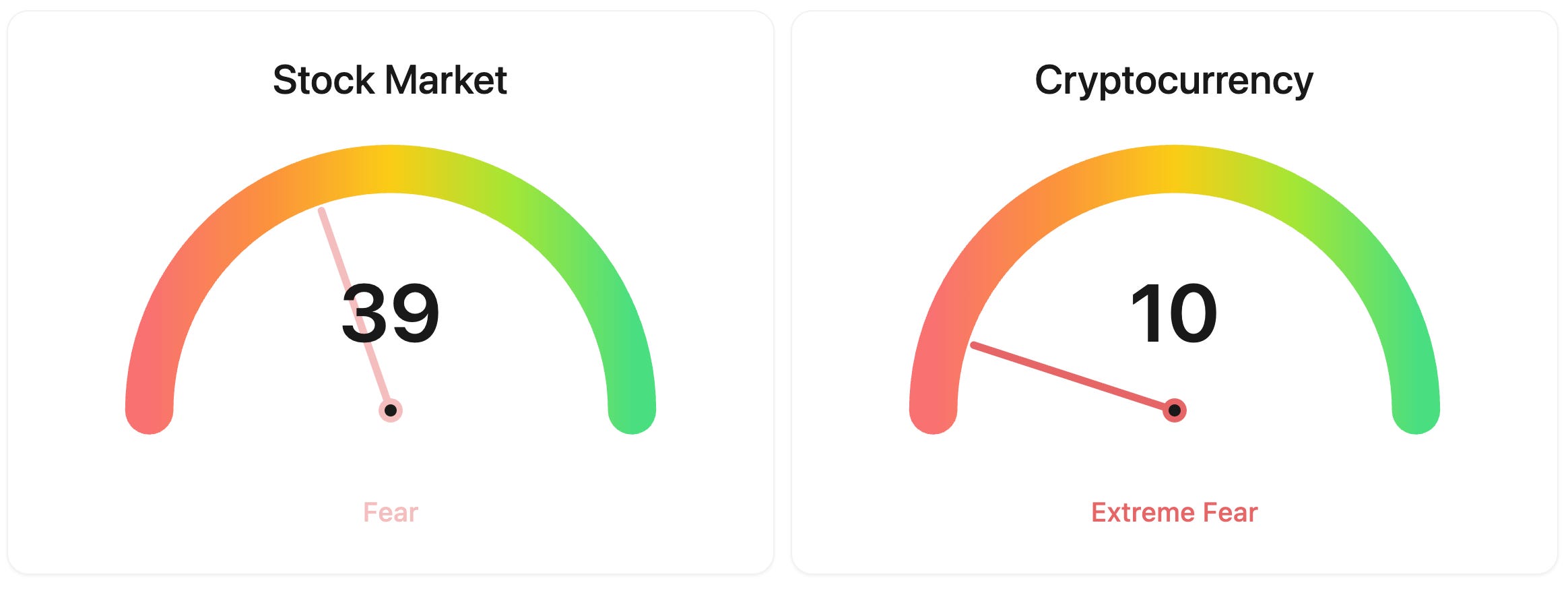
⚖️ Fear & Greed
📉 The Number That Matters
1,000 POINTS
Citi and Bank of America set year-end S&P 500 targets 1,000 points apart in the same week, 8,100 against 7,100, the widest split between two major banks and the cleanest read on the bull-versus-bear divide.
⚔️ Winners vs Losers
Winners
AZI 0.00%↑: Autozi Internet Technology (Global) Ltd. ripped higher in a low-float squeeze, the latest in a string of triple-digit pre-market gaps this year as thin trading volume drove an outsized move in the volatile Chinese microcap.
NUVL 0.00%↑: Nuvalent, Inc. shares soared after GSK agreed to acquire the Boston oncology company for $10.6 billion, gaining two late-stage lung cancer therapies now under FDA review.
MU 0.00%↑: Micron Technology, Inc. extended its rebound as the memory and AI-chip trade recovered from last week’s sharp semiconductor selloff, helped by recent analyst price target hikes ahead of fiscal Q3 earnings on June 24.
RKLB 0.00%↑: Rocket Lab Corporation rose alongside the broader space sector as Musk’s pitch for AI satellites and orbital data centers lifted names across the group ahead of the SpaceX IPO.
Losers
STI 0.00%↑: % Solidion Technology, Inc. pulled back hard after a parabolic multi-day rally on its space-battery announcements, with a newly disclosed $35 million private placement adding dilution and an outstanding going-concern warning weighing on shares.
📊 Market Snapshot
Cryptocurrencies:
Bitcoin (BTC): $62,610 (▼ 0.72%)
Ethereum (ETH): $1,671 (▼ 1.12%)
XRP: $1.15 (▼ 1.15%)
Equity Indices (Futures):
S&P 500: 7,447 (▲ 0.42%)
NASDAQ 100: 29,709 (▲ 0.86%)
FTSE 100: 10,353 (0.00%)
Commodities & Bonds:
10-Year US Treasury Yield: 4.55% (▼ 0.48%)
Oil (WTI): $90 (▼ 1.88%)
Gold: $4,342 (▲ 0.29%)
Silver: $68.57 (▲ 0.66%)
Data as of: UK: 12:57 BST / US: 07:57 EDT / Asia (Tokyo): 20:57 JST
✅ 5 Things to Know
🚩 BofA Says Take Profits as Warning Signs Pile Up
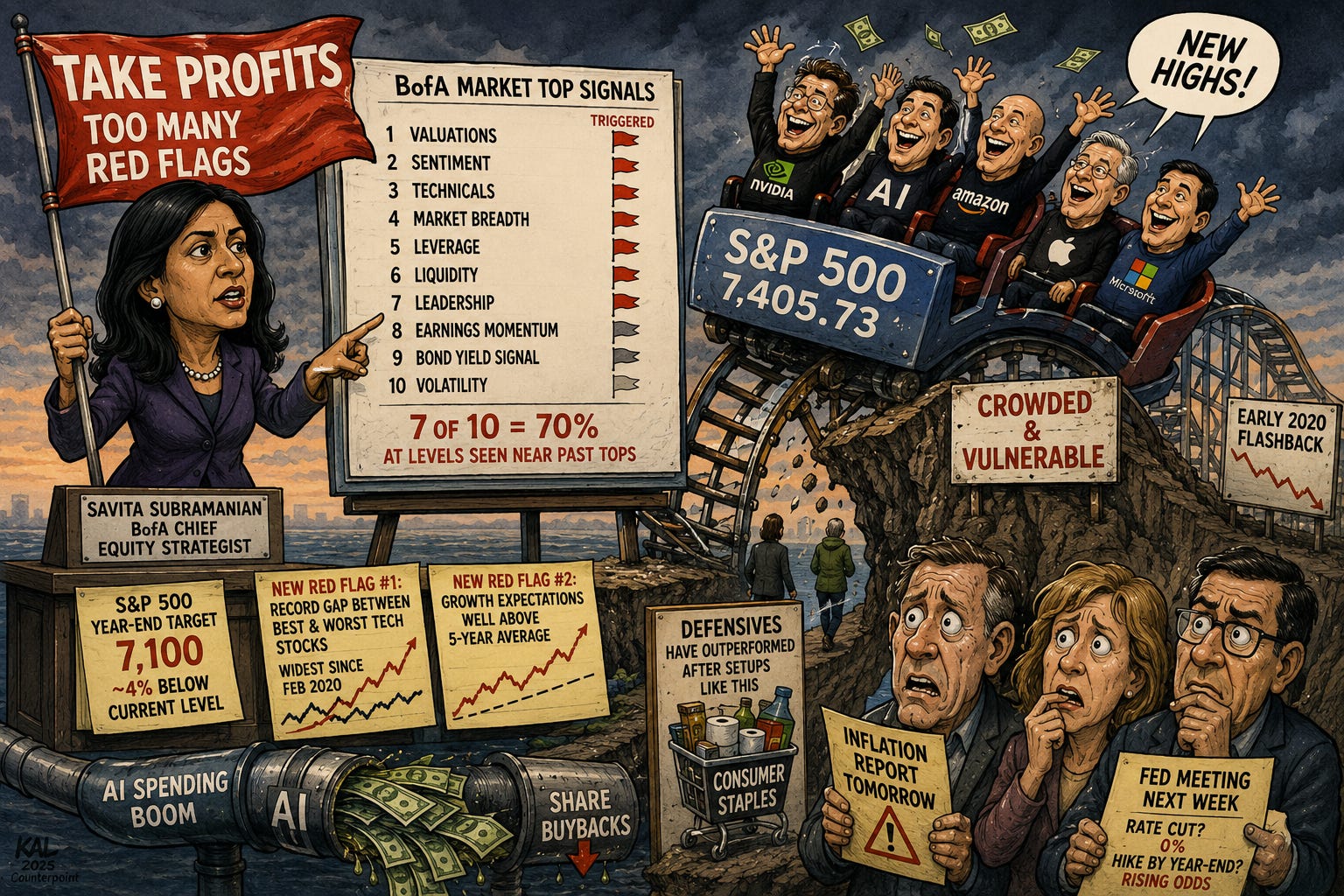
Bank of America’s most-followed stock strategist, Savita Subramanian, told clients to take profits, citing “too many red flags” across US shares. Seven of the 10 indicators the bank uses to spot market tops have now triggered, up from five in April and four in March, putting roughly 70% of its warning signals at levels last seen near past peaks. The firm kept its year-end S&P 500 target at 7,100, about 4% below where the index closed yesterday at 7,405.73. The two newest flags: a record-wide gap between the best and worst tech stocks, the widest since February 2020, and growth expectations running well above their five-year average. (CNBC)
The nuance matters for anyone holding an index fund, because Subramanian is not saying sell everything. Her point is that the cap-weighted S&P 500, where a handful of megacap technology names dominate, has become the crowded and vulnerable trade, while individual stocks still offer room to hide. She drew the comparison to early 2020 and noted that defensive stocks such as consumer staples have tended to outperform after setups like this one. The near-term test is tomorrow’s May inflation report and the Federal Reserve’s meeting next week, where markets see almost no chance of a rate cut and growing odds of a hike by year-end. (Bloomberg)
Sensei’s Insight: BofA’s 7,100 target already sits below where the S&P trades, so this is a call for a drop from here, not someday. Watch the cash side: the boom in spending on AI is quietly eating into the share buybacks that powered much of this rally.
📈 Citi Lifts S&P Target to 8,100 on AI Earnings
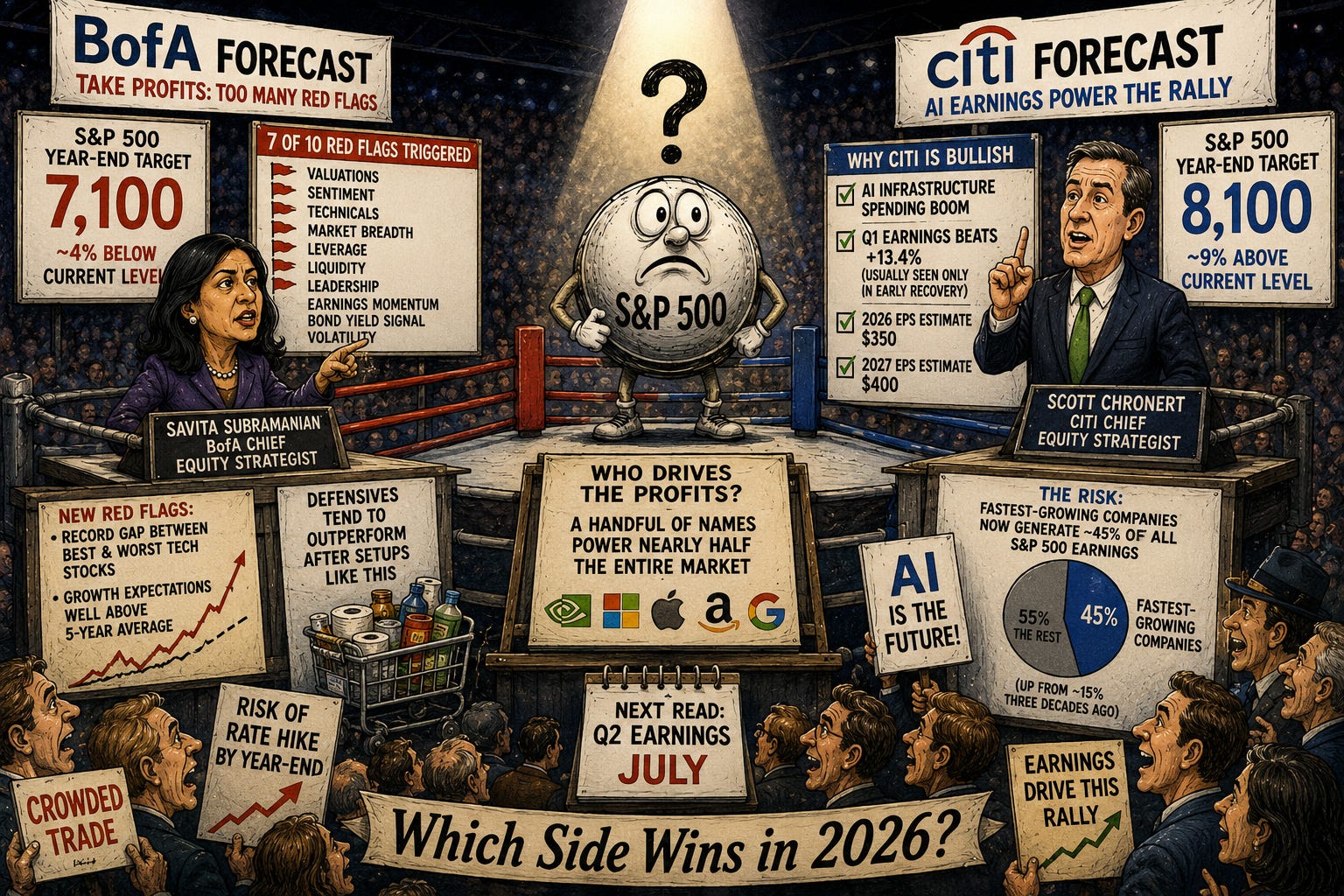
Citigroup went the other way the same week. Its equity strategist, Scott Chronert, raised the firm’s year-end S&P 500 target to 8,100 from 7,700, about 9% above where the index closed yesterday, and lifted his 2026 earnings estimate for the index to $350 a share, with $400 pencilled in for 2027. The driver is what Citi calls a one-time spending boom on AI infrastructure that is lifting company profits rather than just inflating valuations. Chronert pointed to unusually large first-quarter earnings beats, about 13.4% above expectations, a margin normally seen only in the early recovery out of a recession. (CNBC)
For retail investors, the split is the story. Citi at 8,100 and BofA at 7,100 in the same week frames the central question of 2026: whether AI is a durable earnings engine or a crowded bubble. Citi’s case rests on profits holding up, and the firm flags its own risk. It notes that the market’s fastest-growing companies now generate about 45% of all S&P 500 earnings, up from roughly 15% three decades ago, so a stumble by a few names would ripple through the whole index. Citi also expects valuations to cool from here, which puts more weight on earnings actually landing. The next read comes with second-quarter results in July. (Kitco)
Sensei’s Insight: Strip away the headlines and Citi and BofA agree on the facts: a handful of AI names now drive close to half the market’s profits. They just split on whether that is strength or fragility. Second-quarter earnings in July settle the argument, not strategists.
💥 Intel Jumps 13% as Google Taps It for Chips
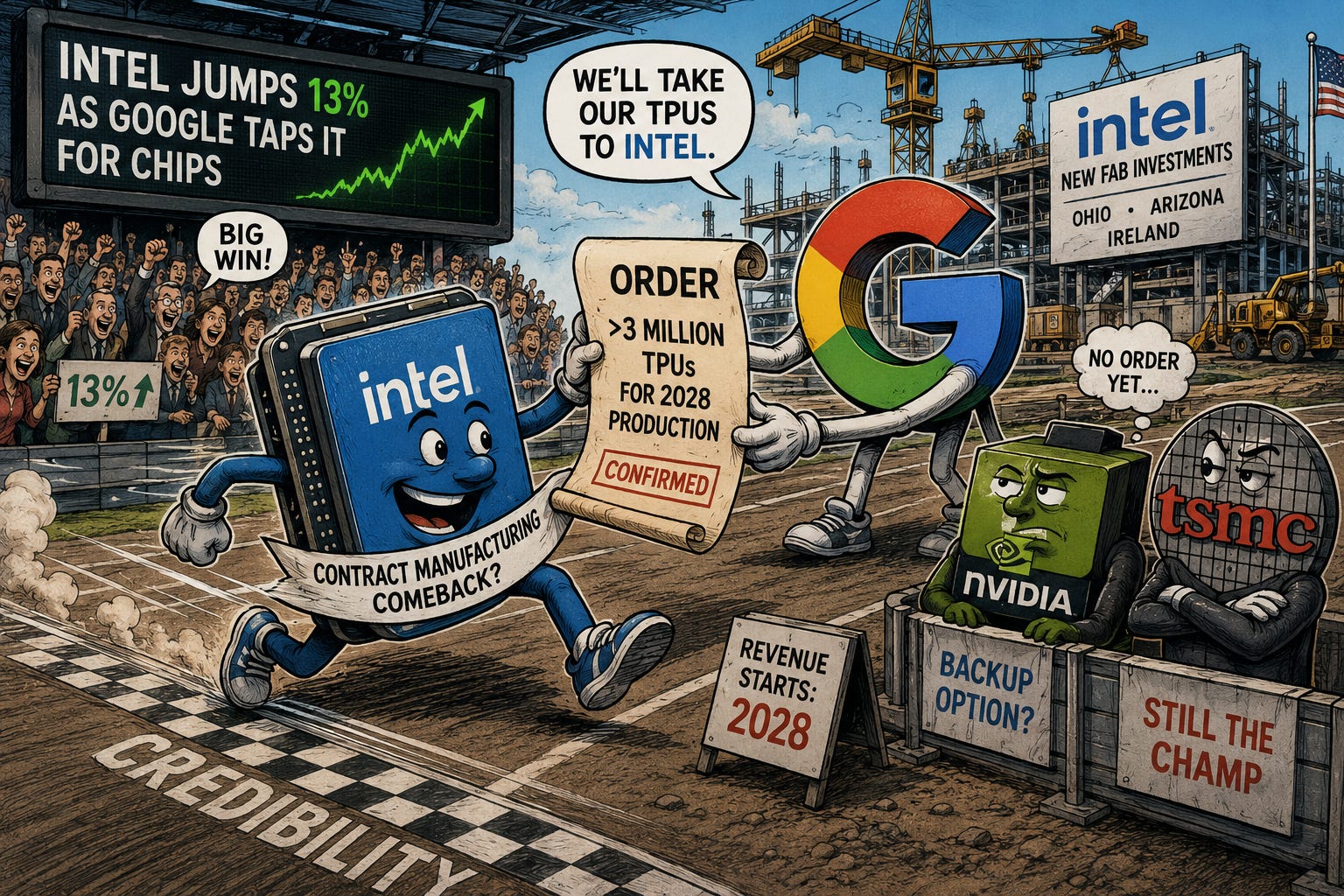
Intel shares jumped more than 13% in premarket trading yesterday and held a double-digit gain after a report that Alphabet’s Google ordered it to build more than 3 million of Google’s custom AI chips, called tensor processing units (TPUs), for 2028 production. The order, first reported by The Information and confirmed by Bloomberg, came after months of Google testing Intel’s factories. Separately, chip designers including Nvidia are weighing Intel as a backup manufacturer, though no Nvidia order has been placed. For Intel, whose contract-manufacturing arm builds chips for outside customers, a high-volume win from a name like Google is the validation it has chased for years. (Bloomberg)
The bigger picture is a chip supply chain that has leaned almost entirely on Taiwan Semiconductor Manufacturing Co., or TSMC, whose factories cannot keep pace with AI demand. That crunch is pushing the giant cloud companies to find a second source, and Intel is positioning to be it. The limit for investors is timing: this order is for 2028, so the revenue is years away, and Nvidia has not committed. Intel has poured tens of billions into new plants in Ohio, Arizona, and Ireland on a bet exactly like this one. What to watch next is whether another big buyer follows Google, and whether Intel’s newest manufacturing process holds up at scale. (TheStreet)
Sensei’s Insight: The cash from this order does not arrive until 2028, so yesterday’s pop is about credibility, not revenue. What matters next is a second big buyer following Google. If Nvidia commits, Intel’s comeback stops being a story and starts being a business.
🎯 Marvell Jumps 14% on Its S&P 500 Ticket
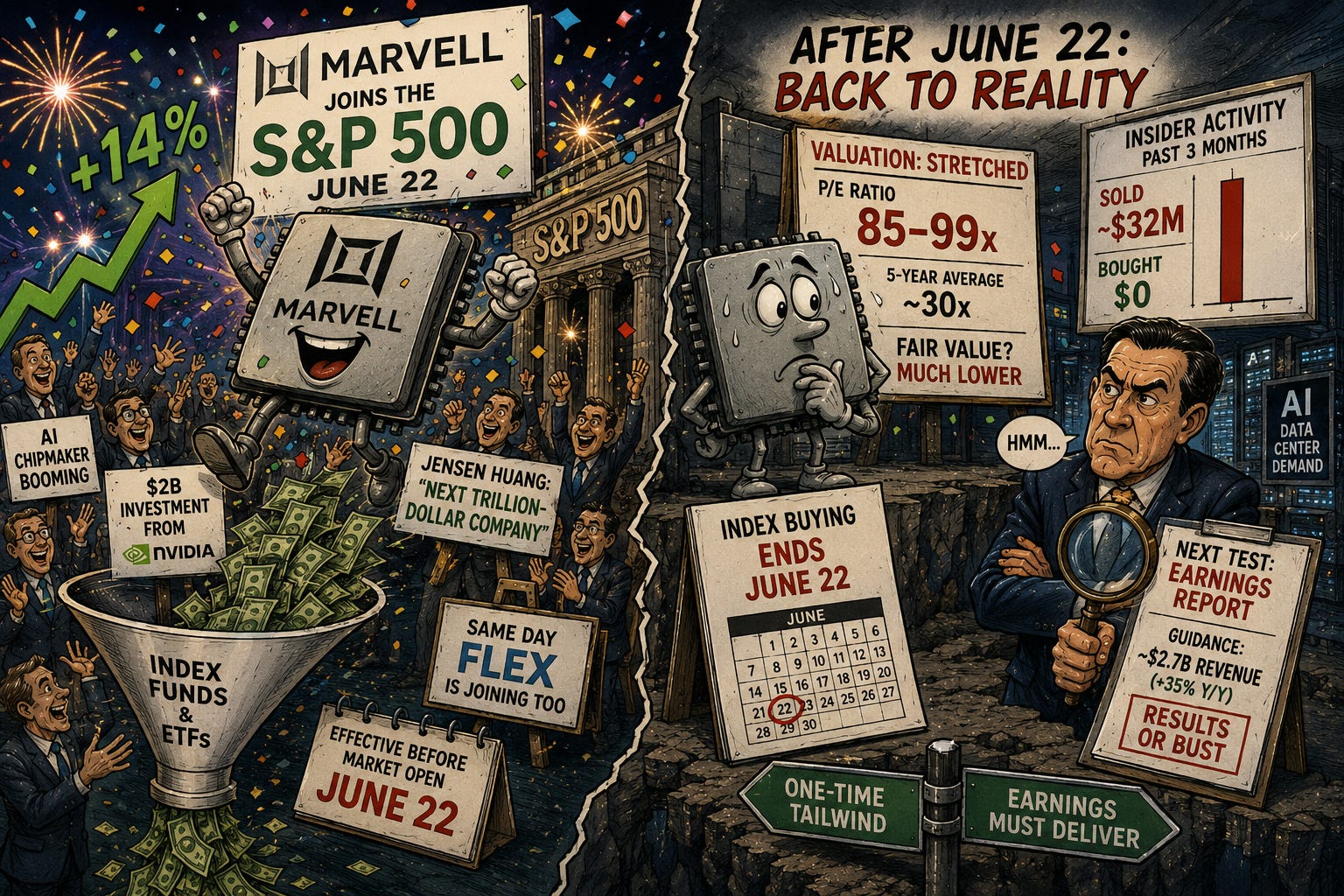
Marvell Technology jumped nearly 14% yesterday after confirmation it will join the S&P 500 before trading opens on June 22, replacing pool-supplies distributor PoolCorp. The AI chipmaker cleared the bar for inclusion by posting a full-year accounting profit, and its addition forces every index fund and exchange-traded fund (ETF) tracking the benchmark to buy the shares, creating built-in demand. Contract manufacturer Flex is joining the index the same day. Marvell has more than tripled in 2026, helped by a $2 billion investment from Nvidia in March and Nvidia chief Jensen Huang calling it the “next trillion-dollar company.” Its market value is now around $230 billion. (CNBC)
For anyone who owns an S&P 500 fund, the change quietly bakes more AI exposure into a holding most people treat as safe and diversified, a sign of how thoroughly chip and data-center names have taken over the benchmark. The forward question is valuation. Marvell trades at roughly 85 to 99 times earnings, well above its five-year average near 30, and at least one widely used model pegs fair value far below the current price. The built-in buying from index funds runs only through June 22. After that, the stock has to justify the price on results, and the next test is the coming earnings report, where Marvell has guided to about $2.7 billion in revenue, up roughly 35% from a year earlier. (Reuters)
Sensei’s Insight: Index inclusion is a one-time tailwind that runs out on June 22. After that, Marvell trades on results, not forced buying. Worth noting: insiders sold about $32 million in stock over the past three months and bought none. The next earnings report is the real test.
🤖 OpenAI Files for IPO, in No Rush to List
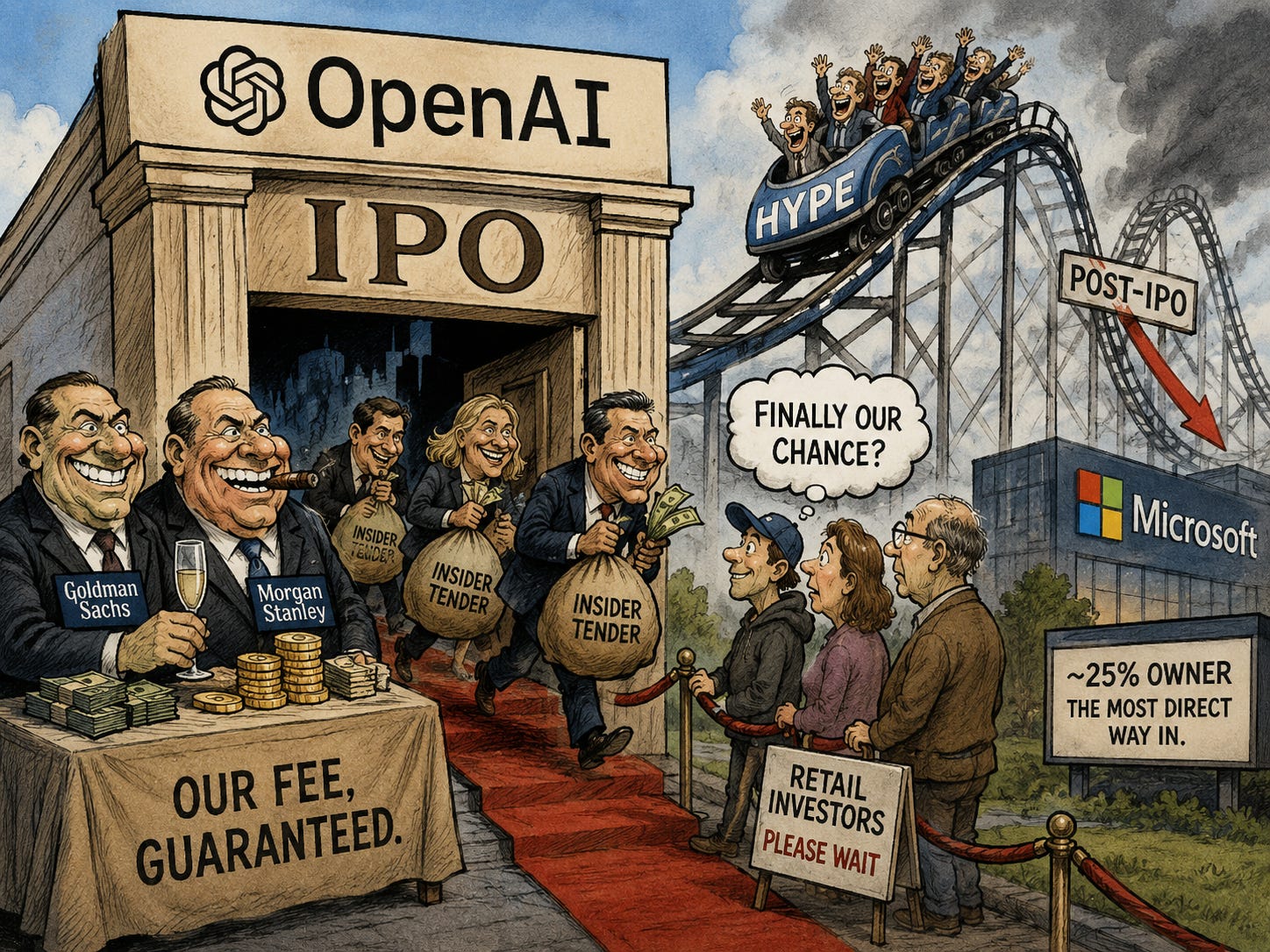
OpenAI confirmed yesterday that it has filed a confidential S-1, the registration form a company submits to the US Securities and Exchange Commission (SEC) before going public, its first formal step toward a listing. The company announced the move itself, saying it expected the news to leak. OpenAI carries an $852 billion valuation from a $122 billion funding round in March backed by SoftBank, Nvidia, Amazon and Microsoft, and pulls in around $2 billion a month in revenue, more than $20 billion a year. It is still losing heavily, with internal forecasts pointing to a roughly $14 billion loss this year and no profit expected until about 2029. Goldman Sachs and Morgan Stanley are running the process. (CNBC)
For retail investors the filing reads like a chance to finally own a piece of OpenAI, but it is a long way from that. A confidential filing only lets the SEC review the books privately, the company says it may stay private a while longer, and a real listing is months off at the earliest. The track record here is not subtle: shares sold in initial public offerings have as a group trailed the wider market for years after listing, and the most hyped technology debuts tend to spike on day one before fading. The guaranteed winners are the banks running the deal, who earn their fee whether the stock performs or not, and insiders, who are lining up a tender offer to sell some of their holdings before any public buyer can. The nearer read on appetite comes this week from SpaceX, which prices its own record listing and starts trading on the Nasdaq under the ticker SPCX. For now the most direct way to own a slice of OpenAI stays Microsoft, which holds roughly a quarter of it. (NBC News)
Sensei’s Insight: The one certainty in this filing is who gets paid: the banks earn their fee whatever the stock does, and insiders get a tender offer to sell before the public can. IPOs lag the market for years after listing, and the loudest fade fastest.
Stories You Might Have Missed
💊 Zealand Pharma Sinks 25% on Obesity-Drug Side Effects
Shares of Danish drugmaker Zealand Pharma fell as much as 25% yesterday after full late-stage data on its weight-loss drug survodutide raised side-effect concerns. The drug hit its weight-loss targets, with up to 16.6% loss at 76 weeks, but 19% of patients quit the trial because of gastrointestinal problems, against 2.9% on placebo, and more than 40% reported vomiting. That tolerability gap matters in a market ruled by Novo Nordisk’s Wegovy and Eli Lilly’s Zepbound, where rivals saw far fewer dropouts, and it could cap how many patients ever take the drug. The contrast was stark: at the same diabetes conference, Eli Lilly shares rose after its next-generation obesity drug, retatrutide, was shown to ease sleep apnea and knee pain on top of weight loss. (CNBC)
💵 Cash in Money Funds Tops $8 Trillion
US money-market fund assets have topped $8 trillion for the first time, with Crane Data putting the pile at $8.29 trillion after more than $1 trillion flowed in last year. The pull is simple. These funds, which hold short-term debt such as Treasury bills, are paying around 3.3% with almost no risk, and investors keep parking cash there even as stocks, gold, and bitcoin set records. The backdrop is uncertainty over interest rates, war, and energy, with markets now pricing a real chance the Federal Reserve’s next move is a hike rather than a cut. That near-risk-free yield raises the bar for every riskier asset, and the cash heap is also potential fuel for stocks if it ever rotates back in. (Bloomberg)
🛢️ China Is the Reason Oil’s Still Under $100
Oil has stayed under $100 a barrel despite a Middle East war and disruption around the Strait of Hormuz, and a sharp drop in Chinese buying is the main reason. China’s crude imports fell from 11.7 million barrels a day in February to under 9 million by late May, which JPMorgan reckons accounts for about 74% of the drop in global crude imports, absorbing a supply shock that some feared could push oil past $200. Brent crude still jumped 4.9% yesterday to $97.67 after fresh Israel-Iran strikes. Societe Generale’s warning: as global inventories drain, prices have to climb, and if China returns as a buyer, some see Brent heading toward $120 to $130. That feeds straight into inflation and Fed policy, with May inflation data due tomorrow. (CNBC)
🔗 Connect with Us
Stay plugged in across platforms:
Sensei on X: sensei_live_
Martyn Lucas on X: MartynInvestor
Vaz on X: eVTOLHUB
📺 YouTube Channel (Live & Replays): Martyn Lucas Investor