

👀 Today’s Stories at a Glance
🏛️ Warsh’s first Sintra test: The new Fed chair shares a stage with Lagarde, Bailey and Macklem today at 2pm (BST), with markets now leaning toward a rate rise rather than the cut the White House wants.
🚁 AeroVironment’s drone blowout: Revenue jumped 133% to $641.6 million and the funded backlog swelled to $1.2 billion, sending the defence stock up around 28%.
₿ Strategy ends “never sell”: Michael Saylor’s firm cleared the way to sell up to $1.25 billion of Bitcoin to cover dividends, the first crack in its buy-and-hold doctrine.
👟 Nike beats, China bites: A $986 million tariff refund flattered Nike’s profit, but a double-digit drop in China sales sank the shares, while Constellation’s cleaner beat sent it higher.
🍎 Apple’s iPhone 18 Pro leaks: Hackers dumped 630 gigabytes from a key Apple supplier in India, exposing unreleased designs and the full parts map for the next iPhone.
🚗 Tesla’s number lands tomorrow: Wall Street wants roughly 406,000 second-quarter deliveries, a 12% jump on the first quarter but still short of last year’s 410,831.
⚖️ Big pharma’s China probe: A House committee is investigating Merck and AbbVie over clinical trials in China, and five drug stocks dipped on the news.
🚀 NASA’s new Moon contracts: NASA handed Astrobotic, Firefly and Intuitive Machines fresh lunar lander deals, widening the space trade beyond the rocket launchers.
🛢️ Oil’s worst quarter since 2020: Crude shed almost a third in three months, with WTI near $70 as traders brace for a global supply glut.
🔍 The quarter crypto missed: Stocks posted their best quarter in six years while Bitcoin fell to a yearly low, and the split has a clear cause.
🧠 One Big Thing
Michael Saylor spent years telling the world Strategy would never sell a single Bitcoin. This week that promise quietly died. The company gave itself room to sell up to $1.25 billion of its stash to cover dividends, right after the market value of the business fell below the value of the Bitcoin it holds for the first time. That inversion is the real signal. The whole Bitcoin-treasury trade was built on companies being worth more than their coins, and now the flagship is worth less. Watch whether other corporate Bitcoin holders face the same squeeze, because forced sellers are how a slow crypto decline turns into a fast one.
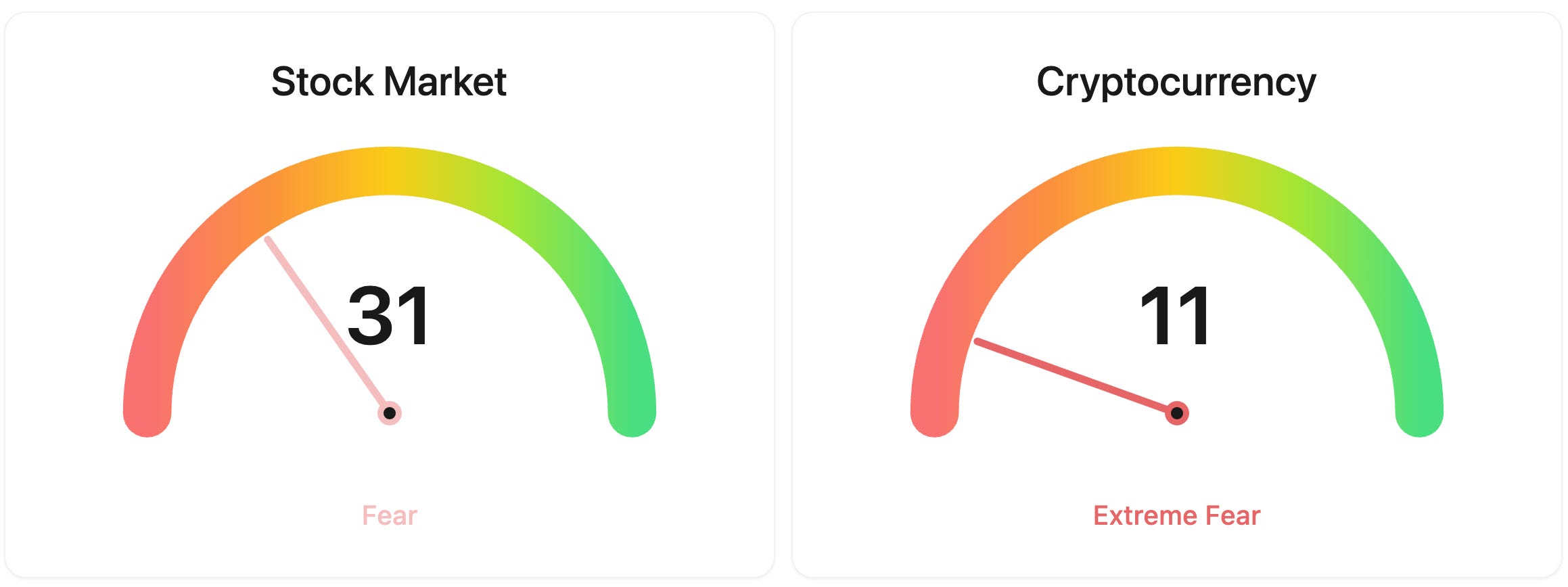
⚖️ Fear & Greed
📉 The Number That Matters
$1.25 billion
Strategy cleared itself to sell up to $1.25 billion of Bitcoin to fund dividends, the first real break in Michael Saylor’s vow never to sell, days after the company’s market value slipped below the worth of its own coins.
⚔️ Winners vs Losers
Winners
BE 0.00%↑: Bloom Energy Corporation extended its rally after Brookfield expanded their strategic partnership fivefold to a $25 billion framework to build and finance rapid onsite fuel-cell power for AI data centers, a scale-up that RBC Capital Markets called larger than the market had expected.
NOW 0.00%↑: ServiceNow, Inc. rose as the chip-to-software rotation rolled on, with investors pulling out of semiconductors and back into beaten-down enterprise software on fading fears that AI agents would hollow out SaaS subscription models.
CRM 0.00%↑: Salesforce, Inc. climbed in sympathy with ServiceNow as the same software-sector rebound lifted the major SaaS names, aided by easing AI-disruption worries and falling Treasury yields that support high-multiple growth stocks.
Losers
SSTK 0.00%↑: Shutterstock, Inc. collapsed after Getty Images said its board resolved to terminate their merger agreement rather than divest Shutterstock’s editorial business as UK regulators had required, unwinding a deal that had propped up the stock.
OPTU 0.00%↑: Optimum Communications, Inc. extended its slide after Citi downgraded the stock to Sell on its heavy debt load and weak outlook. The selling was compounded by sector-wide pressure from reports that Starlink could enter the US retail mobile market, and by the expiration of a $2.50-per-share cash tender offer that had provided a partial floor under the shares.
📊 Market Snapshot
Cryptocurrencies:
Bitcoin (BTC): $58,642 (▲ 0.17%)
Ethereum (ETH): $1,571 (▲ 0.11%)
XRP: $1.04 (0.00%)
Equity Indices (Futures):
S&P 500: 7,537 (▼ 0.15%)
NASDAQ 100: 30,407 (▼ 0.38%)
FTSE 100: 10,440 (▼ 0.67%)
Commodities & Bonds:
10-Year US Treasury Yield: 4.48% (▲ 0.45%)
Oil (WTI): $69 (▼ 1.50%)
Gold: $4,025 (▲ 0.45%)
Silver: $58.87 (▲ 0.61%)
Data as of: UK: 12:38pm BST / US: 7:38am EDT / Asia (Tokyo): 8:38pm JST
✅ 5 Things to Know
🏛️ Warsh faces his first Sintra test as records stack up
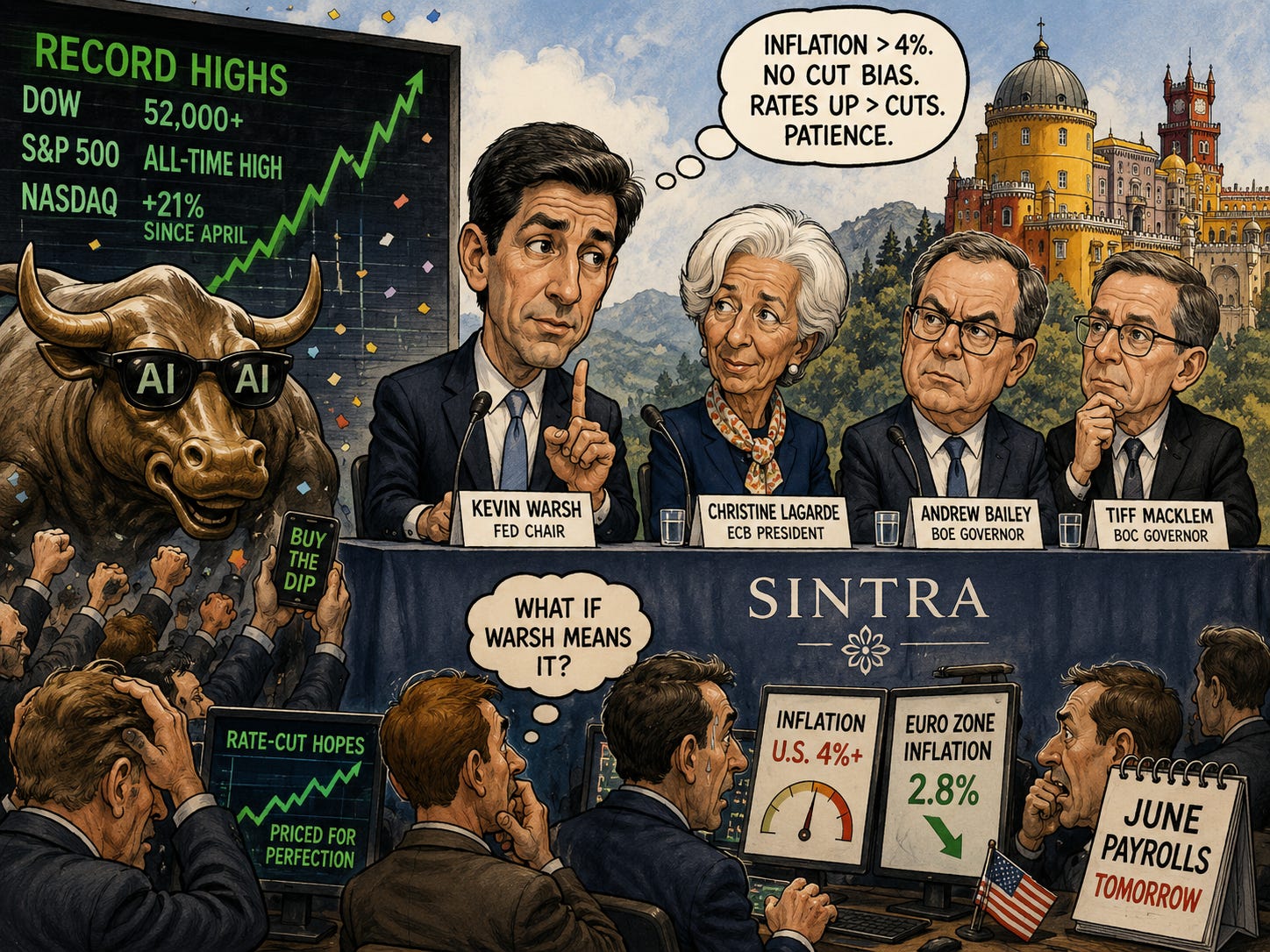
Wall Street begins the second half of 2026 at record highs. The Dow closed above 52,000 for the first time yesterday, capping the best quarter for US stocks in six years, with the Nasdaq up around 21% since April on relentless demand for anything tied to AI. Into that backdrop steps Kevin Warsh, who takes his first Sintra panel as Fed chair today at 2pm, alongside Christine Lagarde, Andrew Bailey and Tiff Macklem. His problem is awkward: headline inflation is running above 4%, the Fed has just dropped its bias toward cuts, and traders now lean toward a rate rise by year end rather than the reductions the White House keeps demanding (CNBC).
For everyday investors the tension is simple: markets are priced for perfection at the exact moment the Fed is least willing to ease. Warsh built his reputation on inflation discipline, so any hint of patience today could cool the rate-cut hopes still baked into stock valuations. The mood music is already shifting abroad, where euro-zone inflation cooled to 2.8% in June, its first real step down in months, as the quarter’s slump in oil fed through to prices (Bloomberg). The bigger test comes tomorrow, when June payrolls land in a holiday-thinned market that could amplify any surprise.
Sensei’s Insight: Warsh does not need to say much to move markets. With a record-high tape still leaning on rate cuts the data no longer supports, the risk today skews hawkish, not dovish. I am watching his tone on inflation more closely than tomorrow’s jobs headline.
🚁 AeroVironment soars as drone demand explodes
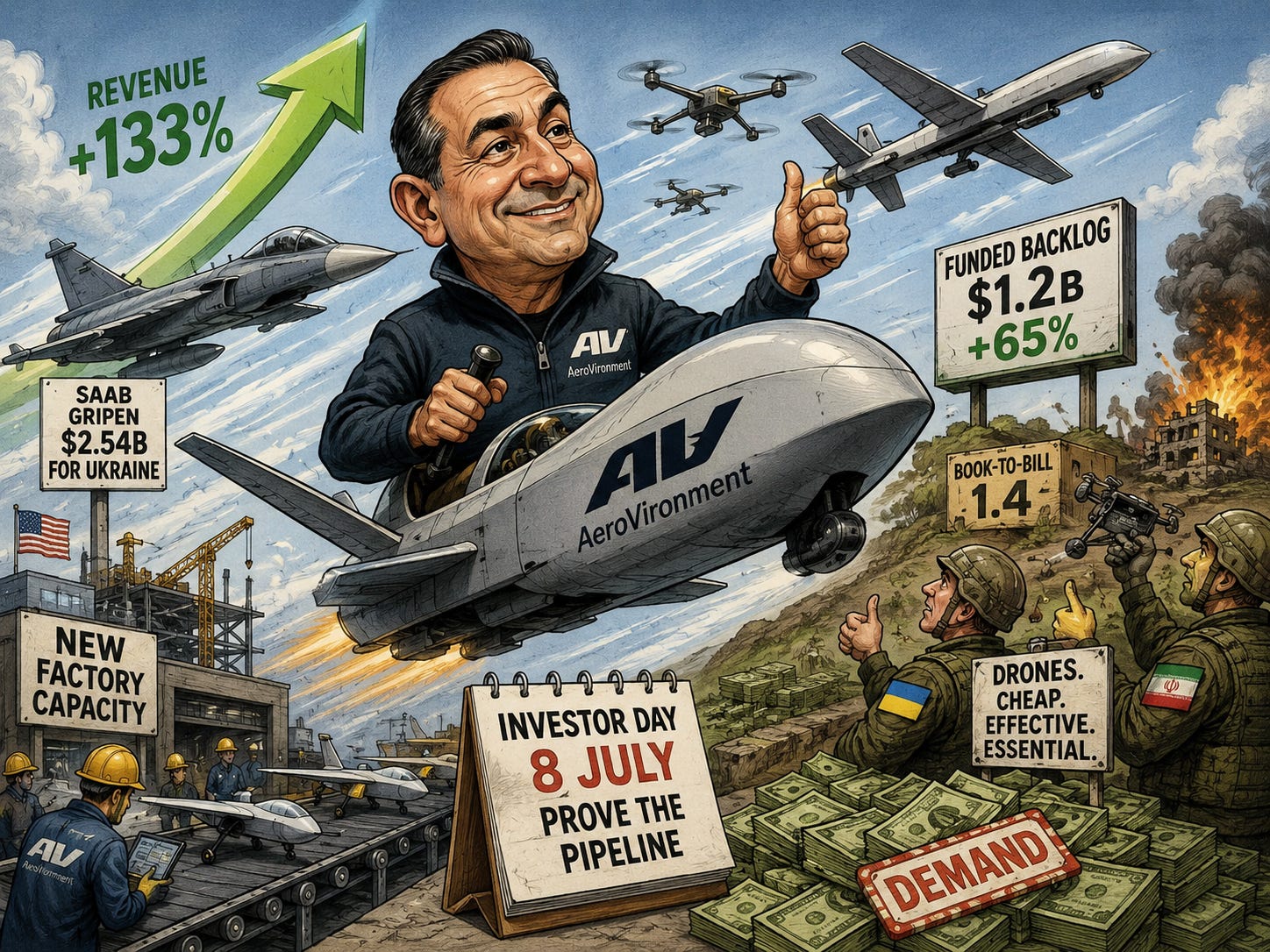
AeroVironment has become one of the hottest names in defence, and its latest results show why. Fiscal fourth-quarter revenue jumped 133% from a year earlier to a record $641.6 million, comfortably ahead of the roughly $559 million Wall Street expected, while adjusted earnings of $1.84 a share beat the $1.46 estimate. The order book is the eye-catching part: funded backlog swelled 65% to $1.2 billion, and the book-to-bill ratio, a gauge of new orders against orders filled, ran at a healthy 1.4. Shares surged around 28% after the results as investors piled into the drone maker (CNBC).
The one blemish, softer profit guidance for the year ahead of $3.02 to $3.34 a share against hopes near $3.94, barely dented the mood, because it reflects heavy spending to build new factory capacity rather than weak demand. Ukraine and the recent Iran conflict have turned cheap drones and counter-drone systems into standard battlefield kit, and the spending wave is spreading: Sweden’s Saab has just agreed a $2.54 billion deal to sell Gripen fighter jets to Ukraine. Chief executive Wahid Nawabi has flagged major contract wins over the next 12 to 24 months, and an investor day on 8 July is where he has to show the pipeline behind that claim (Reuters).
Sensei’s Insight: Defence budgets move slowly, but this quarter’s backlog growth outran the guidance cut. The capacity spend is building for demand that already exists on the battlefield, not a bet on future orders. 8 July is where Nawabi has to prove the pipeline is real.
₿ Strategy tears up its “never sell” Bitcoin pledge
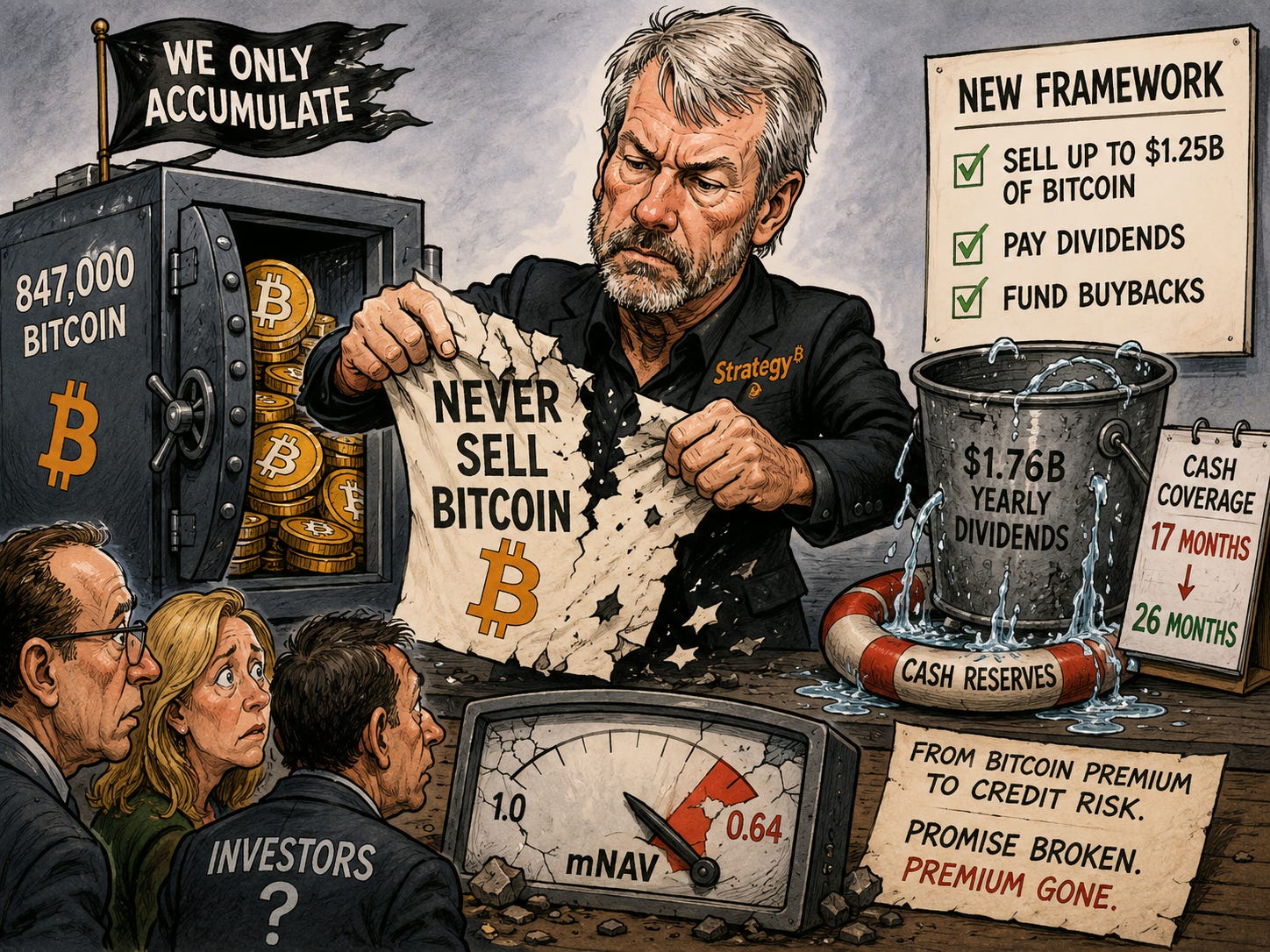
Strategy, the company Michael Saylor built into the world’s biggest corporate Bitcoin holder on a promise never to sell, has just given itself permission to do exactly that. Its new Digital Credit Capital Framework, unveiled this week, authorises the board to sell up to $1.25 billion of Bitcoin to top up cash reserves, cover preferred dividends and fund buybacks. The trigger was a milestone the firm long insisted would never matter: its enterprise value slipped below the market value of its Bitcoin for the first time, a ratio traders call mNAV falling under 1, and it now sits near 0.64. Strategy holds about 847,000 Bitcoin bought for an average $75,651 each (Reuters).
This exists because the dividend maths stopped working. Strategy owes close to $1.76 billion a year on its preferred stock, and its cash cushion alone covered barely 17 months of that; the Bitcoin-sale authorisation stretches coverage to roughly 26 months. It also lifted the dividend on its STRC preferred shares to 12% to keep that security near its face value. The point for investors is blunt: the entire pitch for owning Strategy over Bitcoin itself was that it would only ever accumulate. That pitch is gone, and the stock now trades on whether it can service its obligations rather than simply track the coin it holds.
Sensei’s Insight: Never sell was the whole reason to own Strategy instead of Bitcoin directly. With that gone, this is now a credit story: can it cover $1.76 billion of yearly dividends without selling coins into a weak market. The premium that made it special has evaporated.
👟 Nike beats but sinks on China, while Constellation shines
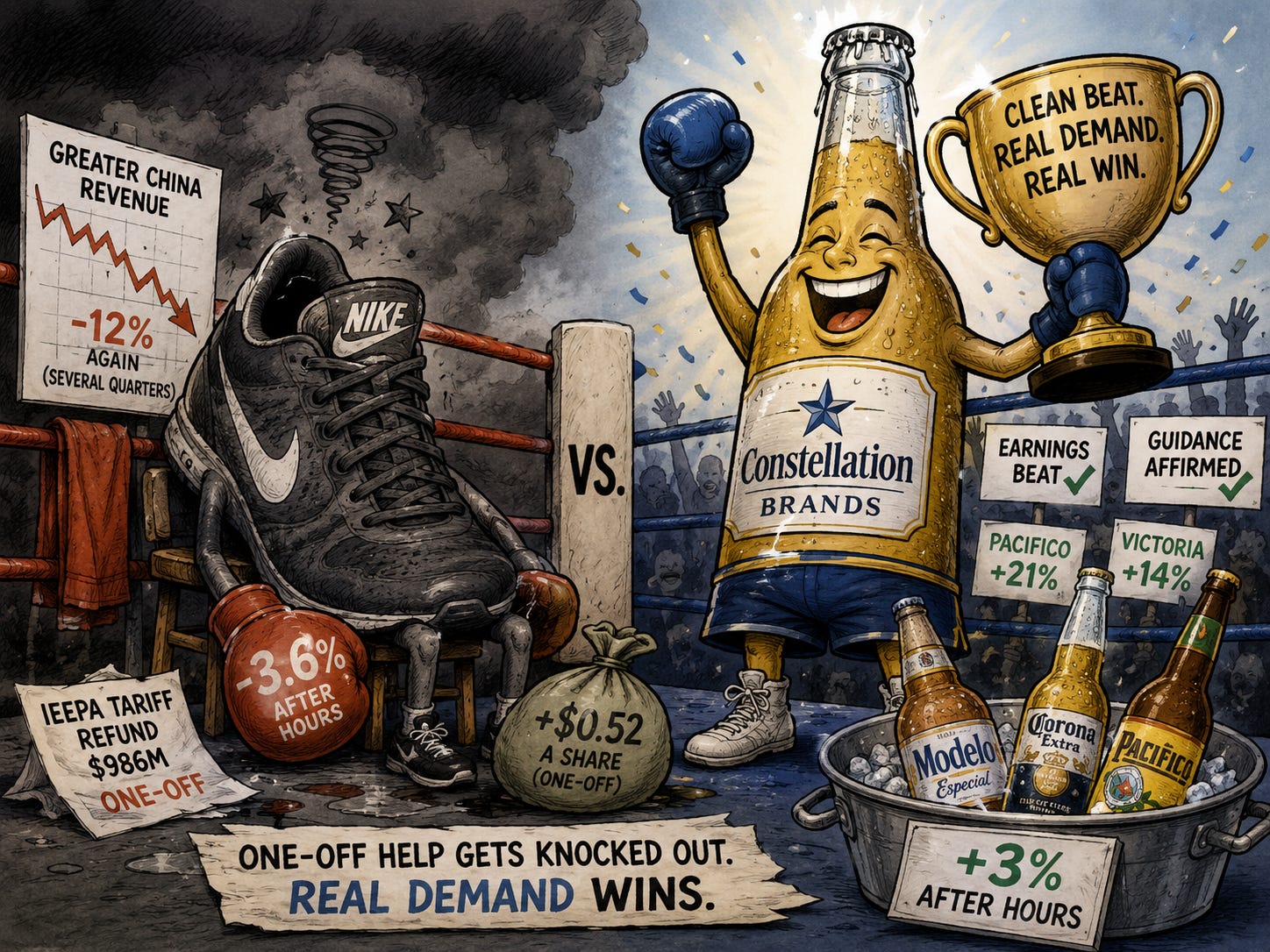
Two consumer heavyweights reported after yesterday’s close, and the market split them cleanly. Nike posted fiscal fourth-quarter revenue of $10.97 billion, just ahead of the $10.85 billion expected, with net income of about $1.07 billion. A $986 million refund on IEEPA tariffs added $0.52 a share to earnings, and even stripping that out Nike still beat on an underlying basis. None of it counted once investors saw Greater China revenue fall again, by around 12%, a slide now several quarters deep. The shares fell roughly 3.6% after hours to around $39.58 (CNBC).
Constellation Brands had the opposite night. The maker of Modelo and Corona posted comparable earnings of $3.43 a share on net sales of about $2.43 billion, both ahead of forecasts, and it affirmed its full-year guidance rather than trimming it. Reported sales fell around 3%, but that mostly reflects last year’s wine disposals, and newer beer brands did the heavy lifting: Pacifico grew 21% and Victoria 14%, more than offsetting softer Modelo Especial and Corona Extra. The shares rose about 3% after hours. The contrast is the lesson: Nike’s beat leaned on a one-off that reverses next year, while Constellation’s came clean, which is why one was punished and the other rewarded (Yahoo Finance).
Sensei’s Insight: A beat built on a one-time tariff refund is not really a beat. Nike’s China revenue fell double digits and that trend is now well established, while Constellation held its guidance without any help. Real demand beat financial cosmetics, and the share moves said so.
🍎 Hackers leak Apple’s unreleased iPhone 18 Pro files
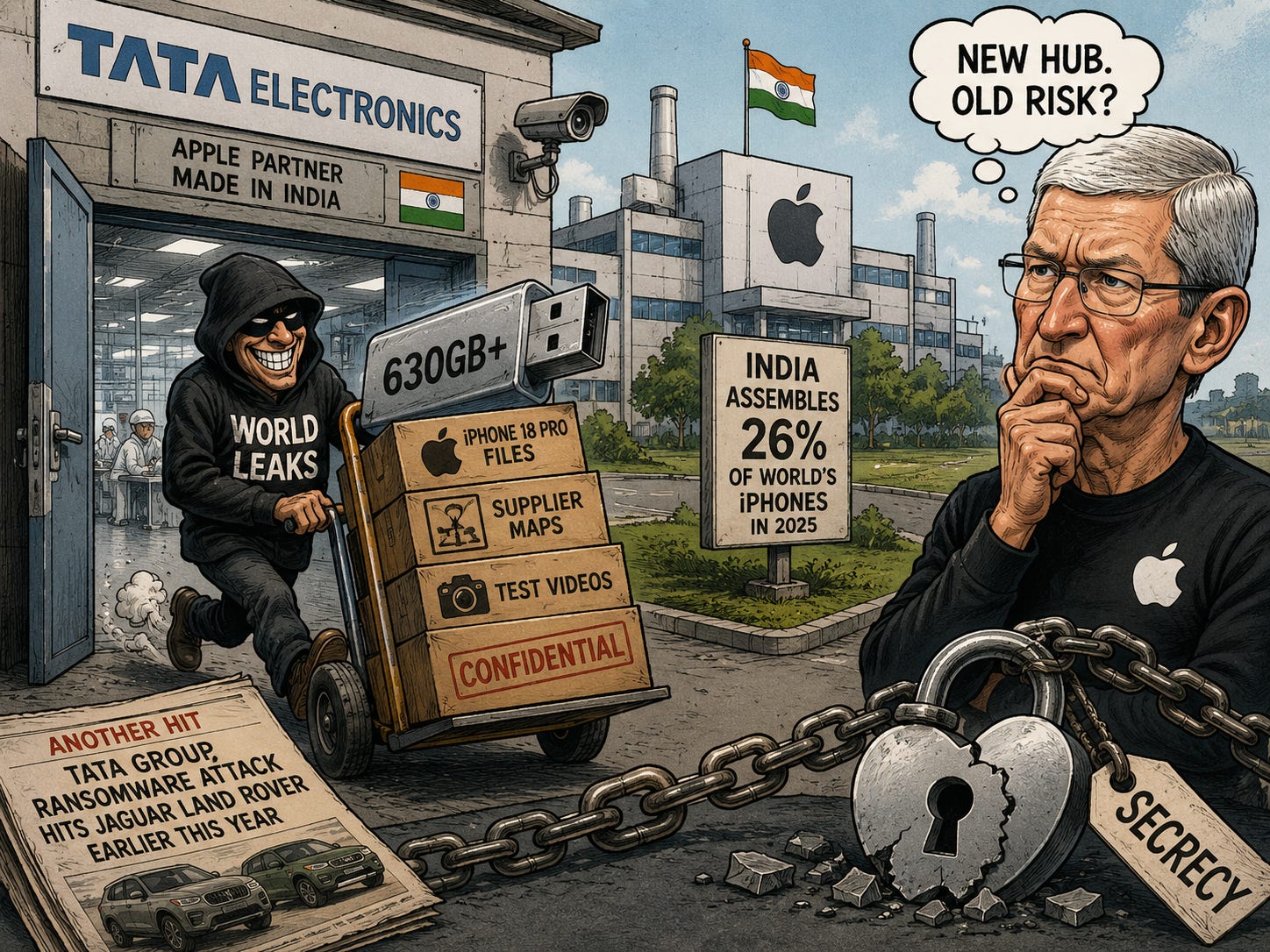
A ransomware group calling itself World Leaks has dumped more than 630 gigabytes of files, over 200,000 of them, stolen from Tata Electronics, one of Apple’s key manufacturing partners in India. The haul includes supplier maps naming which firms make the iPhone 18 Pro’s chips, batteries and camera parts, along with photos and video of unreleased handsets going through drop tests at a Tata site earlier this year. Several files carried Apple’s internal confidential markings and project codenames. Apple says it is concerned and investigating with Tata, which has locked down internal access and brought in outside forensic auditors (CNBC).
The leaked photos grab attention, but the strategic exposure is the real story. Apple has been shifting iPhone production to India specifically through Tata, and the country is on track to assemble about 26% of the world’s iPhones this year, up from just 6% four years ago. A breach at the exact partner underpinning that shift raises an awkward question: can newer manufacturing hubs match the operational secrecy Apple spent two decades building in China. This is not an isolated hit either, since Tata’s parent group was tangled in a separate ransomware attack on Jaguar Land Rover earlier this year, a pattern that will worry every brand leaning on the same supply chain.
Sensei’s Insight: The unreleased iPhone photos are the eye-catching bit. The number that matters is 26%, the slice of global iPhone output now sitting with a supplier breached twice in a year across its group. Supply-chain diversification only works if the new hubs can keep secrets.
Stories You Might Have Missed
🚗 Tesla’s Q2 delivery number lands tomorrow
Tesla reports second-quarter deliveries tomorrow, the figure the whole market is waiting on. Wall Street’s official consensus sits near 406,000 vehicles, a 12% jump on a weak first quarter but still short of the 410,831 Tesla delivered a year ago. Estimates are unusually spread out: Goldman Sachs sees 420,000 on stronger sales in China and Europe, while the more cautious Bloomberg consensus sits closer to 396,000. The number has two jobs, to show a genuine recovery and to prove the first-quarter backlog is clearing. Expect an outsized share move either way in a thin, pre-holiday market, with the fuller story landing at the 22 July earnings call (Yahoo Finance).
⚖️ Merck and AbbVie face a China trials probe
A bipartisan House committee has opened national-security investigations into Merck and AbbVie over clinical trials run in China, with letters also going to Eli Lilly, Pfizer and Bristol Myers Squibb. Lawmakers want details by 17 July on how the trials were overseen, with particular focus on sites in Xinjiang and hospitals linked to China’s military. Merck has run 224 studies in China since 2005, including 40 at military-linked centres; AbbVie has run more than 100 since 2007. The letters cite no evidence of wrongdoing but flag the risk that research at military hospitals could expose valuable drug intellectual property. All five stocks dipped roughly 1% to 2% (Reuters).
🚀 NASA hands out new Moon lander contracts
NASA has awarded fresh lunar lander contracts under its Artemis Moonbase programme: Astrobotic picks up $280 million for two missions, while Firefly Aerospace and Intuitive Machines each take $144 million for one more. Only Intuitive Machines among the three is publicly traded, with Firefly and Astrobotic still private. The awards push investor interest in space beyond the launch companies and into lunar logistics, payload delivery and the wider web of firms tied to NASA’s Commercial Lunar Payload Services programme. For a retail crowd that loves a space story, it is a reminder the Moon economy is quietly turning into real, recurring government contracts (Reuters).
🛢️ Oil closes its worst quarter since 2020
Crude has just finished its ugliest quarter since the pandemic, with WTI settling near $70 a barrel and Brent around $73, both down close to a third over three months. The slide traces back to the US-Iran de-escalation that reopened the Strait of Hormuz and let bottled-up supply flow again, and traders are now bracing for a glut rather than a shortage. Morgan Stanley reckons the world could be oversupplied by nearly 5 million barrels a day by 2027, and analysts are trimming their forecasts. Weekly US inventory data is due later today, the last big energy signal before the 4 July driving weekend (Fortune).