

This content is for informational and educational purposes only and does not constitute financial advice. Always do your own research. Not financial advice (NFA).
👀 Today’s Stories at a Glance
🚨 Iran Hits Back After US Strikes: Missiles fired at three US bases overnight; markets fade it as another contained round, for now.
🏗️ Oracle’s $50 Billion Question Tonight: Options price a 12% swing as the AI capex debate condenses into one earnings call.
⚠️ Wall Street Starts Hedging AI: Wells Fargo tells clients to keep their AI stocks but sell calls against them.
📈 OpenAI Files for September Listing: Third AI giant in a $3.6 trillion IPO queue, with $207 billion still to fund.
💳 Swipe Fee Truce Wins Approval: Judge clears the $38 billion Visa and Mastercard deal; merchants get small cuts, slowly.
🇨🇦 Loonie Limps Into Rate Hold: Bank of Canada expected to hold at 2.25% with the currency at 2026 lows.
🍎 Siri Promises, Apple Shares Slide: Stock drops another 3% as analysts punish an AI reveal with no shipping date.
🧪 Activist Targets Ashland for Sale: Ancora pushes the chemicals maker toward a sale it says could lift shares 30%.
🔍 Deep Dive: CPI Cheat Sheet: The first 4% print in three years lands today; full scenario playbook below.
🧠 One Big Thing
Everything else in today's edition is downstream of one number landing at 1:30 PM UK time. Oracle's 12% implied swing, Wall Street's shift to hedge-everything, Bitcoin stuck near $61,500 in extreme fear: all of it is positioning ahead of the first 4% CPI headline in three years. The setup is unusual: a market priced for hikes, a new Fed chair on record as opposed to hiking on oil, and crude already $19 off its peak, meaning the data may describe a problem that is reversing. If core comes in tame, the relief trade could move fast precisely because everyone is braced the other way. The full breakdown, scenario table and the shelter tiebreaker are in today's Deep Dive cheat sheet below.
🔴 Sensei is LIVE for CPI Report
The first 4% print in three years lands today. I'll be live ahead of the release, walking through the cheat sheet scenarios in real time.
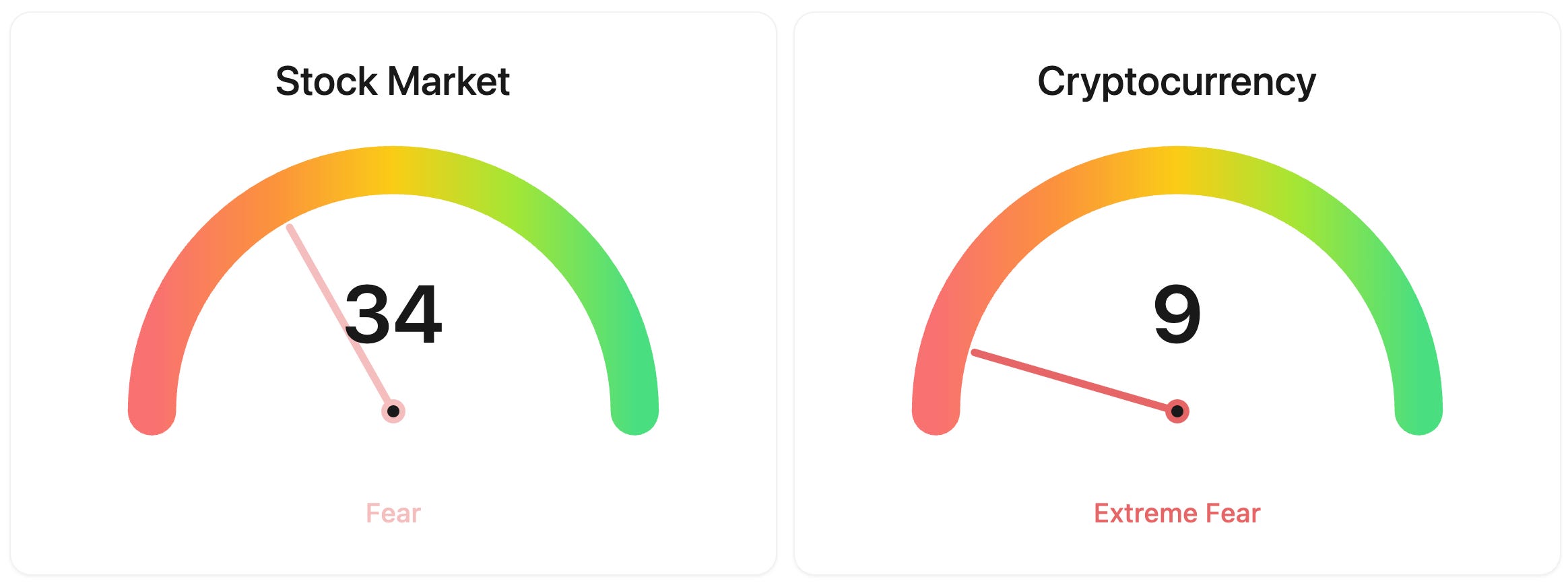
⚖️ Fear & Greed
📉 The Number That Matters
12% SWING
Options traders are pricing a 12% move in Oracle shares tonight, and a 12% swing on one earnings call shows how much of the AI capex debate now rests on a single company.
⚔️ Winners vs Losers
Winners
No major winners today
Losers
SMCI 0.00%↑: Super Micro Computer dropped after filing to raise roughly $7 billion through at-the-market equity programs to fund components for its $39 billion AI server backlog, with dilution concerns compounding a broader sell-off in AI hardware names.
📊 Market Snapshot
Cryptocurrencies:
Bitcoin (BTC): $61,211 (▼0.80%)
Ethereum (ETH): $1,621 (▼1.10%)
XRP: $1.11 (▼2.66%)
Equity Indices (Futures):
S&P 500: 7,331 (▼0.84%)
NASDAQ 100: 28,742 (▼1.29%)
FTSE 100: 10,180 (▼1.10%)
Commodities & Bonds:
10-Year US Treasury Yield: 4.53% (▲0.22%)
Oil (WTI): $88 (▼0.54%)
Gold: $4,163 (▼2.27%)
Silver: $64.05 (▼1.92%)
Data as of: UK: 11:27 BST / US: 06:27 EDT / Asia (Tokyo): 19:27 JST
✅ 5 Things to Know
🚨 US Strikes Iran Overnight, Tehran Fires Back at Three Bases
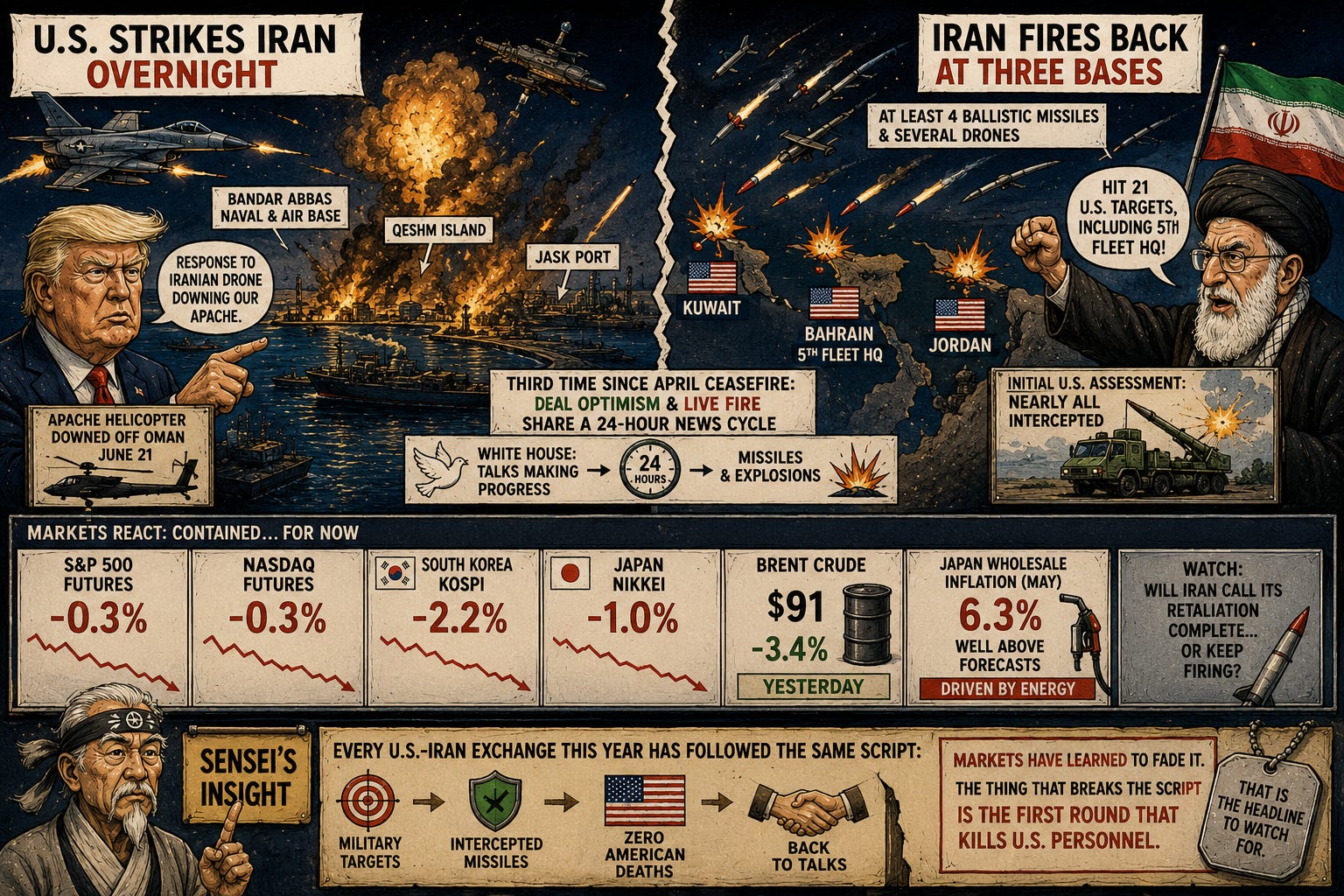
The US military struck Iranian military sites near the Strait of Hormuz overnight, with explosions reported around 2:35 a.m. local time at Bandar Abbas, home to a key naval and air base, Qeshm Island and the port of Jask. Central Command called the strikes a response to the downing of a US Army Apache helicopter off Oman a day earlier, which President Trump blamed on an Iranian drone. Iran answered within hours, firing at least four ballistic missiles and several drones at US bases in Bahrain, Kuwait and Jordan. Initial US assessments, reported by Reuters, say nearly all were intercepted. Iran’s Revolutionary Guards claimed hits on 21 US targets, including the Fifth Fleet headquarters in Bahrain. (CNBC)
Markets are treating it as another contained exchange, for now. S&P 500 and Nasdaq futures slipped about 0.3% overnight, South Korea’s Kospi fell more than 2% and Japan’s Nikkei lost around 1%. The cruel timing: Brent crude settled near $91 yesterday, down 3.4%, after a White House official said nuclear talks were making progress. The strikes landed hours later, the third time since the April ceasefire that deal optimism and live fire have shared a 24-hour news cycle. Japan reported wholesale inflation of 6.3% this morning, well above forecasts and driven by energy, a reminder that this war is already inside the world’s inflation data. Watch whether Iran calls its retaliation complete, as it has after previous rounds, or keeps firing.
Sensei’s Insight: Every US-Iran exchange this year has followed the same script: military targets, intercepted missiles, zero American deaths, then back to talks. Markets have learned to fade it. The thing that breaks the script is the first round that kills US personnel. That is the headline to watch for, not the strike count.
🏗️ Oracle Reports Tonight With a 12% Swing Priced In
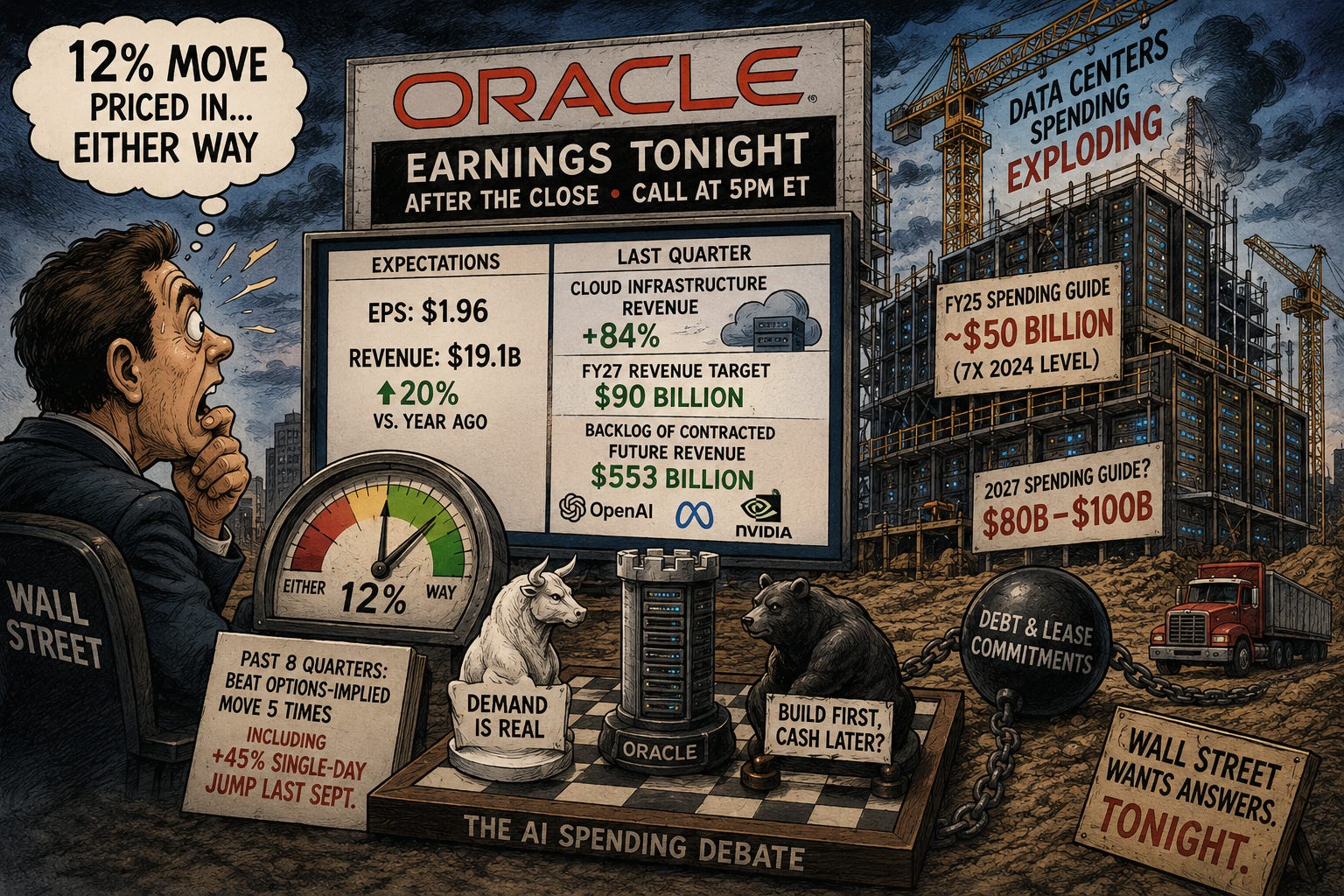
Oracle reports fiscal fourth-quarter results after today’s close, with the call at 5 p.m. Eastern, and the stakes are unusually high: options markets are pricing a move of roughly 12% in either direction. Wall Street expects earnings of $1.96 a share on revenue near $19.1 billion, up about 20% from a year ago. Last quarter, cloud infrastructure revenue grew 84% and Oracle raised its fiscal 2027 revenue target to $90 billion, backed by a $553 billion backlog of contracted future revenue from customers including OpenAI, Meta and Nvidia. The shares trade near $212, up 9.5% this year but down nearly 13% over the past week in the chip-led selloff. (Yahoo Finance)
This print is the AI spending debate condensed into one company. Oracle is on track to spend about $50 billion on data centers this fiscal year, more than seven times its 2024 level, and BNP Paribas analysts expect the 2027 spending guide could land between $80 billion and $100 billion. The backlog proves the demand is real; the open question is whether building ahead of revenue, funded with rising debt and lease commitments, produces cash before the market loses patience. With Wells Fargo and others questioning debt-fueled AI buildouts this same week, tonight is the first hard test of that thesis from a company at the center of it. (Yahoo Finance)
Sensei’s Insight: Oracle has blown past its options-implied move in five of the past eight quarters, including a 45% single-day jump last September. Revenue won’t decide tonight. The 2027 capital spending guide and how Oracle plans to fund it will, because that’s the question the whole AI trade is asking.
⚠️ Wells Fargo Calls the AI Selloff a Wake-Up Call
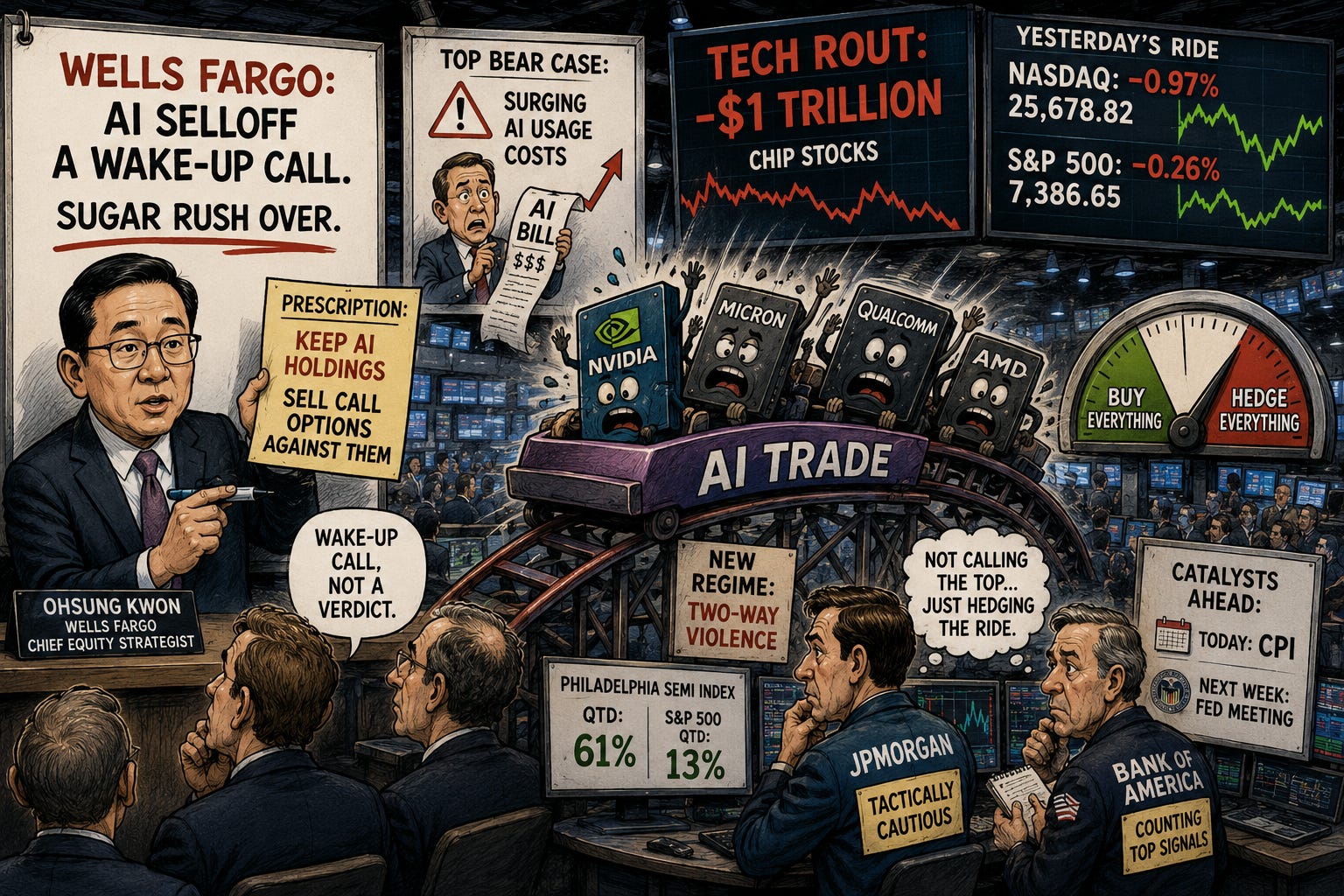
Wells Fargo’s chief equity strategist Ohsung Kwon told clients the technology rout that erased roughly $1 trillion from chip stocks on Friday was a wake-up call about piling into the artificial intelligence trade, and that the rally’s “sugar rush” phase is over. His prescription is the revealing part: keep AI holdings but sell call options against them, collecting income while capping the upside. Kwon views the selloff as positioning-driven rather than a verdict on AI fundamentals, and expects the narrow buy-semiconductors trade to return as big tech keeps raising money for data centers. His top worry among five bear cases: surging AI usage costs that could strain enterprise budgets. (Bloomberg)
The market stress-tested the note immediately. The Nasdaq fell as much as 2.5% yesterday as Micron, Qualcomm and AMD slid again, hit session lows on the Iran headlines, then clawed most of it back to close down 0.97% at 25,678.82, with the S&P 500 off just 0.26% at 7,386.65. That two-way violence is the new regime. The bigger picture: the Philadelphia Semiconductor Index is up 61% this quarter against 13% for the S&P 500, so most index-fund investors own this concentration whether they chose it or not. With JPMorgan tactically cautious and Bank of America counting top signals, the Street has downshifted from buy-everything to hedge-everything without anyone calling the top. Today’s CPI and next week’s Fed meeting are the catalysts that settle it. (CNBC)
Sensei’s Insight: Watch what Kwon recommends, not what he titles the note. Owning AI while selling calls means trading future upside for income today. When the Street’s prominent AI bulls start capping their own gains, the easy-money phase is over by their own admission, whatever the price targets say.
📈 OpenAI Joins a $3.6 Trillion Race to Go Public
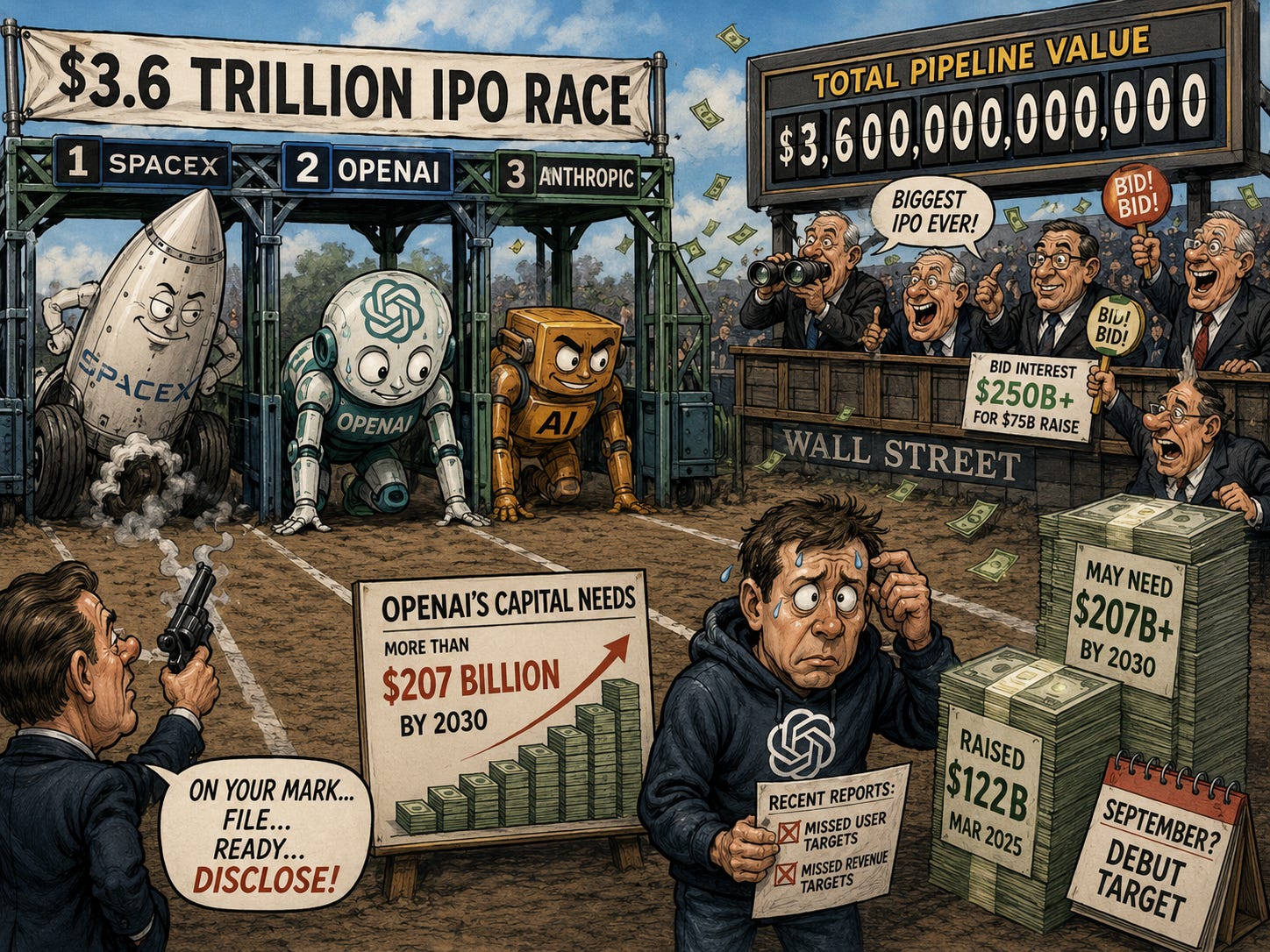
OpenAI confirmed it has filed confidentially for an initial public offering, becoming the third major AI player in the pipeline after SpaceX filed in April and Anthropic on June 1, a queue of listings worth a combined $3.6 trillion. A confidential S-1 lets a company submit its financials privately to regulators and reveal them publicly later, so this is a starting gun, not a launch: reports point to a September debut. OpenAI was valued at $852 billion in a March funding round that raised $122 billion, and said it was generating $2 billion in revenue per month. Goldman Sachs and Morgan Stanley are among the banks on the deal. (Bloomberg)
The first test of public appetite comes Friday, when SpaceX starts trading in what is set to be the biggest IPO ever, at a reported valuation near $1.75 trillion, with bid interest reportedly topping $250 billion for a $75 billion raise. For OpenAI the listing is less a victory lap than a funding necessity: HSBC estimates the company may need more than $207 billion in additional capital by 2030 to cover its computing bills, and the Wall Street Journal has reported it recently missed its own user and revenue targets. The public filing will expose OpenAI’s real margins for the first time, a direct confrontation between disclosed numbers and a valuation built in private rooms. (CNBC)
Sensei’s Insight: A company that raised $122 billion three months ago and may need $207 billion more by 2030 is not listing for the bell-ringing photo. It needs the deepest capital pool that exists. Friday’s SpaceX open is the first hard read on whether that pool shows up.
💳 Judge Approves $38 Billion Visa, Mastercard Fee Deal
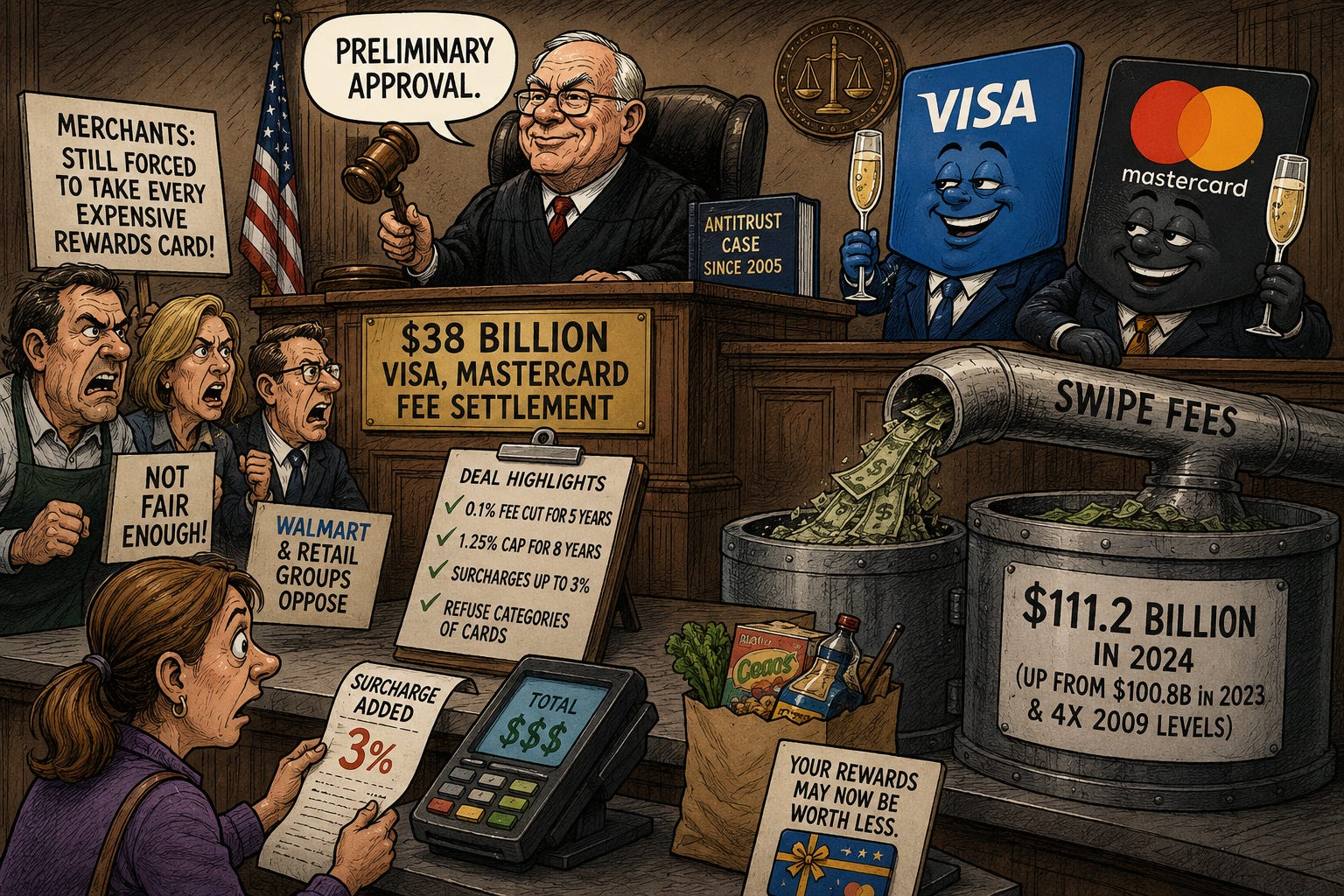
A fedral judge granted preliminary approval to Visa and Mastercard’s revised $38 billion settlement with merchants, a major step toward ending an antitrust fight that began in 2005 over swipe fees, the roughly 2% to 2.5% charge merchants pay on every card transaction. The deal covers about 12 million US businesses. Its core terms: a 0.1 percentage point fee cut for five years, an eight-year cap of 1.25% on standard consumer cards, the right to surcharge customers up to 3%, and, for the first time, the ability to refuse whole categories of cards, such as premium rewards cards. Judge Brian Cogan’s ruling comes two years after a different judge rejected a $30 billion version as too small. (Reuters)
This is preliminary, not final: a formal objection period and fairness hearing come next, and Walmart and major retail trade groups are still fighting, arguing merchants remain forced to accept expensive rewards cards from every issuing bank in a network. Worth knowing before celebrating either side: the $38 billion is not a payment, it is the estimated value of fee reductions through 2031. US swipe fees hit $111.2 billion in 2024, up from $100.8 billion the year before and roughly four times 2009 levels, so the deal slows the growth of the fee pool rather than shrinking it. For shoppers, expect more card surcharges at checkout and a possible squeeze on rewards programs as merchants gain the right to refuse the priciest cards. (Yahoo Finance)
Sensei’s Insight: Swipe fees grew more than $10 billion in a single year; a 0.1-point cut hands a slice of that back. The fee pool keeps growing, just slightly slower. That is why Visa and Mastercard shares barely moved on the news: investors did this math when the deal was announced in November.
Stories You Might Have Missed
🇨🇦 Bank of Canada Set to Hold as Loonie Sits at 2026 Low
The Bank of Canada announces its rate decision at 9:45 a.m. Eastern today, with economists near-unanimous on a fifth straight hold at 2.25%. The Canadian dollar touched 1.3969 per US dollar yesterday, its weakest of the year, weighed down by the gap against the Fed’s 3.50% to 3.75% range and a soft domestic economy. The twist in yesterday’s data: Canada posted a C$2.72 billion April trade surplus, its largest in 15 months, on record exports of C$75.2 billion, driven almost entirely by war-inflated oil prices. The thing to watch today is the statement’s language: any hint of worry about oil-driven inflation could revive hike bets and snap the loonie off its lows. (Bloomberg)
🍎 Apple’s AI Reveal Keeps Selling Off
Apple’s developer-conference unveiling of a next-generation Siri and its Apple Intelligence platform is now a two-day sell-the-news event. The stock touched a record near $317 during the keynote at the start of the week, reversed to close down 1.9% at $301.54 on volume 68% above average, then fell more than 3% further yesterday. The complaint from analysts is simple: no timeline for the new Siri, an AI story Apple first teased two years ago and has delayed repeatedly. The presentation also confirmed Apple’s most advanced AI model runs on Nvidia chips through Google’s cloud, an awkward dependency for a company that prides itself on owning its stack. It was Tim Cook’s final keynote as chief executive, and the AI credibility question now passes to his successor.
🧪 Activist Ancora Pushes Chemical Maker Ashland to Sell Itself
Hedge fund Ancora Alternatives disclosed a significant stake in Ashland, the roughly $2.7 billion specialty chemicals maker whose customers include L’Oreal, and is urging the board to start a sale process it says could lift the shares more than 30%, to around $76. Ashland stock jumped about 6% to $61.12 on the news. Ancora plans to launch the campaign publicly at an activist conference and says it is prepared for a proxy fight if no deal materializes by September. One wrinkle that makes this live: Standard Investments, a private group, already holds roughly 10% of the company and could itself emerge as a buyer, giving the activist case a ready-made bidder.
🔗 Connect with Us
Stay plugged in across platforms:
Sensei on X: sensei_live_
Martyn Lucas on X: MartynInvestor
Vaz on X: eVTOLHUB
📺 YouTube Channel (Live & Replays): Martyn Lucas Investor

🔍Deep Dive: CPI Cheat Sheet: The First 4% Print in Three Years
The May CPI report lands today at 1:30 PM UK time (8:30 AM ET), one week before Kevin Warsh chairs his first Fed meeting. It is likely to be the first 4 percent inflation print in three years. Consensus says 4.2% headline, up from 3.8%, which would be the highest since April 2023 (FactSet). Markets that started the year asking when the Fed would cut now price better than 50/50 odds of a hike in 2026, up from 10% in January (24/7 Wall St). That repricing took five months. Today's print decides whether it sticks.