This content is for informational and educational purposes only and does not constitute financial advice. Always do your own research. Not financial advice (NFA).
👀 Today’s Stories at a Glance
🎯 AI creates new short trades: Wall Street is dumping legacy firms as new automation tools threaten human-led research and data processing.
📉 Bitcoin slips during global rally: Digital assets decoupled from rising stocks as thin order books and low buyer conviction drove prices down.
🛠️ Jobs report faces major reset: Today’s delayed labor data includes massive revisions that could erase nearly one million previously reported jobs.
📉 Beijing limits Treasury purchases: Chinese regulators advised banks to trim U.S. debt exposure, targeting concentration risk and domestic financial stability.
⚔️ AI chip wars shift focus: Broadcom and Google challenge Nvidia’s dominance by ramping up cheaper TPU production for high-volume inference tasks.
🧠 One Big Thing
XRP Community Day 2026 arrives today at a critical crossroads as Ripple shifts from legal defense to aggressive institutional expansion. Despite XRP trading 61% below its 2025 peak, the ecosystem is seeing unprecedented professional adoption, highlighted by Goldman Sachs' new $153 million ETF position and $1.14 billion in total spot ETF inflows. Today’s event serves as a definitive progress report on Ripple’s $1 billion buyback program and its pursuit of national bank status. Key sessions will reveal major tokenization partnerships and new venture capital commitments from influential firms like Dragonfly and Superscrypt. This gathering marks a pivot toward fundamental utility to counter the broader crypto market correction. We are covering the entire event live today to track these market-moving developments. (We will be covering the full day on YouTube)
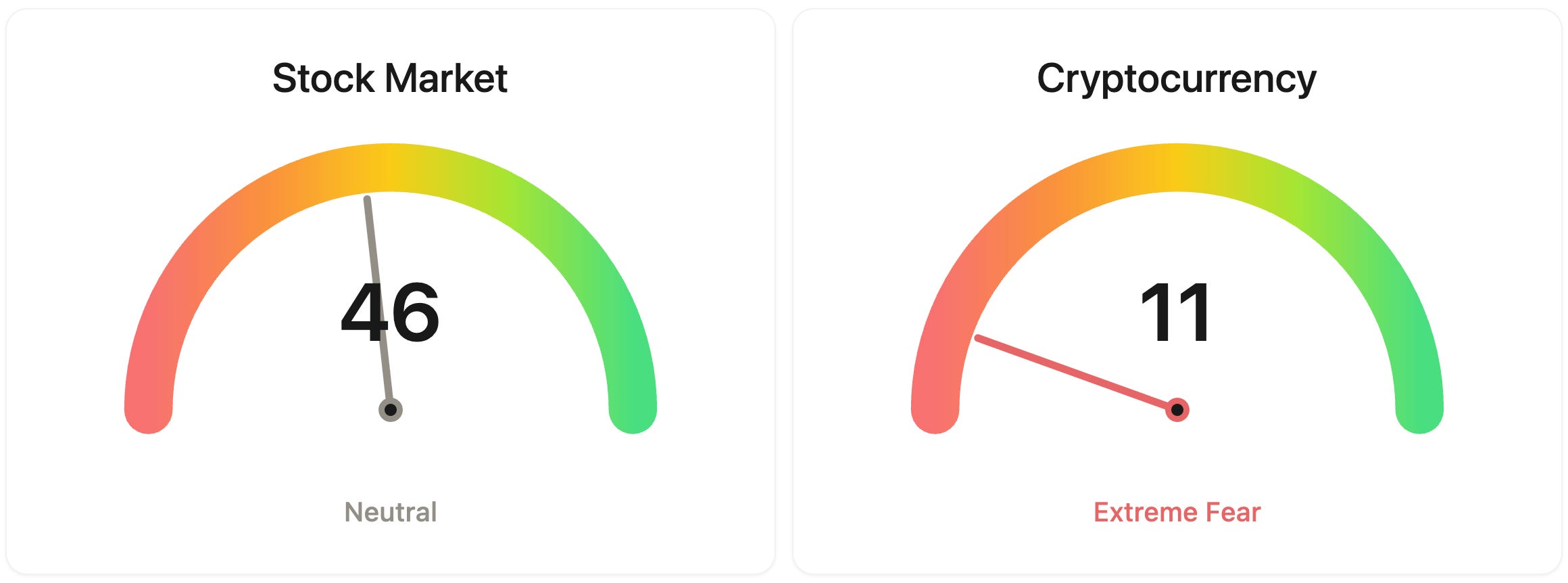
⚖️ Fear & Greed
📉 The Number That Matters
$1.52 BILLION
Ripple’s RLUSD stablecoin achieved a $1.52 billion market cap within 14 months of launch, establishing it as a top-five USD-backed asset while serving as a high-velocity utility driver that burns XRP fees with every ledger transaction.
⚔️ Winners vs Losers
Winners
SHOP 0.00%↑: Shopify Inc. shares surged as investors positioned for the company’s Q4 and full-year 2025 earnings results and guidance scheduled for release this morning.
NET 0.00%↑: Cloudflare, Inc. rallied after reporting a Q4 2025 beat and issuing 2026 guidance that exceeded expectations due to strong AI-related and large-enterprise demand.
TDC 0.00%↑: Teradata Corporation moved higher in sympathy with the AI and data-platform sector following Cloudflare’s results.
MNTN 0.00%↑: MNTN, Inc. surged following a Q4 2025 earnings beat characterized by 36% revenue growth, significant margin expansion, and bullish 2026 financial guidance.
STIM 0.00%↑: Neuronetics, Inc. shares rose sharply after the company reported preliminary Q4 and full-year 2025 results highlighting strong revenue growth and positive operating cash flow.
HURA 0.00%↑: TuHURA Biosciences, Inc. moved higher on speculative flows related to the terms and timing of a $15.6 million registered direct offering closing this month.
Losers
HOOD 0.00%↑: Robinhood Markets, Inc. pulled back as the stock underwent a mean-reversion following a prior 14% rally tied to crypto and risk-asset sentiment.
UPB 0.00%↑: Upstream Bio, Inc. plummeted as traders front-run today’s scheduled webcast of Phase 2 VALIANT top-line data for the company’s severe asthma drug, verekitug.
MAT 0.00%↑: Mattel, Inc. shares plunged after the company reported a holiday-quarter earnings miss and issued soft 2026 guidance that fell below analyst expectations.
RPD 0.00%↑: Rapid7, Inc. shares declined as the market digested a Q4 report and 2026 outlook showing flat annual recurring revenue and minimal top-line growth.
📊 Market Snapshot
Cryptocurrencies:
Bitcoin (BTC): $67,060 (▼ -2.55%)
Ethereum (ETH): $1,958 (▼ -3.17%)
XRP: $1.37 (▼ -1.82%)
Equity Indices (Futures):
S&P 500: $6,951 (▲ 0.02%)
NASDAQ 100: $25,234 (▲ 0.06%)
FTSE 100: £10,434 (▲ 0.62%)
Commodities & Bonds:
10-Year US Treasury Yield: 4.13% (▼ -0.19%)
Oil (WTI): $65 (▲ 1.84%)
Gold: $5,105 (▲ 1.62%)
Silver: $86.01 (▲ 6.44%)
Data as of UK (GMT): 12:15 / US (EST): 07:15 / Asia (Tokyo): 21:15
✅ 5 Things to Know Today
🎯 AI Crosshairs: The New “Short” Trade
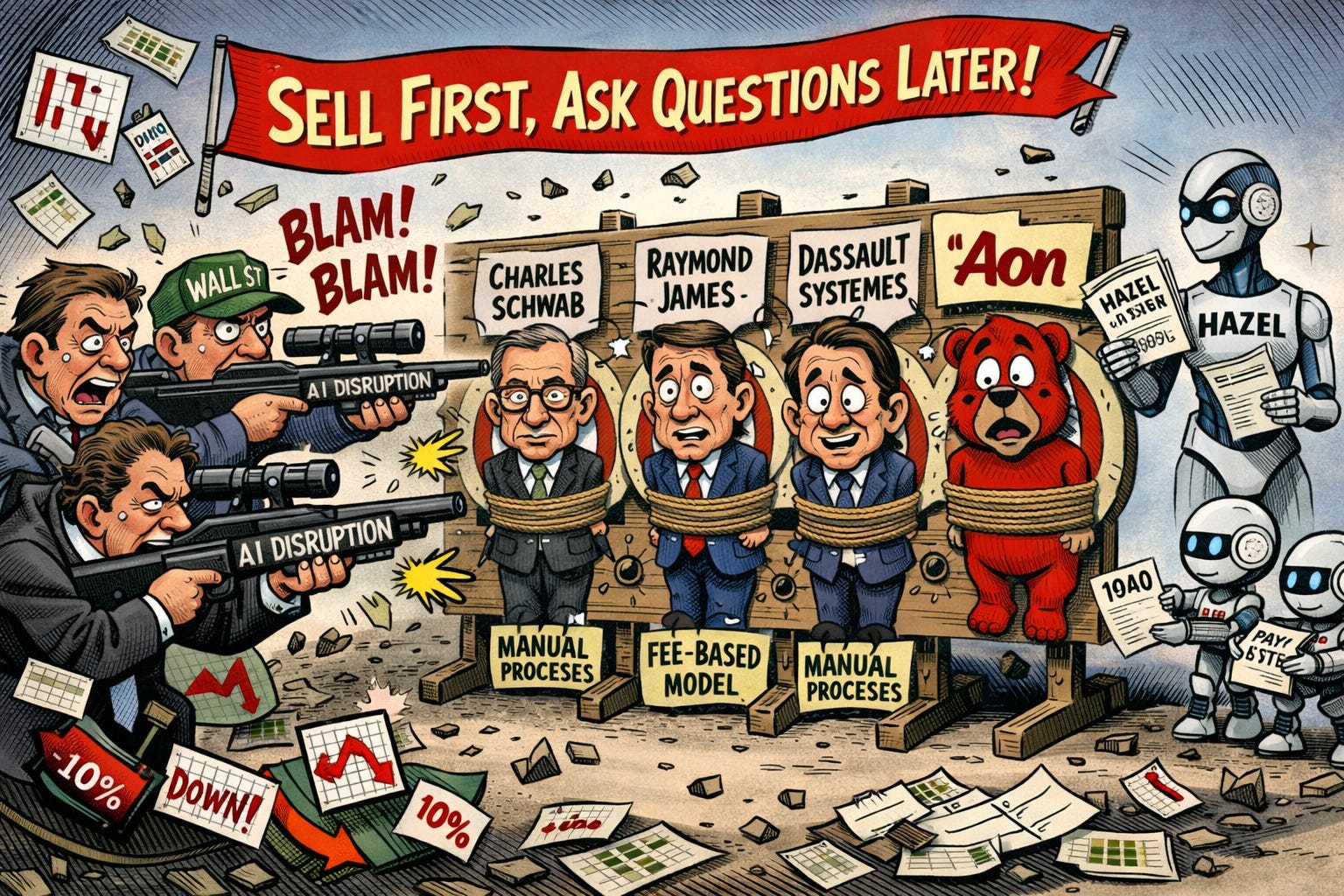
Wall Street has pivoted from chasing AI winners to aggressively dumping anyone caught in the technology’s path. This “sell-first, ask-questions-later” regime triggered a massive rout across software and financial services this week. The selling intensified after wealth-management startup Altruist unveiled “Hazel,” an AI tool that automates complex tax strategies by reading 1040s and pay stubs. The news wiped billions off incumbents, with Charles Schwab, Raymond James, and LPL Financial all sliding 7% to 9% in a single session. It wasn’t just a U.S. phenomenon: European stalwarts like St. James’s Place fell 11%, while software giant Dassault Systèmes plummeted 20% after weak guidance fueled fears that AI-native rivals are already eating into its territory (Bloomberg).
This shift suggests that AI is no longer a vague future threat but a systematic risk factor, much like interest rates. Investors are screening for “automatable” revenue: if a company’s primary value is human-led research or legacy data processing, the market is de-rating it instantly. We saw this with insurance brokers like Aon and Willis Towers Watson, which tumbled after Insurify launched a ChatGPT-based tool for auto-insurance comparisons. For retail investors, the takeaway is that fundamental health matters less than “disruption perception” right now. Even if these incumbents eventually adopt AI to boost their own margins, the market is currently pricing in the worst-case scenario: fee compression and total displacement.
Sensei’s Insight: Watch the gap between “scary” headlines and actual earnings. Disruption usually takes longer than a panicked market expects, but for now, any business model relying on manual data-crunching is a “sell” candidate.
📉 Bitcoin Decouples from the Global Rally

Bitcoin took a hit on Wednesday, sliding toward $66,000 as it failed to hitch a ride on the broader market rally. While the MSCI Asia Pacific Index and emerging-market stocks both surged to all-time highs, crypto stayed stuck in the mud. Bitcoin dropped about 3% intraday, while Ether fared worse, falling nearly 4% to slip below $1,940. This divergence is striking because the typical macro tailwinds, like a weaker dollar and renewed hopes for US rate cuts, are lifting stocks but leaving digital assets behind. Trading has remained sluggish and sentiment has been largely bleak since October, suggesting the “crypto moon” narrative is currently hitting a wall of indifference (Bloomberg).
The real story here isn’t just the price drop: it’s the “thin” market underneath. Analysts at Kaiko point out that recent price slides happened without massive volume spikes, which signals a lack of buyer conviction and empty order books. Essentially, there aren’t enough resting buy orders to catch the falling knife, so even modest selling pressure moves the needle disproportionately. While “whales” (large holders) have started nibbling at these lower levels again, their activity hasn’t been enough to spark a broader recovery. This suggests that the massive volume flush we saw last Friday near $60,000 might have been a “capitulation” low, but without fresh retail or institutional interest, the market is just drifting.
Sensei’s Insight: Watch the $60,000 level closely. If whales stop buying and the “thin” order books don’t fill in, we may see another test of that floor to find real liquidity.
🛠️ Jobs Day: The Great Statistical Reset
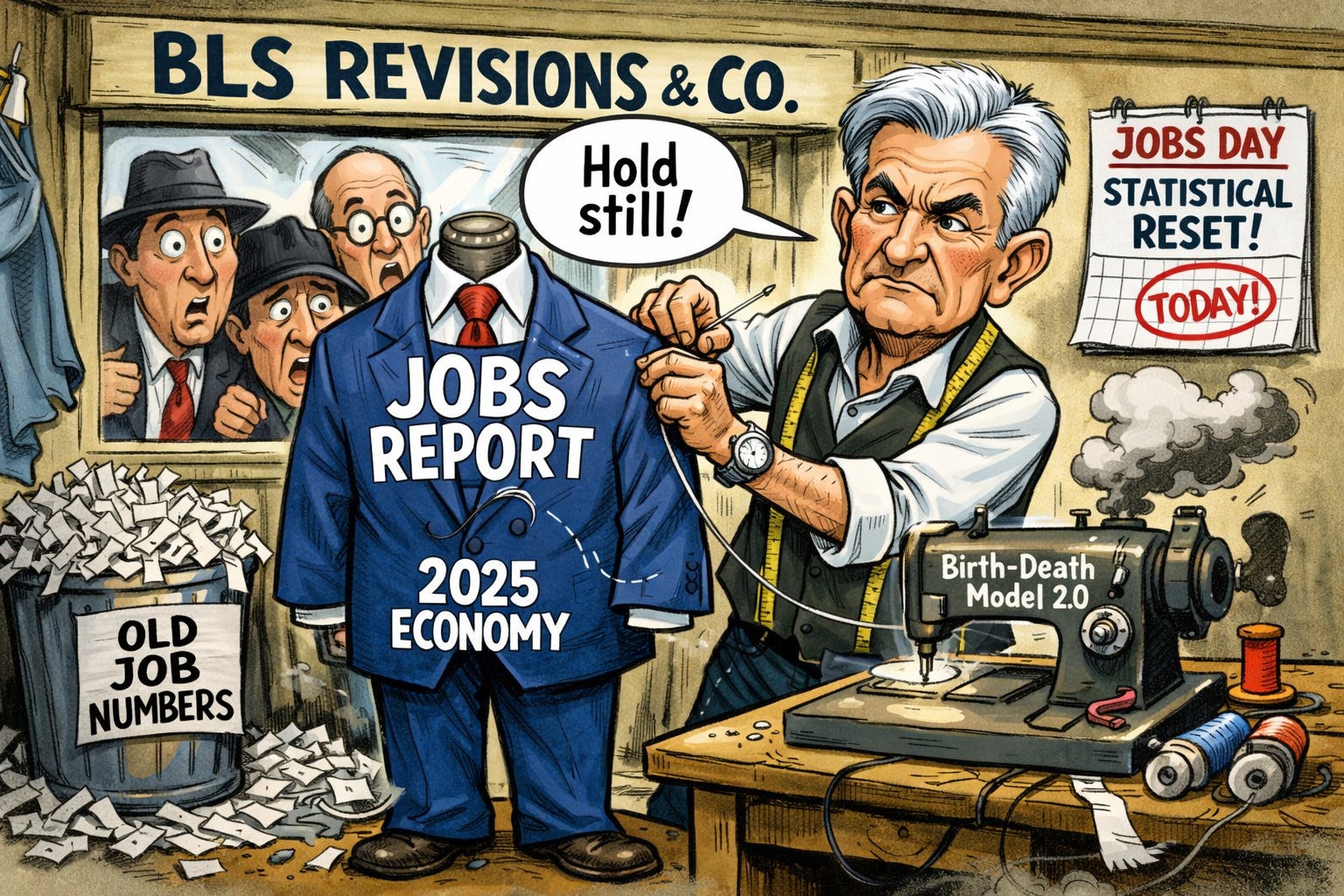
The U.S. labor market faces a moment of truth today as the Bureau of Labor Statistics finally drops the delayed January jobs report. Following a partial government shutdown, this isn’t just another monthly update; it’s a massive statistical recalibration. Wall Street is looking for a modest gain of about 75,000 jobs and an unemployment rate holding steady at 4.4%. However, the real story lies in the annual benchmark revisions and a new “birth-death” model. These adjustments are expected to officially acknowledge that job growth in 2025 was much slower than originally reported, potentially erasing nearly a million jobs from the historical record. Jerome Powell has already hinted at a systemic overcount, and Goldman Sachs suggests the new methodology could shave up to 50,000 jobs off the monthly trend moving forward (Barron’s).
For retail investors, the “headline” number might actually be the least important part of this release. We’re looking at a clash between deteriorating signals, like the five-year low in JOLTS job openings, and more resilient data from Bank of America showing steady paycheck deposits. If the report confirms a sharp slowdown, it signals that the Fed’s three “insurance” rate cuts last year were likely necessary but perhaps insufficient. A “bad” number here is anything significantly below 50,000 or a jump in unemployment toward 4.5%, which would likely force the Fed to consider more aggressive easing. Conversely, a “good” number for market stability would be a print near 80,000 that suggests a soft landing is still the base case despite the methodology tweaks.
Sensei’s Insight: Watch the 2-year Treasury yield immediately after the 8:30 a.m. release. If yields dive despite a “decent” headline, the market is sniffing out a weak internal trend in those historical revisions.
📉 Beijing Tells Banks: Cool It on Treasuries

Chinese regulators just gave their biggest banks a nudge to stop piling into US Treasuries. On February 9, 2026, officials issued “window guidance” advising financial institutions to limit new purchases and pare back existing positions where exposure is high. This directive targets commercial banks rather than the central bank’s official reserves, focusing on reducing concentration risk and shielding the domestic financial system from market volatility. The initial reaction saw 30-year yields jump 5 basis points, though the 10-year yield eventually settled near 4.13%. It’s a calculated move to manage risk as global bond markets face fresh uncertainty (Bloomberg).
This isn’t a sudden panic: it’s the latest chapter in a decade-long retreat. China’s reported Treasury holdings have roughly halved since 2013, hitting their lowest levels since 2008 at approximately $683 billion. While some of these assets likely migrated to custodians in Belgium, where holdings have quadrupled, the broader shift is undeniable. Other major players like India and Brazil are also trimming their US debt exposure to support their own currencies. Even European pension funds, including Denmark’s AkademikerPension, have fully exited the asset class. While total foreign holdings hit a record $9.4 trillion in late 2025, the foreign share of total US debt has actually shriveled from 50% to 31% over the last decade.
Sensei’s Insight: Watch for a “yield floor” as the marginal foreign buyer vanishes. The US Treasury market remains deep, but losing the reliable Chinese bid suggests domestic buyers may eventually demand higher yields to clear massive auctions.
⚔️ The AI Chip War Moves to the Inference Front
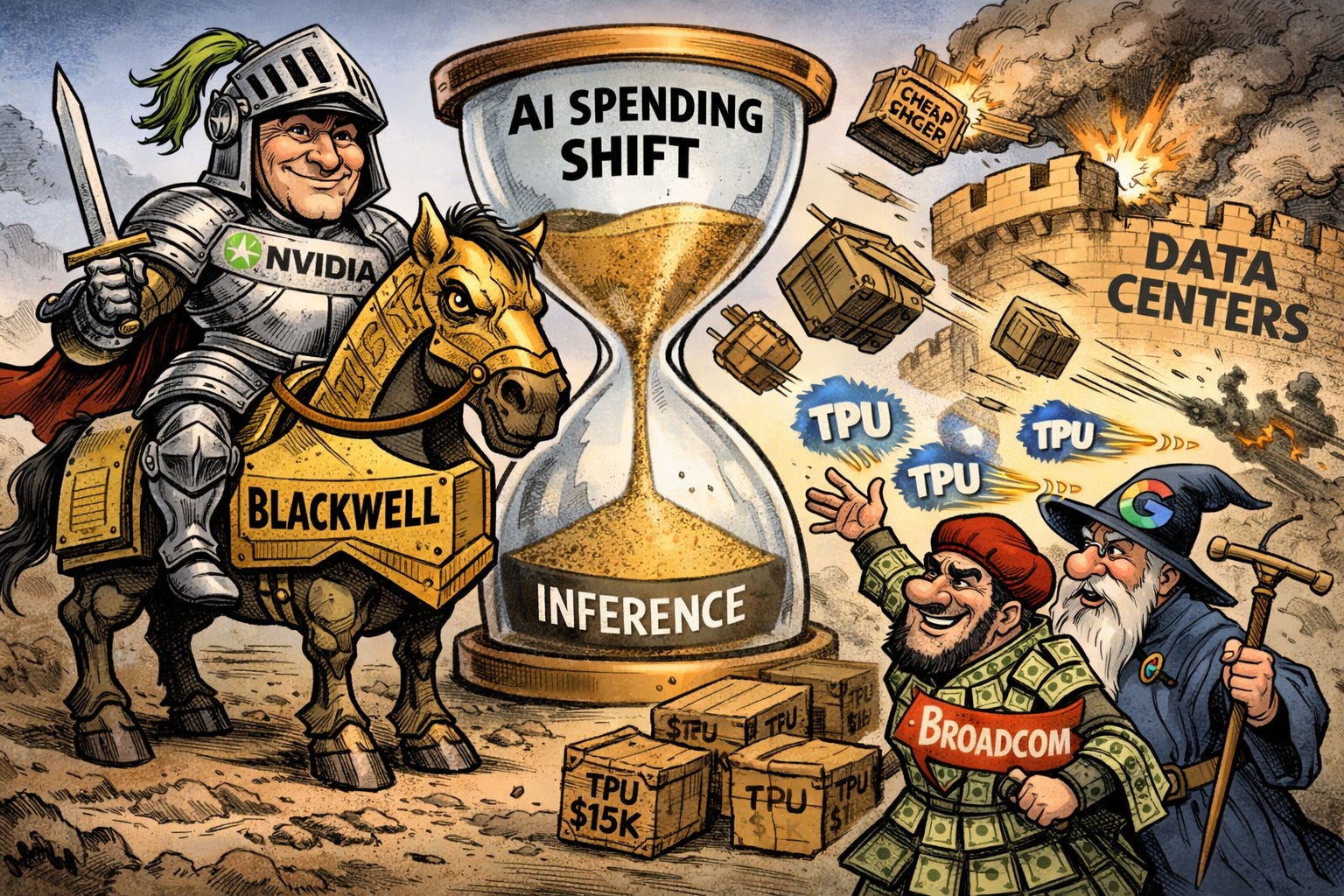
The long-standing dominance of Nvidia in the AI space is facing a calculated challenge as Broadcom and Google ramp up production of Tensor Processing Units (TPUs). UBS analyst Timothy Arcuri projects that Broadcom-related TPU shipments could hit 3.7 million units this year, potentially climbing past 5 million by 2027. This surge is fueled by massive commitments, including a $21 billion order from AI startup Anthropic and ongoing talks with Meta Platforms to adopt the hardware. While Nvidia’s Blackwell GPUs remain the gold standard for heavy-duty model training, TPUs are carving out a significant niche in “inference”—the phase where a model actually generates answers for users. TPUs currently trade at a massive discount, priced between $10,500 and $15,000 compared to the $40,000 to $50,000 price tag for Nvidia’s top-tier chips (Barron’s).
This shift matters because the center of gravity in AI spending is moving. Mizuho estimates that while inference makes up roughly 20% to 40% of AI compute today, it could represent 60% to 80% within five years. For retail investors, this signals that the “pick and shovel” play is diversifying. Nvidia isn’t sitting still, though. It recently inked a non-exclusive $20 billion licensing deal with startup Groq to integrate its ultra-low-latency inference tech and top talent. This suggests a future where Nvidia protects its moat by absorbing specialized tech, while Broadcom and Google use aggressive pricing and high volume to capture the massive, cost-sensitive inference market that will soon dominate data center budgets.
Sensei’s Insight: Watch the pricing gap between Blackwell GPUs and TPUs. If hyperscalers like Meta successfully shift heavy inference workloads to cheaper silicon, Nvidia’s legendary pricing power may finally face a real ceiling.
🔗 Connect with Us
Stay plugged in across platforms:
Sensei on X: sensei_live_
Martyn Lucas on X: MartynInvestor
Vaz on X: eVTOLHUB
📺 YouTube Channel (Live & Replays): Martyn Lucas Investor