This content is for informational and educational purposes only and does not constitute financial advice. Always do your own research. Not financial advice (NFA).
👀 Today’s Stories at a Glance
🏦 Warsh’s First Rate Decision: The new Federal Reserve chair holds rates as the dot plot may erase 2026’s final cut.
🛢️ Iran Fund Lands, Oil Slides: A proposed 300 billion dollar reconstruction fund nears signing as crude sinks toward a three-month low.
🚀 SpaceX Buys Cursor: The 60 billion dollar all-stock deal vaults SpaceX past Microsoft into America’s fourth most valuable company.
🛡️ Trump Refills Missile Stockpiles: He invoked a 1950 defence law to rebuild munitions after the Iran war drained stockpiles.
📦 Regulators Eye Amazon’s Ad Engine: The Federal Trade Commission may sue over ad pricing, threatening billions in penalties and Amazon’s auction model.
🇺🇦 Group of Seven Tightens Sanctions: Leaders use cheaper oil to pressure Russia’s energy sector as Trump and Zelenskiy warm relations.
💊 Hackers Claim Novo Nordisk Breach: An extortion group says it stole 1.3 terabytes of data and demands a 25 million dollar ransom.
🍕 Yum Sells Pizza Hut: The 2.7 billion dollar sale splits the chain and lets Yum focus on Taco Bell and KFC.
🧠 One Big Thing
Two of today's stories are really one trade. The oil slide toward 75 dollars from the Iran deal is doing the Federal Reserve's inflation work before Warsh says a word, cooling the 4.2% reading that has the committee split. That gives the new chair cover to leave the dot plot less hawkish than the headline inflation suggests. The second-order read: a softer dot plus cheaper energy is a quiet tailwind for rate-sensitive equities, not the bond-yield spike many are bracing for. Watch whether crude holds the 72 to 75 support zone, because that level may decide how much room Warsh actually has.
⚖️ Fear & Greed
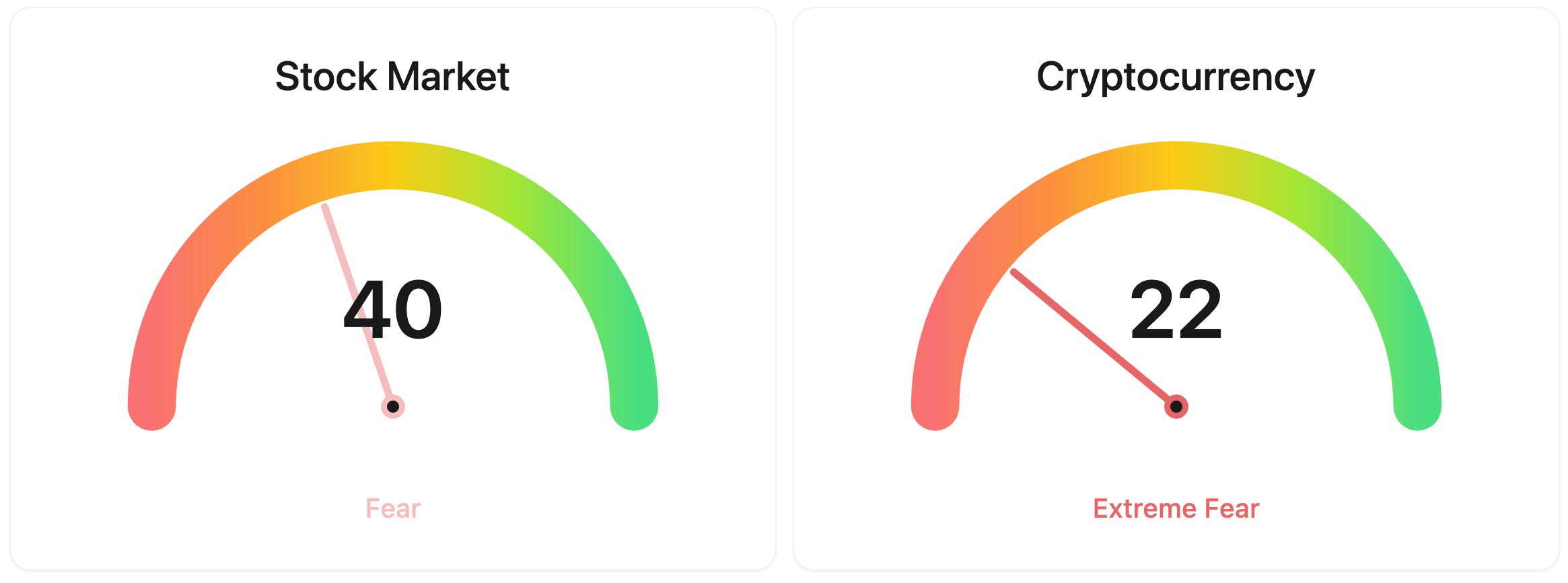
📉 The Number That Matters
43-YEAR LOW
US emergency oil reserves sit at a 43-year low even as crude trades near 75 dollars, a thin cushion if the fragile Iran deal slips before signing.
⚔️ Winners vs Losers
Winners
LZB 0.00%↑: La-Z-Boy Incorporated shares jumped after the furniture maker reported fiscal fourth-quarter earnings of $1.26 per share, well ahead of the $0.82 consensus, with management hosting its results call this morning.
Losers
LILA 0.00%↑: Liberty Latin America Ltd. fell on its ex-dividend date for a special dividend paid in 9.0% Series A preference shares, with the drop reflecting the value of those new shares separating from the common stock rather than any deterioration in the business.
VRXA 0.00%↑:Veraxa Biotech AG extended its post-debut slide after listing on June 11 through a SPAC merger that saw nearly all public shares redeemed, leaving a thin float and triggering a sharp valuation reset that has driven the stock down heavily since trading began.
📊 Market Snapshot
Cryptocurrencies:
Bitcoin (BTC): $64,719 (▼ 1.40%)
Ethereum (ETH): $1,766 (▼ 1.46%)
XRP: $1.19 (▼ 1.79%)
Equity Indices (Futures):
S&P 500: 7,595 (▲ 0.11%)
NASDAQ 100: 30,481 (▲ 0.55%)
FTSE 100: 10,501 (▲ 0.30%)
Commodities & Bonds:
10-Year US Treasury Yield: 4.44% (▼ 0.05%)
Oil (WTI): $76 (▼ 1.17%)
Gold: $4,331 (▲ 0.01%)
Silver: $69.96 (▲ 0.02%)
Data as of: UK: 12:00 BST / US: 07:00 EDT / Asia (Tokyo): 20:00 JST
✅ 5 Things to Know
🏦 Fed Holds Today, Warsh’s Debut Sets the Tone
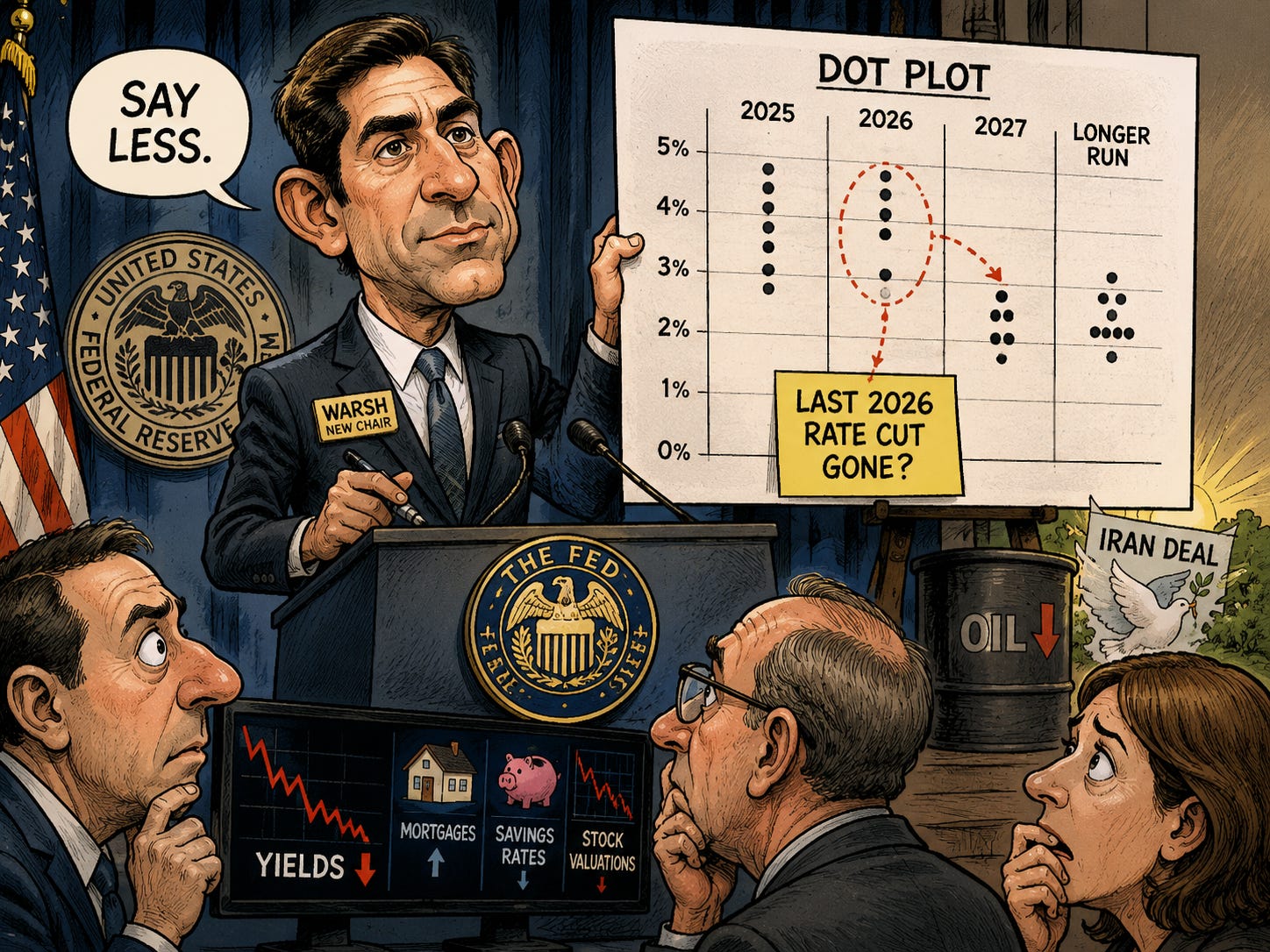
The Federal Reserve almost certainly leaves interest rates alone when it announces its decision today at 2pm Eastern, holding the target range at 3.50% to 3.75% for a fourth straight meeting. The near-certain hold is not the story. This is the first meeting run by Kevin Warsh, sworn in last month as Fed chair after a narrow 54-45 Senate vote, and his first press conference at 2:30pm is what markets are positioned around. Traders are watching three things: the updated “dot plot” of policymakers’ own rate forecasts, whether the Fed drops its long-standing signal that the next move is a cut, and how Warsh handles a committee that split 8-4 at its last meeting, its most divided since 1992. (Yahoo Finance)
For everyday investors, a held rate keeps mortgages, savings yields, and borrowing costs roughly where they are, so the real action is in the forecasts. May inflation ran hot at 4.2%, more than double the Fed’s 2% goal, and if the new projections erase the last rate cut still penciled in for 2026, the first cut slides toward 2027. That repricing moves stock valuations and bond yields well before any rate actually changes. One tailwind landed this week: the slide in oil prices after the Iran deal eases the inflation picture Warsh inherits, which could give him room to focus on his stated goal of changing how the Fed communicates rather than fighting over the next move. He has long argued the Fed should say less, so watch whether he even submits his own dot. (CNBC)
Sensei’s Insight: The rate is a foregone conclusion. The real signal is the dot plot. If it erases the last 2026 cut still penciled in, the first cut slides into 2027, and that repricing hits mortgages, savings rates, and stock valuations long before any rate actually moves.
🛢️ Iran’s $300 Billion Fund Lands as Oil Slides
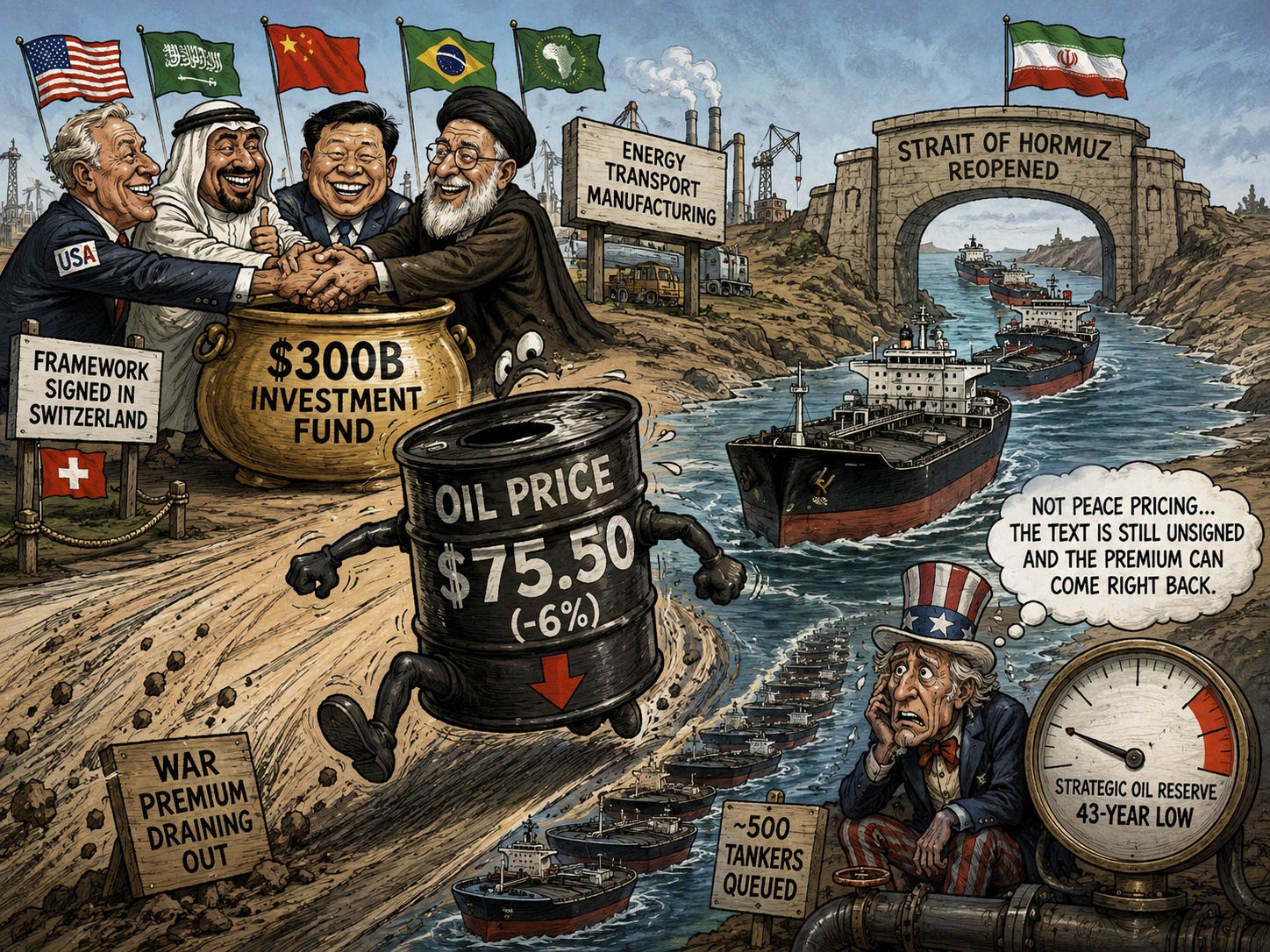
A new piece of the US-Iran framework to end their nearly four-month war is a proposed $300 billion private investment fund, the Reconstruction and Development Fund, with more than half reportedly already committed by companies across the US, the Gulf states, Asia, South America, and Africa. The structure is deliberate. It is private money aimed at Iranian energy, transport, and manufacturing projects, not US government cash, and it only switches on once a final deal is signed. Iran had originally sought $400 billion in war reparations. The framework is set for a formal signing in Switzerland on Friday, which would reopen the Strait of Hormuz, the waterway that carries about a fifth of the world’s oil. (Reuters)
Oil is how this reaches every wallet. US crude fell more than 6% yesterday to around $75.50 a barrel, a three-month low, as traders priced in Iranian barrels returning and tankers crossing Hormuz again. Cheaper oil cools the inflation that hit a three-year high, feeding straight into today’s Fed decision. The relief is not total, though. Oil near $75 is still above the roughly $70 it fetched before the war, supply will take weeks to normalize with around 500 tankers queued, and US emergency reserves have fallen to a 43-year low. The deal also stays fragile: the full text is not public, the 60-day negotiating window still has to settle Iran’s enriched-uranium stockpile, and Washington and Tehran are selling opposite versions at home, with Trump dismissing reports of a US payment as “fake news.” (CBS News)
Sensei’s Insight: Oil at $75 is a low price when you remember we were only at $70 before the war. And look at everything that's happened since: emergency reserves are at a 43-year low, and supply takes a long time to normalise. At $75, it's hard to stay as bearish on oil as we were a few weeks ago. In fact, it’s looking attractive. Have a look at the chart of the day below
🚀 SpaceX Buys Cursor for $60 Billion, Tops Microsoft
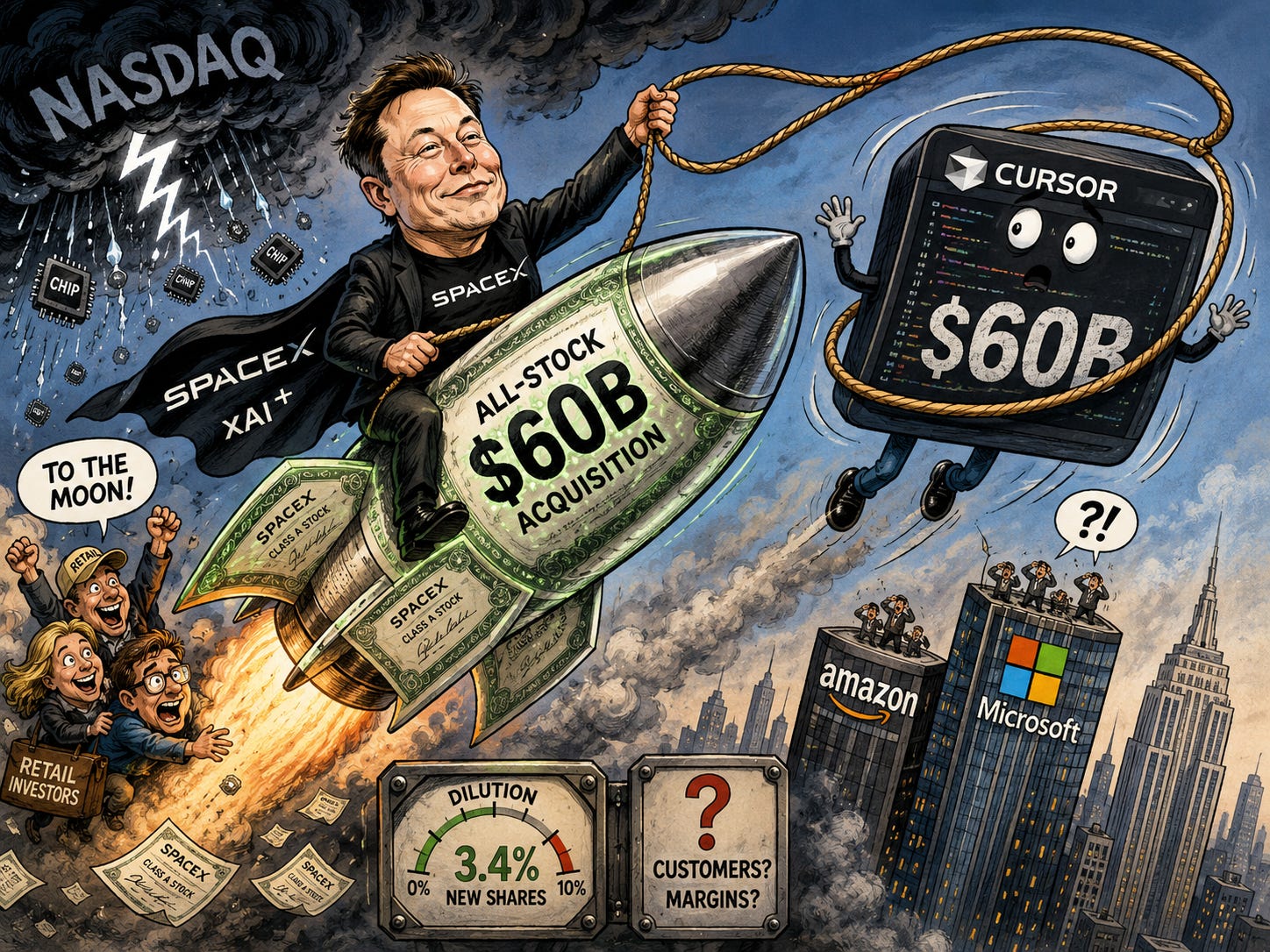
Four days after its record stock market debut, SpaceX confirmed it will buy Anysphere, the maker of the popular artificial-intelligence coding tool Cursor, in an all-stock deal worth $60 billion, disclosed in a regulatory filing yesterday and expected to close in the third quarter. The price tops the roughly $29 billion valuation Cursor carried as recently as November and follows an option SpaceX secured in April to either buy the company for $60 billion or pay $10 billion to walk away. Cursor brings in about $2.6 billion in annual revenue from business customers. SpaceX, which absorbed Elon Musk’s AI startup xAI in February, plans to ship a jointly built AI model inside Cursor and its Grok tools. (CNBC)
The deal reset the leaderboard of America’s most valuable companies. SpaceX stock jumped roughly 16% yesterday, vaulting past Amazon and Microsoft to become the fourth most valuable US company, even as the wider tech-heavy Nasdaq fell on weakness in chip stocks. For retail investors, two things stand out. First, the all-stock structure shows how a sky-high share price makes acquisitions cheap: the $60 billion deal cost existing holders only about 3.4% in new shares. Second, that same structure ties Cursor’s value to SpaceX’s stock from here, and the company has not shown investors Cursor’s customer list or profit margins. The move deepens Musk’s push into business AI against rivals Anthropic and OpenAI. Watch the third-quarter close and the regulatory review. (Yahoo Finance)
Sensei’s Insight: A $60 billion deal that costs only 3.4% in new shares is what a sky-high stock buys you. The flip side: it’s all stock, so Cursor’s value now rides on SpaceX’s share price, and investors still haven’t seen Cursor’s customers or margins.
🛡️ Trump Invokes Defense Law to Refill Missile Stockpiles
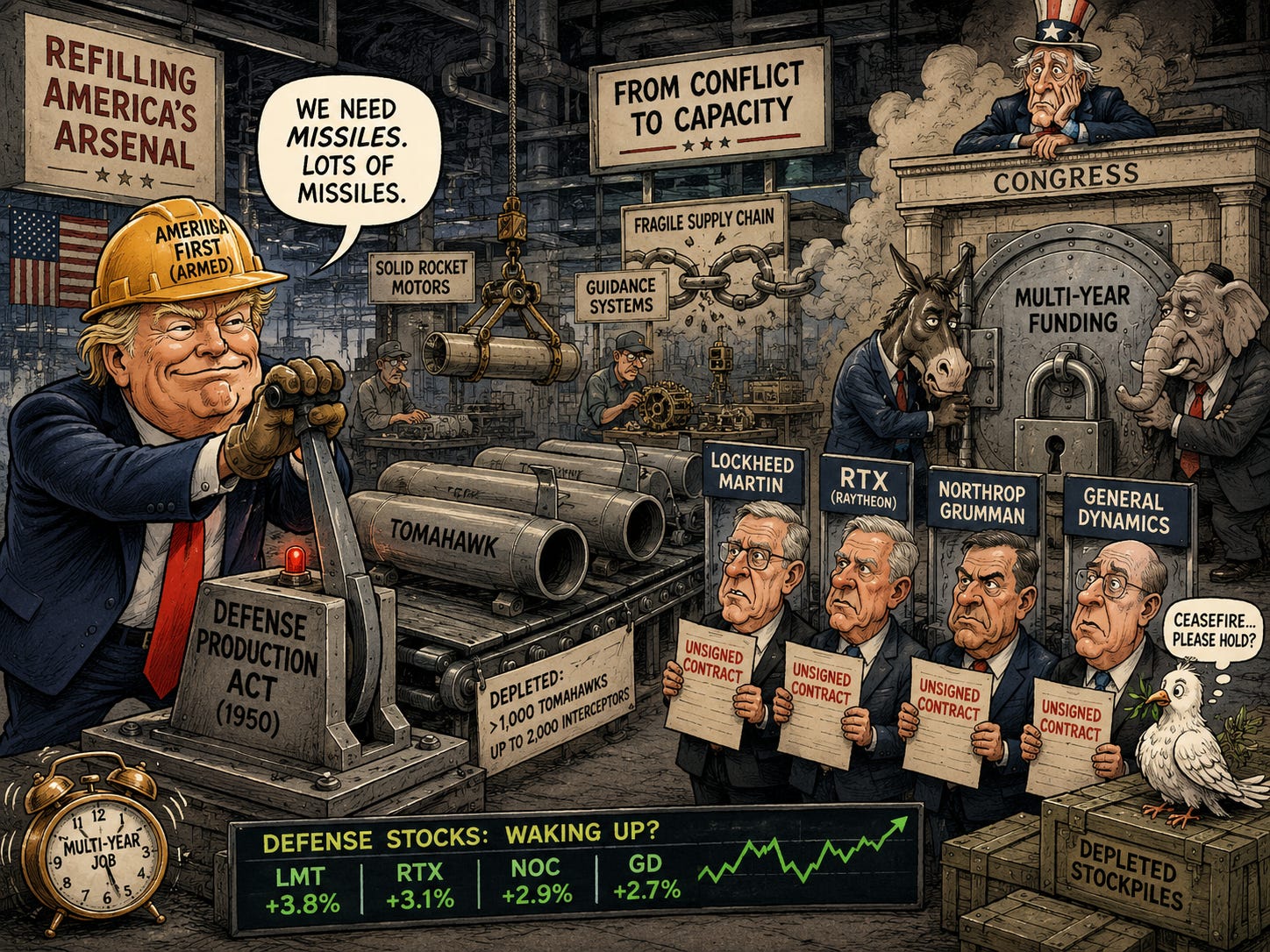
A presidential memo made public yesterday shows Trump invoked the Defense Production Act, a 1950 Korean War-era law that lets the president direct private industry toward defense needs, to fix what it calls systemic constraints in the US munitions base. The memo, dated June 11, cites limited factory capacity, fragile supply chains, and bottlenecks in specialized parts like solid rocket motors and guidance systems. It follows the war with Iran, which burned through more than 1,000 Tomahawk cruise missiles and up to 2,000 air-defense interceptors. The same day, Lockheed Martin and General Motors’ defense arm announced an agreement to apply GM’s high-volume manufacturing to speed up Lockheed’s weapons output, with Lockheed already investing $9 billion across 20 facilities. (U.S. News)
Defense stocks have a stubborn habit of falling on peace headlines and rising on conflict, and the main aerospace and defense exchange-traded fund had dropped about 12% since early March as ceasefire hopes built. This push reframes the demand as something that outlasts any single ceasefire, because refilling stockpiles is a multi-year job. The proposed 2027 defense budget earmarks roughly $53 billion for munitions, and officials want to lift production rates three to four times over. The limit is timing. Invoking the law does not by itself create revenue, since companies still need money cleared by Congress and turned into signed multi-year contracts, and one Washington think tank estimates replacing the missiles used against Iran could take years. The names most tied to this are Lockheed Martin, RTX, Northrop Grumman, and General Dynamics. (Bloomberg)
Sensei’s Insight: Invoking the law is not the same as signing contracts. The money still has to clear Congress and convert into multi-year orders, and rebuilding the missiles burned in the Iran war could take years. That demand outlasts the ceasefire headlines.
📦 FTC Targets Amazon’s Ad Engine, Billions at Stake
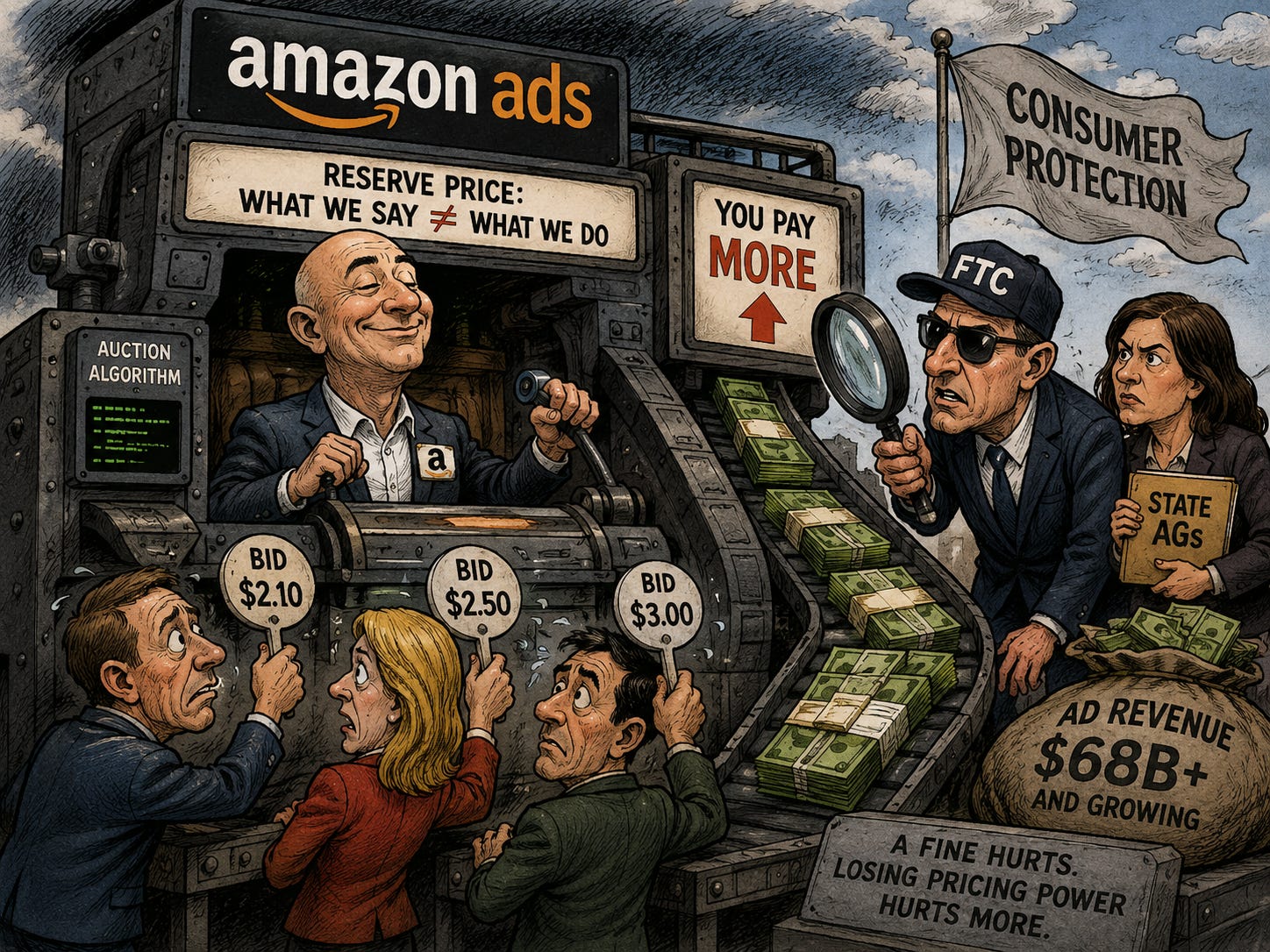
Amazon may be hit with a Federal Trade Commission lawsuit and billions of dollars in civil penalties over claims it misled advertisers, according to a Bloomberg report yesterday. At issue is whether Amazon properly disclosed “reserve pricing,” the minimum price an advertiser must clear to win an ad slot, and how its ad auctions actually worked. Several state attorneys general are involved, and the consumer-protection probe, which also covers Google, could end in a lawsuit or settlement as soon as this summer. The Federal Trade Commission declined to comment and Amazon did not immediately respond. It is separate from Amazon’s 2023 antitrust case and the $2.5 billion settlement it reached last September over deceptive Prime sign-ups. (Reuters)
This lands on Amazon’s most profitable growth engine. Advertising brought in more than $68 billion in 2025 and keeps growing at double-digit rates, and because Amazon doesn’t ship a product to sell an ad, that revenue carries fat margins. A fine in the billions, even a large one, is small against a business that research firm TD Cowen expects to reach about $142 billion by 2030, which is why the bigger question is whether regulators force changes to how the auction is priced. That would touch Amazon’s pricing power, not just one year’s penalty. State involvement also complicates any clean settlement. A resolution could arrive near Amazon’s next earnings around July 30. The stock barely moved on the report, so for now this is a slow-burning legal overhang rather than a same-day shock. (MarketWatch)
Sensei’s Insight: A multi-billion fine barely dents a business heading toward $142 billion by 2030. The risk that matters is whether regulators force changes to how the ad auction is priced, because that hits Amazon’s pricing power, not just a single year’s penalty.
Stories You Might Have Missed
🇺🇦 G7 Steps Up Russia Sanctions After Trump-Zelenskiy Thaw
At the Group of Seven summit in Évian, France, Trump met Ukrainian President Volodymyr Zelenskiy yesterday for the first time in over four months, called the meeting “very good,” and said Russia should make a deal, a far warmer tone toward Kyiv than the pair’s tense 2025 exchange. G7 leaders agreed to step up pressure on Russia’s oil and gas sector, framing the cheaper oil from the Iran deal as the moment to tighten sanctions without stoking inflation, while the UK added 70 new measures targeting Russia’s shadow fleet of tankers. Trump also signaled the US could let eased Russian oil waivers lapse. For investors, the read-through runs to European defense and energy: tougher sanctions could tighten oil even as Iranian barrels return, and Ukraine’s push for more air defense feeds missile-maker demand. (Reuters)
💊 Hackers Claim Novo Nordisk Breach, Demand $25 Million
Cyber-extortion group FulcrumSec says it stole more than 1.3 terabytes of data, over 700,000 files, from Novo Nordisk, the Danish maker of Ozempic and Wegovy, after spending two months inside its networks, and that a $25 million ransom went unpaid, so it is now weighing private sales. The group claims the haul includes source code, drug-pipeline and clinical-trial data, and internal AI models. Novo disclosed the breach on June 11, saying coded trial-patient data was accessed but core operations were unaffected, and Reuters could not verify the stolen files. For investors, the reaction matters more than the claim: Novo’s US-listed shares fell less than 1%, because the hack is dwarfed by its real concern, fierce competition with Eli Lilly in the GLP-1 class of weight-loss and diabetes drugs. (Reuters)
🍕 Yum Sells Pizza Hut for $2.7 Billion
Yum Brands agreed to sell Pizza Hut for $2.7 billion, splitting the chain between Yum China, which pays $1.2 billion for the China business, and private-equity firm LongRange Capital, which takes the rest for $1.5 billion. The sale follows years of falling sales at Yum’s weakest major brand and lets it concentrate money and attention on Taco Bell and KFC, while Yum China plans to grow Pizza Hut past 6,000 locations there by 2028. The deal, expected to close in the third quarter, is a piece of portfolio cleanup in a hard market for restaurants, where delivery competition, cautious spending, and even GLP-1 weight-loss drugs are reshaping how much people eat out. Yum shares rose about 2% yesterday to $157.67, a sign investors liked the cleaner structure. (Reuters)
🔗 Connect with Us
Stay plugged in across platforms:
Sensei on X: sensei_live_
Martyn Lucas on X: MartynInvestor
Vaz on X: eVTOLHUB
📺 YouTube Channel (Live & Replays): Martyn Lucas Investor