This content is for informational and educational purposes only and does not constitute financial advice. Always do your own research. Not financial advice (NFA).
👀 Today’s Stories at a Glance
🍎 Apple breaks from tech herd: The iPhone maker’s stock correlation with Nasdaq hit a 20-year low, acting as a safe haven.
🤝 Meta locks in Nvidia chips: A massive multiyear deal secures millions of GPUs, positioning Nvidia as Meta’s primary data center architect.
⚖️ Fed reveals internal policy split: Minutes show a contentious 10-2 vote as some officials pushed for immediate interest rate cuts.
📉 DJT breaks the $10 floor: Trump Media shares hit record lows, signaling evaporating market confidence in the company’s fiscal fundamentals.
🇯🇵 Japan funds US energy projects: A $36 billion investment launches massive infrastructure builds in exchange for specific trade tariff caps.
🔍 🇬🇧 Deep Dive, UK inflation drops significantly: Headline CPI fell to its lowest level since mid 2025, fueled by tumbling food and petrol costs.
🧠 One Big Thing
The UK’s Pivot to Easing
The UK economy has reached a critical inflection point as cooling inflation and a deteriorating labor market all but guarantee a Bank of England rate cut in March. While headline inflation fell to 3.0%, the more significant catalyst for investors is the surge in unemployment to a four-year high of 5.2% and a sharp slowdown in private sector wage growth. This domestic weakness contrasts sharply with the U.S., where potential tariff-driven price spikes and a stickier fiscal deficit are keeping the Federal Reserve in a restrictive stance. For market participants, this divergence signals a period of sterling weakness but creates a tactical opening for UK equities, which now benefit from a faster path to monetary easing than their American counterparts.
The deep dive today covers more on this story.
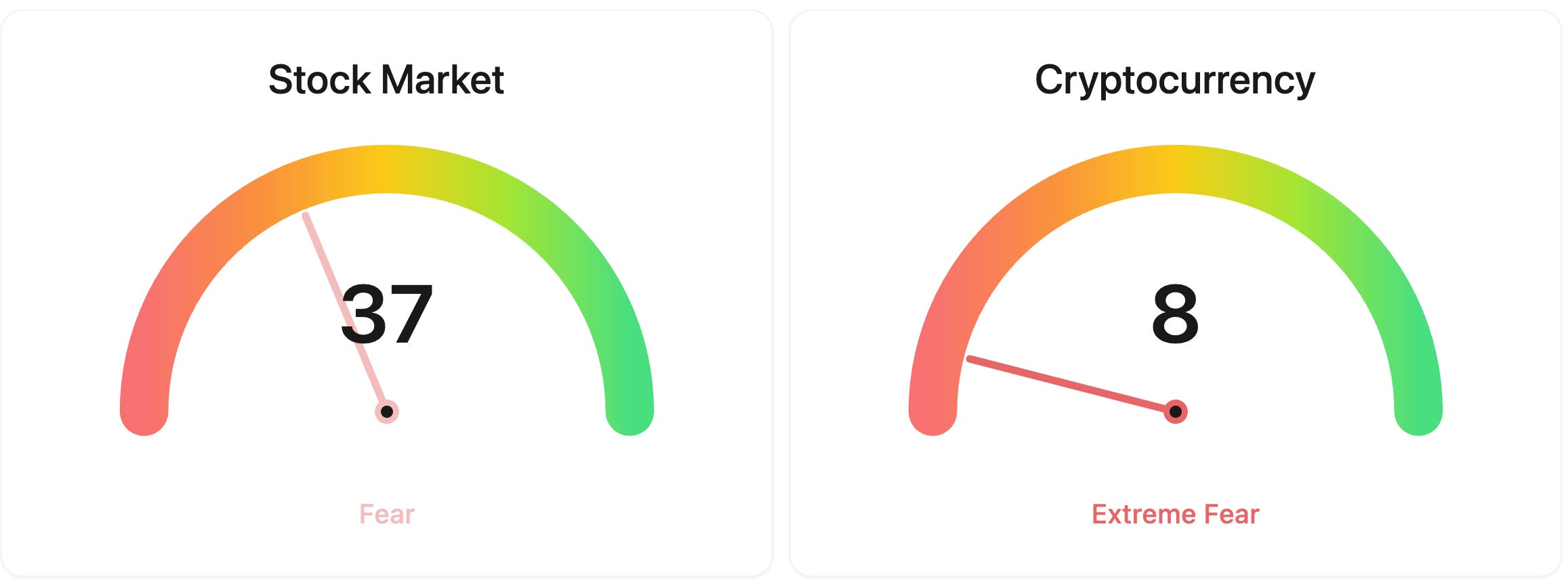
⚖️ Fear & Greed
📉 The Number That Matters
3.0%
UK headline inflation fell to 3.0% in January, down from 3.4% in December to reach its lowest level since March 2025. While matching consensus, the 0.5% monthly price drop represents the steepest decline since last summer.
⚔️ Winners vs Losers
Winners
TCMD 0.00%↑: Tactile Systems Technology Inc. soared to a 52-week high after reporting fourth-quarter revenue and earnings that surpassed analyst expectations.
GLBE 0.00%↑: Global-E Online Ltd. jumped on a significant earnings beat and a first-quarter 2026 revenue forecast that surpassed analyst estimates.
RSI 0.00%↑ : Rush Street Interactive Inc. rose sharply following a positive earnings surprise and bullish management commentary regarding future margin expansion.
MCW 0.00%↑: Mister Car Wash Inc. surged after announcing a agreement to be taken private by Leonard Green & Partners at $7.00 per share.
GRMN 0.00%↑: Garmin Ltd. shares climbed after reporting strong fourth-quarter results and issuing fiscal year 2026 guidance well above the consensus.
WING 0.00%↑: Wingstop Inc. moved higher after the company delivered an earnings beat and higher-than-expected system-wide sales growth.
VRSK 0.00%↑: Verisk Analytics Inc. shares increased following the release of robust quarterly results and an updated share repurchase plan.
GSHD 0.00%↑ : Goosehead Insurance Inc. moved higher after the company expanded its buyback program and updated its 2026 organic growth outlook.
ADI 0.00%↑: Analog Devices Inc. gained as the company reported a better-than-expected quarter and signs of a recovery in the industrial sector.
Losers
NLOP 0.00%↑: Net Lease Office Properties shares declined as the stock began trading ex-dividend was today for a significant $6.75 per share special cash distribution.
ACLS 0.00%↑: Axcelis Technologies Inc. fell due to soft first-quarter guidance for both revenue and earnings per share despite a fourth-quarter earnings beat.
RXRX 0.00%↑: Recursion Pharmaceuticals Inc. plummeted after a 13F filing revealed that Nvidia Corp. had entirely sold its previous stake in the company.
VNET 0.00%↑: VNET Group Inc. faced intensified selling following news that Blackstone triggered events terminating its governance rights under existing note agreements.
VECO 0.00%↑: Veeco Instruments Inc. shares declined after the company provided a sub-consensus financial outlook for the upcoming fiscal year.
PANW 0.00%↑ -7.3%: Palo Alto Networks Inc. fell in pre-market trading due to a reduction in full-year billings guidance during its earnings call.
📊 Market Snapshot
Cryptocurrencies:
Bitcoin (BTC): $67472 (▲ 0.00%)
Ethereum (ETH): $1982 (▼ -0.42%)
XRP: $1.47 (▼ -0.53%)
Equity Indices (Futures):
S&P 500: $6868 (▲ 0.33%)
NASDAQ 100: $24873 (▲ 0.42%)
FTSE 100: £10673 (▲ 0.99%)
Commodities & Bonds:
10-Year US Treasury Yield: 4.06% (▲ 0.05%)
Oil (WTI): $64 (▲ 2.86%)
Gold: $4938 (▲ 1.20%)
Silver: $75.52 (▲ 2.75%)
Data as of UK (GMT): 12:56 PM / US (EST): 7:56 AM / Asia (Tokyo): 9:56 PM
✅ 5 Things to Know Today
🍎 Apple Breaks Free From the Tech Herd
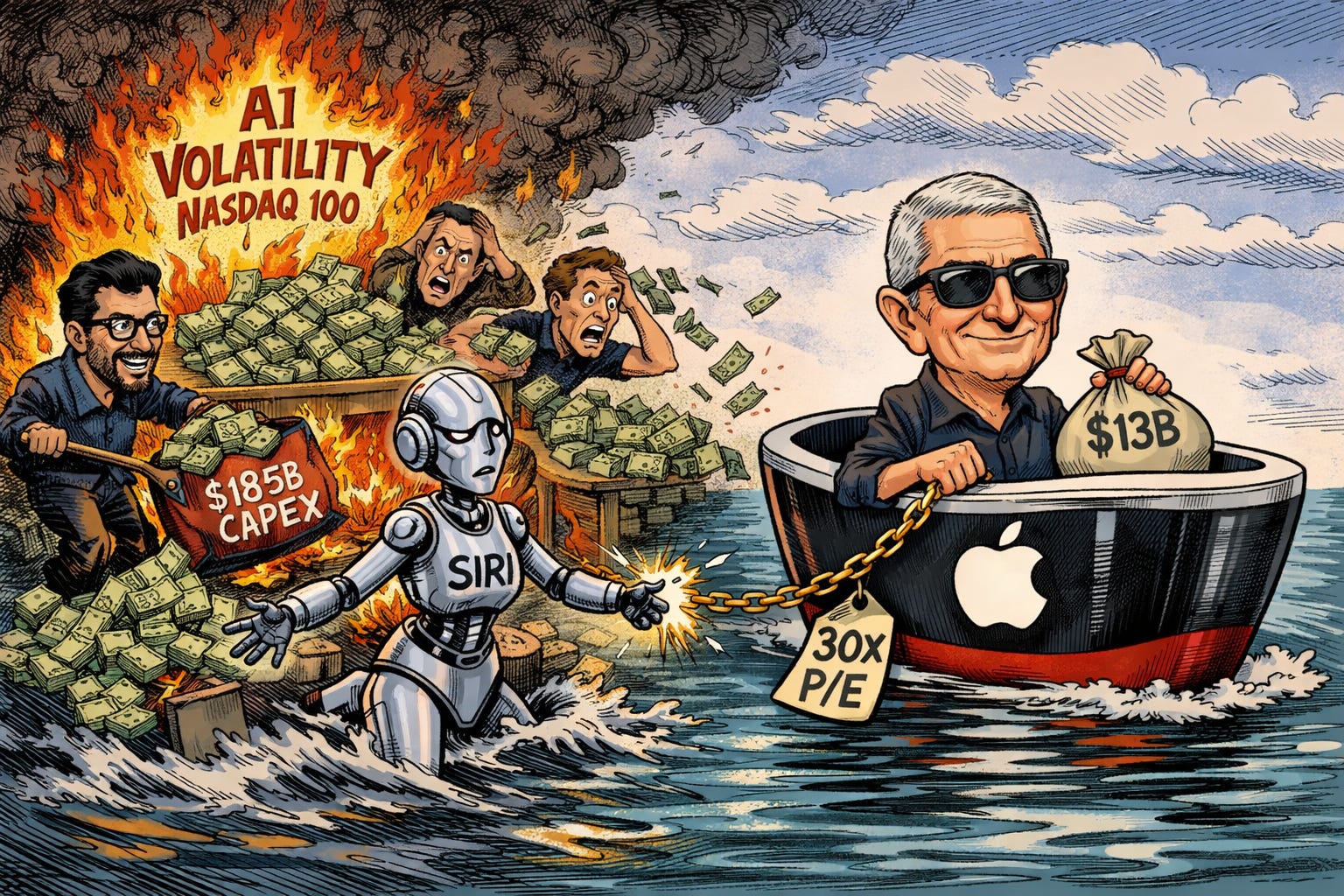
Apple’s trading relationship with the broader tech market just hit a 20-year low. Its 40-day correlation with the Nasdaq 100 plummeted to 0.21, a level not seen since 2006 and a massive drop from the 0.92 reading we saw last May. While the rest of the “Magnificent Seven” and AI software names are getting whacked by volatility, Apple’s behaving like a relative safe haven. In February, the stock climbed about 1.7% even as the Nasdaq 100 dropped 3.3% and its mega-cap peers sank 7.5%. It’s a major shift in how the market prices the iPhone maker compared to its cloud and chip rivals (Bloomberg).
This decoupling stems from Apple’s hardware-heavy model and lighter AI spending. Unlike Alphabet, which is guiding for up to $185 billion in 2026 capex, Apple’s spend is estimated at a modest $13 billion. Investors seem to view physical devices as more insulated from AI disruption than software services. However, this protection isn’t free. Apple trades at 30 times forward earnings, a hefty premium to the index’s 24x multiple. It’s also not bulletproof: news of Siri AI delays recently triggered a $202 billion single-day market-cap loss, proving that while it’s untethered from the index, it’s still chained to its own AI execution.
Sensei’s Insight: Watch the March 4 product event for AI hardware clues. Apple’s defensive status depends entirely on the market’s willingness to pay a 30x premium for perceived safety from AI volatility.
🤝 Meta Locks in Millions of Nvidia AI Chips
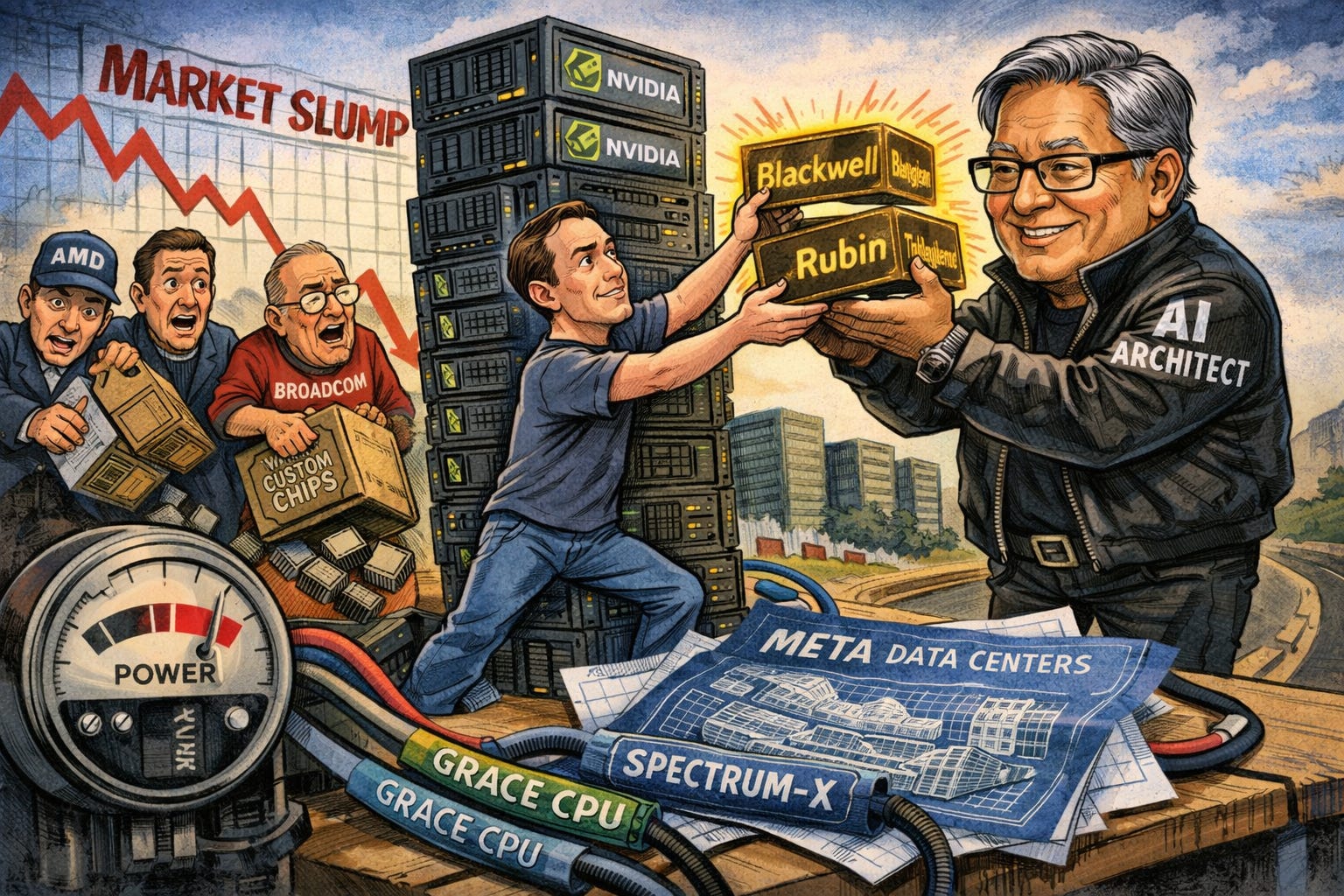
Meta just dropped a massive multiyear deal with Nvidia to build out its personal superintelligence infrastructure. The partnership secures millions of Nvidia’s current Blackwell and next-generation Rubin GPUs. It’s a full-stack commitment, including a huge rollout of Arm-based Grace CPUs and Nvidia’s Spectrum-X Ethernet networking. After-hours markets reacted instantly: Nvidia and Meta shares climbed, while rivals like Broadcom, AMD, and Arista Networks saw red. Meta is aiming for better performance per watt as it scales its global data centers for massive AI inference and training workloads (Nvidia Newsroom).
This deal signals a significant shift because it suggests Meta is doubling down on Nvidia rather than switching to custom chips like Google’s TPUs. For months, analysts worried that Broadcom-designed custom silicon would eat Nvidia’s lunch, but this agreement puts those fears on ice for now. By integrating Spectrum-X networking and Grace CPUs, Nvidia is moving from being a component supplier to the primary architect of Meta’s entire data center fabric. This could pressure margins for networking giants like Arista and indicates that Meta’s massive AI capital expenditure likely has a long runway through 2027 and beyond.
Sensei’s Insight: Watch the 2027 rollout of the Vera CPU. If Meta successfully cuts power costs with Nvidia’s proprietary silicon, it may lock out competitors for an entire hardware generation.
⚖️ The Fed’s Internal Split
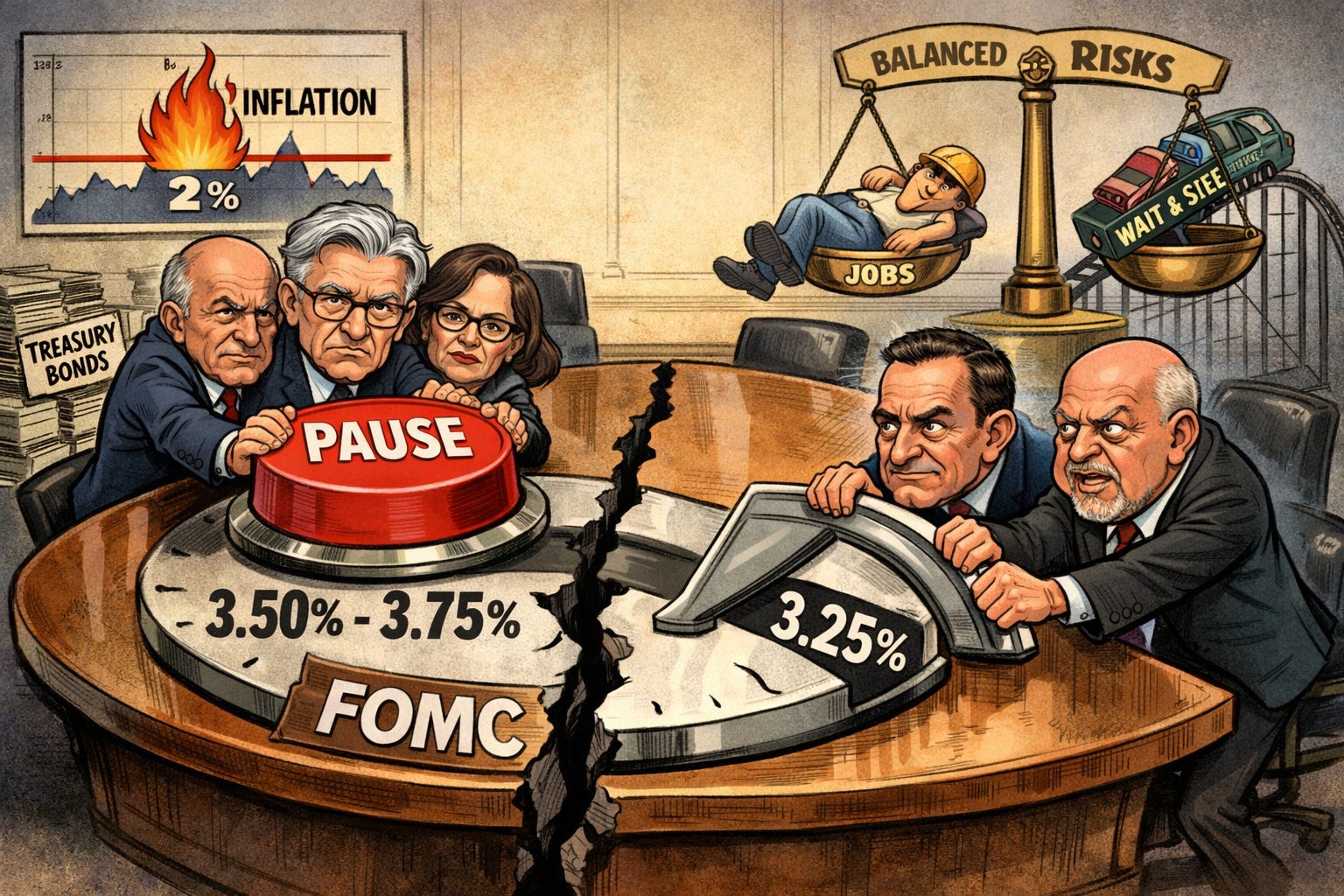
The Federal Open Market Committee (FOMC) held interest rates at 3.50% to 3.75% during its January 27–28 meeting, but the decision was far from unanimous. While ten members voted to pause, Governors Stephen I. Miran and Christopher J. Waller formally dissented, pushing for an immediate 25-basis point cut. The official statement described economic activity as expanding at a “solid pace,” a notable upgrade from previous “moderate” labels, even as job gains remained low and inflation stayed somewhat elevated above the 2% target. With the meeting minutes dropping today at 2:00 p.m. ET, investors are looking for the blow-by-blow of this internal friction (Federal Reserve).
This matters because the Fed has shifted its tone, moving away from a primary focus on labor market weakness to a more balanced view of risks to both jobs and inflation. By removing language about “downside risks” to employment, the Committee signaled it isn’t in a rush to resume the cutting cycle that began in 2024. For retail investors, the 10-2 vote split suggests the “wait and see” phase might be more contentious than the headline suggests. If the minutes reveal that more members were leaning toward the Miran-Waller “cut now” camp, it could trigger a repricing in Treasuries and growth stocks that have been bracing for a long plateau.
Sensei’s Insight: Watch the language around “balanced risks” in today’s minutes. If the majority appears more worried about inflation re-accelerating than the dissenters are about job stalls, the pause could last through spring.
📉 DJT Breaks the $10 “SPAC Floor”
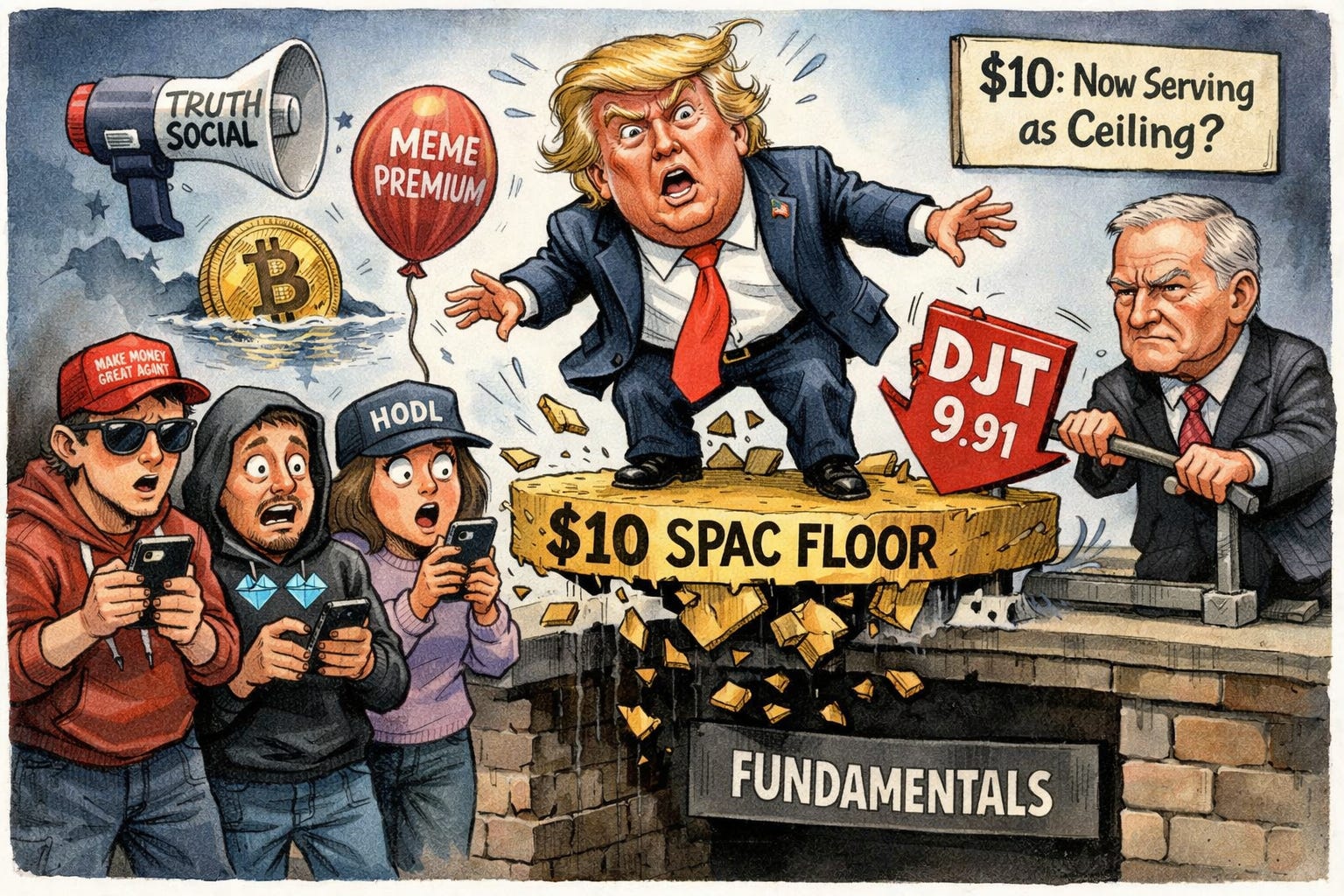
Trump Media shares tumbled 9.7% on Tuesday, closing at $9.91 and marking the first time the stock has finished below the $10 mark since its 2024 merger. This slide pushed the ticker to its lowest level since it began trading on the Nasdaq, continuing a brutal stretch where the stock has lost roughly a quarter of its value in 2026 alone. Despite a tiny 2% bounce in Wednesday’s pre-market action, the technical damage is notable. The company, which operates Truth Social, Truth+, and a crypto unit holding over $2 billion in Bitcoin, has now seen its market price fall about two-thirds over the last twelve months (Wall Street Journal).
This $10 level is more than just a round number; it represents the original “trust value” common to SPAC deals, often viewed by the street as a definitive floor for sentiment. Breaking below it suggests that the market now values the combined business at less than the cash pile it started with. While DJT has historically traded on political narrative and “meme” energy rather than traditional earnings, the recent price action reflects a growing exhaustion among retail holders. Even with Donald Trump’s political prominence, the stock has struggled to outrun persistent losses and a lack of clear profitability, proving that ideological loyalty has its limits when the fundamentals remain thin.
Sensei’s Insight: Watch if $10 flips from a floor to a ceiling. If the stock can’t reclaim that level quickly, it may signal that the “meme” premium has permanently evaporated.
🇯🇵 Japan Puts $36 Billion on the Table
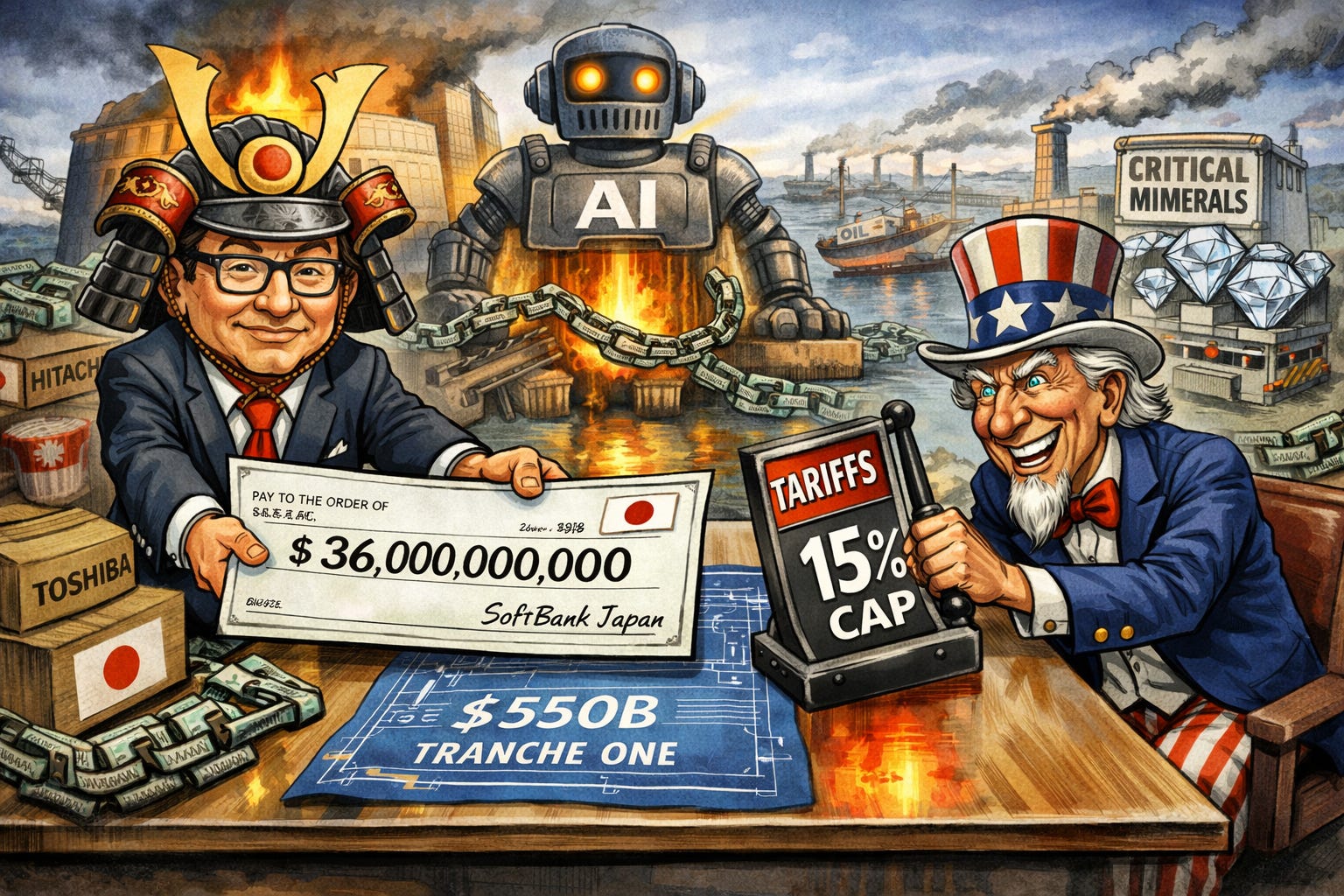
Japan just kicked off the first phase of its massive $550 billion investment pledge to the U.S., committing roughly $36 billion to three major infrastructure projects. The centerpiece is a 9.2-gigawatt natural gas power plant in Ohio, led by SoftBank’s SB Energy, which is being touted as the largest gas-fired facility in U.S. history. Another $2.1 billion is headed to the Texas GulfLink deepwater crude export terminal, while $600 million will fund a synthetic industrial diamond facility in Georgia. This isn’t a simple cash gift: Japan is using government-backed loans and guarantees to secure these deals, effectively trading capital for a 15% cap on U.S. tariffs for Japanese goods (Bloomberg).
This deal signals a shift in how trade wars are settled: tariffs are being used as a carrot to force allies to build U.S. industrial capacity. For investors, the Ohio project is a massive “old-school” bet on the AI boom. While the tech world focuses on chips, this project acknowledges that AI data centers need massive, reliable baseload power that renewables can’t always provide alone. By involving industrial giants like Toshiba and Hitachi, Japan is ensuring its own companies get the equipment contracts while the U.S. gets the infrastructure. It turns “critical minerals” into a broader category, now including engineered materials like the synthetic diamonds in Georgia used for high-precision semiconductor manufacturing.
Sensei’s Insight: Watch how quickly these projects clear local hurdles. This “tranche” sets the template for the remaining $500 billion, shifting Japan from a simple exporter to a foundational owner of U.S. energy.
🔗 Connect with Us
Stay plugged in across platforms:
Sensei on X: sensei_live_
Martyn Lucas on X: MartynInvestor
Vaz on X: eVTOLHUB
📺 YouTube Channel (Live & Replays): Martyn Lucas Investor