

This content is for informational and educational purposes only and does not constitute financial advice. Always do your own research. Not financial advice (NFA).
👀 Today’s Stories at a Glance
🔻 Korea’s market cracks: The KOSPI fell 5.8% as rising bond yields tore through chipmakers, with SK Hynix down 9.93%.
🏦 Fed minutes land tonight: The record of July’s triple-dissent meeting arrives at 7pm UK, 2pm ET, already three weeks stale.
🛢️ Brent nears $92: Trump says there are no talks with Iran, and eight ships have been hit this month.
🇬🇧 UK inflation back to 2.9%: Gas bills rose 14.7% in July, the biggest jump since October 2022, after the price cap moved.
🔨 Meta on trial in Oakland: Twenty-nine states accuse it of hooking children, and Meta says the bill could reach $1.4 trillion.
💉 Moderna almost doubles: The first late-stage win for a personalised mRNA cancer vaccine, in 1,137 melanoma patients.
💸 SK Hynix buys back $28bn: Korea’s largest buyback ever starts tomorrow, and the shares still fell almost 10%.
🚀 SpaceX closes the Cursor deal: The $60 billion all-stock purchase is the largest startup acquisition ever recorded.
🏛️ Crypto goes to the White House: Coinbase, Ripple and Kraken sit down with Trump, Atkins and Selig today.
📡 Keysight books record orders: Orders topped $2 billion for a second straight quarter while the rest of the chip trade sold off.
🔍 Cheat Sheet before the minutes: Three dissents, one document, and the lines to look for the second it drops.
🧠 One Big Thing
Your fund fell overnight and no company did anything wrong. Governments are borrowing enormous sums, and the price of that borrowing has reached levels last seen in 2007, with the US 30-year yield touching 5.33% on Tuesday. When safe government debt pays that much, the expensive stocks that need years of future growth to justify today’s price get marked down against it. That is why chipmakers were sold first and sold hardest. Korea’s market fell 5.8% on Wednesday morning and its exchange froze programme selling five minutes after the open. Nothing about the AI build-out changed. Borrowing costs did.
⚖️ Fear & Greed
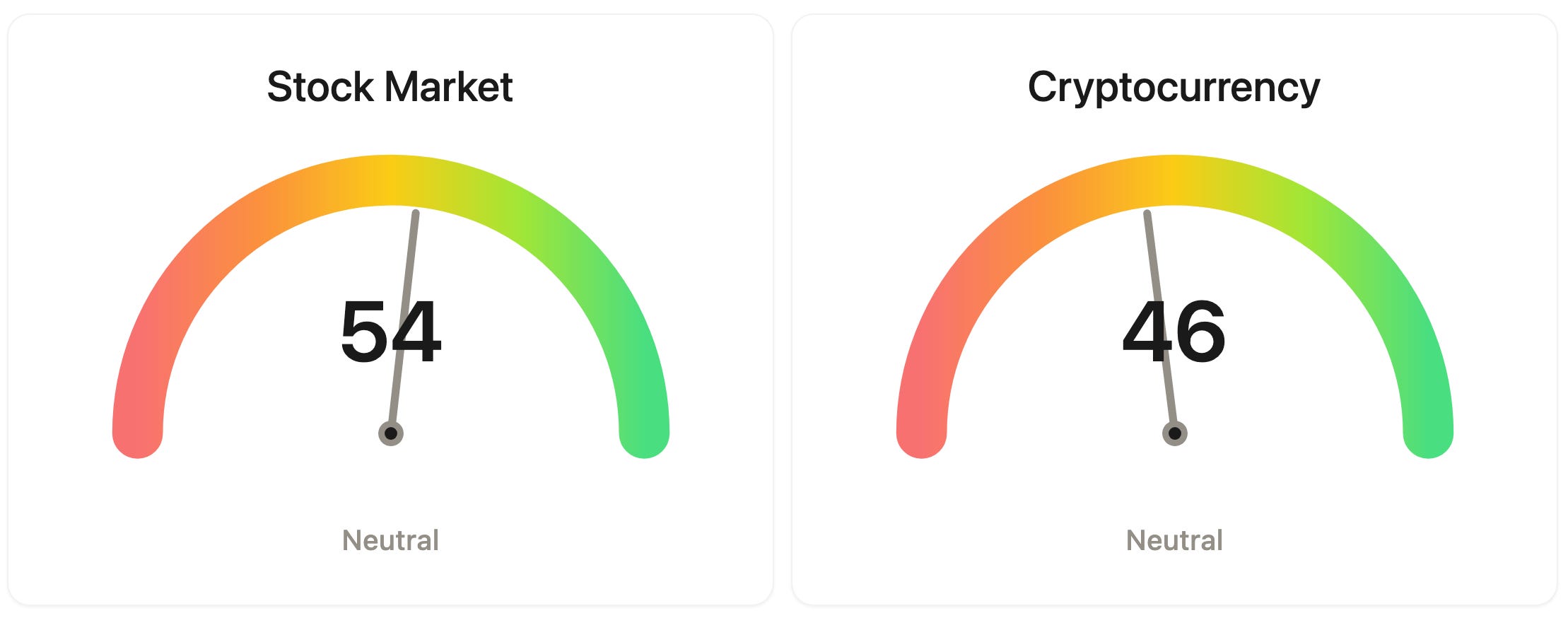
📉 The Number That Matters
48
The Korea Exchange triggered its 48th sidecar of 2026 five minutes after Wednesday’s open. A sidecar freezes programme selling. There were 26 in all of 2008.
⚔️ Winners vs Losers
Winners
MRNA 0.00%↑ : +98.22% Moderna nearly doubled after its personalized mRNA cancer vaccine with Merck met both endpoints in a Phase 3 melanoma trial, the first positive Phase 3 result for any mRNA-based cancer treatment.
EIKN 0.00%↑ : +15.88% Eikon Therapeutics extended a two-day run on the melanoma read-across to its own Keytruda combination trial, ahead of a PARP inhibitor investor event on Thursday.
MRK 0.00%↑ : +9.23% Merck rose on the same readout, the first regimen to beat Keytruda alone in adjuvant melanoma, with regulatory filings now in play.
Losers
WYFI 0.00%↑ : -23.90% WhiteFiber sank after pricing an upsized $270 million convertible note offering to fund data center expansion.
NBIS 0.00%↑ : -6.11% Nebius Group extended Tuesday’s slide as rising yields and oil prices drove a broader retreat from AI cloud names.
📊 Market Snapshot
Cryptocurrencies:
Bitcoin (BTC): $64,464 (▼0.32%)
Ethereum (ETH): $1,922 (▲0.29%)
XRP: $1.01 (▲0.40%)
Equity Indices (Futures):
S&P 500: 7,716 (▲0.02%)
NASDAQ 100: 29,512 (▼0.25%)
FTSE 100: 10,722 (▲0.03%)
Commodities & Bonds:
10-Year US Treasury Yield: 4.69% (▼0.42%)
Oil (WTI): $85 (▲0.28%)
Gold: $4,364 (▲0.71%)
Silver: $63.54 (▲0.36%)
Data as of: UK: 12:59pm BST / US: 7:59am EDT / Asia (Tokyo): 8:59pm JST
✅ 5 Things to Know
🔻 Korea’s market breaks under the weight of yields
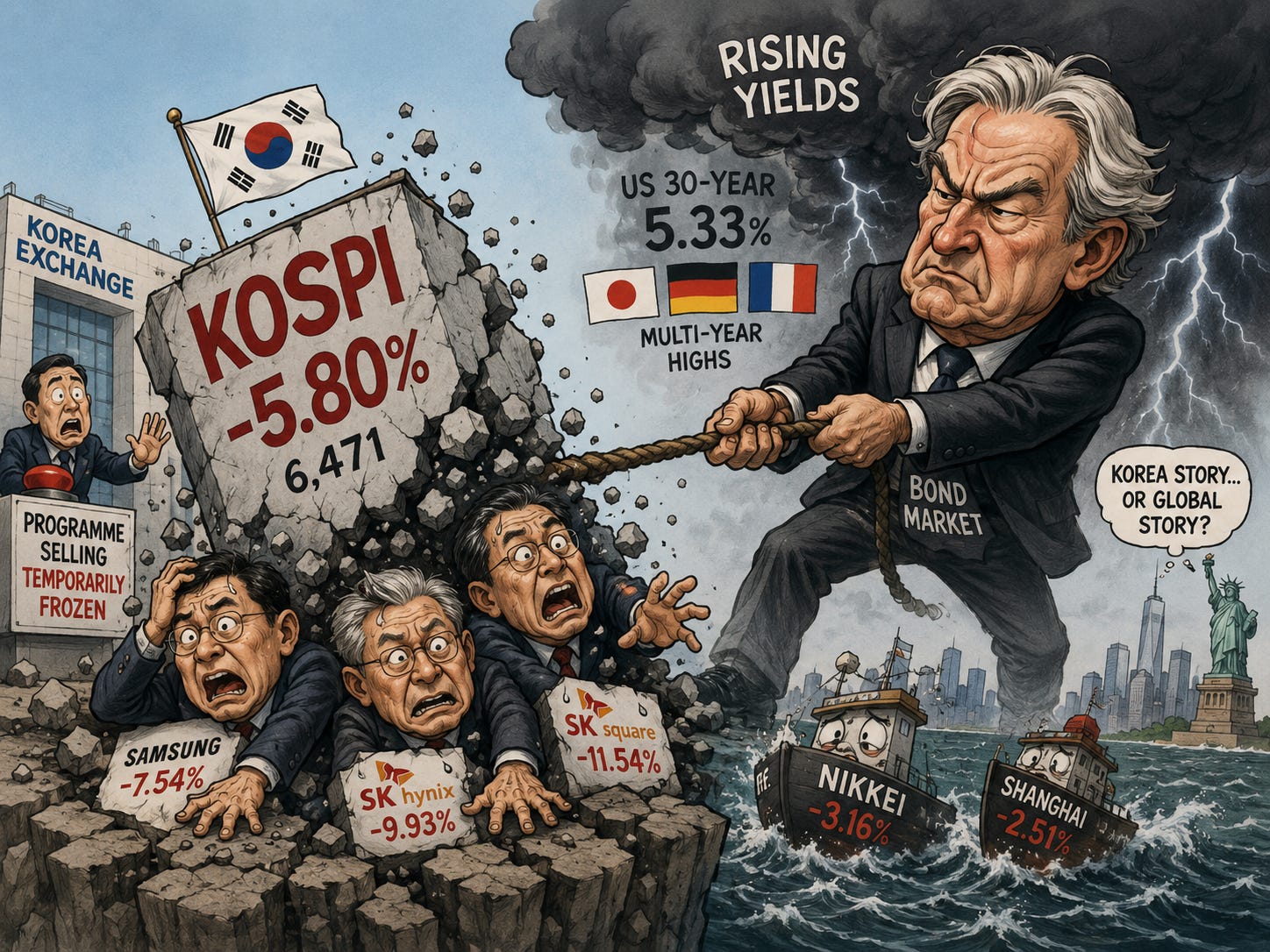
The KOSPI closed down 5.80% at 6,471 on Wednesday, a second straight fall and by far the deeper one. The Korea Exchange froze programme selling five minutes after the open, the 48th time it has done that this year. SK Hynix fell 9.93%, Samsung Electronics 7.54% and SK Square 11.54%. Japan’s Nikkei 225 closed 3.16% lower. Shanghai fell 2.51%. The selling began in New York on Tuesday, where a closely watched gauge of semiconductor firms dropped 5.5% and the Nasdaq composite fell 1.3%, with Micron, SanDisk and Western Digital all down 4% or more. (Trading Economics, Yahoo Finance)
So why chips, when the trigger sat in the bond market? Because the AI build-out is being paid for with borrowed money. The yield on 30-year US government debt hit 5.33% on Tuesday, the highest since 2007, and long yields reached multi-year highs in Japan, Germany and France in the same week. Higher borrowing costs tighten financial conditions even when the Fed does nothing, so the most expensive and longest-dated growth stories get repriced before anything else. Korea is the concentrated version of that trade. S&P 500 futures were roughly flat on Wednesday morning, which leaves the American open to settle whether this is a Korea story or a global one.
Sensei’s Insight: I have said all week that the bond market prices everything else. There it is, in one morning, in one index. Nothing in Seoul got worse overnight. The money got more expensive, and expensive money is brutal on expensive stocks.
🏦 The Fed opens its books tonight
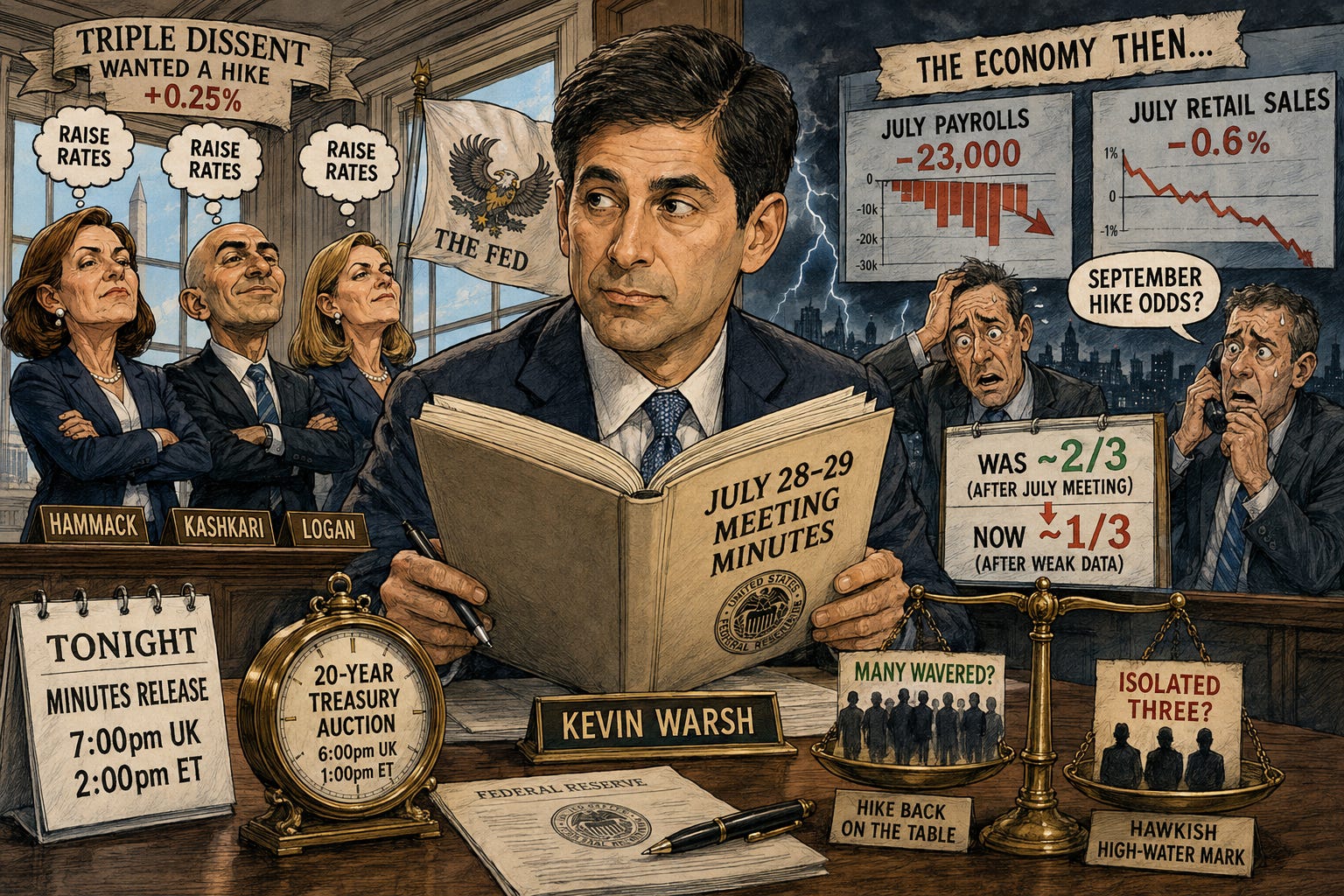
Three officials voted to raise rates at the July meeting. Tonight the rest of the record arrives. The Fed publishes the minutes of its 28 and 29 July meeting at 7:00pm UK and 2:00pm ET. That meeting left rates at 3.50% to 3.75% and produced the first same-direction triple dissent since 2016. Beth Hammack, Neel Kashkari and Lorie Logan all wanted a quarter point. In the days after that vote, futures markets put the odds of a September rise at roughly two thirds. They have collapsed to around a third since, after July payrolls came in at minus 23,000 and July retail sales fell 0.6%. (Federal Reserve, CNBC)
These minutes describe a world that has gone. They were written before payrolls went negative and before the American consumer stopped spending, so every hawkish line inside them comes from a committee looking at a stronger economy than the one on the screen today. What the document can still settle is how close the rest of the committee came to joining the three dissenters. A record showing several others were wavering puts a September rise back on the table and pushes long yields higher again. A record showing the three were isolated says the July vote was the high-water mark for the hawks. A 20-year Treasury auction lands an hour earlier, at 6:00pm UK and 1:00pm ET.
Sensei’s Insight: Minutes are history. Markets trade them anyway, because the vote count tells you where the committee’s centre of gravity actually sits. My read is that the three dissenters were louder than they were numerous, and tonight the text either backs that up or it does not.
🛢️ Brent pushes toward $92 with no talks left
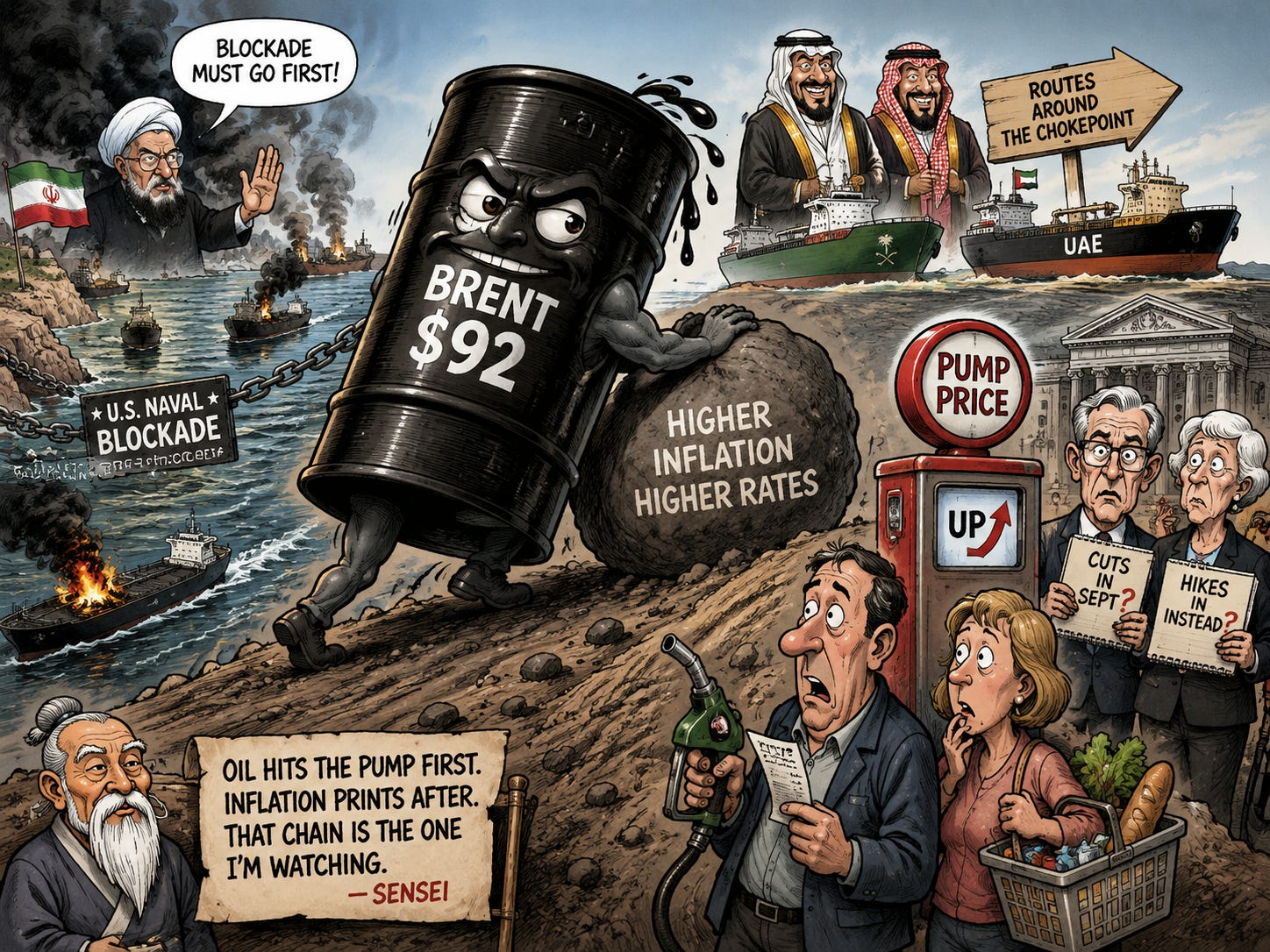
Brent crude traded around $91.50 on Wednesday morning, a fourth consecutive session of gains, with West Texas Intermediate near $85.50. Trump said this week that Washington is holding no talks with Tehran. The US naval blockade stays in place. Iran’s foreign ministry spokesman replied that the blockade has to go before the Strait of Hormuz can fully reopen. Eight vessels transiting the strait have been attacked this month, including ships linked to the United Arab Emirates and Saudi Arabia. Industry data showed American crude stocks fell by 328,000 barrels last week, after a 9.07 million barrel build the week before. (Trading Economics)
The 60-day memorandum signed in June expired on Monday with nothing put in its place. That leaves oil as the swing factor in every inflation forecast this autumn, which is a large part of why the bond market has been so ugly for a week. Petrol and diesel feed into consumer prices with a lag, so central banks that were being asked about cuts in September are being asked about rises instead. Gulf producers are routing around the chokepoint. Saudi Arabia has begun offering cargoes sourced outside the strait, following the route the United Arab Emirates took first. (Reuters)
Sensei’s Insight: Oil is the reason the hike conversation refuses to die. A barrel near $92 reaches the UK pump first and the inflation prints after that. That chain is what I am watching into September, well ahead of the headlines about who is talking to whom.
🇬🇧 UK inflation climbs back to 2.9%
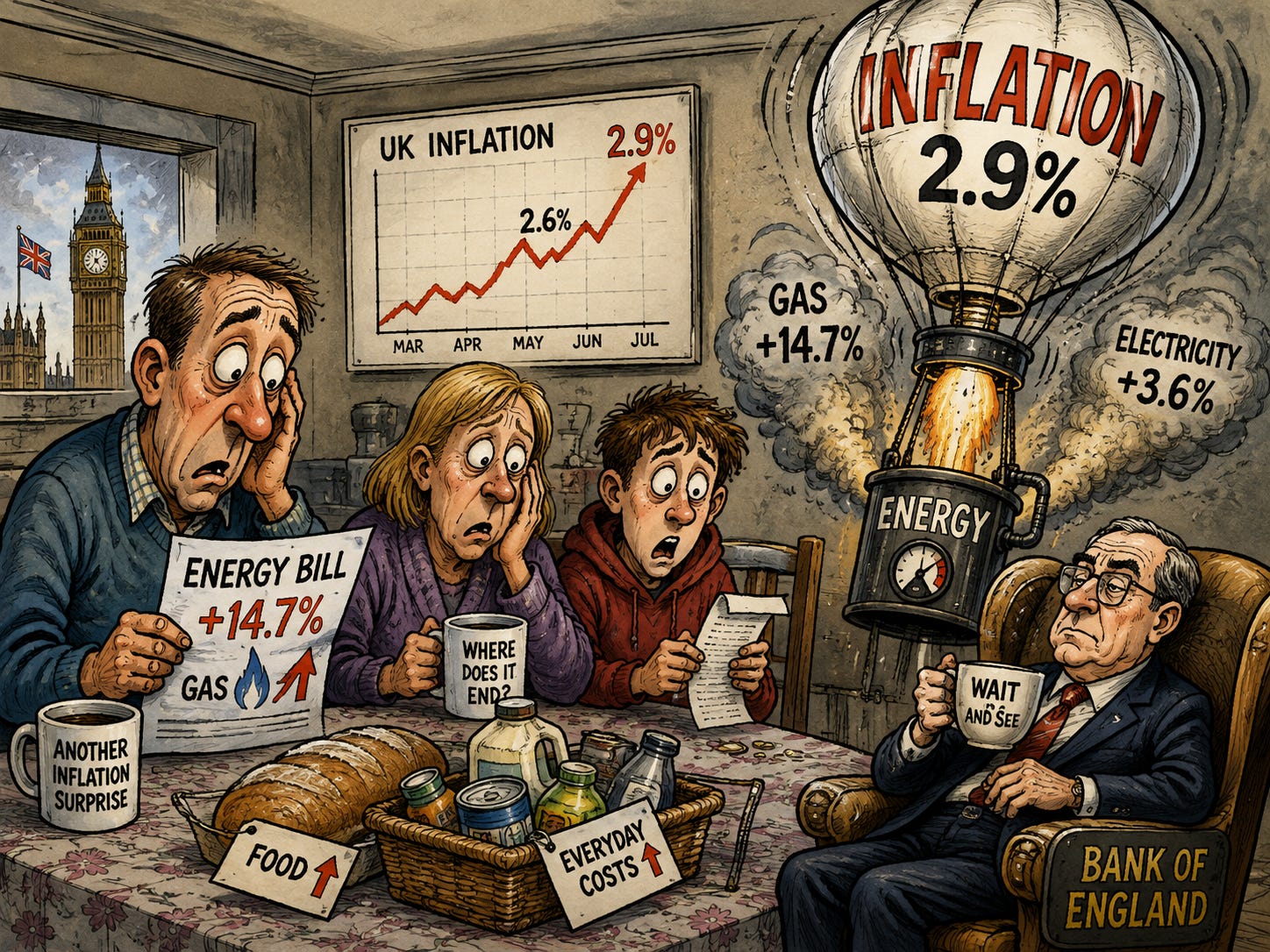
2.9%. That is where annual inflation landed in July, up from 2.6% in June and the highest in four months. Economists had pencilled in exactly that. Housing and household services did most of the work, running at 4.1% against 2.7% a month earlier. Gas prices were 14.7% higher than a year ago, the largest increase since October 2022. Ofgem lifted the energy price cap by 13% at the start of July. Electricity added 3.6%. Core inflation held at 2.6% for a third month, and producer prices slowed to 3.1%, a four-month low. (Trading Economics, FXStreet)
Energy did the damage, and an energy step like this one drops out of the annual comparison next July. Underneath it, core inflation has now been stuck at 2.6% for three straight months, and services inflation was 3.6% in June, which is the measure the Bank of England watches most closely. Transport inflation fell to 3.6% from 5.7% as the average price of diesel dropped 8.8 pence a litre between June and July. UK 10-year gilt yields sat above 5.05% on Wednesday, caught in the same global move that broke Seoul. Markets went into this print expecting the Bank to hold rates for the rest of the year. Nothing here forces a change of mind.
Sensei’s Insight: Gas bills up 14.7% is the line that matters here, because it lands on every household on the same day whatever their income. Take the energy step out and Britain has an inflation rate that has stopped falling rather than one that is climbing.
🔨 Meta goes on trial over children and Instagram
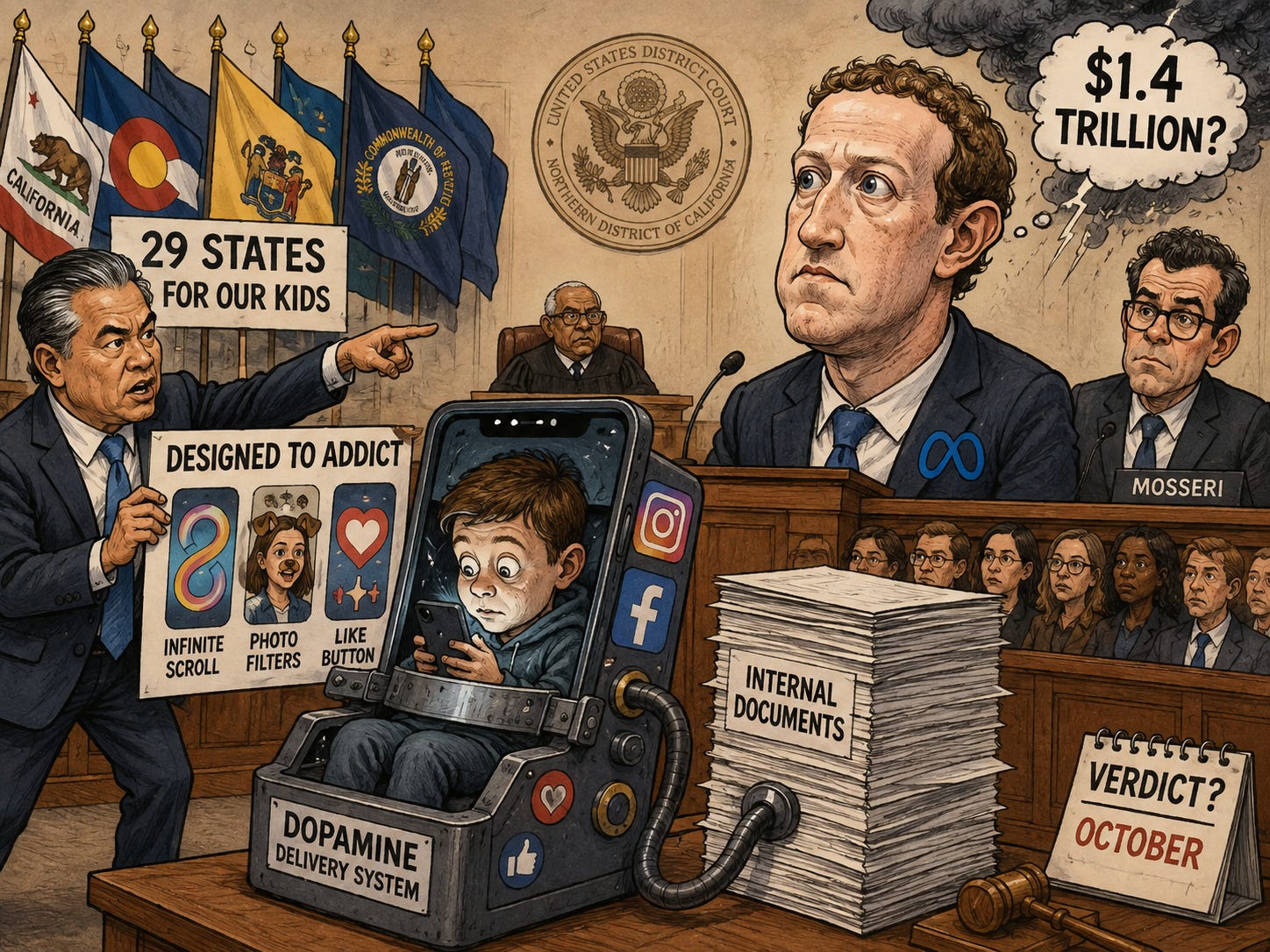
A jury of eight was seated at the federal courthouse in Oakland on Tuesday, and lawyers for California, Colorado, Kentucky and New Jersey opened the largest social media addiction case yet brought. They lead a bipartisan group of 29 states arguing that Meta designed Facebook and Instagram to be addictive to children, through infinite scroll, photo filters and the like button, and that it misled the public about what it knew of the harm. All 29 states also claim Meta broke the federal Children’s Online Privacy Protection Act by collecting data on under-13s. Meta rejects every part of it. The shares fell 4.45% on Tuesday. (CNN)
Meta has told the court that a loss could cost it up to $1.4 trillion, close to its entire market value. California attorney general Rob Bonta says the states have named no figure at all and that Meta is quoting that number to make the case look unreasonable. Both statements can be true. The trial is expected to run six to eight weeks with a verdict around October, and Mark Zuckerberg and Instagram head Adam Mosseri are both expected to testify. Meta is fighting this while spending heavily elsewhere. Second-quarter capital expenditure was $31.1 billion, and free cash flow fell to $784 million from $8.55 billion a year earlier. (NPR)
Sensei’s Insight: The headline number is designed to frighten people and it is doing its job. What I am watching is discovery. Six to eight weeks of internal documents read out in open court has repriced companies before, long before any verdict arrives.
Stories You Might Have Missed
💉 Moderna nearly doubles on a cancer vaccine result
Moderna almost doubled before Wednesday’s open and Merck rose more than 8%. The two companies said their personalised mRNA cancer vaccine, given alongside Merck’s immunotherapy Keytruda, met the primary endpoint of the Phase 3 INTerpath-001 trial. The study enrolled 1,137 patients whose high-risk melanoma had been surgically removed, and the combination cut recurrence compared with Keytruda on its own. It also met a key secondary endpoint on stopping the cancer spreading to new sites in the body. This is the first positive Phase 3 result for a personalised cancer vaccine from any company, and the first for any mRNA cancer treatment. The FDA cleared Moderna’s mRNA flu shot for adults over 50 on Tuesday. (Quartz, CNBC)
💸 SK Hynix approves Korea’s biggest buyback ever
SK Hynix’s board approved the repurchase of up to 40 trillion won of its own shares, roughly $28 billion. That is the largest in Korean history. The programme runs from 20 August to 19 November and covers as many as 24 million shares, which will be cancelled rather than held. The company also committed more than half of the free cash flow it generates between 2025 and 2027 to shareholder returns, answering months of pressure on both SK Hynix and Samsung to say what they intend to do with record AI memory profits. The shares fell 9.93% in Seoul on the same day. (Bloomberg)
🚀 SpaceX closes the largest startup deal on record
SpaceX completed its $60 billion all-stock acquisition of Anysphere, the company behind the AI coding tool Cursor, with the merger effective on 14 August. Cursor’s shareholders received 389,289,254 SpaceX Class A shares, and the business now sits inside a new SpaceXAI division with access to the Colossus supercomputer. No venture-backed startup has ever sold for more. SpaceX traded at $143.04 ahead of Tuesday’s open, down 2.2%. The stock debuted at $135 on 12 June and reached a record $225.64 four days later. Deutsche Bank reiterated a $235 price target after the deal closed. (TheStreet, Yahoo Finance)
🏛️ Crypto’s biggest names go to the White House today
Trump hosts executives from Coinbase, Ripple, Kraken, Gemini, a16z, Chainlink, Kalshi, Paradigm and the Digital Chamber at the White House today, alongside SEC chairman Paul Atkins and CFTC chairman Michael Selig. Executives from the New York Stock Exchange, Nasdaq and DTCC, which settles US share trades, were invited too, which puts the operators of the mainstream market in the same room as token issuers and prediction markets. The meeting comes with the CLARITY Act stalled in the Senate, where a procedural vote ripens on 15 September. XRP sat either side of $1.00 overnight. (Bitcoin.com News)
📡 Keysight books a second straight record quarter
Keysight Technologies reported fiscal third-quarter revenue of $1.85 billion against $1.35 billion a year earlier. Adjusted earnings came in at $3.07 a share where analysts had modelled $2.48. Orders topped $2 billion for a second consecutive quarter. The company lifted its full-year outlook. Its communications division, which sells the test equipment engineers use to prove a data centre link works before anything gets plugged in, grew 43% to $1.345 billion. The shares rose 2.6% ahead of Wednesday’s open while the rest of the chip complex was being sold. (Benzinga)