

👀 Today’s Stories at a Glance
🔍 Big Tech’s earnings test lands: Alphabet and Tesla report tonight, the season’s first megacap results, with the AI spending line the market’s focus.
🇬🇧 UK inflation cools again: June CPI slowed to 2.6%, below the 2.7% expected and the lowest since early 2025, giving the Bank room to hold.
🛢️ Oil tops $92 on Iran: Brent jumped nearly 4% to its highest since June after an 11th night of US strikes on Iran.
₿ Bitcoin near a one-month high: BTC hovered just below $66,000 as the crypto market bill advanced, though Democrats dispute how its ethics rules get enforced.
🍁 Trump hits Canada with 50%: New tariffs on most Canadian goods, from wine to cement, take effect next month, sparing energy and minerals.
📱 AT&T beats on earnings: Adjusted profit topped forecasts and the carrier added 432,000 postpaid phone customers, though revenue came in a touch light.
🏦 The ECB decides this week: Europe’s central bank is expected to hold, so Lagarde’s press conference carries the signal on a September move.
🏭 SK Hynix denies Intel Ohio deal: The memory maker rejected a report it is buying Intel’s stalled Ohio chip campus, days before Intel reports.
🔍 Deep Dive, Japan’s rate shock: A faster Bank of Japan could unwind the yen carry trade that props up global markets, as in August 2024.
📈 Chart of the Day, WTI oil: US crude presses toward the 88 to 90 ceiling that capped summer rallies; I want a daily close above 90.
🧠 One Big Thing
Two forces are pulling inflation in opposite directions at once. UK prices cooled to 2.6% this morning largely because oil fell over the summer, yet Brent is now back above $92 and Trump has just slapped 50% tariffs on most Canadian goods, both of which push prices the other way. The divergence matters for positioning: it gives the Bank of England room to sit still while the Federal Reserve stays boxed in a week before it meets. The question is whether the oil spike sticks. Watch the Strait of Hormuz, because that decides how hard the “higher for longer” backdrop hardens.
⚖️ Fear & Greed
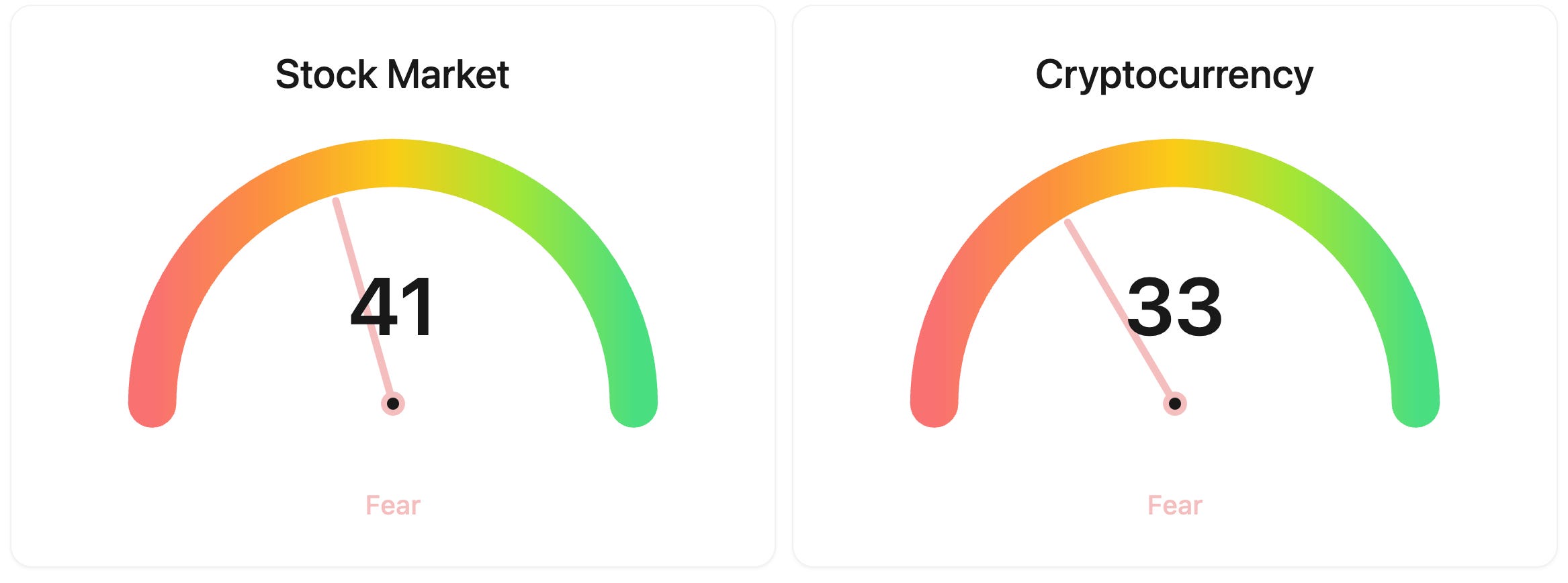
📉 The Number That Matters
¥163
The yen at its weakest against the dollar since 1986, the pressure now pushing the Bank of Japan toward faster rate hikes.
⚔️ Winners vs Losers
Winners
SXTC 0.00%↑ : +66.38% China SXT Pharmaceuticals is riding a low-float momentum bid that swept through US-listed Chinese micro-cap pharma names after China Pharma Holdings rallied nearly 700% on Tuesday on volume more than 20 times its daily average. The move is mechanical rather than fundamental, with no company announcement behind it.
FNWD 0.00%↑ : +19.18% Finward Bancorp agreed to be acquired by First Financial Bancorp in an all-stock deal valuing the Munster, Indiana lender at roughly $208 million, with each Finward share converting into 1.35 First Financial shares. The combination lifts First Financial’s pro forma Chicago-area deposits by 75% to more than $4 billion.
AIRJ 0.00%↑ : +17.51% AirJoule Technologies announced an exclusive sales agreement with Japan’s Kubota Corporation covering multi-unit residential developments, alongside initial deployments of its water-from-air technology in Texas and California.
SMCI 0.00%↑ : +15.76% Super Micro Computer disclosed a preliminary fourth-quarter update showing more than $60 billion in new orders and a record backlog, and lifted its gross margin estimate to 15% to 17% from prior guidance of 8.2% to 8.4%. Revenue is tracking near the low end of the $11 billion to $12.5 billion range, which investors largely waved through given the scale of the margin surprise.
FTAI 0.00%↑ : +12.25% FTAI Aviation moved sharply higher in pre-market with no specific catalyst identified, ahead of second quarter results scheduled for July 29.
DELL 0.00%↑ : +5% Dell Technologies extended Tuesday’s advance in sympathy with Super Micro Computer, as investors treated the server maker’s margin upgrade as a favourable read-through for the broader AI hardware supply chain.
Losers
ZYBT 0.00%↑: -16.84% Zhengye Biotechnology Holding is extending the unwind of a parabolic low-float run that carried the veterinary vaccine maker from under $1 to an $8.01 close on Monday before it surrendered more than 64% on Tuesday. The company said Tuesday it was unaware of any material non-public information that would explain the trading.
PEGA 0.00%↑: -15.61% Pegasystems missed on both lines in the second quarter, posting adjusted earnings of $0.35 per share against a $0.43 consensus on revenue of $420.7 million. Management said unprecedented shifts in the AI market are causing clients to delay purchasing decisions, slowing annual contract value growth to 7%.
GEV 0.00%↑: -7.77% GE Vernova reported second quarter revenue of $11.1 billion and raised its full-year revenue and free cash flow guidance, but GAAP earnings of $2.47 per share landed well short of the roughly $3.18 analysts expected. Adjusted EBITDA of $1.25 billion also came in below consensus, and Wind orders fell 39%.
📊 Market Snapshot
Cryptocurrencies:
Bitcoin (BTC): $65,983 (▼ 0.77%)
Ethereum (ETH): $1,928 (▼ 0.03%)
XRP: $1.14 (▼ 0.50%)
Equity Indices (Futures):
S&P 500: 7,529 (▼ 0.22%)
NASDAQ 100: 29,158 (▼ 0.54%)
FTSE 100: 10,712 (▲ 1.10%)
Commodities & Bonds:
10-Year US Treasury Yield: 4.63% (▲ 0.13%)
Oil (WTI): $87 (▲ 3.29%)
Gold: $4,120 (▲ 0.97%)
Silver: $59.37 (▲ 1.02%)
Data as of: UK: 12:13 BST / US: 07:13 EDT / Asia (Tokyo): 20:13 JST
✅ 5 Things to Know
🔍 Alphabet and Tesla put AI spending on trial
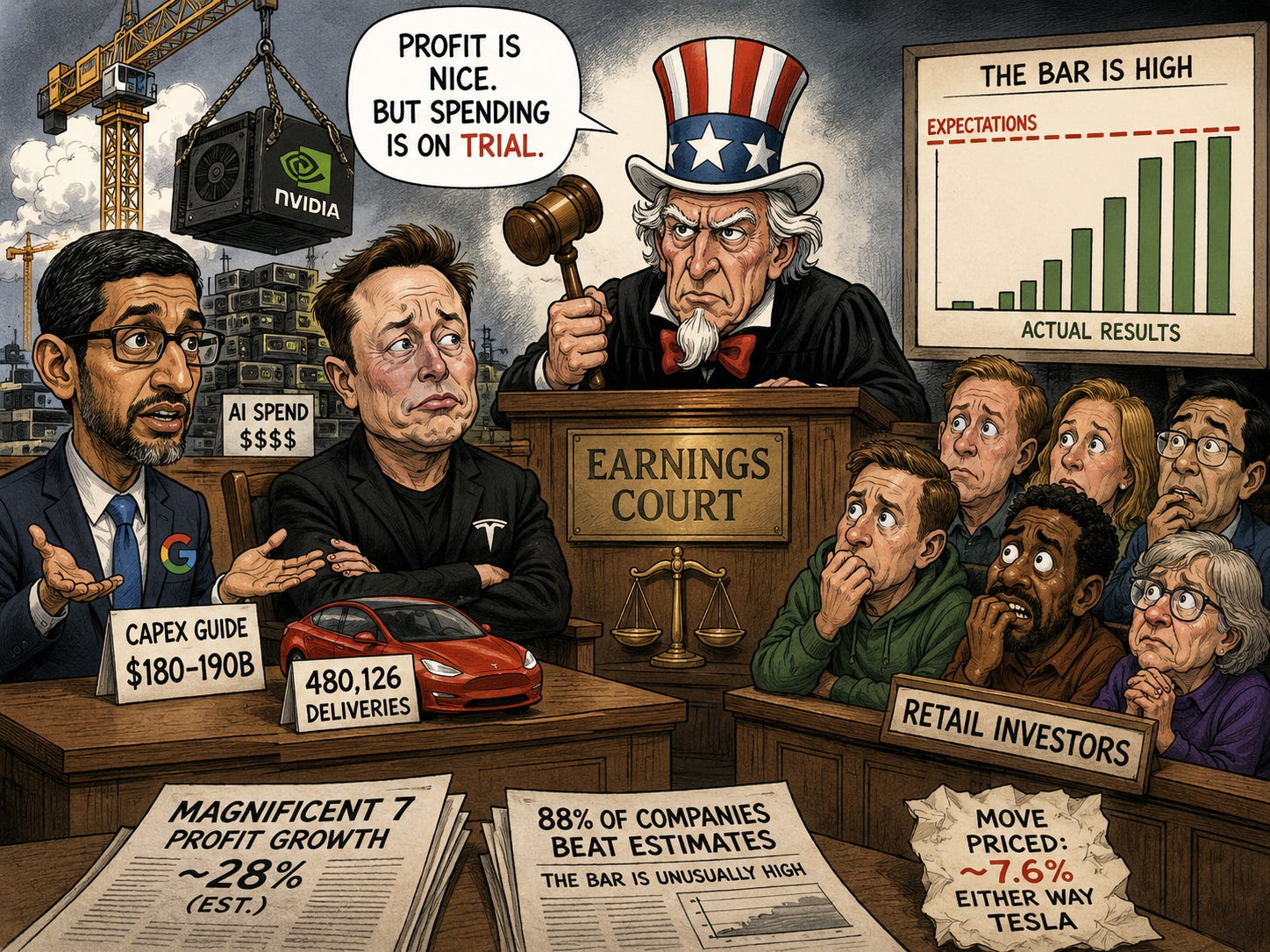
Alphabet and Tesla report after the US close today, the first two of the so-called Magnificent Seven megacaps to open the earnings season, and the market is jittery going in. US stock futures slipped, with the Nasdaq 100 down about half a percent, giving back part of yesterday’s chip-led rally that lifted the S&P 500 0.9% and sent Micron up 12%. Analysts expect the seven biggest tech names to post blended profit growth near 28% on a year ago, but with almost 88% of companies that have already reported beating estimates, the bar is unusually high (CNBC).
For retail investors the swing factor is spending, not the headline profit. Alphabet, which grew first-quarter revenue 22% to $109.9 billion on cloud and search, has guided full-year capital spending toward $180 to $190 billion, and that figure funds the chip orders propping up Nvidia and the wider AI trade. Tesla delivered a record 480,126 vehicles in the quarter, yet its shares hang on automotive margins after months of heavy discounting, with options pricing a move of about 7.6% in either direction. IBM also reports tonight (Yahoo Finance).
Sensei’s Insight: The market has already pre-paid for good news, chips rallied hard into these prints, so the bar tonight is brutal. Alphabet’s spending guide matters more than its profit. A confident number validates the chip trade; a cautious one proves the bears right.
🇬🇧 UK inflation cools, easing the pressure on the Bank
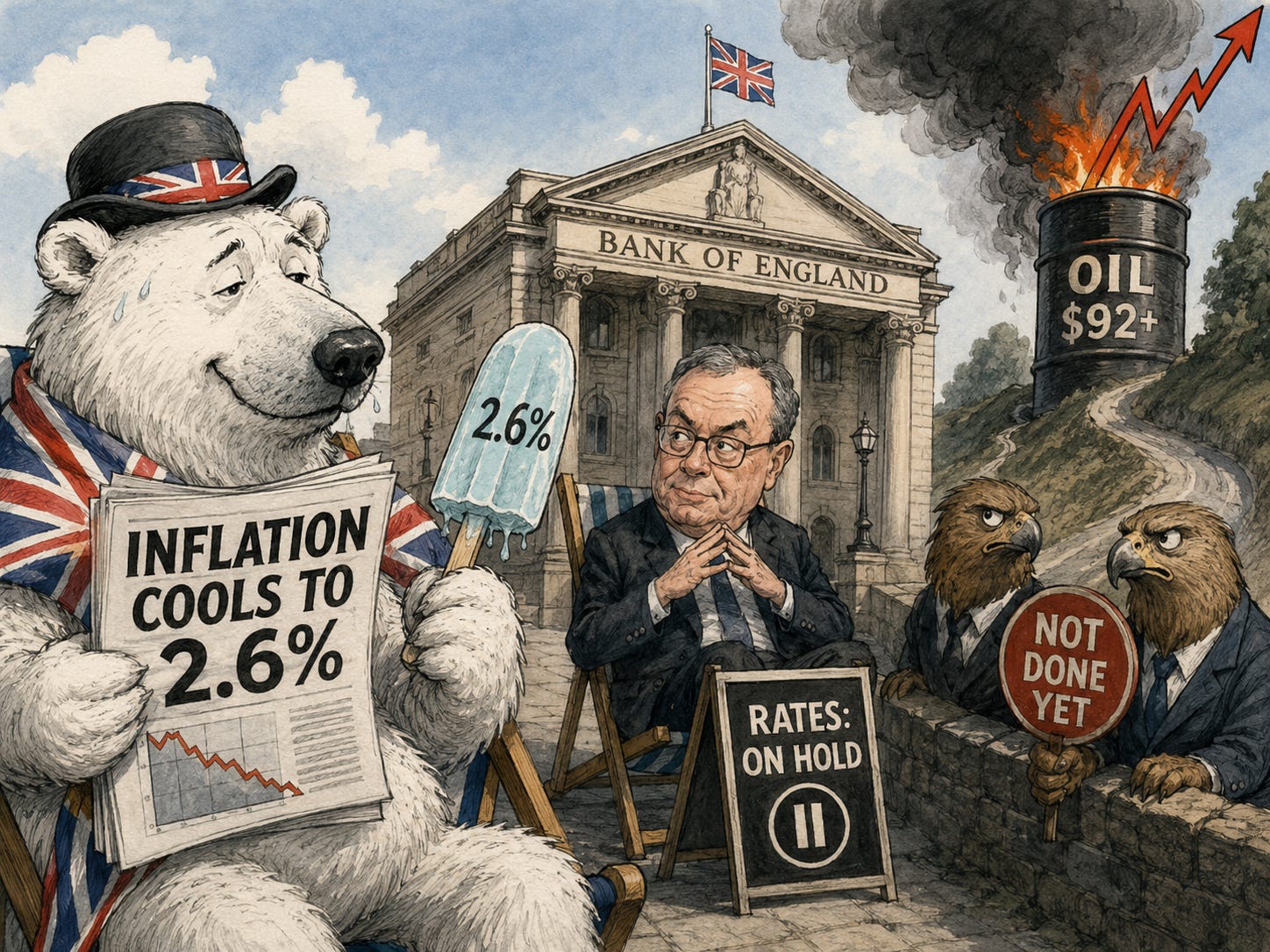
UK consumer prices rose 2.6% in the year to June, the Office for National Statistics reported this morning, down from 2.8% in May and below the 2.7% economists had expected. It was the slowest annual pace since early 2025. The biggest driver was transport, where price growth cooled to 5.7% from 6.8% as the earlier drop in oil fed through to petrol pumps. Core inflation, which strips out food and energy, held at 2.6%, and services inflation, the gauge the Bank of England watches most closely, eased to 3.6% from 3.7% (ONS).
For British households and investors this hands the Bank of England room to keep interest rates on hold at its meeting late this month. Two of the Bank’s nine rate-setters voted in June to raise rates to 4% on fears the summer’s energy shock would leave inflation stuck, and a softer print undercuts that case. Sterling and gilt yields moved on the release before US markets opened. The next test is this week’s flash business surveys, then the rate decision at month end, though a fresh climb in oil could still complicate the picture.
Sensei’s Insight: A cooling headline masks the sticky part. Services at 3.6% is still well above target, which is why the hawks have not gone away. The oil spike is the wild card: if Brent holds above $92, this friendly print may be the last soft one.
🛢️ Oil tops $92 as Iran talks sour
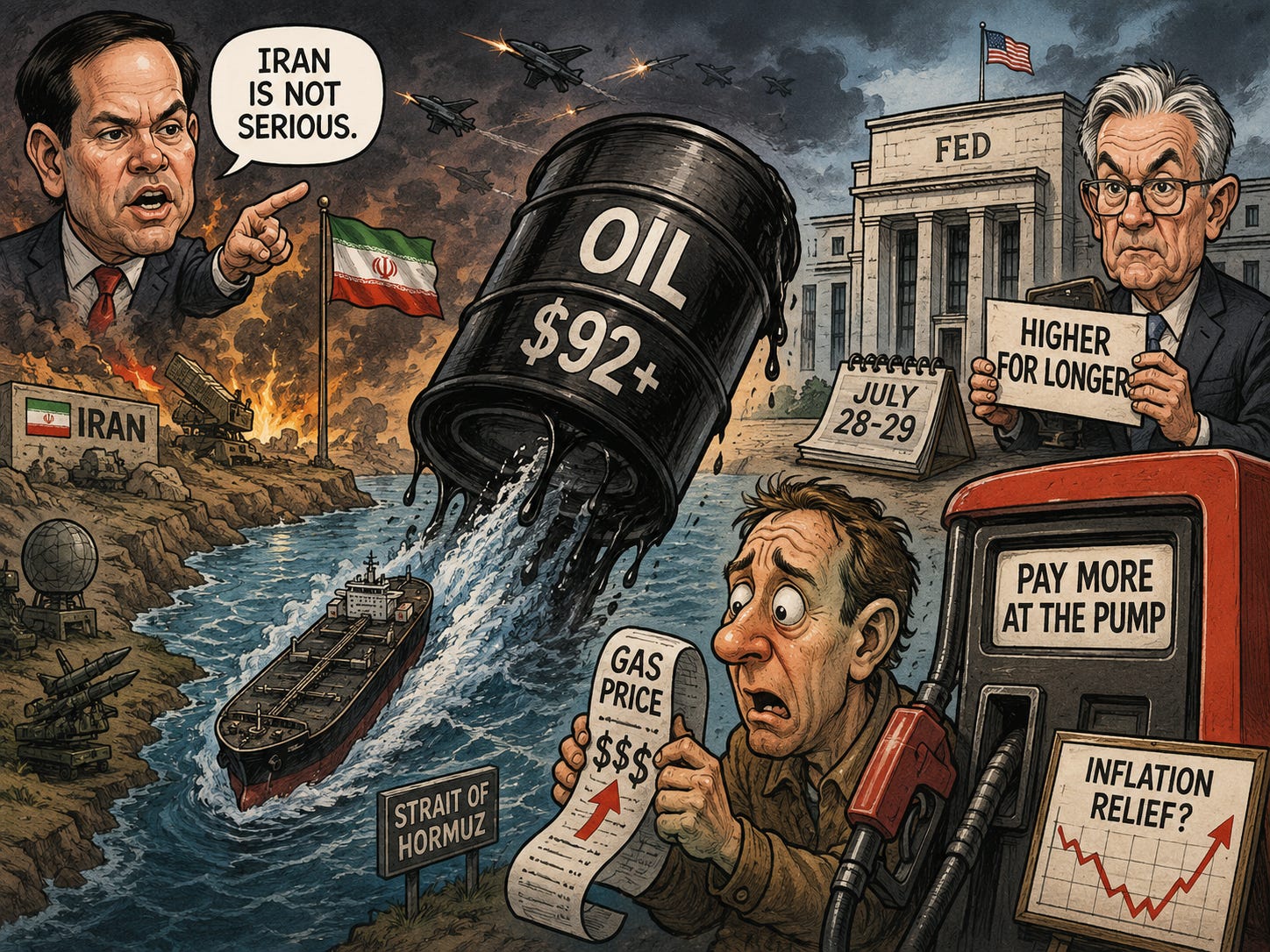
Brent crude pushed above $92 a barrel today, its highest since June, after the US carried out an 11th consecutive night of strikes on Iran and diplomacy appeared to stall. Prices jumped almost 4% at one point. Secretary of State Marco Rubio said Iran was “not serious” about peace talks and that control of the Strait of Hormuz, the channel that carries roughly a fifth of the world’s seaborne oil, remained a sticking point between the two sides. Iran was reported to have targeted US radar and air-defence installations across the Gulf overnight (CNBC).
Higher oil feeds straight into petrol prices and the broader inflation picture, and that is the real market worry, because it strengthens the case for central banks to keep interest rates high for longer. It arrives at an awkward moment, hours before Big Tech earnings and a week before the Federal Reserve meets on the 28th and 29th. The slide in oil earlier in the summer, from around $95 to the low $70s after a mid-June ceasefire, was the single biggest reason inflation cooled. A sustained move back toward triple digits would unwind much of that relief.
Sensei’s Insight: This is the story that quietly undoes the good inflation news. Cheaper energy is what pulled UK and US prices lower this summer; a return toward $100 puts that in reverse. The Fed reads this line as clearly as the market does.
₿ Bitcoin holds near $66,000 as the crypto bill inches forward
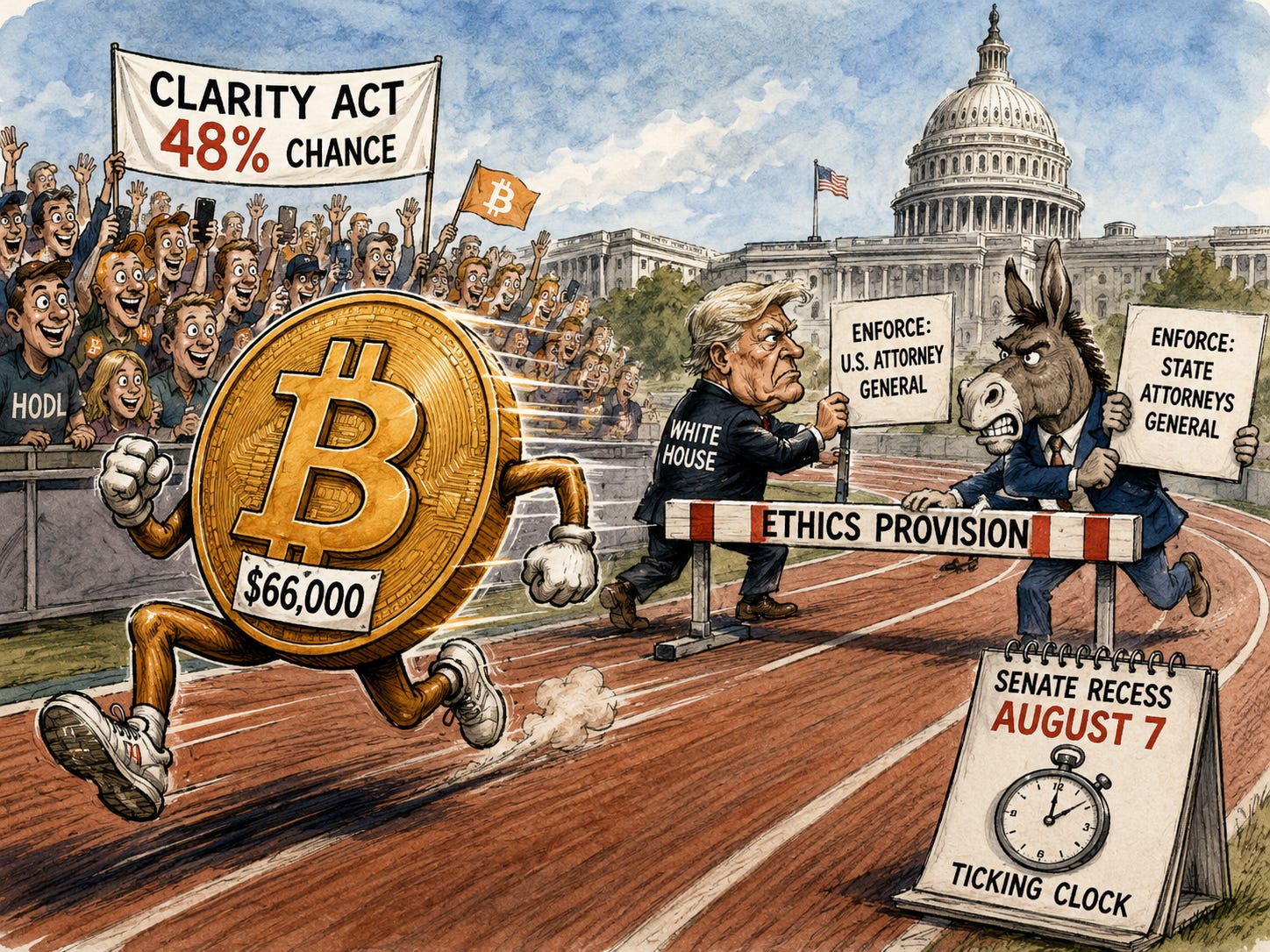
Bitcoin pushed to a one-month high above $66,000, a gain of about 3.5% in a day, before easing back to hover just below that level, as the crypto market-structure bill known as the CLARITY Act moved closer to a Senate vote. The rally followed reports that President Trump had accepted an ethics provision barring senior officials from profiting on digital assets, the clause that had held the bill up. Prediction market Polymarket now puts the odds of the bill passing this year near 48%, up from around a third a week ago (CoinDesk).
The path is still not clear. Senate Democrats are unhappy with the detail of that ethics section, disagreeing over who should enforce the ban, with the White House wanting the US attorney general and Democrats pushing for state attorneys general. Crypto insiders expect the text to reach the Senate floor as soon as next week, but lawmakers leave for their summer recess on the 7th of August, so the bill either passes within a fortnight or likely slips toward the year end (CoinDesk).
Sensei’s Insight: Price is running ahead of the politics. Bitcoin near a one-month high says traders expect this to pass, but the enforcement fight is real and the recess clock is unforgiving. If the text does not appear next week, that 48% starts to look generous.
🍁 Trump slaps 50% tariffs on Canada
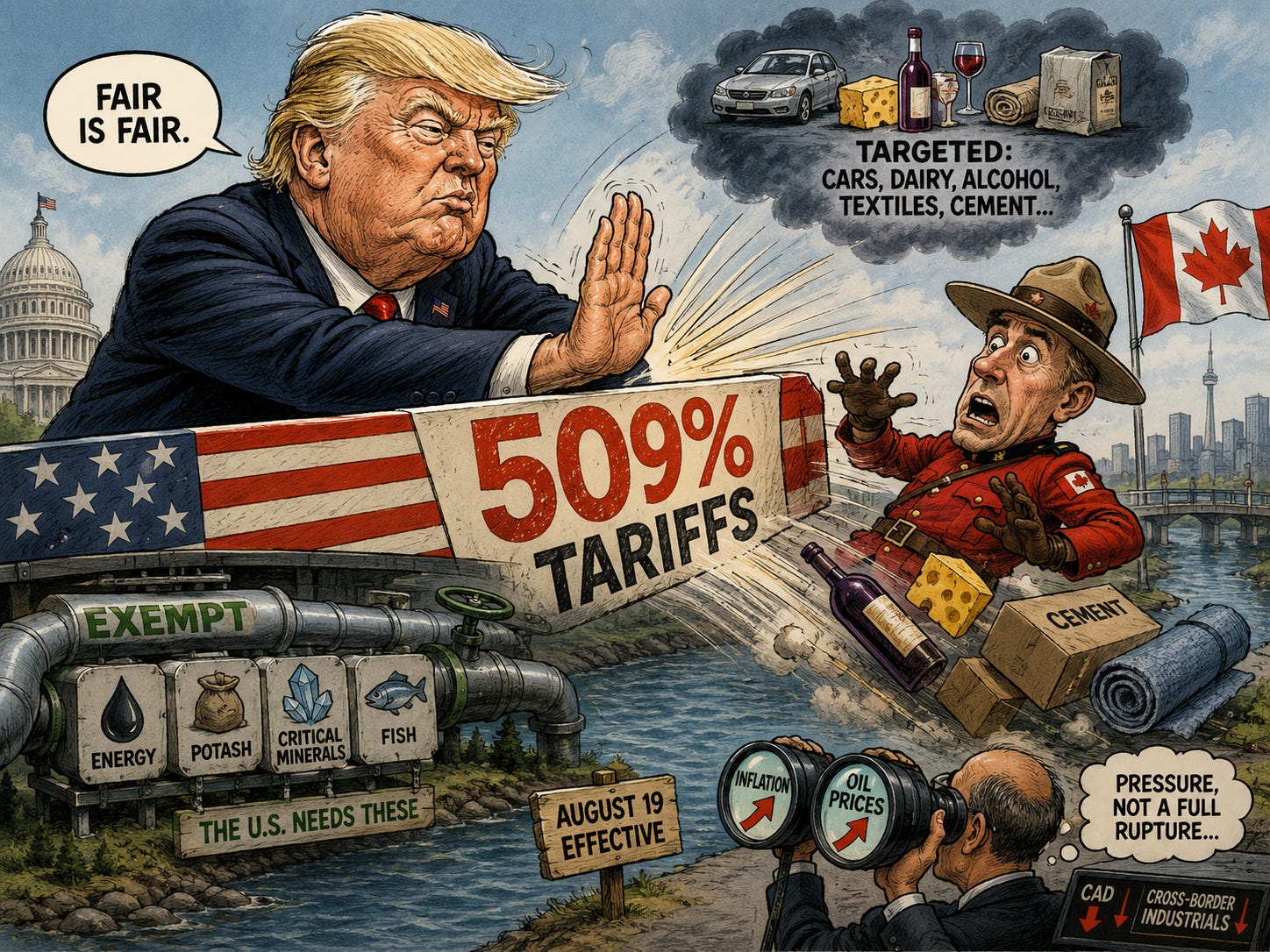
President Trump imposed 50% tariffs on most Canadian goods, accusing Canada of unfairly discriminating against American cars, dairy and alcohol. The new levy covers items from wine and packaging to textiles and cement, and takes effect around the 19th of August. Energy, potash, critical minerals and fish are exempt, which softens the blow, and the affected goods account for only about 5% of Canada’s exports to the US. The White House singled Canada out as one of only two countries, alongside China, that retaliated against last year’s tariffs (CNBC).
For markets the tariffs matter less for their direct hit than for what they signal, a fresh flare-up in trade tension just as investors were focused on earnings and oil. Tariffs act like a tax on imports and tend to nudge prices higher, which lands awkwardly with the Federal Reserve already reluctant to cut rates. The Canadian dollar and cross-border industrial names are the most exposed. With the measure not biting until next month, there is room to negotiate, and past tariff threats have often been softened before the deadline.
Sensei’s Insight: The exemptions show the intent: energy and minerals are spared because the US needs them, so this is pressure, not a full rupture. Tariffs threatened rarely land at full strength. The risk is the inflation signal, arriving just as oil climbs.
Stories You Might Have Missed
📱 AT&T beats on profit and packs on phone customers
AT&T opened the telecom earnings run before the US market opened, and its shares rose on a clear beat. Adjusted earnings came in at 65 cents a share, up from 54 cents a year ago and ahead of the 59 cents analysts expected, with adjusted core profit of $12.3 billion also topping forecasts. The carrier added 432,000 postpaid phone customers, comfortably above the roughly 325,000 the market had penned in, and generated $4.7 billion of free cash flow. Revenue was the one soft spot, rising about 2.5% to $31.6 billion but landing just shy of the $31.8 billion expected. AT&T stood by its full-year plan for at least $18 billion of free cash flow and around $24 billion of share buybacks. IBM reports after the close, with its AI-bookings pipeline in focus (Yahoo Finance).
🏦 The ECB takes its turn this week
The European Central Bank delivers its rate decision later this week, the only major central-bank call with the Fed in its pre-meeting quiet period. After lifting its deposit rate to 2.25% in June, the Bank is widely expected to hold, so the market reaction will run through President Lagarde’s press conference rather than the decision itself. Around 70% of forecasters still see one more increase this year, most likely in September, so any hint from Lagarde about whether that move is still live would move the euro and European bond yields. The eurozone economy contracted 0.2% on a year ago in the first quarter, so an overly tight stance carries its own risk (Bloomberg).
🏭 SK Hynix denies it is buying Intel’s Ohio plant
A report that SK Hynix was in talks to buy Intel’s semiconductor campus in Ohio was swiftly denied by the South Korean memory-chip maker today. In a regulatory filing, SK Hynix said it had “not pursued or decided to acquire” the site, after Korea JoongAng Daily reported it was negotiating to set up US memory production there within five years. Intel broke ground on the New Albany campus in 2022 with a planned $28 billion investment, but has since pushed the timeline out to 2030 or 2031. The episode underlines the pressure on foreign chipmakers to build on American soil, days before Intel reports its own results (Yahoo Finance).
🔍 Deep Dive: Japan just hinted it will hike faster, and that is everyone’s problem
Two things happened within hours of each other overnight, and together they are the biggest macro story of the week. First, the yen slid past 163 per dollar, its weakest level against the dollar since 1986. Then, this morning, Bloomberg reported that Bank of Japan officials are open to raising interest rates faster than the once-every-six-months pace markets had assumed, precisely because that weak yen is pushing up inflation (Bloomberg). That sounds like a local Japan problem. It is not. Japan is the cheap-money tap for the entire global financial system, and the last time the BOJ surprised markets on rates, in the summer of 2024, stocks from Tokyo to New York had their worst day in years.