This content is for informational and educational purposes only and does not constitute financial advice. Always do your own research. Not financial advice (NFA).
👀 Today’s Stories at a Glance
📉 Chip Selloff Tests AI Trade: Kospi crashed 9.99% and tripped a circuit breaker as Samsung and SK Hynix dived.
🚀 Short Sellers Target SpaceX: Traders shorted roughly 5% to 7% of tradable stock as post-listing euphoria fades.
⚛️ Quantum Stocks Defy Tech Selloff: Names rallied after a White House order backing a research-grade quantum machine for Energy.
📦 FedEx Beats, Guidance Disappoints: Shares fell about 6% despite an earnings beat as cautious full-year guidance spooked investors.
📡 Qualcomm AI Pivot Faces Test: Shares dropped 8% on a reported $4 billion Modular deal ahead of Investor Day.
💹 Goldman Eyes Record Trading Quarter: Equities desk could top $5 billion, a third straight record on volatility-driven flows.
🏛️ Fed Stress Test, No Teeth: Results land today for 32 lenders but won’t change capital rules amid an overhaul.
🎬 AMC Sinks on Share Sale: Stock fell 20% after selling 95 million new shares at a 24% discount.
🏗️ Copper Slides on Rate Bets: Metal fell below $6.30 a pound, dragging miners down as a firmer dollar bit.
📈 Chart of the Day: Copper breaks $6.24 support and tests the Momentum Band near $6.
🧠 One Big Thing
One macro shift drove almost every red number today. Traders flipped from pricing Fed cuts to pricing a possible hike, and that single move hit the most rate-sensitive corners at once: high-multiple AI and chip names cracked, copper slid below $6.30 a pound, and gold pulled back as Treasury yields firmed. The tell sits in where money went, rotating into Walmart and Johnson & Johnson rather than for the exits, which signals caution not panic. Five separate stories are really one rates story wearing different clothes. Watch the next inflation print and Fed commentary, since rising hike odds could give the rotation room to run.
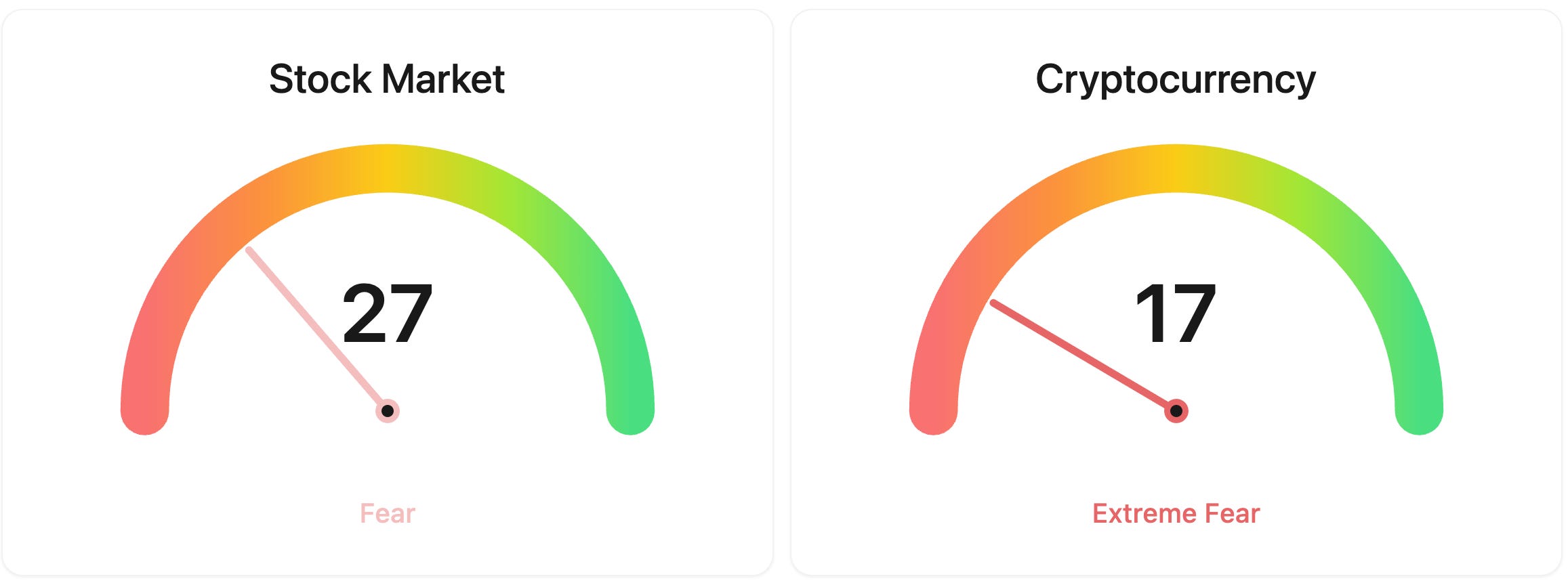
⚖️ Fear & Greed
📉 The Number That Matters
9.99%
South Korea's Kospi plunged 9.99% and tripped a circuit breaker, the automatic halt that cools panic selling, as memory giants Samsung and SK Hynix each fell more than 12%.
⚔️ Winners vs Losers
Winners
WEN 0.00%↑: Wendy’s Company shares surged after the Financial Times reported that activist investor Nelson Peltz’s Trian Fund Management is seeking financing to take the chain private, news that landed alongside the appointment of former Potbelly executive Steve Cirulis as chief financial officer.
ABSI 0.00%↑: Absci Corporation jumped after releasing interim Phase 1 data this morning from the HEADLINE trial of ABS-201, its AI-designed antibody for hair loss.
BNC 0.00%↑: CEA Industries, the BNB-focused digital asset treasury company, rose after reaching a cooperation agreement with YZi Labs that ends a proxy fight, reshapes its board, and kicks off a CEO search, reported alongside full-year results.
FCEL 0.00%↑: FuelCell Energy climbed after signing a strategic agreement with Fit Energy for up to 380 megawatts of clean power for data centers, including a deposit for an initial 30 megawatts set to begin delivery this year.
Losers
CBRS 0.00%↑: Cerebras Systems fell after its first earnings report as a public company beat on revenue but guided to sharply lower gross margins of 36 to 38 percent for the current quarter, rattling investors on the path to profitability.
SYRE 0.00%↑: Spyre Therapeutics dropped after Fairmount Healthcare Fund sold roughly 4.7 million shares at 85.31 dollars, a large block that pressured the stock following a gain of more than 500 percent over the past year.
FDX 0.00%↑: FedEx slipped despite a fourth quarter adjusted earnings beat, as cautious full year guidance of 16.90 to 18.10 dollars and a stock already near 52 week highs after a 40 percent rally this year prompted profit taking.
NEM 0.00%↑: Newmont eased lower alongside a pullback in gold prices, extending a multi week slide from its mid June highs above 110 dollars as higher Treasury yields and a firmer dollar weighed on bullion.
📊 Market Snapshot
Cryptocurrencies:
Bitcoin (BTC): $62,395 (▼ 0.42%)
Ethereum (ETH): $1,659 (▼ 0.36%)
XRP: $1.08 (▼ 2.17%)
Equity Indices (Futures):
S&P 500: 7,446 (▲ 0.11%)
NASDAQ 100: 29,750 (▲ 0.28%)
FTSE 100: 10,432 (▲ 0.08%)
Commodities & Bonds:
10-Year US Treasury Yield: 4.48% (▼ 0.40%)
Oil (WTI): $71 (▼ 2.12%)
Gold: $4,047 (▼ 1.60%)
Silver: $59.90 (▼ 2.70%)
Data as of: UK: 12:30 BST / US: 07:30 EDT / Asia (Tokyo): 20:30 JST
✅ 5 Things to Know
📉 Chip Rout Halts Korea Trading, Tests the AI Trade
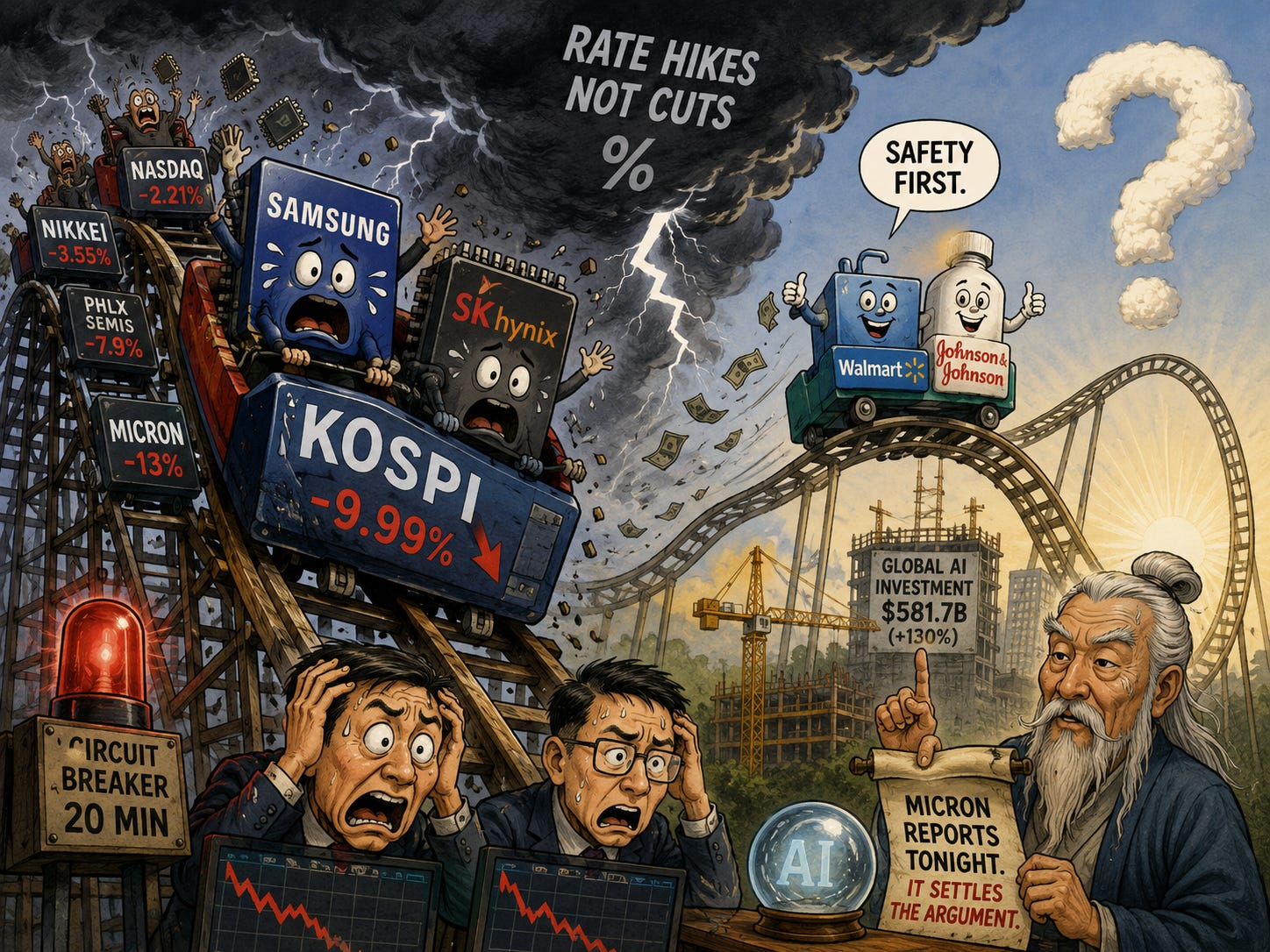
A global selloff in artificial-intelligence and chip stocks buckled the AI trade yesterday, hitting hardest where it had climbed highest. South Korea’s Kospi plunged 9.99% and tripped a 20-minute circuit breaker, the automatic halt exchanges use to cool panic selling, as Samsung Electronics and SK Hynix, the two memory-chip giants that make up about half the index, each fell more than 12%. The damage spread west. Japan’s Nikkei dropped 3.55%, and in the US the Nasdaq closed down 2.21% and the S&P 500 fell 1.44%, their worst day in two weeks. Memory names led the losses, with Micron down about 13% and the Philadelphia Semiconductor Index off 7.9%. (CNN)
This matters because a handful of AI and chip names have carried the entire 2026 rally, so when they fall together, index funds and AI-focused funds drop with them even while most stocks hold up. The trigger was a shift in rate expectations: traders now see the Federal Reserve possibly raising interest rates rather than cutting, which hits richly valued growth stocks hardest. Money rotated into safety yesterday, with Walmart and Johnson & Johnson each up about 2%, the kind of move that signals caution rather than a rush for the exits. The next real test lands tonight, when Micron reports earnings after the close, the clearest read on whether memory demand is cracking or just being repriced. (CNBC)
Early signs point to a wobble, not a crash. Korea’s Kospi bounced about 3% this morning and Samsung jumped 7%, echoing the dips that have snapped back all year, and the Nasdaq sits only about 5.5% below the record high it set early this month. Underneath it all is one question investors keep circling: whether the AI building boom pays off. Global corporate AI investment hit $581.7 billion last year, up 130%, and the market is starting to ask when the returns show up.
Sensei’s Insight: Micron reports after the close today, and it settles the argument. The memory makers at the center of this rout are the ones with real AI revenue, so if Micron’s guidance holds up, yesterday reads as another dip. If it disappoints, the selloff has room to run.
🚀 Short Sellers Take Their First Real Shot at SpaceX
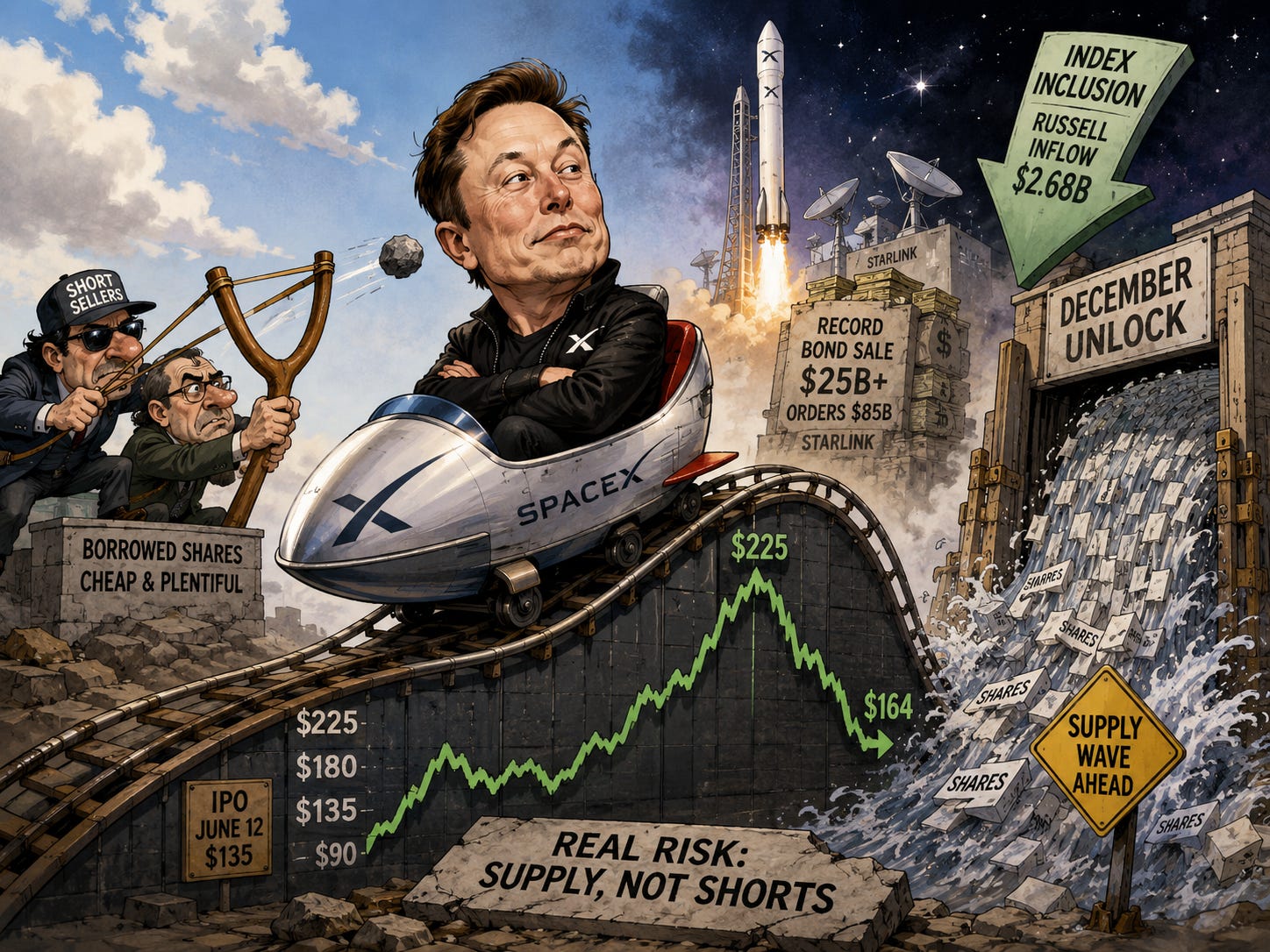
For the first time, investors can bet against Elon Musk’s SpaceX, and some are doing it. About 40 million shares, roughly 5% to 7% of the stock available to trade, have been sold short, according to S3 Partners, meaning traders borrowed shares and sold them hoping to buy back lower. That is modest by market standards, with around 60 companies in the S&P 500 carrying heavier short positions. SpaceX went public only on June 12 in a record $75 billion initial public offering at $135 a share, and the stock has whipsawed since, climbing as high as $225 before sliding back toward $164. The pullback is the clearest sign yet that part of the market thinks the post-listing euphoria went too far. (CNBC)
The reason this matters is that SpaceX has become a live test of the whole 2026 mega-listing and AI boom. Its tradable float is tiny, less than 5% of shares outstanding, which makes the stock swing far more than its size suggests. Two forces now pull against each other. SpaceX just sold a record corporate bond that grew to at least $25 billion on roughly $85 billion of orders, funding its cash-hungry Starlink and AI plans with debt rather than fresh stock. At the same time, index inclusion looms, and Jefferies estimates that joining the Russell index alone could pull in about $2.68 billion from passive funds that have to own it. (Reuters)
Sensei’s Insight: The short sellers aren’t the real risk here. Borrowing SpaceX shares is cheap and plentiful, so this is ordinary price discovery, not a squeeze setup. The bigger force is supply: a December unlock could free most of the company’s shares, and that wave is what to watch, not the bears.
⚛️ Quantum Stocks Rise Against the Tide on a US Push

While the rest of tech was selling off, quantum computing stocks went the other way after Washington threw its weight behind the technology. A White House executive order signed this week sets a national effort to build at least one research-grade quantum computer for a Department of Energy lab, gives the agency 90 days to define the specifications, and directs the Pentagon to field quantum sensing projects by 2028. It follows a May move in which the government took $2 billion in equity stakes across nine quantum firms. The names rallied yesterday even as the Nasdaq fell: Infleqtion rose 11%, Quantinuum 13%, IBM 4.6% and D-Wave 2.2%. (Reuters)
This matters because quantum has shifted from a science story to an investable one, now with public stocks, a fresh listing benchmark and direct federal funding behind it. Quantum computers use qubits, which can represent far more states than the simple ones and zeros of ordinary computers, and in theory crack problems in chemistry, materials and code-breaking that classical machines cannot. The payoff is still years out, and the field runs on extreme volatility, with single-day swings of 6% to 25% routine. The catalysts to watch from here are Honeywell-backed Quantinuum, which raised $1.68 billion in its June debut, and IBM’s stated target of a fault-tolerant machine by 2029. (Reuters)
Sensei’s Insight: What changed is that policy now moves these stocks, not products, and the products are still years from paying off. Government money lowers the odds the sector fails, but not the timeline risk. The quieter angle sits in cybersecurity, where federal systems have to shift to quantum-proof encryption by around 2030.
📦 FedEx Beats the Numbers, Falls on the Forecast

FedEx beat Wall Street on both sales and profit yesterday and still dropped about 6% after hours, a reminder that guidance, not the quarter, moves a stock. The shipping giant reported adjusted earnings of $6.31 a share on revenue of $25 billion, up 12.5% from a year ago, topping estimates of about $5.92 and $24 billion. The beat leaned on international priority shipping, where package yields rose 16%, and the full year brought in $94.7 billion in revenue and $1.6 billion in quarterly net income. But shares closed down 3.6% in regular trading and slid toward $298 after the report as investors fixed on a cautious outlook for the rest of the year. (CNBC)
This matters because FedEx is read as a gauge of the wider economy and online shopping, so a careful forecast feeds caution about trade and consumer demand. It was also the company’s first report since it spun off its Freight trucking division on June 1, leaving behind stranded costs and a one-time charge from retiring 10 aircraft. For the new June-through-December stretch, FedEx guided to adjusted earnings of $16.90 to $18.10 a share and revenue growth near 11%, a setup the market found light against current trends. The next read comes tomorrow, when FedEx Freight reports separately as a standalone company.
Sensei’s Insight: What matters isn’t the beat, it’s the spending cut. FedEx took capital spending to the lowest share of revenue in its history, the move companies make when they expect softer volumes. As a shipping bellwether, that caution tends to show up next across transports like UPS.
📡 Qualcomm’s AI Bet Faces Its Big Test Today
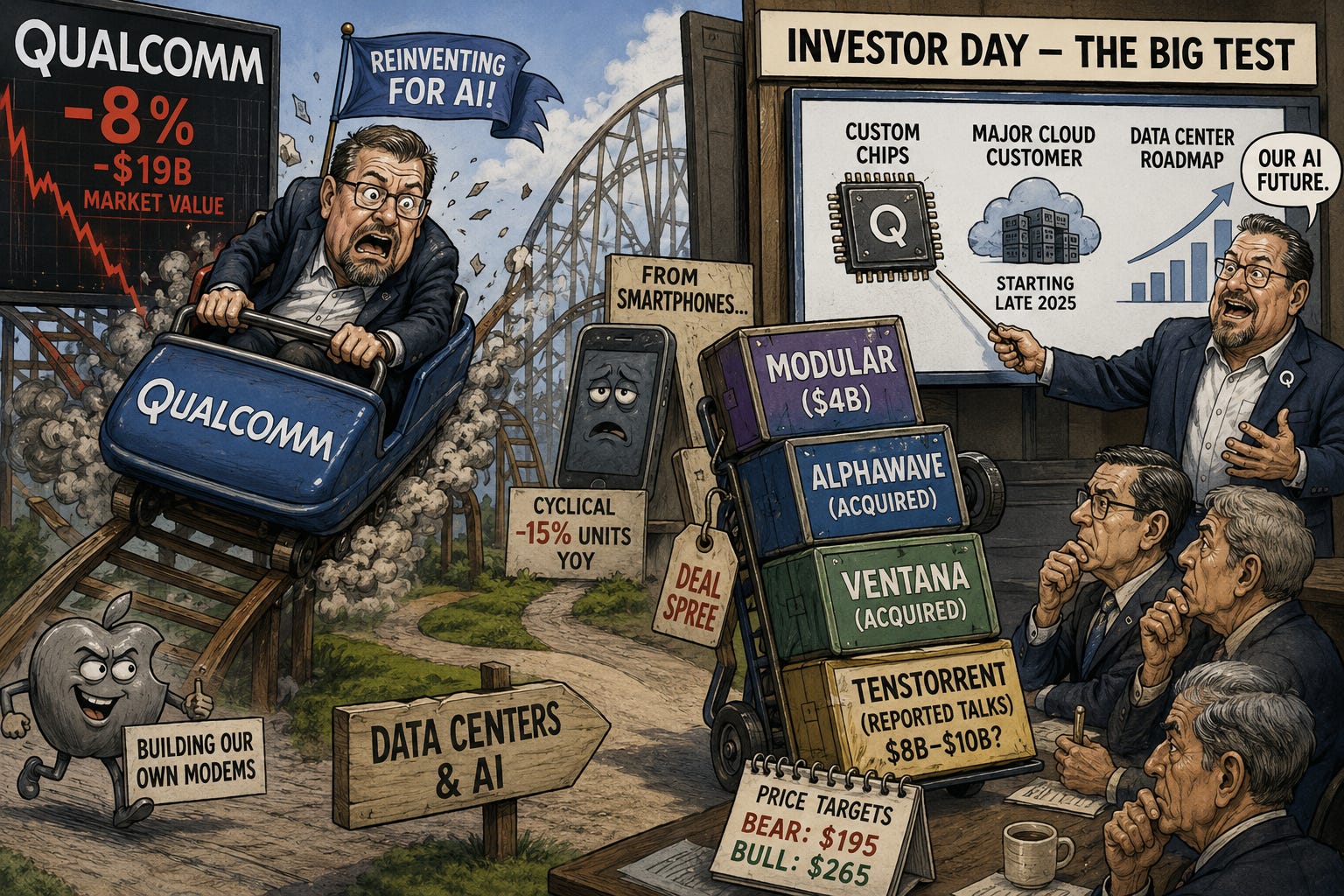
Qualcomm is trying to reinvent itself as an artificial-intelligence player, and yesterday the market made it pay. Shares fell about 8%, erasing roughly $19 billion in value, after reports it is in advanced talks to buy AI software startup Modular for around $4 billion. The drop came one day before Qualcomm’s Investor Day, held today, where chief executive Cristiano Amon is expected to lay out the plan to move beyond smartphone chips into AI data centers, including custom chips for a major cloud customer starting late this year. The Modular talks follow purchases of connectivity firm Alphawave and chip startup Ventana, and reported interest in Tenstorrent at $8 billion to $10 billion. (Bloomberg)
This matters because Qualcomm is being repriced as an AI hopeful before it has shipped much AI hardware, and investors are split on whether the spending pays. Its core phone-chip business is cyclical, with units reportedly down about 15% from a year ago, and it still leans on Apple, which is building its own modems. Today’s Investor Day is the catalyst: management needs to show the data-center roadmap is real and that the deal spree won’t crimp cash returns to shareholders. Analysts are divided, with price targets running from $195 at the bearish end to $265 at the bullish end. (Yahoo Finance)
Sensei’s Insight: Qualcomm is buying its way into AI fast, with Modular, Alphawave and reported interest in Tenstorrent all inside a few months. Today’s Investor Day is where it has to prove those deals add up to a real data-center business, not just a run of expensive purchases. Watch for a Modular confirmation.
Stories You Might Have Missed
💹 Goldman Heads for a Third Straight Record Trading Quarter
Goldman Sachs is on track to pull in more than $5 billion from stock trading in the second quarter, which would mark a third consecutive record for its equities desk, people familiar with the matter told Bloomberg. That would top the $5.33 billion it booked in the first quarter and beat the $4.77 billion analysts expected. The driver is the same volatility rattling stock pickers: hedge funds repositioning around AI and geopolitics, plus heavy demand for the financing Goldman lends them. It reads as a positive sign for rival trading houses Morgan Stanley, JPMorgan and Bank of America ahead of bank earnings in mid-July, though strong trading alone doesn’t always lift the share price. (Bloomberg)
🏛️ Banks Face the Fed’s Stress Test, With a Twist
The Federal Reserve releases its annual bank stress test results today for 32 large lenders, run against a scenario of severe global recession, a property crash and corporate-debt strain. Normally the outcome sets each bank’s capital cushion, which dictates how much it can spend on dividends and share buybacks. This year is different. The Fed says it will not change those cushions while it overhauls the system under Vice Chair Michelle Bowman. So the results still work as a health check on giants like JPMorgan, Goldman Sachs and Bank of America, but they won’t directly move capital requirements this year, making the signal more informational than usual. (Reuters)
🎬 AMC Tumbles on a Surprise Stock Sale
AMC Entertainment dropped about 20% yesterday after agreeing to sell roughly 95 million new shares at $2.10 each, a steep 24% discount to its prior close, to raise $200 million. Selling fresh stock dilutes existing shareholders, which is why the price fell so hard, and it is a familiar move for the meme-stock favorite, which has repeatedly raised cash by issuing shares since its 2021 retail-trading frenzy. This was its second equity raise in under two weeks, coming days after a $150 million sale. Most of the proceeds will redeem about $125.5 million of notes due in 2027, easing a heavy debt load. The offering is set to close today. (Yahoo Finance)
🏗️ Copper Slides as Rate-Hike Bets Bite
Copper fell below $6.30 a pound yesterday, its lowest since May, dragging mining shares down with it. In London, industrial-metal miners dropped around 4%, with Antofagasta off 5.5%, as a stronger dollar and bets on a possible Fed rate hike pressured the metal. The pullback is macro-driven rather than a break in copper’s long-term story, which still points to a supply shortfall against electrification, grid upgrades and AI data-center demand, and the metal remains up about 28% over the past year. A sign of that confidence: Vedanta-backed CopperTech Metals launched a US listing roadshow yesterday targeting a valuation of up to $3.57 billion. (Reuters)
🔗 Connect with Us
Stay plugged in across platforms:
Sensei on X: sensei_live_
Martyn Lucas on X: MartynInvestor
Vaz on X: eVTOLHUB
📺 YouTube Channel (Live & Replays): Martyn Lucas Investor