This content is for informational and educational purposes only and does not constitute financial advice. Always do your own research. Not financial advice (NFA).
👀 Today’s Stories at a Glance
📢 Trump SOTU Focuses on Economy: The President pitched new savings accounts and housing bans despite slowing GDP growth and high disapproval.
🛢️ Iran Nuclear Talks Hit Deadline: Two U.S. carrier groups converge as officials warn Iran is one week from bomb-making material.
🎬 WBD Bidding War Intensifies: Paramount raised its hostile bid to $77 billion, challenging Netflix for control of HBO assets.
🚢 Record Chinese Trade Fraud Uncovered: A $112 billion reporting gap suggests massive tariff evasion through phantom importers and trans-shipment hubs.
🚁 Joby Aviation Reports Results Tonight: Earnings will test investor confidence in air taxi timelines as certification remains the primary hurdle.
🧠 One Big Thing
The Iran Oil Premium
A massive U.S. naval buildup in the Middle East has created a volatile binary for energy markets ahead of Thursday’s nuclear negotiations. While a production surplus should keep oil prices near $60, current rates carry a $10 geopolitical risk premium. Investors face two starkly different paths. A diplomatic breakthrough could trigger an overnight collapse in crude prices, while a failure in Geneva threatens to push costs above $100. This tension is already driving a wedge between surging defense stocks and airlines burdened by fuel fears. Thursday’s session is the defining pivot for near-term market direction.
⚖️ Fear & Greed
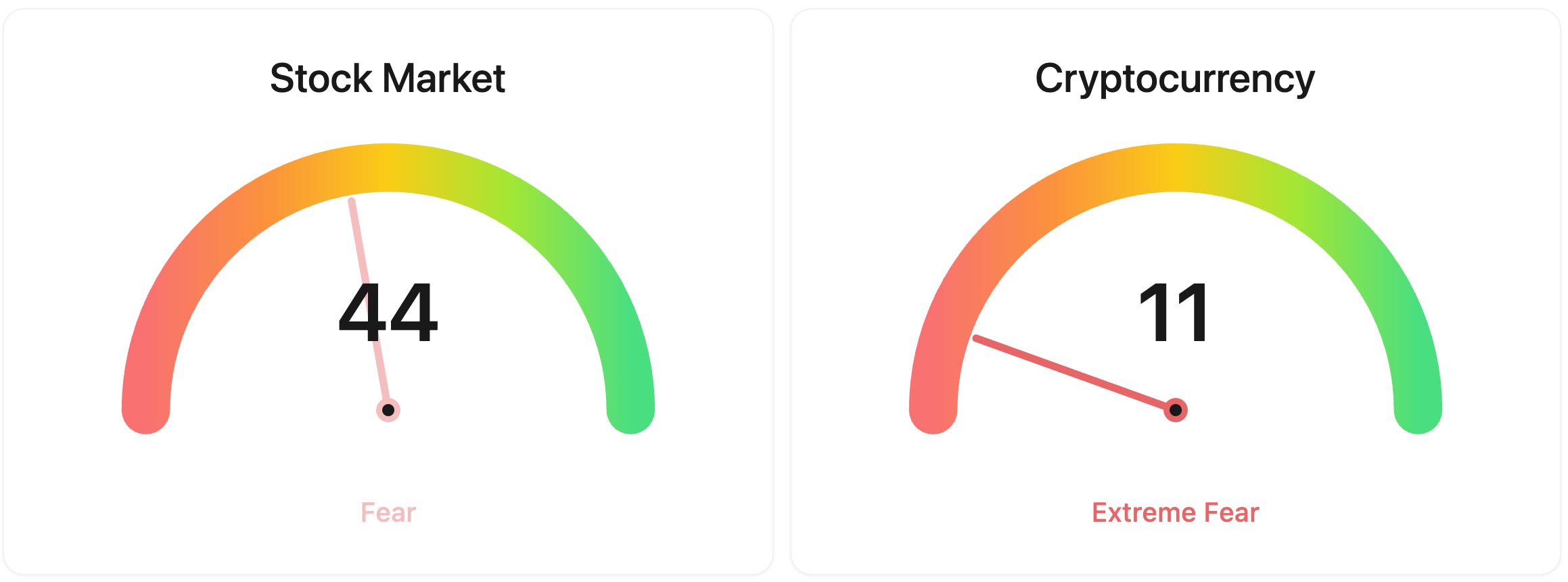
📉 The Number That Matters
36%
Trump’s overall approval rating has hit a low of 36% as GDP growth slowed to 2.2% in 2025. Despite SOTU claims of economic victory, 57% of voters specifically disapprove of his handling of the economy.
📊 Market Snapshot
Cryptocurrencies:
Bitcoin (BTC): $67,457 (▲ 5.34%)
Ethereum (ETH): $2,021 (▲ 9.19%)
XRP: $1.44 (▲ 6.88%)
Equity Indices (Futures):
S&P 500: $6,921 (▲ 0.51%)
NASDAQ 100: $25,302 (▲ 1.09%)
FTSE 100: £10,771 (▲ 0.60%)
Commodities & Bonds:
10-Year US Treasury Yield: 4.05% (▲ 0.27%)
Oil (WTI): $65 (▼ -1.10%)
Gold: $5,196 (▲ 1.04%)
Silver: $90.30 (▲ 3.69%)
Data as of UK (GMT): 3:50 PM / US (EST): 10:50 AM / Asia (Tokyo): 12:50 AM
✅ 5 Things to Know Today
📢 Trump’s Marathon SOTU Pitched Economic Victory, but the Numbers Fight Back
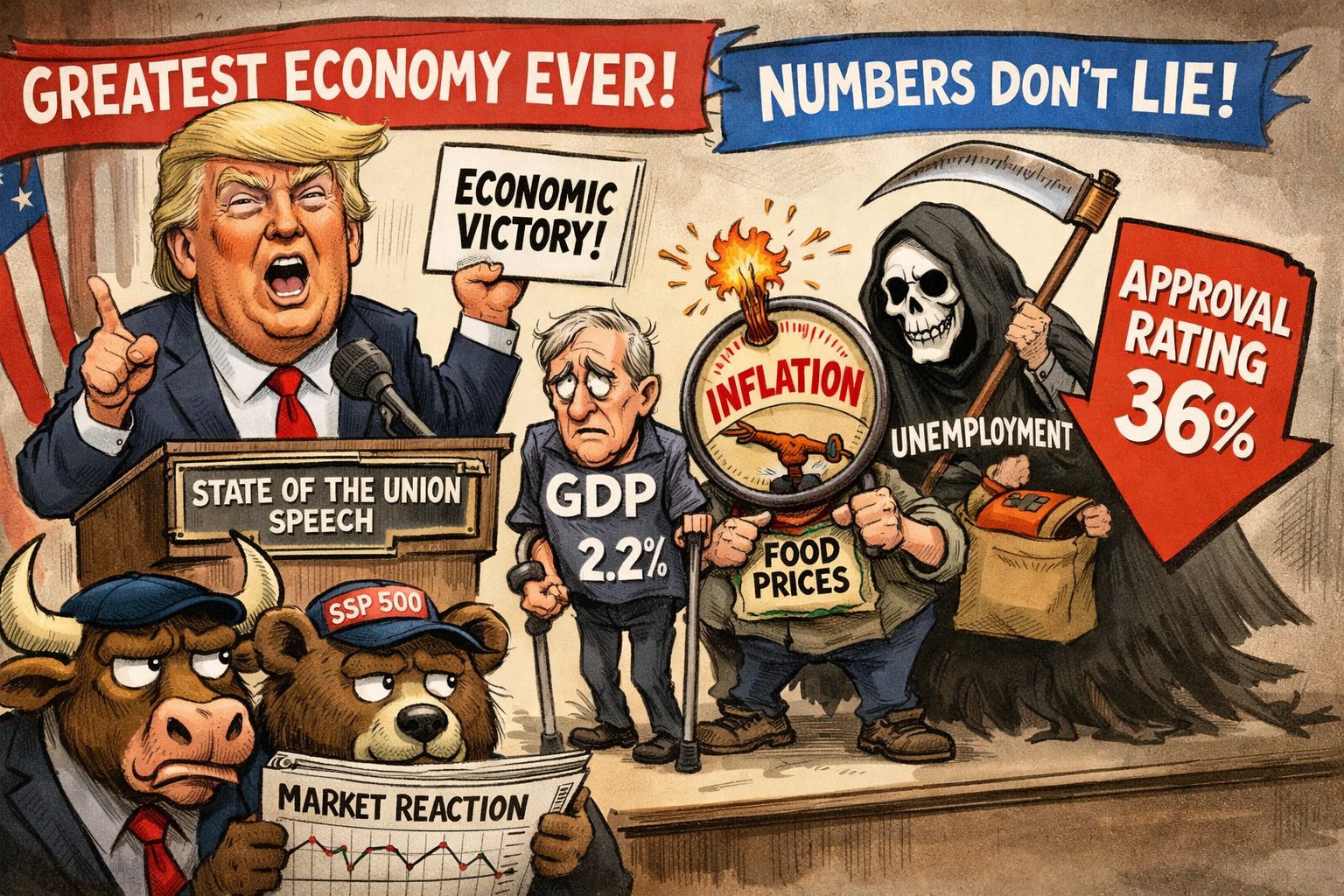
Trump delivered the longest State of the Union address in modern history on Tuesday night, clocking in at one hour and 48 minutes. He declared the nation “bigger, better, richer and stronger than ever before,” claimed inflation was plummeting, and unveiled three financial proposals: a government-backed retirement plan modelled on the federal Thrift Savings Plan, tax-advantaged children’s savings accounts seeded with $1,000 from the Treasury, and a ban on large institutional investors buying single-family homes. Markets were unmoved. S&P 500 futures edged up just 0.3% on Wednesday morning, suggesting traders heard little they hadn’t already priced in.
The headline economic figures Trump cited were selectively accurate. January Consumer Price Index inflation did come in at 2.4% year-over-year, the lowest since April 2021, and the Dow has crossed 50,000. But the fuller picture is less comfortable. Gross domestic product growth slowed to 2.2% for 2025, below every year of the Biden presidency, and fourth-quarter annualised growth was a thin 1.4%. Unemployment has crept up to 4.3% from 4.0% a year ago, and food prices remain 2.9% higher year-over-year. Polling reflects the disconnect: a CNN/SSRS survey put his overall approval at just 36%, while an ABC/Washington Post/Ipsos poll found 57% disapprove of his economic handling specifically. Republican pollster Frank Luntz warned that mocking Democrats’ use of the word “affordability” was a misstep, writing that it is “the word Americans use” and cautioning Trump has “until Labor Day of 2026 to turn things around” ahead of midterms.
Sensei’s Insight: With approval at 36% and GDP growth at its weakest since before the pandemic, the gap between the rhetoric and the reality is widening. The SCOTUS tariff ruling days earlier may matter more than anything said on Tuesday night. Watch whether cooling economic momentum forces a policy pivot before midterms.
🛢️ Two Carrier Groups, One Deadline: Iran Talks Hit the Wire
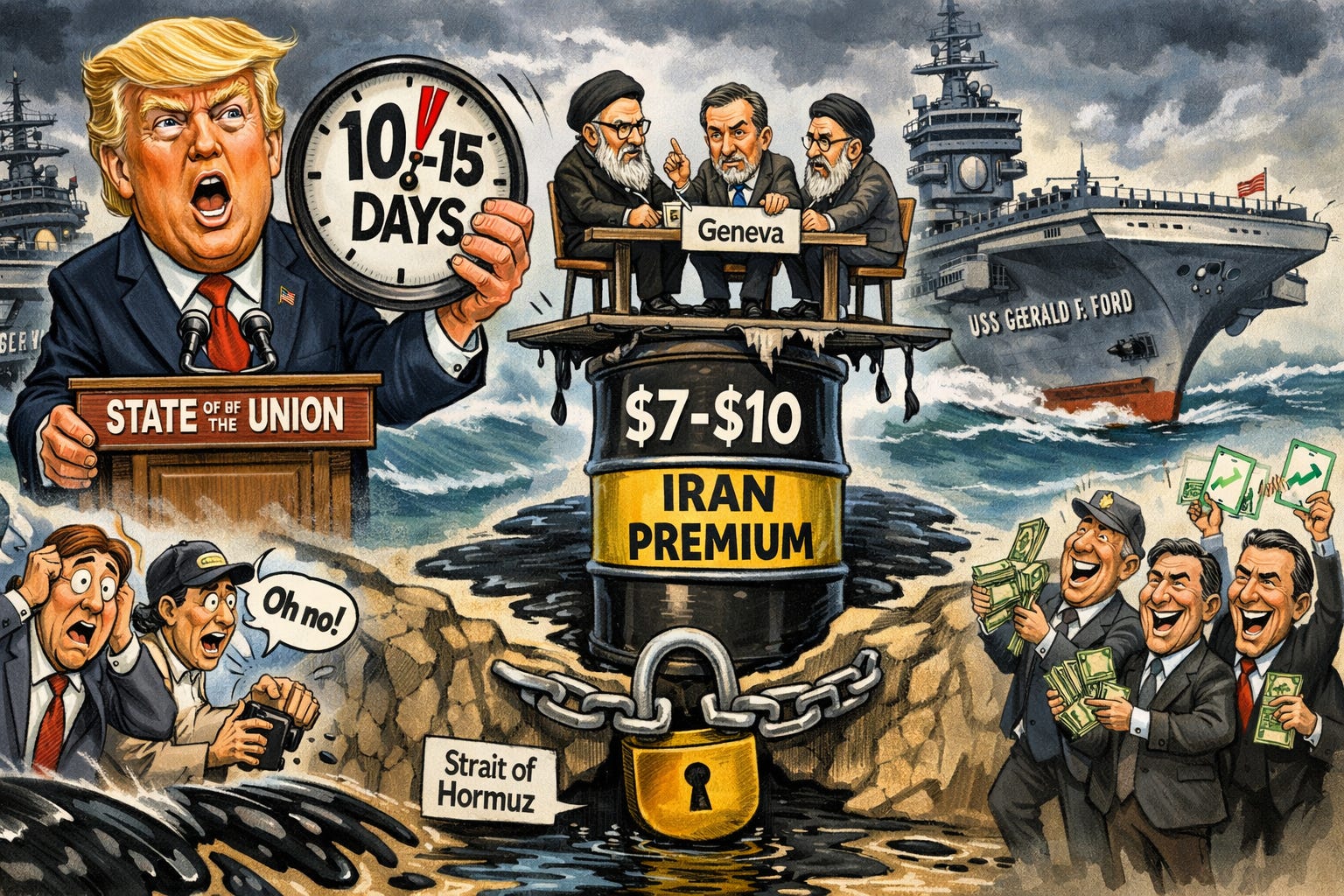
Trump used his State of the Union to escalate pressure on Iran, declaring the country is “again pursuing sinister ambitions” to rebuild the nuclear weapons program that American airstrikes devastated last June. The warning comes as the largest U.S. military buildup in the Middle East since the 2003 Iraq invasion takes shape: two aircraft carrier strike groups, the USS Abraham Lincoln and the $13 billion USS Gerald R. Ford, are converging on the Arabian Sea, with roughly 50,000 troops, 150-plus aircraft, and 12 F-22 Raptors now deployed across the region. A third round of negotiations begins Thursday in Geneva, where U.S. envoy Steve Witkoff and Jared Kushner will face Iranian Foreign Minister Abbas Araghchi. Witkoff warned on Saturday that Iran is “probably a week away from having industrial-grade bomb-making material”.
The stakes for investors are concentrated in oil. Goldman Sachs and Barclays estimate a $7 to $10 per barrel “Iran premium” is already baked into crude prices, with Brent sitting at a six-month high near $71.20. Without geopolitical tension, West Texas Intermediate would likely trade in the high $50s given a projected 3.7 million barrel-per-day surplus. A disruption to the Strait of Hormuz, which Iran briefly closed during naval drills on February 16, could push oil above $100 according to Lombard Odier. Defence stocks have rallied, with RTX up roughly 10.4% over the past month, while airlines have dropped 5 to 6% in February on fuel cost fears. Trump issued a 10 to 15 day deadline on February 19, making the Geneva talks on Thursday and early March, when the USS Ford arrives in theatre, the dates to watch. A deal could rapidly deflate the oil premium overnight. No deal sets a very different chain of events in motion.
Sensei’s Insight: Most analysts tracking these talks are pessimistic, and the military buildup suggests Washington is preparing for both outcomes. Oil is the clearest expression of that risk: a deal could strip $7 to $10 off crude almost overnight, while failure could send it well past $80. Thursday’s Geneva session may be the deciding moment.
🎬 Warner Bros Discovery’s $77 Billion Bidding War Heats Up
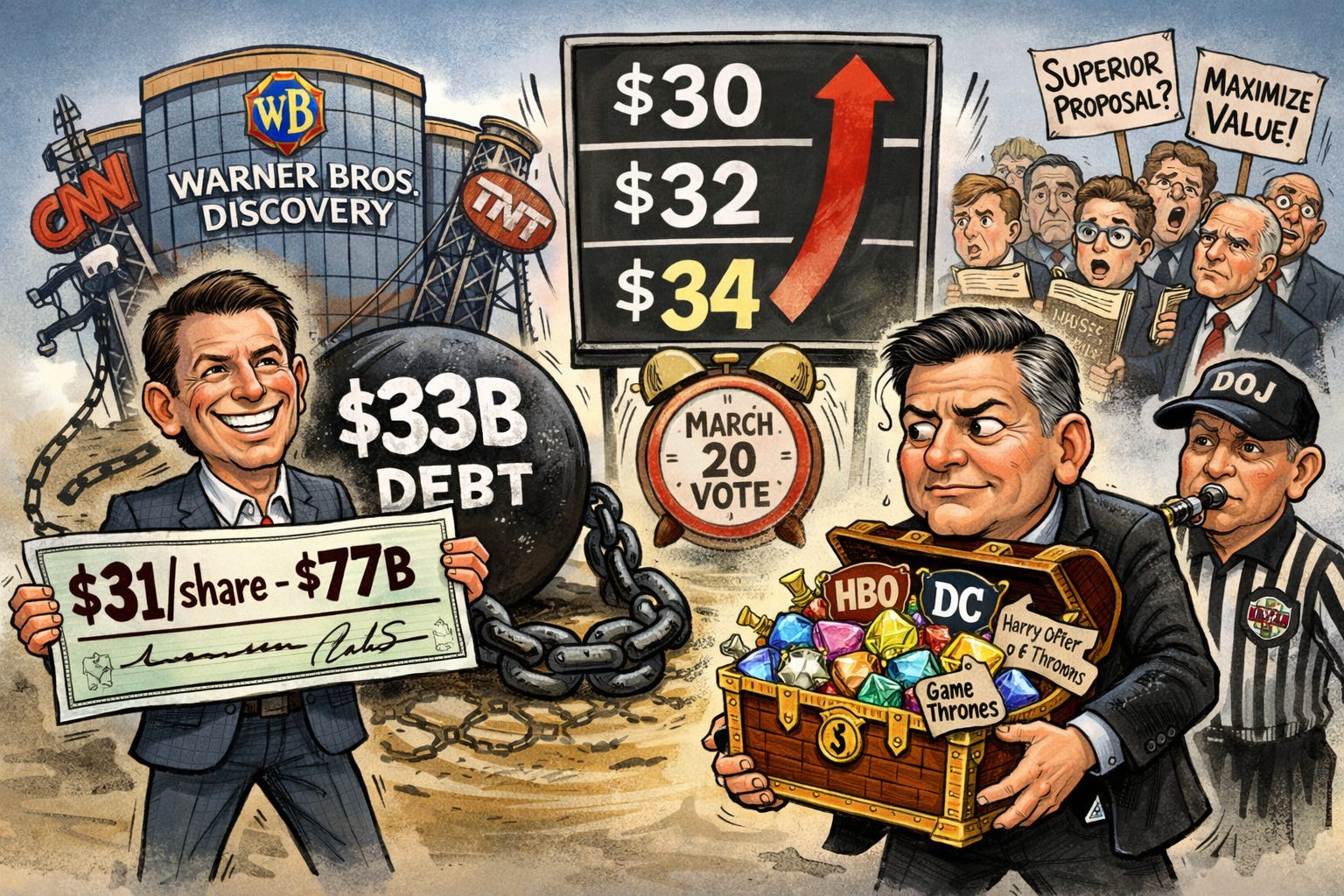
Paramount Skydance raised its hostile bid for Warner Bros Discovery to $31 per share on Monday, up from $30, putting pressure on WBD’s existing $27.75 per share deal with Netflix for the company’s prized studio and HBO assets. At the new price, Paramount is valuing all of WBD at roughly $77 billion in equity, or $111 billion including $33 billion in debt, a staggering 312% premium to WBD’s April 2025 low of $7.52. The WBD board acknowledged the revised offer “could reasonably be expected to lead to a superior proposal” but has not made that formal determination yet. If it does, Netflix would have a four-business-day window to match. The two bids reflect fundamentally different strategies: Netflix wants only the crown jewels, namely the Warner Bros. studio, DC Comics, HBO, and a content library spanning Harry Potter, Game of Thrones, and Friends, while Paramount Skydance, led by David Ellison, wants the whole company, including the declining linear TV networks like CNN and TNT Sports.
Shareholders are increasingly vocal in favour of the Paramount bid. Pentwater Capital, WBD’s seventh-largest shareholder, has accused the board of breaching its fiduciary duty and is in discussions with Paramount about running for a board seat. Activist fund Ancora Holdings released a detailed presentation opposing the Netflix deal, warning that once Discovery Global’s roughly $17 billion debt burden is factored in, total shareholder value under that structure could land as low as $21.23 per share. Legendary investor Mario Gabelli said he is “highly likely” to tender to Paramount. MoffettNathanson analyst Robert Fishman expects Paramount to push to at least $32 and suggested $34 would end the contest outright, though he cautioned that if Netflix raises above $30, the deal math becomes difficult to justify. Netflix co-CEO Ted Sarandos signalled discipline, telling Variety that Netflix has a “rich history” of walking away when the price gets too high. Key dates ahead: Paramount reports earnings today, WBD reports tomorrow, Paramount’s tender offer expires March 2, and WBD shareholders vote on the Netflix deal March 20.
Sensei’s Insight: The quieter story may be Netflix itself. Shares are down roughly 40% from 2025 highs, weighed down by acquisition uncertainty, yet analyst consensus still implies around 44% upside. Whether Netflix wins WBD, walks away, or gets blocked by the DOJ, resolving this overhang one way or another could be the catalyst. Watch the March 20 shareholder vote.
🚢 A Record $112 Billion in Chinese Goods Vanished Between Ports
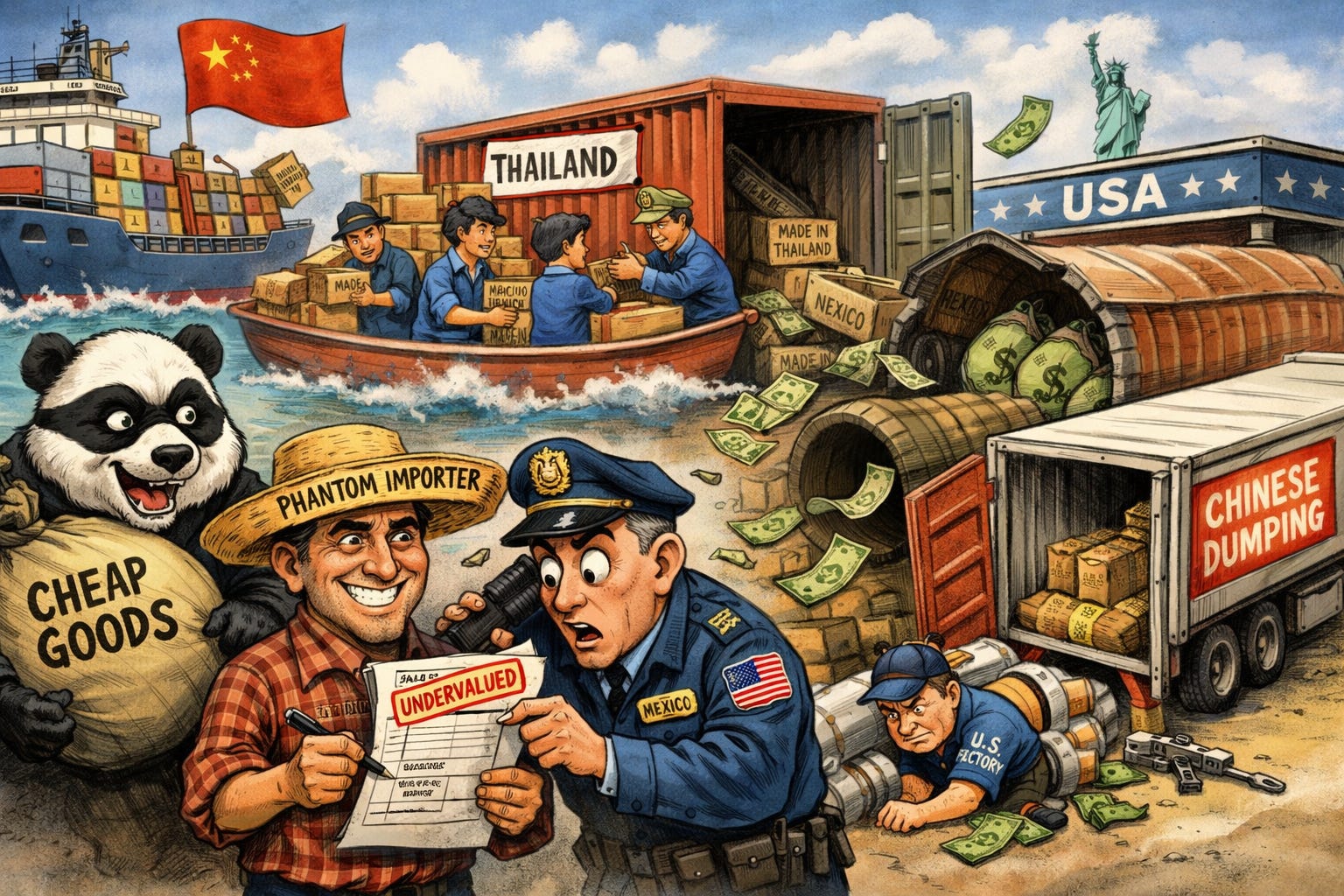
A record $112 billion gap now exists between what China reported exporting to the United States in 2025 and what U.S. Customs recorded as arriving, suggesting roughly a quarter of Chinese shipments are slipping through via fraud. The discrepancy has undergone a dramatic reversal: before Trump’s first-term tariffs in 2018, the U.S. actually reported more imports from China than China claimed to be shipping. By 2024, the gap had flipped to $66 billion in the opposite direction. Last year, it nearly doubled. The New York Federal Reserve said the gap is “much too large and persistent to be explained by normal variation or technical factors.” Goldman Sachs estimated that tariff evasion on Chinese imports ran between $110 and $130 billion in 2023 alone, with roughly $15 billion in lost customs revenue.
The methods are well-documented. Shell entities known as “phantom importers” file customs paperwork, underpay duties, and dissolve before enforcement catches up. Chinese sellers using Delivered Duty Paid arrangements handle all shipping and customs themselves, offering prices that only work by undervaluing goods on declarations. And trans-shipment through countries like Vietnam, Mexico, and Thailand disguises Chinese products as originating elsewhere. Brookings researcher Robin Brooks found that Chinese exports to Thailand and Vietnam surged in early 2025, fully offsetting the decline in direct shipments to the U.S. The effect on domestic manufacturers is severe: American Lawn Mower Company pays tariffs of up to 45%, while competitors who cheat undercut on price. Charlotte Pipe and Foundry documented Chinese rivals underselling pipe products by up to 345% below fair value. U.S. factories shed 108,000 manufacturing jobs in 2025. The Department of Justice and Department of Homeland Security launched a Trade Fraud Task Force in August 2025, and the largest customs-related False Claims Act recovery in history came in December at $54.4 million, but with 1,200 open investigations and an average tariff rate on Chinese goods that peaked at 57.6%, the financial incentive to evade still dwarfs enforcement capacity.
Sensei’s Insight: The trade deficit with Vietnam hit a record $178.2 billion last year, and Mexico reached $196.9 billion, while ASEAN’s share of U.S. imports has doubled since 2018. The goods are still arriving, just through different doors. Cast iron, tungsten carbide, textiles, furniture, and consumer electronics are the sectors most exposed to this dynamic. Watch whether the new Trade Fraud Task Force shifts the enforcement math.
🚁 Joby Aviation Reports Tonight With the Air Taxi Dream on the Line
Joby Aviation reports fourth-quarter and full-year 2025 earnings after today’s close, and this is more than a routine results call. With certification, early operations, production scaling, and revenue visibility all converging, tonight could define investor sentiment for the entire electric air taxi sector. Joby enters with roughly $2.5 billion in cash, a stock down 26% year-to-date, and the most advanced regulatory timeline of any electric vertical takeoff and landing company globally. Analysts expect quarterly revenue of about $16.9 million, almost entirely from its Blade helicopter charter business, and a loss of around $0.20 to $0.22 per share. The options market is pricing a roughly 12% move in either direction.
Certification remains the single most important variable. Joby sits at stage four of five in the FAA’s Type Certification process, the core regulatory gate before commercial passenger flights. The company has been publishing its own internal progress tracker showing consistent quarter-on-quarter advancement, and it completed more than 850 flights in 2025 while producing 15 times more FAA-conforming parts than the year before. But independent analysts increasingly believe the timeline has slipped to mid-2027 or beyond. Whether management commits to a specific target window tonight or keeps guidance open-ended will set the tone.
Operations are starting to take shape. Joby has applied for three sites under the FAA’s eVTOL Integration Pilot Program (eIPP), a framework enabling limited early flights ahead of full certification: an Ohio medical corridor, New York City for airport transfers, and Dallas-Fort Worth for regional commuting. The FAA must select at least five pilot sites by March 3. Internationally, Dubai remains the most advanced deployment, with a vertiport at DXB expected this quarter and initial nodes at Palm Jumeirah, Downtown Dubai, and Dubai Marina. Clarity on remaining dependencies around aircraft availability and local approvals matters.
Production readiness is where ambition meets industrial reality. Joby continues expanding its manufacturing footprint, including Ohio rotor and blade facilities, with reports of increased shifts suggesting preparations for higher volumes. Toyota has invested approximately $1.14 billion to date, has around 200 staff embedded in Joby’s facilities applying the Toyota Production System, and has closed the first $250 million tranche of a strategic investment with a further $250 million outstanding. The conditions required to unlock that second tranche could serve as a real-time indicator of whether production is becoming predictable and scalable.
Financially, liquidity is not the issue. The January capital raise brought in $600 million in equity plus $690 million in convertible notes, giving Joby roughly four-plus years of runway. Revenue visibility is the gap. Blade’s passenger business generated approximately $248.7 million in revenue in 2024 and brings 12 urban terminals that could transition to eVTOL operations once certified, but the market is growing impatient with prolonged pre-revenue phases. Bears note that Joby’s market capitalisation of roughly $9.5 billion exceeds American Airlines and Southwest despite minimal revenue. Wall Street is sharply divided: Needham has a $22 price target, Deutsche Bank sits at $4, and JPMorgan at $6.
Vaz’s Insight: This is a defining two weeks for eVTOL. Three catalysts will shape sentiment in rapid succession: Joby earnings tonight, Archer Aviation earnings on Monday, and the expected eIPP application outcomes on Tuesday. Together, these will determine whether the flying taxi sector enters a renewed bearish phase driven by delays and uncertainty, or whether fundamentals, certification progress, and early operations provide the foundation for a sustained move higher. This is not about hype. It is about execution.
🔗 Connect with Us
Stay plugged in across platforms:
Sensei on X: sensei_live_
Martyn Lucas on X: MartynInvestor
Vaz on X: eVTOLHUB
📺 YouTube Channel (Live & Replays): Martyn Lucas Investor