

This content is for informational and educational purposes only and does not constitute financial advice. Always do your own research. Not financial advice (NFA).
👀 Today’s Stories at a Glance
🛢️ The war reaches Saudi soil: Houthi drones and missiles hit Aramco sites, and Brent traded as high as $99.
📉 The Dow drops 628 points: oil near $100 and rate-rise fears took 1.18% off it, with the S&P down 0.58%.
🇨🇳 China’s factory prices beat: producer prices rose 3.8% in August against 3.6% expected, which answers yesterday’s question about discounting.
💊 Amgen falls on a rival’s failure: it dropped 10.15%, its worst day since October 2000, after Novartis’s cholesterol drug missed.
📱 Apple goes foldable tonight: the first foldable iPhone is expected at 6pm UK, 1pm ET, with prices estimated near $1,999.
🇬🇧 The Chancellor’s spare cash nearly halves: the bond selloff cut his headroom from £26bn to about £13.8bn before the October Budget.
🥈 Silver rises while gold falls: silver added 1.31% to $66.61 while gold slipped to $4,367.90, and silver is up 150% in a year.
₿ Bitcoin ETFs take the money: they pulled in $986.9m in a week while ether, Solana and XRP funds fell 73% to 96%.
🔍 SpaceX frees 319 million shares: today’s Deep Dive covers the unlock, the 12-day gap before the index buyers arrive, and November.
📈 Oil above $90 is the danger zone: Chart of the Day covers $94, $100 and what happens if we drop back under $92.
🧠 One Big Thing
Brent traded as high as $99 on Tuesday. That is the number running everything else this week. It took 628 points off the Dow. It is why the market prices a Federal Reserve rise on 16 September, and it is why the Chancellor’s spare cash nearly halved before he has chosen a single policy. Oil is an input into almost everything a company makes and everything you buy, so it lands in inflation data with a lag and in share prices immediately. American consumer prices arrive on Friday at 1:30pm UK, 8:30am ET. Oil is what that print is now measuring.
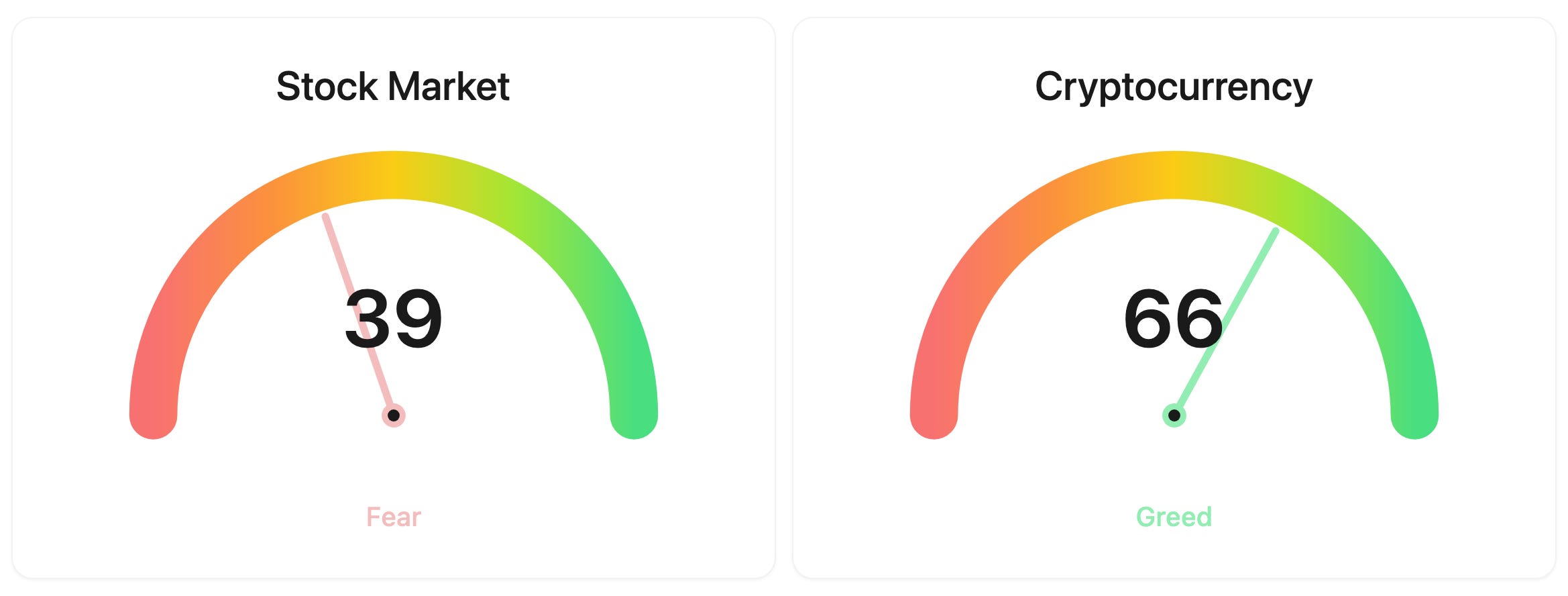
⚖️ Fear & Greed
📉 The Number That Matters
£13.8bn
Oil near $100 has cut the Chancellor’s fiscal headroom to about £13.8bn from £26bn, and that is before he has chosen a single Budget policy.
⚔️ Winners vs Losers
Winners
OCC 0.00%↑ : 15.47% Optical Cable Corporation rose ahead of its third quarter fiscal 2026 results, which the company confirmed will be released today before an 11:00 a.m. Eastern conference call. No separate catalyst had been published at the time of the screener.
INNV 0.00%↑ : 14.07% InnovAge Holding Corp. jumped after reporting fiscal 2026 revenue of $989.7 million, up 15.9%, with adjusted EBITDA nearly tripling to $94.6 million and the net loss narrowing to $0.7 million from $35.3 million. Management guided fiscal 2027 revenue to $1.05 billion to $1.085 billion and adjusted EBITDA to $105 million to $115 million.
Losers
TTAN 0.00%↑ : 17.26% ServiceTitan, Inc. sank after gross transaction volume growth slowed to 17% and third quarter revenue guidance of $285 million to $287 million came in below the $292.8 million just reported. Management flagged softer lead volumes among HVAC customers and a $2 million to $3 million subscription revenue headwind from prioritising its AI-powered Max product.
BRZE 0.00%↑ : 11.51% Braze, Inc. fell after guiding third quarter adjusted EPS to $0.13 to $0.14 against consensus of $0.16, overshadowing a second quarter beat of $0.19 adjusted EPS on revenue of $227.2 million, up 26%.
📊 Market Snapshot
Cryptocurrencies:
Bitcoin (BTC): $79,010 (▲0.72%)
Ethereum (ETH): $2,495 (▲0.42%)
XRP: $1.42 (▲0.37%)
Equity Indices (Futures):
S&P 500: 7,672 (▼0.11%)
NASDAQ 100: 29,488 (▼0.17%)
FTSE 100: 10,755 (▼0.07%)
Commodities & Bonds:
10-Year US Treasury Yield: 4.81% (▲0.38%)
Oil (WTI): $95 (▲0.83%)
Gold: $4,393 (▲0.88%)
Silver: $66.39 (▲1.00%)
Data as of: UK: 10:50 am BST / US: 5:50 am EDT / Asia (Tokyo): 6:50 pm JST
✅ 5 Things to Know
🛢️ The war reaches Saudi soil
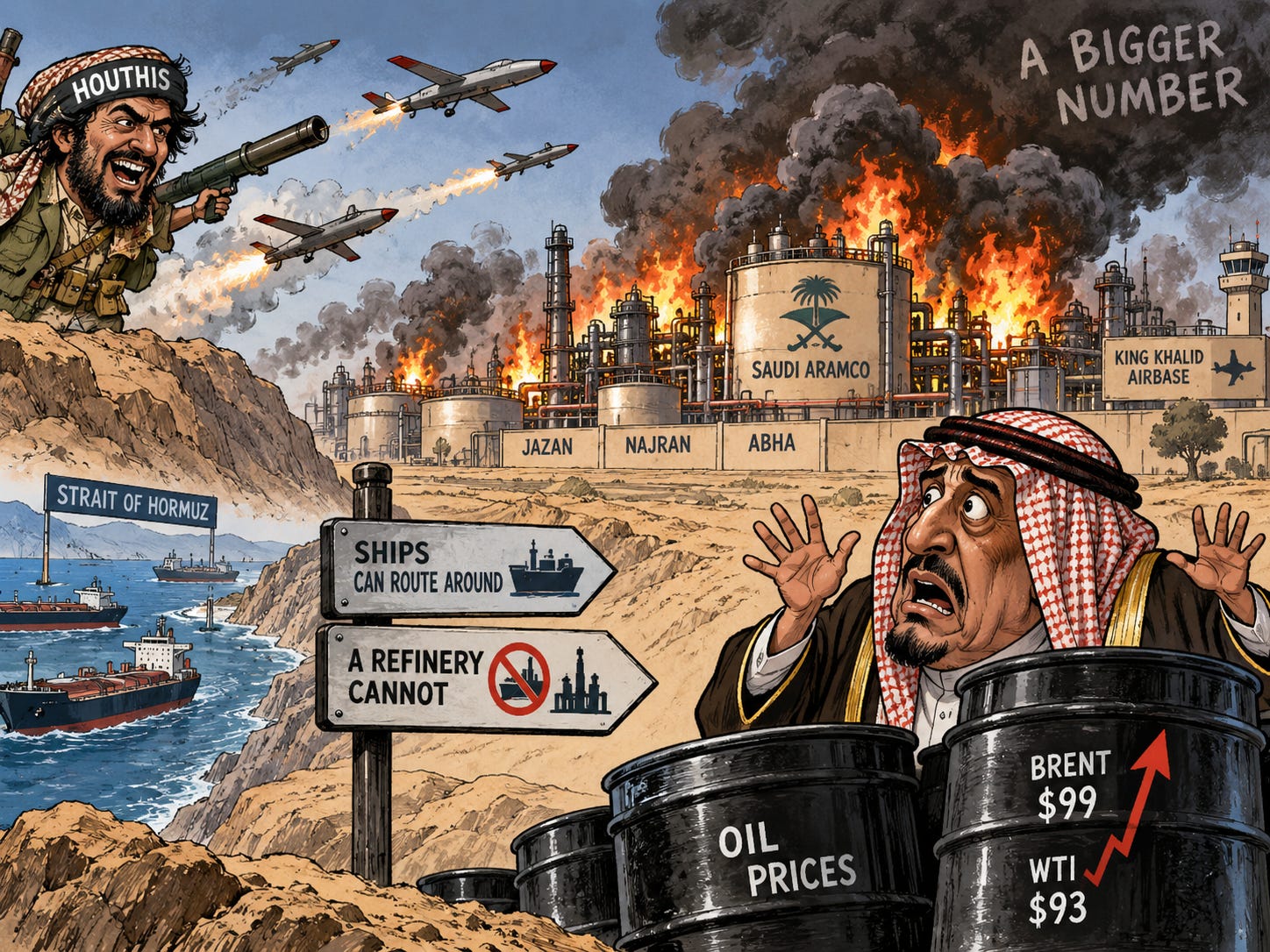
Houthi missiles and drones hit targets across Saudi Arabia on Tuesday, in one of the largest assaults on the kingdom since the fighting restarted in July. Saudi Aramco facilities at Abha, Najran and Jazan were struck, along with the King Khalid airbase at Khamis Mushait. Fires broke out at several sites. Some energy facilities were halted, and 73 people were wounded. Jazan holds a refinery that processes 400,000 barrels a day, one of the kingdom’s largest, and it has been hit repeatedly since the Houthis threatened in July to blockade Saudi oil flows. Brent traded as high as roughly $99 during the session and WTI held above $93. (NPR)
What did not happen matters as much. Saudi Arabia’s main crude-producing fields sit in the east of the country and were not targeted, and the damage was reported as limited. So why did the price move like that? Because the front has moved. For 6 months this war has been priced through the Strait of Hormuz, a stretch of water that ships have to cross. It is now being priced through installations on land in the country that produces more oil than any other, and there is no way to sail around a refinery. Brent sits close to 40% above where it was before the fighting began. (World Oil)
Sensei’s Insight: Hormuz was a chokepoint that ships could eventually route around. A refinery is not. The market spent 6 months pricing the risk to vessels and is now being asked to price the risk to the plant itself. That is a bigger number.
📉 Wall Street starts paying for the oil price
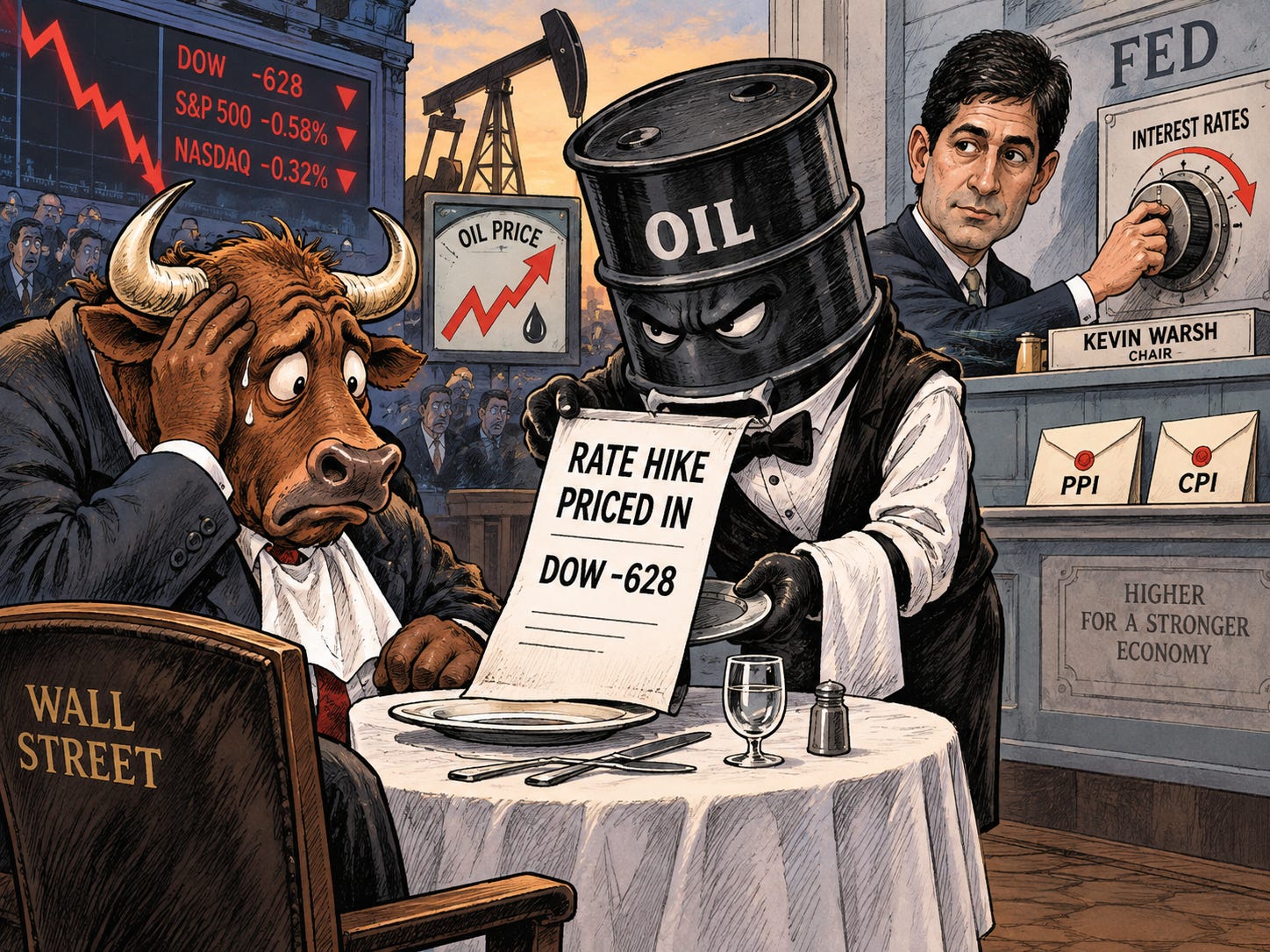
628 points. That is what came off the Dow Jones Industrial Average on Tuesday, a fall of 1.18% to 52,786.07. The S&P 500 lost 0.58% to 7,673.52 and the Nasdaq Composite 0.32% to 26,421.41. Energy prices did most of it. Higher crude raises input costs for almost every listed company outside the oil sector, which squeezes margins. It also raises the odds that the Federal Reserve votes for a rise next week rather than a hold. Markets have been pricing roughly 60% odds on that rise. Amgen’s 10.15% fall accounted for a large share of the Dow’s points on its own. (Yahoo Finance)
The argument about the Fed has moved on. For a fortnight the question was whether a rise was coming. The market has started charging for one. That is what a session like Tuesday is, equities marking themselves down against a discount rate they expect to go up, and it happens before any decision is announced. That leaves 2 prints to settle it. Producer prices arrive on Thursday and consumer prices on Friday, both at 1:30pm UK, 8:30am ET, and the committee votes on 16 September. The European Central Bank decides on Thursday as well, about 15 minutes before the American producer number. (CNBC)
Sensei’s Insight: The debate is finished and the invoice has arrived. When a market stops arguing about a rate rise and starts marking assets down for one, that is the part that shows up in prices, and it always happens before the vote.
🇨🇳 China answers the question its export data raised
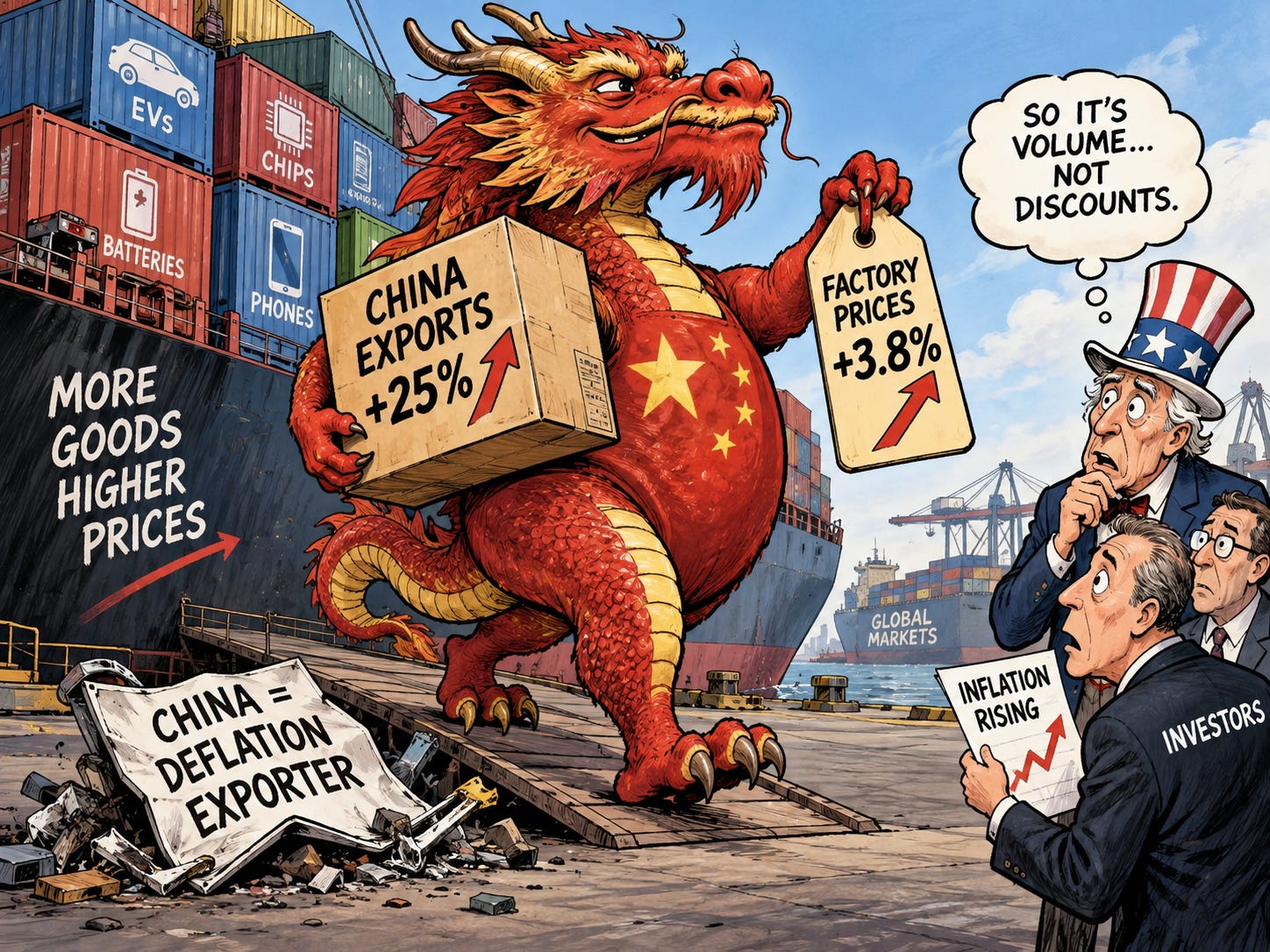
Yesterday’s Chinese trade figures raised a question. Was 25% export growth coming from volume, or from manufacturers cutting prices to hold market share through the tariffs? Wednesday’s inflation data answered it. Producer prices rose 3.8% in August from a year earlier, against 3.6% expected and 3.5% in July. Factory-gate prices accelerating is the opposite of discounting. Consumer prices rose 0.8% on the year, matching forecasts and up from 0.5%, and 0.4% on the month, which ended 3 consecutive monthly falls. Core inflation, stripping out food and energy, reached 1% from 0.9%. (CNBC)
Dong Lijuan, a statistician at the National Bureau of Statistics, put the rise down to energy prices and seasonal food increases. Summer holiday travel added to it, along with higher prices for smartphones and computers driven by demand for computing power. Energy and computing power are the same forces moving markets everywhere else. China spent 3 years being described as an exporter of deflation. That description is out of date. The practical consequence for an investor is that the cheapest source of manufactured goods in the world has stopped getting cheaper. (People’s Daily)
Sensei’s Insight: This is the number I wanted out of yesterday’s trade data, and it says volume. Chinese factories are raising prices and still shipping 25% more. The deflation-exporter line people keep repeating has been out of date for a while now.
💊 Amgen has its worst day since 2000 on someone else’s trial
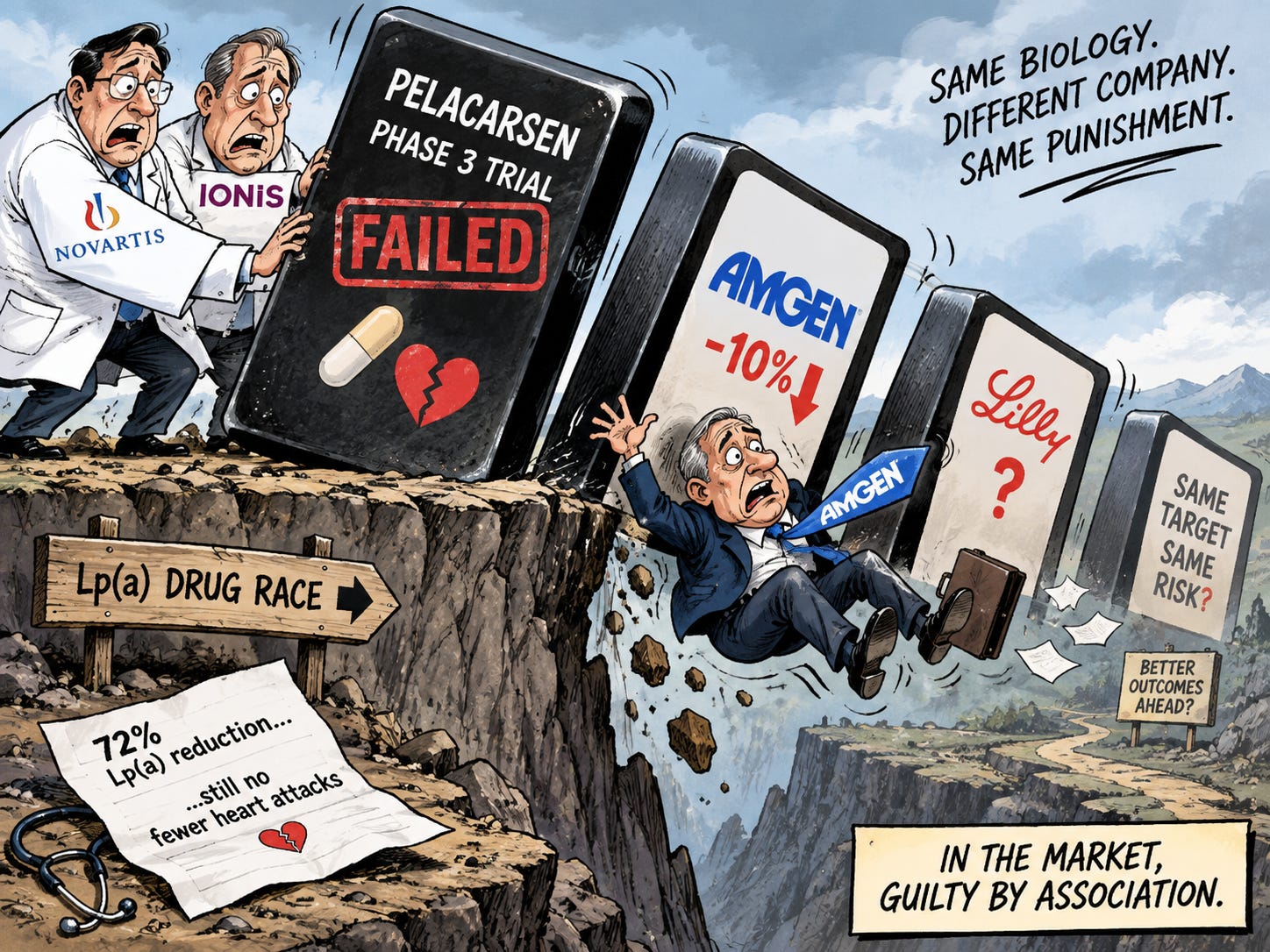
On 4 September, Novartis and Ionis said their heart drug pelacarsen had failed its Phase 3 trial. Lp(a)HORIZON enrolled 8,323 patients with high levels of lipoprotein(a), a blood fat linked to heart attacks and strokes. The drug cut Lp(a) by an average of 72%, and it still did not beat placebo on the combined measure of cardiovascular death, heart attack, stroke and urgent artery surgery. On Tuesday Amgen closed down 10.15% at $393.17 on nearly 3 times its average monthly volume, its worst single day since October 2000. Novartis fell 14% and Ionis 10%. (Yahoo Finance)
Amgen was not in that trial. It runs its own drug at the same target, olpasiran, and Eli Lilly runs lepodisiran. Both cut Lp(a) by more than 90%, against pelacarsen’s 72%, which is the argument for why they might succeed where it failed. What happened on Tuesday is read-across: when one company’s trial misses, the market marks down everyone chasing the same biology, because a failure raises the odds that the target itself does not work. Whether the deeper reductions are enough to change the outcome is now the whole question, and Amgen’s own trial reports later. (CNBC)
Sensei’s Insight: Keep this one. You can hold a company that reported nothing, said nothing and did nothing wrong, and watch it lose 10% in a day because a competitor’s trial missed. That risk never appears in a valuation model.
📱 Apple’s foldable arrives tonight and the price is the story

Apple opens its Surprise and Shine event at Apple Park at 6pm UK, 1pm ET. It is John Ternus’s first. He replaced Tim Cook as chief executive on 1 September. The iPhone 18 Pro and Pro Max are expected alongside the company’s first foldable, reported to be called the iPhone Ultra. Its inner screen is put at roughly 7.7 to 7.8 inches and the outer one at 5.3 to 5.5 inches. Carrier listings and several analysts point to a starting price near $1,999, down from the $2,399 that circulated last year, while analysts quoted by Reuters expect above $2,500. (TechRepublic)
This launch differs in 2 ways. Supply of the foldable is expected to be severely constrained, which caps how much revenue it can add to the December quarter whatever the demand looks like. And the memory chips inside it are in genuine shortage with contract prices rising, which is a cost Apple either absorbs or passes on. September launches set up the December quarter, the biggest 3 months of Apple’s financial year. Pre-orders are expected from Friday 11 September, with devices arriving around 19 September. (9to5Mac)
Sensei’s Insight: A $2,000 phone is a test of one thing, which is whether Apple can still carry a price nobody else can. Samsung has sold foldables for years without moving the market. The constraint is the bit to watch, because a launch you cannot buy adds nothing.
Stories You Might Have Missed
🇬🇧 The bond market has written half the Budget already
The global bond selloff has cut Chancellor John Healey’s fiscal headroom from about £26bn to roughly £13.8bn ahead of his Budget on 28 October. Headroom is the gap between what the government expects to raise and what its own fiscal rules allow it to spend. It shrinks on its own when borrowing costs rise, because the interest bill grows before any policy changes. The 30-year gilt sat at 5.81% on Tuesday. The 10-year sat near 5.2%, with investors increasingly pricing further Bank of England rises on renewed inflation worries. Oil near $100 is doing much of that work, which is how a Middle East story ends up inside a British tax decision. (Options Trading Report)
🥈 Silver keeps going while gold does not
Silver rose 1.31% to $66.61 an ounce on Wednesday while gold slipped to $4,367.90, down 0.84%. The 2 metals usually move together. They have separated over the past year: silver is up more than 150%, a level it has not held in over a decade, while gold has spent September giving ground back. The split comes from what each one is. Gold is priced almost entirely as a store of value, so it suffers when interest rates are expected to rise and holding an asset that pays no income costs more. Silver carries that same monetary demand plus industrial demand from solar panels and electronics, and the industrial leg is still growing. (Trading Economics)
₿ Bitcoin ETFs took the money and left the rest
American spot bitcoin exchange-traded funds pulled in $986.9m in the week to 4 September, while inflows into ether, Solana, XRP and Hyperliquid products fell between 73% and 96% over the same week. Bitcoin traded at $79,129 on Wednesday, up 1.03%. XRP sat at $1.42, up 2% on the day and 5.5% over 7 days. Concentration like that usually points to institutional money rather than retail, because the funds buying through ETFs are the ones with mandates naming bitcoin specifically. Everything else in the market is being bought by somebody else, in smaller size. (Investing News)