


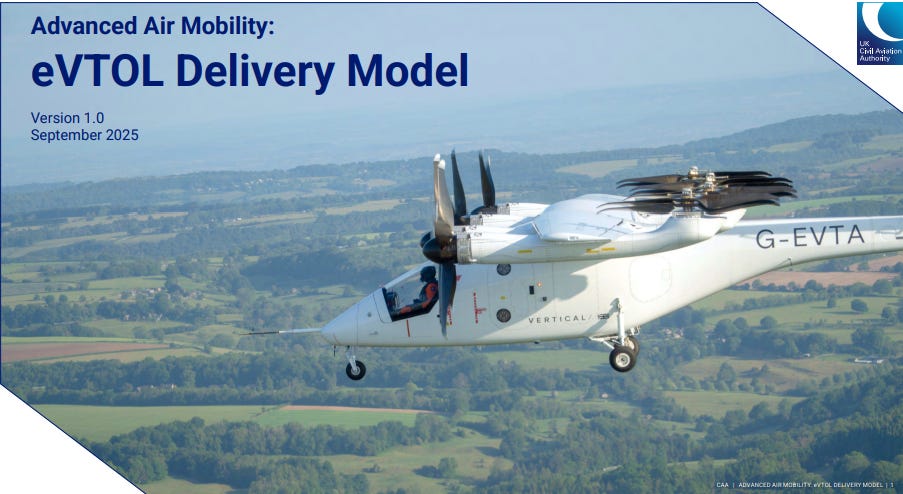
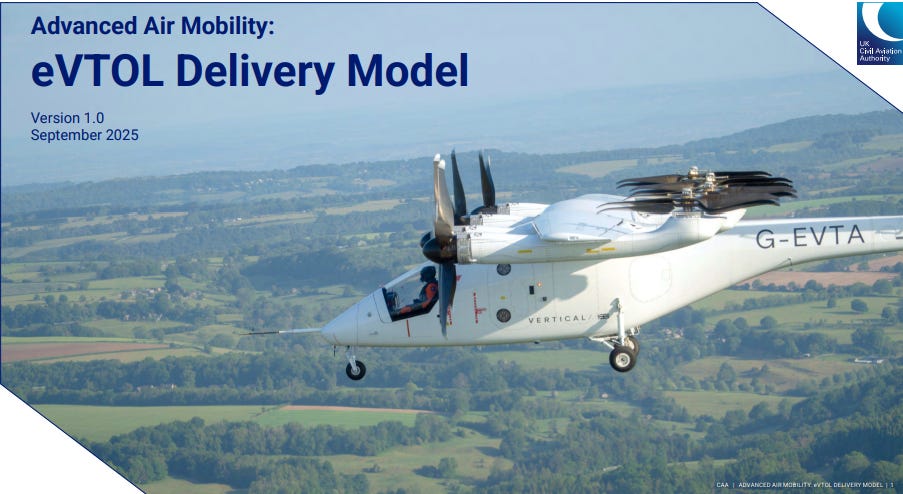
🛫 UK CAA’s eVTOL Delivery Model — The Road to First Commercial Flights by 2028
The UK regulator has published a Version-1 plan to enable initial commercial, piloted eVTOL operations by end-2028. It uses today’s aviation rulebook wherever possible, adds targeted new rules where needed, and sequences consultations (late-2025), legislative proposals (2026), and implementation (2027–2028)
JOIN US FOR THE SATURDAY LIVE EVTOL SHOW WITH VAZ
🔗 Connect with Us
Stay plugged in across platforms:
Sensei on X: sensei_crypto_
Martyn Lucas on X: MartynInvestor
Vaz on X: eVTOLHUB
💎 Premium Discord Access: Join the Discord
📺 YouTube Channel (Live & Replays): Martyn Lucas Investor
👕 Limited Merch: Shop Here
🧩 What This Document is (and Isn’t)
Purpose: A regulator playbook for getting eVTOL from demonstrations to first passenger services in the UK. Think: “how the law, rules and systems will change” rather than a tech spec.
Scope: Piloted operations first (commercial focus). Uncrewed/autonomous eVTOL is out of scope for this version. The CAA proposes; the Department for Transport (DfT) ultimately legislates.
Ambition: By end-2028, have the regulatory framework + operational systems in place to allow initial commercial eVTOL flights.
🧠 Mechanics: How the UK Will Roll This Out
Three horizons
Flying Now — development & certification testing possible today via Permit to Fly (PtF) and Flight Conditions.
Flying Tomorrow (by 2028) — first commercial, piloted ops once the legal changes land.
Flying in the Future (post-2030) — scaling & more advanced use-cases as experience grows.
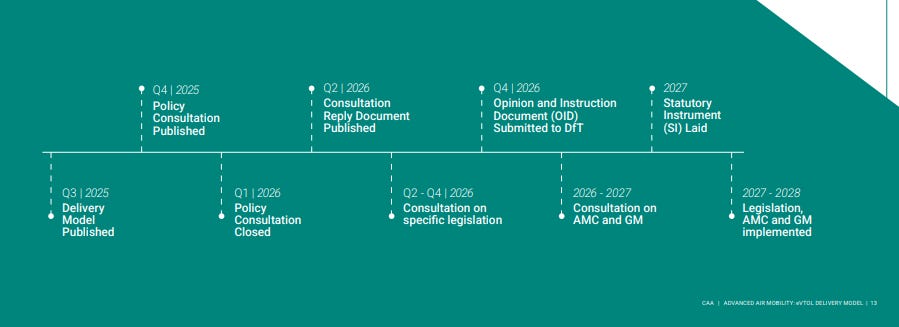
Rulemaking timeline (high level)
Q4 2025: initial policy consultation opens.
2026: CAA submits its Opinion & Instruction to DfT with the legislative package needed.
2027: Statutory Instruments (SIs) laid; AMC/GM guidance follows.
2027–2028: implementation to enable first commercial ops.
Workstreams the CAA is changing
Design & Certification, Continuing Airworthiness, Flight Operations, Aerodromes/Vertiports, and Pilot Licensing—done as a “one CAA” program so the pieces fit together.
🧪 Deep Dive: Aircraft Certification in the UK
Certification basis:
The UK will certify eVTOL designs against UK.SC.VTOL (Issue 2)—the UK’s adopted version of EASA’s Special Condition for VTOL—supported by accepted Means of Compliance (MoCs). This gives OEMs objective-based rules and practical “how-to-comply” material.
How an OEM progresses (simplified):
Design Organisation Approval (DOA): most applicants work under Part 21 Sub-part J so the CAA can oversee competence and findings.
Agree certification basis: UK.SC.VTOL becomes the rule set; CAA will entertain justified edge cases (e.g., mass/pax) case-by-case.
Show compliance (MoCs): applicants map each UK.SC.VTOL objective to accepted MoCs (EASA continues to add MoCs; the UK has adopted earlier sets via ORS9 Decision 37, with newer ones being reviewed/consulted).
Operational Suitability Data (OSD): provide pilot-training, maintenance-training inputs and the Master Minimum Equipment List alongside the Type Certificate so type ratings and service docs are grounded in the design.
Flight testing before TC: developmental & certification testing uses the UK’s PtF and Flight Conditions regime, already in active use for UK and foreign products.
Validation & international harmonisation: the CAA is working bilaterally with the FAA and via an international NAA network to smooth cross-border validation (they even flag work to reconcile probability-level assumptions).
After certification (in service):
eVTOL will be treated by default as Complex Motor-Powered Aircraft (CMPA)—a higher bar for maintenance/oversight—using retained-EU Part 21 / Part 145 / Part CAMO / Part CAO for initial and continuing airworthiness (updated only where the tech demands).
The CAA also plans an engineer-licence endorsement for electrical powerplants via a Statutory Instrument targeted for 2027, recognising high-voltage competencies in maintenance.
👩✈️ Pilot Licensing, Operations & Ground Infrastructure (by 2028)
Pilots: For commercial ops, the CAA’s baseline is CPL/ATPL + eVTOL type rating, with the UK’s licensing framework aligned to powered-lift principles. Private (PPL) use is intended later for non-commercial flying, with FSTD/FCS training policy forthcoming and openness to novel training approaches where safely justified.
Aerodromes/Vertiports: Policy work under way on infrastructure, layout, Rescue & Fire-Fighting Service (RFFS), and integration with existing aerodrome regimes in time for first ops.
🌍 How the UK Compares (FAA • EU/EASA • UAE • Japan)
United States — FAA (Powered-Lift Final Rule + SFAR)
FAA issued the final powered-lift rule (Oct–Nov 2024), setting pilot qualifications and integrating powered-lift ops into Parts 61/91/97/135/136, with a Special Federal Aviation Regulation (SFAR) to stand up the first wave of pilots/instructors. This is the U.S. on-ramp for air-taxi ops.
Contrast: FAA has already codified powered-lift at federal level; the UK is running a synchronized 2025–2028 legislative program to achieve comparable outcomes nationally.
European Union — EASA (SC-VTOL + rolling MoCs)
EASA pioneered SC-VTOL and grows it via successive MoCs (Issue-2 baseline; MoC-5 consulted in July 2025). The UK has formally adopted the EASA SC-VTOL framework and associated MoCs via ORS9 Decision 37, then layers UK specifics on top.
United Arab Emirates — fast-track corridors & early services
The UAE is mapping urban air corridors and building a hybrid AAM framework on a ~20-month schedule; 2026 is cited for first passenger services. Dubai–Joby agreements include six-year exclusivity and a vertiport network; Joby delivered its first aircraft into Dubai and began local testing in 2025.
Japan — methodical ConOps + vertiport standards, Expo demos
Japan’s MLIT/JCAB has published Vertiport Design Guidelines (Dec 2023) and AAM ConOps documents, framing a phased rollout (including Expo 2025 Osaka demonstration flights and trials of digital UTM). It’s a measured, infrastructure-first approach that complements certification progress.
🔭 What to Watch Next (UK Catalysts You Can Call Out on Air)
Late-2025 — CAA opens the first eVTOL policy consultation.
2026 — CAA’s Opinion & Instruction to DfT with proposed legislative package.
2027 — SIs laid (incl. engineer electric-powerplant endorsement), AMC/GM issued.
2027–2028 — Implementation window for first commercial ops.

🧠 Investor Angle
Regulation doesn’t create revenue by itself, but it de-risks timelines. The UK now has a coherent plan (consult → legislate → implement) and a clear certification basis (UK.SC.VTOL + MoCs + PtF), plus a defined in-service regime (CMPA) and a 2027 engineer-licensing update for electric powerplants. Translation: the fog is lifting on when and how first UK passenger flights can happen—use the 2025–2028 milestones as your catalyst checkpoints.
🔤 Glossary (Quick Scan for Readers)
UK.SC.VTOL (Issue 2): UK Special Condition for VTOL — eVTOL design rules. Civil Aviation Authority
MoC: Means of Compliance — accepted test/analysis methods (EASA continues to expand; UK adopts via ORS9). EASA+1
PtF: Permit to Fly — allows pre-TC flight testing. Civil Aviation Authority
CMPA: Complex Motor-Powered Aircraft — higher bar for continuing airworthiness. Civil Aviation Authority
DOA (Part 21J): Design Organisation Approval — company-level authority to make findings. Civil Aviation Authority
AMC/GM: Acceptable Means of Compliance / Guidance Material — the “practice notes” regulators publish to show ways to comply. Civil Aviation Authority
DfT/SI: UK’s Department for Transport / Statutory Instrument — how aviation laws are actually changed.
🚁 Osaka Expo 2025 — eVTOLs Take Center Stage
Joby’s live flights kick off next week, and we’ll cover it LIVE.

🌍 Expo 2025 — A Testbed for Future Flight
Osaka Expo 2025 (Apr 13 – Oct 13) carries the theme Designing Future Society for Our Lives. Among its most ambitious showcases is Advanced Air Mobility (AAM), with a dedicated EXPO Vertiport where visitors can watch real eVTOL operations. This isn’t just a display — it’s a working experiment in how air taxis could fit into cities.

Tweet with Joby’s test flight:
https://x.com/yamaryoymr2/status/1971589172642316606
✈️ Who’s in the Spotlight?
SkyDrive (Japan)
Demo flights of the SD-05, a compact 3-seater eVTOL.
Partnered with Osaka Metro to open the Osakako Vertiport.
Public flights over Osaka Bay showcased urban integration in real time.
Lift / Marubeni — HEXA
Single-person eVTOL from Lift Aircraft.
Highlights micro-mobility and individual vertical flight.
Joby + ANA — The Big Moment
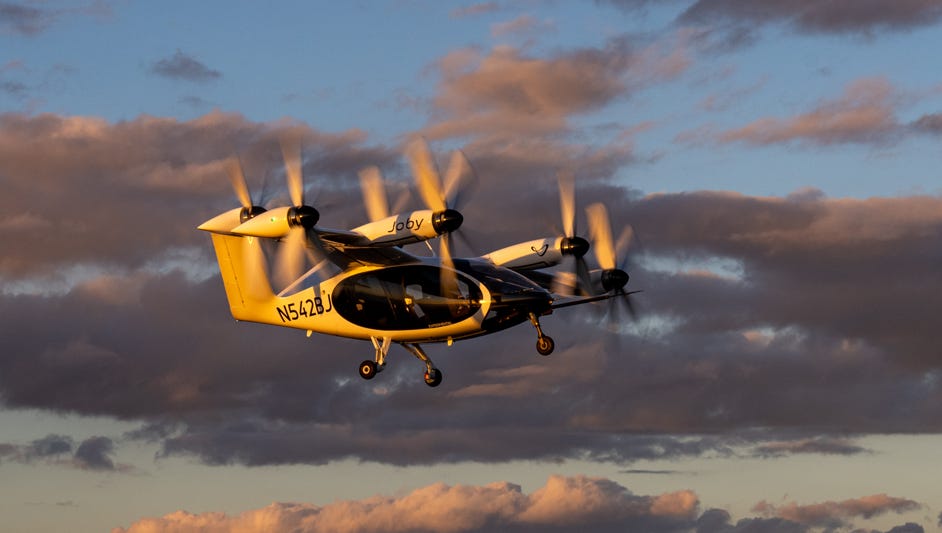
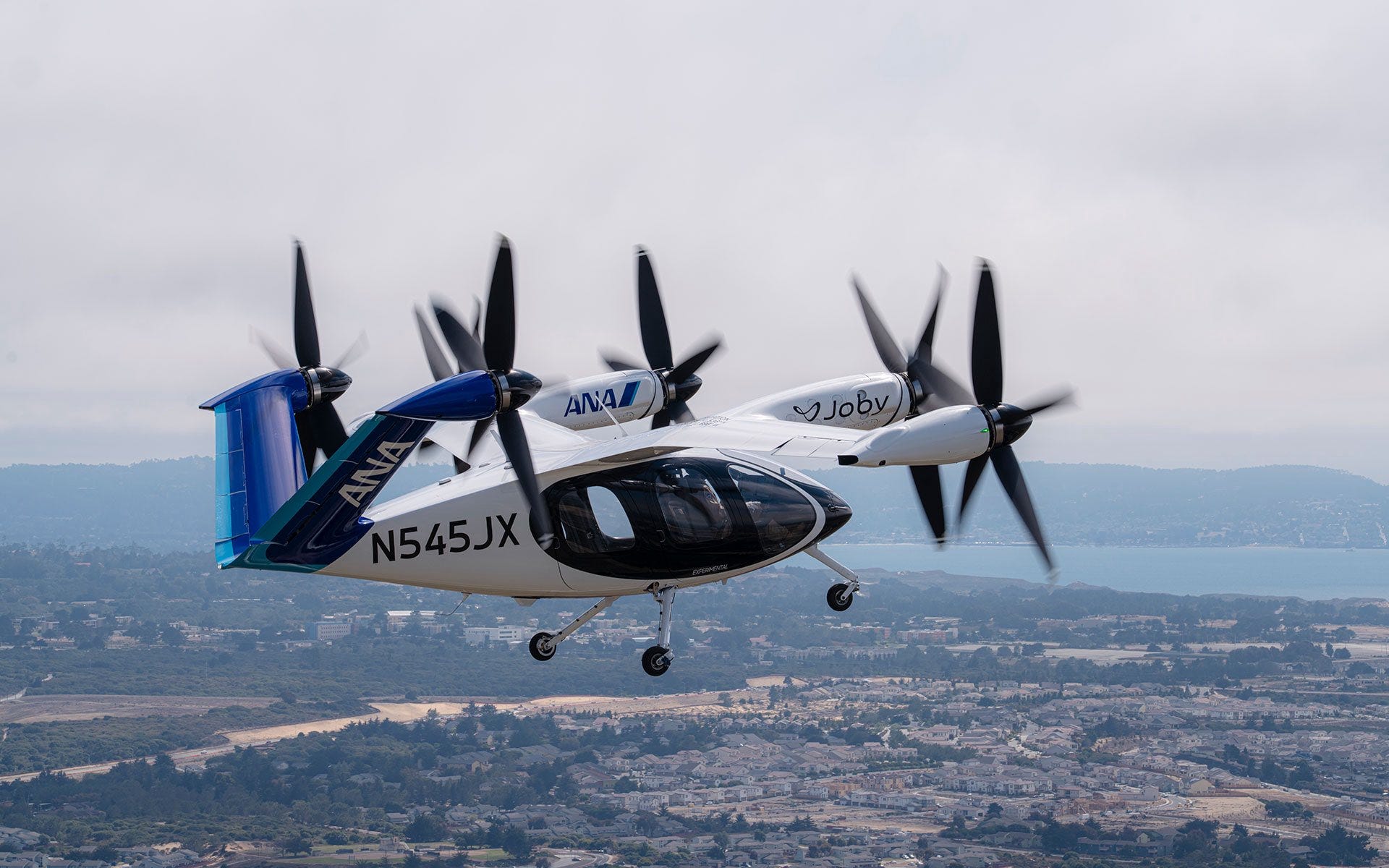
From Oct 1–13, Joby’s S4 (ANA livery) will fly twice daily at the Expo.
Full VTOL demos: takeoff ➝ transition ➝ wing-borne flight ➝ landing.
Off-days: static display for visitors.
Joby & ANA aim to scale to 100+ aircraft across Japan in the coming years.
Archer Aviation
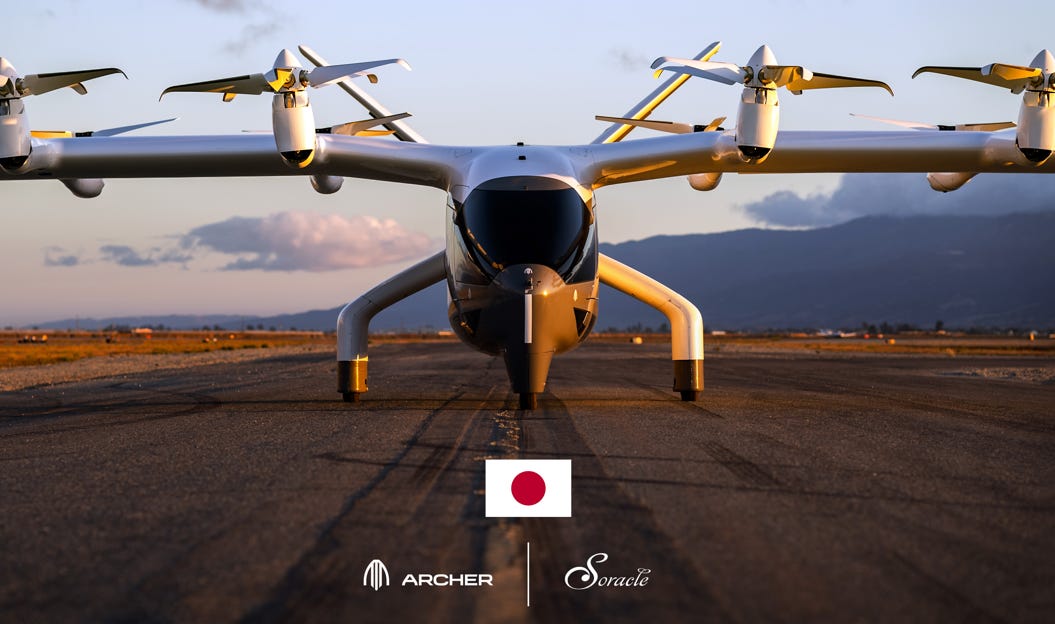
Took the stage earlier in the Expo but did not fly.
Presented a static Midnight model to showcase design and progress.
Vertical Aerospace
Were signed to present but withdrew months ago.
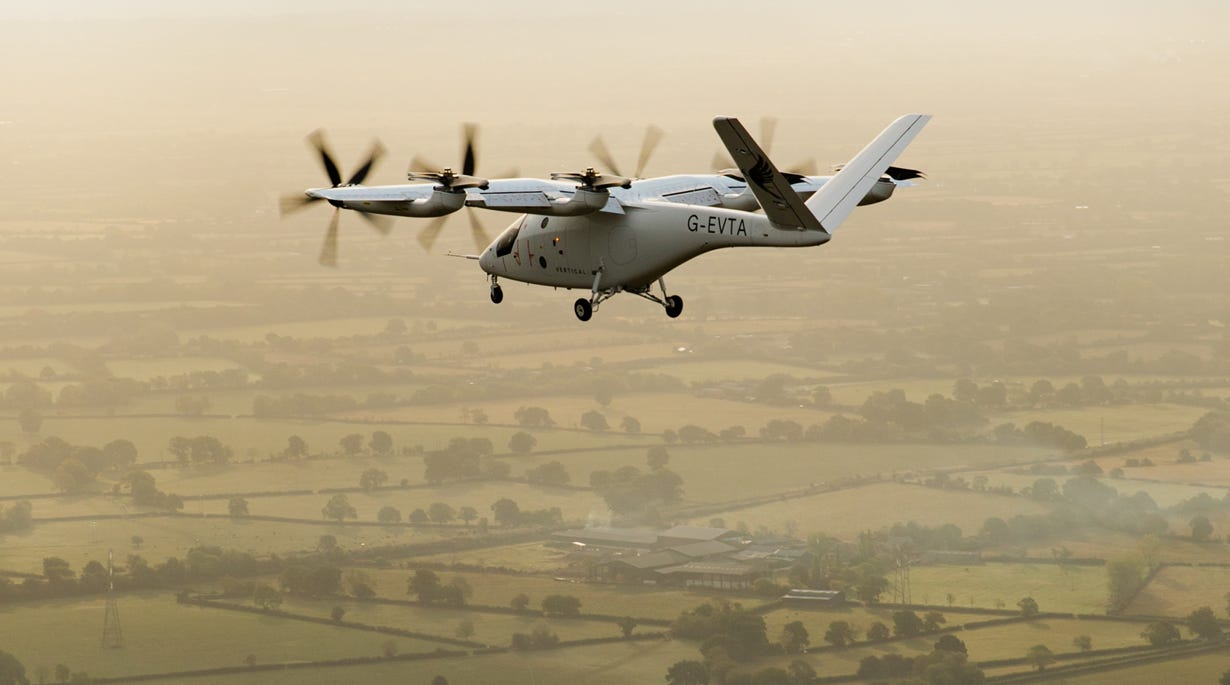
Refocused resources toward their development roadmap and UK milestones.
📌 Why This Matters
Visibility: First time global audiences see air taxis in live urban action.
Integration: Real-world test of vertiports, ATC coordination, passenger flow.
Momentum: Smooth Joby flights could boost both public trust and investor confidence.
Competition: SkyDrive leads Japan’s local effort; Archer & Vertical play long games; Joby brings global ambition.
Next Step: By 2028, Japan targets real commercial AAM services.

🎥 Our Coverage
Next week, we’ll bring you exclusive LIVE commentary on Joby’s flights direct from Osaka Expo 2025. Expect breakdowns of:
The flight sequence
Passenger experience insights
Public reactions on the ground
How this all fits into the global eVTOL race
Stay tuned — this is history in motion.
✈️ Boeing & Palantir: A Defense Tech Power Move
The Aerospace Titan meets the Data Warlord.
In a move that could reshape how data powers defense manufacturing, Boeing’s Defense, Space & Security division (BDS) has struck a strategic partnership with Palantir Technologies to deploy AI-powered analytics and digital operations across its production lines.