🧠 One Big Thing
Bitcoin Breaks $118K, Gold Shines at $3,375 – Bitcoin has surged to $118,177, extending its relentless climb as institutional demand and ETF inflows drive record highs. At the same time, gold is holding firm at $3,375 (▲ +0.77%), reflecting heightened safe-haven demand amid falling US Treasury yields (10Y down -1.09%). This dual rally in crypto and gold suggests investors are hedging both inflation risk and geopolitical uncertainty while seeking non-traditional stores of value.
💰 Money Move of the Day
When assets like Bitcoin and gold are both rallying, it’s a reminder to stress-test your portfolio balance. Ask yourself: If markets swing sharply, do I have enough defensive assets (like cash or bonds) to ride it out without panic?
📊 Market Snapshot
Cryptocurrencies:
Bitcoin (BTC): $118,177 (▲ +0.72%)
Ethereum (ETH): $3,810 (▲ +1.38%)
XRP: $3.54 (▲ +2.33%)
Equity Indices (Futures):
S&P 500 (SPX): 6,311 (▲ +0.24%)
NASDAQ 100: 23,278 (▲ +0.23%)
FTSE 100: 8,987 (▲ +0.03%)
Commodities & Bonds:
10-Year US Treasury Yield: 4.372% (▼ -1.09%)
Oil (WTI): $67.27 (▼ -0.20%)
Gold: $3,375 (▲ +0.77%)
🕒 Data as of
UK (BST): 12:27 / US (EST): 07:27 / Asia (Tokyo): 20:27
✅ 5 Things to Know Today
🇪🇺 EU Scrambles for US Trade Deal Amid Trump's Tariff Ultimatum
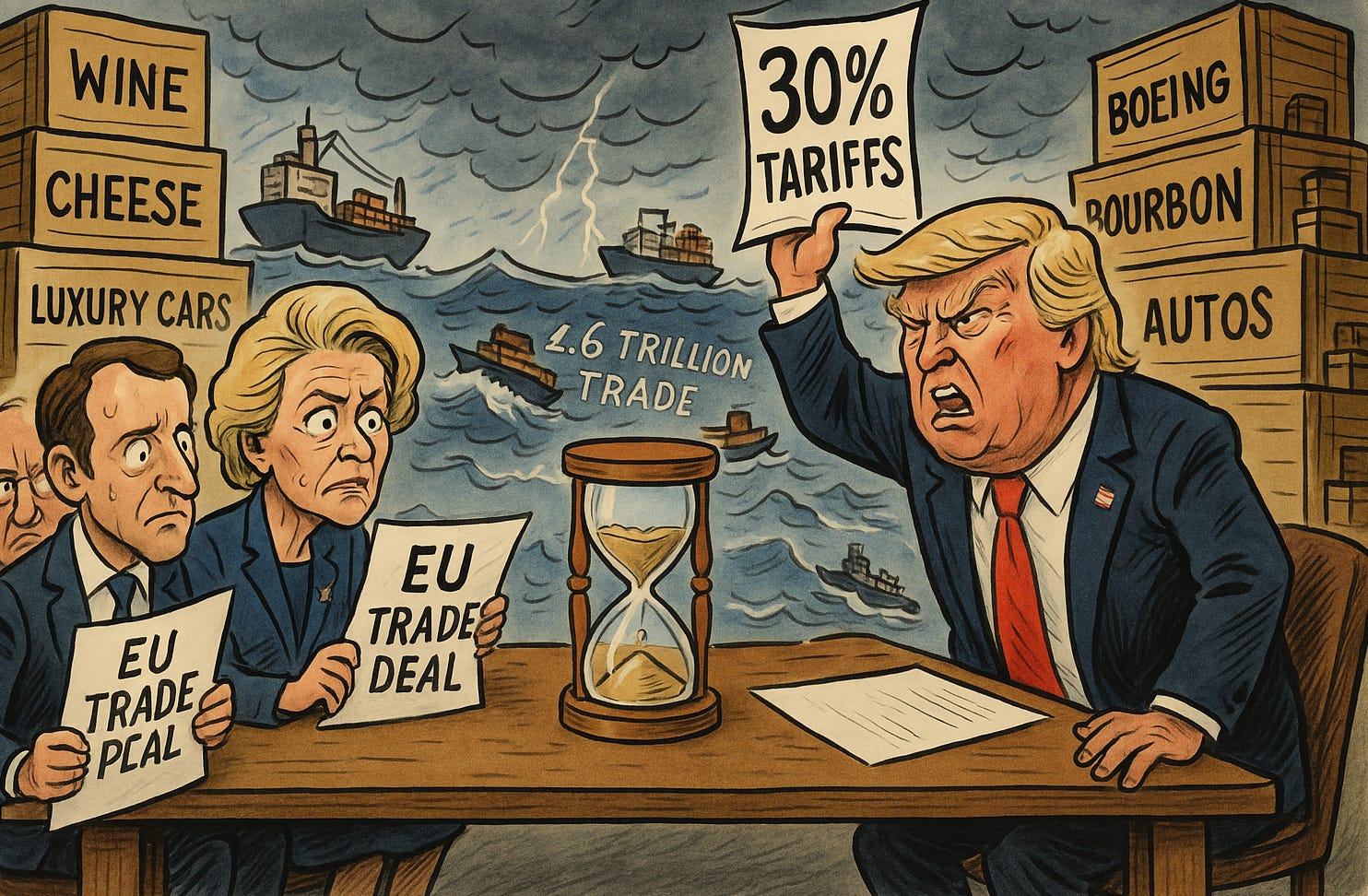
European Union and US negotiators are locked in a tense final push to strike a trade deal before August 1, when President Trump has vowed to impose 30% tariffs on most EU exports (CNN, Sky News). Commerce Secretary Howard Lutnick reiterated over the weekend that the deadline is “hard” and warned that countries will “start paying the tariffs on August 1” (NY Post, CNBC). The negotiations come amid unprecedented strain in the transatlantic relationship as Washington pushes for sweeping tariffs exceeding 10% on nearly all EU goods, with exemptions kept to a minimum (Yahoo Finance). Trump unveiled the 30% tariff plan via letters posted on social media, pointing to the $235.6 billion US trade deficit with Europe and declaring the relationship “far from reciprocal” (Sky News, Al Jazeera). The threatened tariffs would hit the world’s largest bilateral trade relationship, worth €1.6 trillion in goods and services in 2023 (FTI Consulting, European Commission), with the US accounting for 20.6% of all EU exports (Eurostat).
Goldman Sachs warns that full implementation of 30% tariffs could drag eurozone GDP down by 1.2% by late 2026 (Euronews), while other economists caution the measures could push Europe “to the brink of recession” (Fortune). In response, Brussels is preparing a retaliatory package targeting €72 billion worth of US goods, including Boeing aircraft, automobiles, and Kentucky bourbon (Al Jazeera, Yahoo Finance). With the US serving as Europe’s largest export destination and the EU supplying over 20% of global exports to America (CaixaBank Research), any disruption threatens global supply chains and could spark the most significant transatlantic trade confrontation in decades.
Sensei’s Insight: With a €1.6 trillion trade corridor at stake, these negotiations are more than a tariff dispute—they’re a stress test for global supply chains, currency stability, and the future of Western economic alliances.
Peter Thiel-Backed Crypto Exchange Bullish Files for IPO
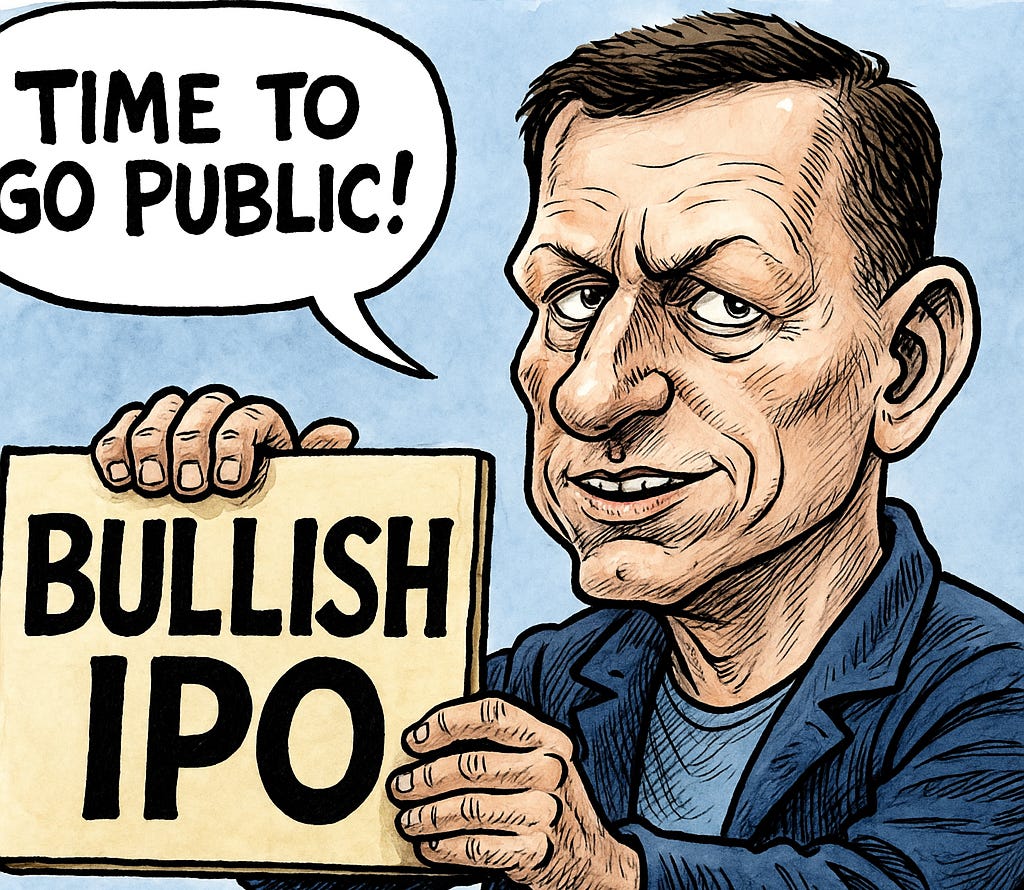
Bullish, the digital asset exchange backed by billionaire investor Peter Thiel, has filed for an initial public offering with the SEC, aiming to list on the New York Stock Exchange under the ticker "BLSH" (CNBC). The move positions Bullish among a growing wave of crypto firms pursuing public listings, driven by increased institutional adoption and favorable regulatory shifts. Led by CEO Tom Farley, former president of the NYSE, the exchange reported a stark turnaround in financial performance for Q1 2025, posting a net loss of $349 million on digital asset sales of about $80 million. This contrasts sharply with a net income of $105 million on similar sales in the same quarter last year (Crowdfund Insider). Despite the loss, Bullish maintained strong operational metrics, averaging over $2.5 billion in daily trading volume and ranking among the top five global exchanges for Bitcoin and Ether spot trading. Since its launch, the platform has processed more than $1.25 trillion in total trading volume (CryptoNews).
The IPO filing underscores the crypto sector's push toward public market legitimacy, following high-profile listings such as Circle (up over 700% since June) and eToro earlier this year (Cointelegraph). The timing aligns with Trump’s signing of the GENIUS Act, which introduces federal oversight for the $250 billion stablecoin market (Crowdfund Insider). However, Bullish’s steep Q1 losses—a swing from $105 million profit to a $349 million loss year-over-year—highlight the volatility and operational risks that could weigh on its valuation. For institutional investors, the company’s $1.9 billion in liquid assets and Peter Thiel’s backing lend credibility, but the earnings decline signals the need for careful risk evaluation when considering exposure to crypto exchange equities (AInvest).
Sensei’s Insight: Bullish’s IPO is a litmus test for the resilience of crypto market confidence. While its trading volumes and Thiel’s reputation provide a strong foundation, the financial swing warns that even top-tier exchanges face sharp profitability pressures in volatile markets.
Political Volatility Wipes $320 Billion From Global Corporate Profits
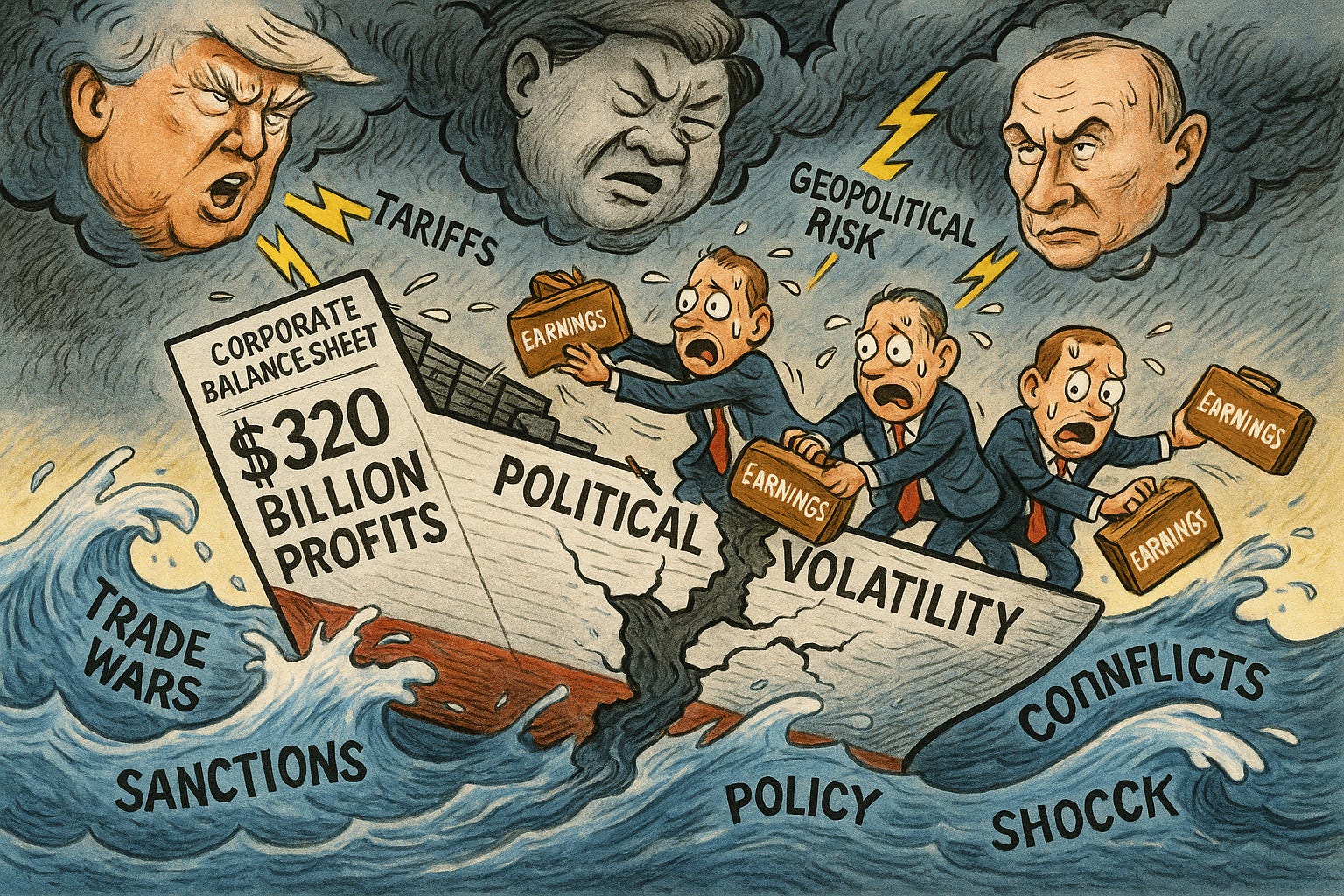
Almost 3,500 listed companies worldwide, each generating over $1 billion in annual revenue, collectively lost $320 billion in profits during periods of geopolitical and economic turbulence, according to a new study (FT). The research highlights that policy shifts and global events now exert a “greater impact on value and profits than in many decades” (FT). Examining data across markets and timeframes, the study shows how political uncertainty—ranging from trade disputes to conflicts—has led to measurable earnings contractions for large-cap corporations. The focus on companies with substantial revenue bases underscores the implications for institutional investors closely monitoring blue-chip performance.
The $320 billion profit erosion represents a fundamental change in how external risks shape corporate outcomes. Unlike conventional market volatility driven by economic cycles, this loss is rooted in unpredictable policy and geopolitical factors, creating a category of systematic risk that is difficult to hedge. Multinational companies with complex global operations are particularly exposed to sudden policy changes, international conflicts, and trade barriers. The findings suggest that political risk analysis is becoming as critical as traditional financial metrics for investors seeking to safeguard portfolios in a climate of mounting uncertainty (Nature, White Rose).
Sensei’s insight: Political risk is no longer a background factor—it’s a front-line driver of profit erosion. Investors ignoring geopolitics risk being blindsided by sudden shocks that balance sheets alone can’t predict.
Pound Rallies Against Weak Dollar as UK Bonds Rise
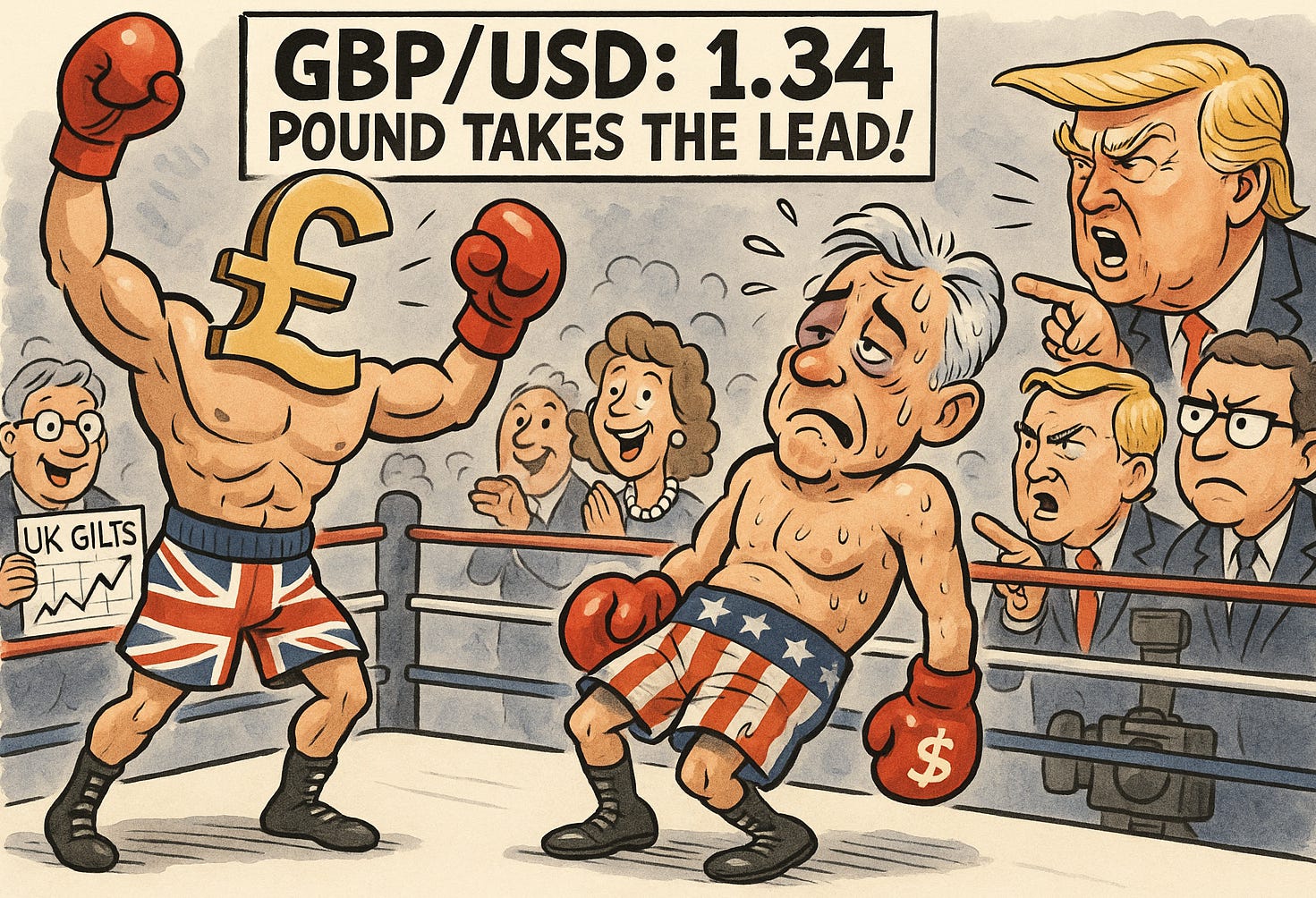
The British pound climbed above 1.34 against the US dollar on Monday as dollar weakness dominated global currency markets, fueled by ongoing trade tensions and uncertainty around Federal Reserve policy (Reuters, Investing.com). The greenback retreated after President Trump renewed criticism of Fed Chair Jerome Powell, sparking concerns over the Fed’s independence and future rate decisions (TorFX). UK gilts advanced, with the 10-year yield falling to 4.65% from near 4.67%, while 5-year yields eased to 4.08% (Trading Economics, Trading Economics). The FTSE 100 hovered near the 9,000 level, up 0.1%, as mining stocks gained on Chinese infrastructure spending plans (YouInvest, Independent).
Investor sentiment towards sterling improved as markets pared back expectations for aggressive Bank of England rate cuts, following higher-than-expected June inflation at 3.6% and a softer-than-feared decline in employment figures (FXStreet). However, the pound still faces headwinds from UK fiscal concerns and speculation about tax increases in the upcoming autumn budget (TorFX). Meanwhile, the dollar’s broader weakness could create opportunities for non-USD assets, but heightened trade policy uncertainty remains a risk. UK bond markets appear to be stabilizing after recent volatility, although long-term gilt yields remain elevated compared to early 2024 levels (Bloomberg).
Sensei’s Insight: The pound’s strength is riding a wave of dollar weakness, but this rally may be tested if Fed policy stabilizes or UK fiscal risks worsen. Keep an eye on upcoming BoE signals and US trade headlines for the next major move.
China Launches World's Largest $170 Billion Hydropower Dam in Tibet
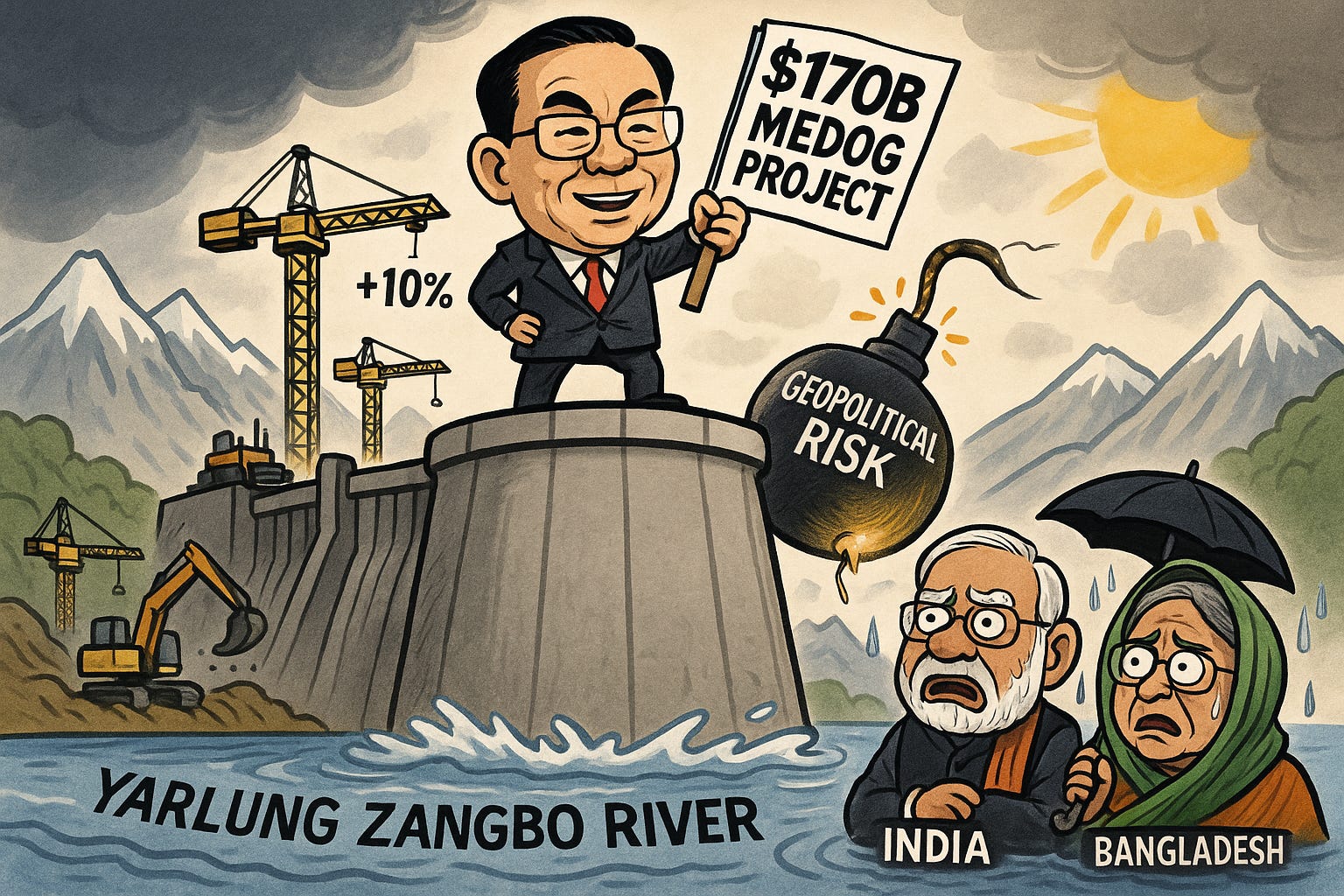
China has officially begun construction on the world’s largest hydropower project, the Medog Hydropower Station, on the Yarlung Zangbo River in Tibet, with Premier Li Qiang attending the groundbreaking ceremony in Nyingchi (Straits Times, Reuters). The $170 billion mega-project, which will feature five cascade hydropower stations, aims to generate 300 billion kilowatt-hours annually—three times the output of the Three Gorges Dam (Reuters). Commercial operations are expected to start in the 2030s (Tibetan Review).
The announcement sent China’s construction stocks soaring, with the CSI Construction & Engineering Index jumping 4% to a seven-month high. Shares of Power Construction Corporation of China (601669.SS) and Arcplus Group (600629.SS) surged by their 10% daily limit, while cement maker Xizang Tianlu (600326.SS) and Tibet GaoZheng Explosive Co (002827.SZ) also hit their maximum 10% limit (Pakistan Today). Tunnel equipment firm Hunan Wuxin Tunnel gained 30%, reflecting market optimism about rising construction material demand (EconoTimes). However, the project is drawing international scrutiny, with India and Bangladesh voicing strong concerns over potential downstream impacts. Officials warn the dam could act as a “water bomb” in conflict scenarios (Hindustan Times). The location at the Great Bend offers immense hydropower potential but faces significant seismic and engineering risks (BBC).
Sensei’s Insight: This project is both an engineering marvel and a geopolitical gamble. It highlights China's aggressive push for renewable energy dominance, but the seismic risks and transboundary tensions with India make it a high-stakes play for the next decade.
🔗 Connect with Us
Stay plugged in across platforms:
Sensei on X: sensei_crypto_
Martyn Lucas on X: MartynInvestor
Vaz on X: eVTOLHUB
💎 Premium Discord Access: Join the Discord
📺 YouTube Channel (Live & Replays): Martyn Lucas Investor
👕 Limited Merch: Shop Here

🔍 Deeper Dive: Block’s S&P 500 Debut: Bitcoin Vision Meets Wall Street Validation