🧠 One Big Thing
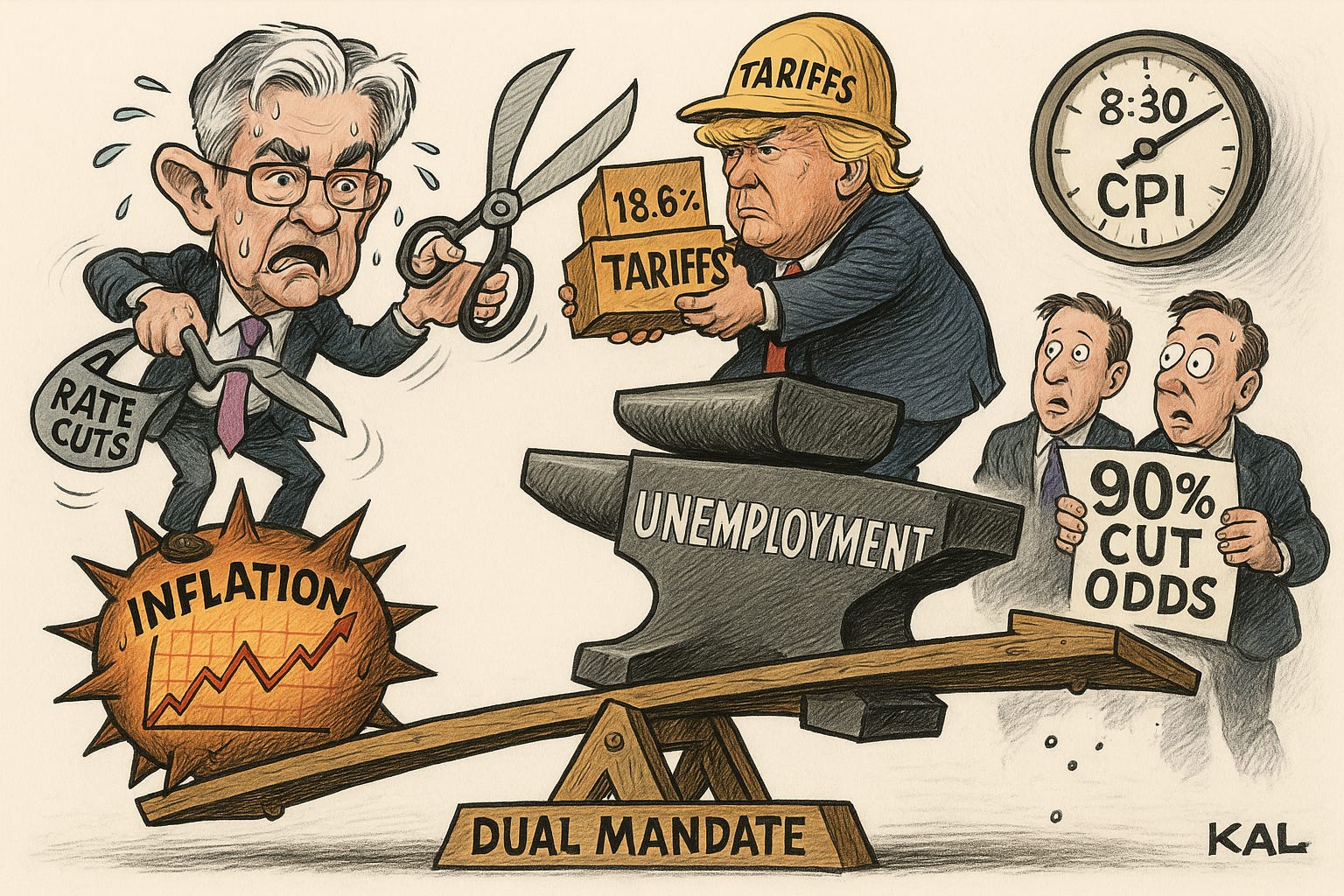
This morning’s CPI report is the Fed’s biggest credibility test since the pandemic — with inflation accelerating for a third straight month while unemployment rises, the central bank may be forced into choosing which side of its dual mandate to prioritize.
💰 Money Move of the Day
When key economic data like CPI is about to drop, think less about predicting the number and more about planning for volatility. Markets can swing sharply in either direction, so having a clear “if-then” plan for your portfolio can help you respond to surprises instead of reacting in panic.
📊 Market Snapshot
Cryptocurrencies:
Bitcoin (BTC): $118,506 (▼ -0.17%)
Ethereum (ETH): $4,282 (▲ +1.37%)
XRP: $3.13 (▲ +0.12%)
Equity Indices (Futures):
S&P 500 (SPX): 6,376 (▲ +0.05%)
NASDAQ 100: 23,639 (▲ +0.01%)
FTSE 100: 9,144 (▲ +0.10%)
Commodities & Bonds:
10-Year US Treasury Yield: 4.285% (▲ +0.14%)
Oil (WTI): $64.20 (▼ -0.22%)
Gold: $3,342 (▲ +0.00%)
🕒 Data as of UK (BST): 12:03 / US (EST): 07:03 / Asia (Tokyo): 20:03
✅ 5 Things to Know Today
Trump Extends China Tariff Truce for 90 Days
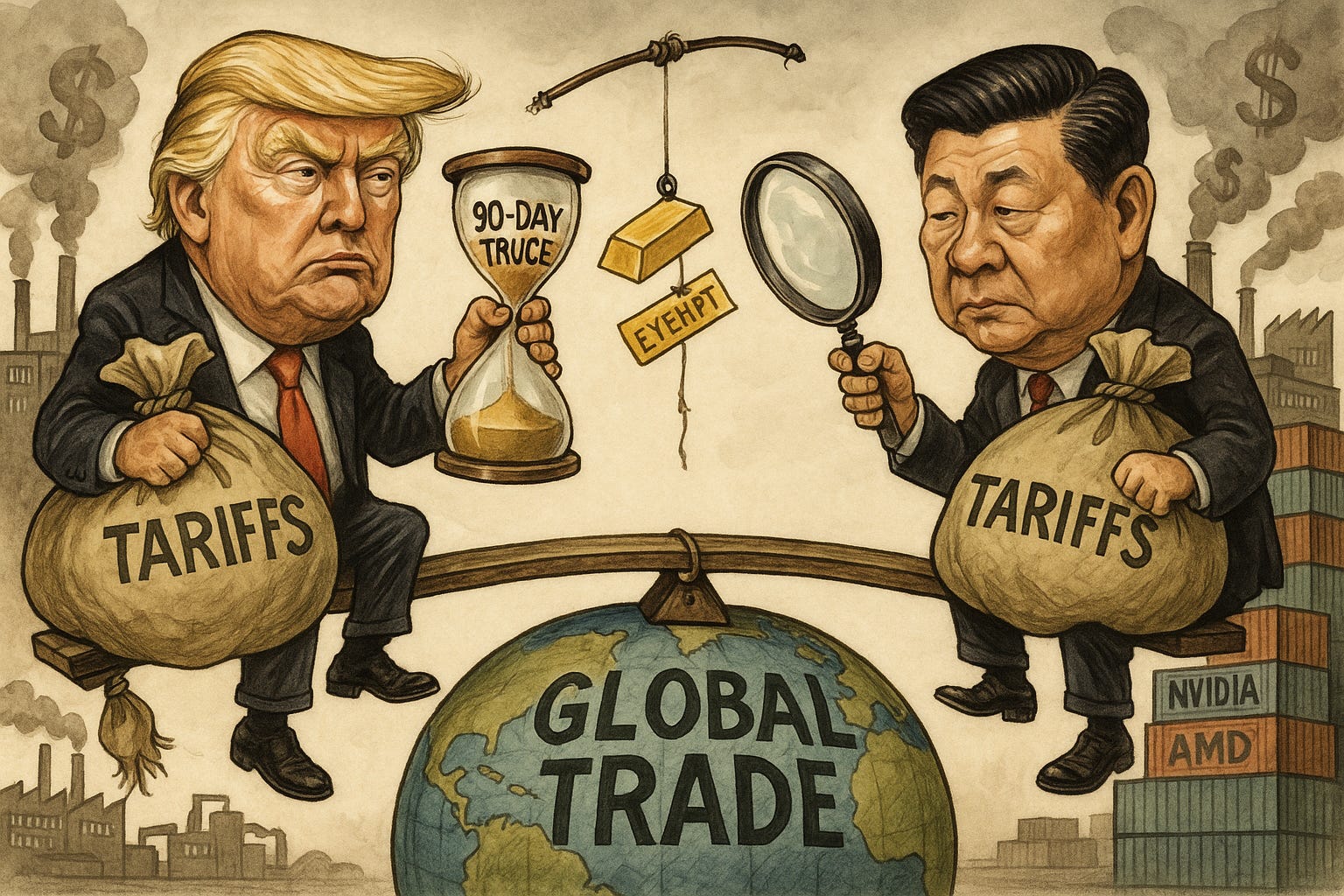
President Donald Trump signed an executive order extending the U.S.–China tariff truce until November 10, avoiding a massive escalation in trade duties that would have taken effect at midnight. Without the extension, U.S. tariffs on Chinese goods would have jumped from 30% to 145%, while China’s retaliatory tariffs would have risen from 10% to 125%—levels that would have effectively created a trade embargo. The truce maintains May’s Geneva agreement terms, keeping current tariff rates in place, including the 20% fentanyl-related duties. The move follows late-July talks in Stockholm between Chinese Vice Premier He Lifeng, U.S. Treasury Secretary Scott Bessent, and Trade Representative Jamieson Greer, which both sides called “constructive” despite premature claims of a deal from Chinese officials. Trump also exempted gold imports from tariffs and struck a deal allowing Nvidia and AMD to sell certain AI chips to China in exchange for a 15% revenue share with the U.S. government (BBC, NPR, CNBC).
The extension removes immediate risks to global trade and stabilizes supply chains ahead of the holiday season, sending Asian markets higher—Japan’s Nikkei hit record highs, and Chinese stocks rose 0.5%. However, the deal is temporary, highlighting unresolved structural disputes over industrial overcapacity, rare earth exports, and the U.S. trade deficit. The move sets the stage for a possible Trump–Xi summit at the APEC meeting in South Korea this fall, where negotiators hope to forge a longer-term pact. For investors, the reprieve offers short-term relief but keeps November as a looming deadline and potential flashpoint (Reuters, FT, Bloomberg).
Sensei’s Insight: Markets may be breathing a sigh of relief, but the 90-day truce is more like a pressure cooker timer than a peace treaty. Both Washington and Beijing have sidestepped economic chaos for now, yet the November 10 deadline ensures another high-stakes showdown right as the U.S. enters election season and China grapples with slowing growth. For traders, that’s an open invitation to ride the relief rally—but keep one hand on the exit.
🇨🇳 China Urges Firms to Avoid Nvidia H20 Chips
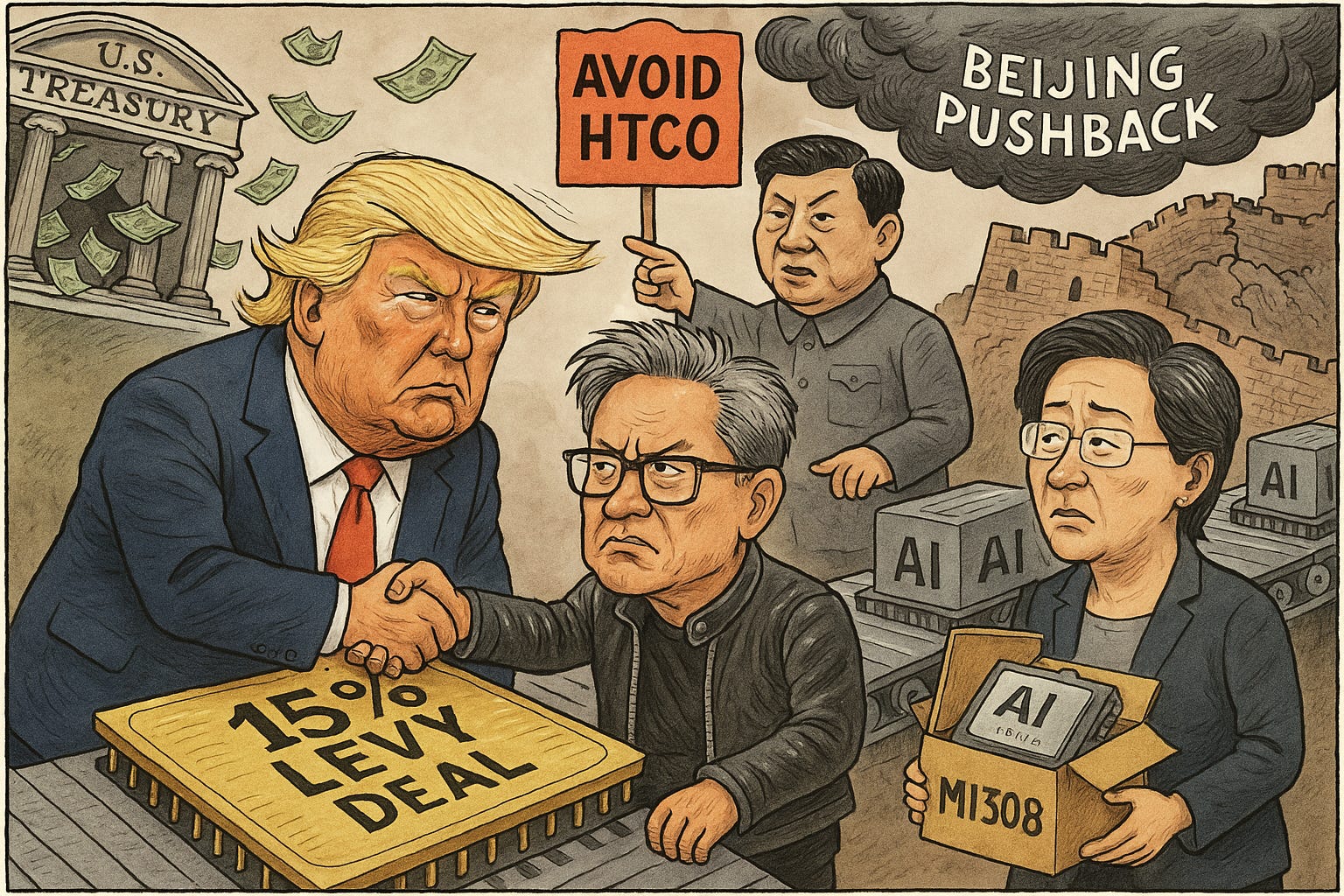
Chinese authorities have issued new notices telling local companies to avoid Nvidia’s H20 processors for government-related or sensitive work, Bloomberg reported (Investing.com, Reuters). The guidance, sent over recent weeks, also discourages use of AMD’s AI accelerators, though it’s unclear if the MI308 chip is named. Both Nvidia and AMD shares fell after the news. The move directly contradicts the unprecedented deal struck just days earlier between Nvidia, AMD, and the Trump administration, under which both companies agreed to remit 15% of their China AI chip revenue to the US government in exchange for export licenses. That arrangement—finalized after an August 6 White House meeting between Nvidia CEO Jensen Huang and President Trump—permitted the resumption of H20 and MI308 sales following an April ban that had cost Nvidia $4.6B in first-quarter sales and prompted a $4.5B inventory writedown. Trump lifted the export restrictions in July, projecting over $2B in annual Treasury revenue from the levy, but China’s latest guidance threatens to derail those expectations.
Why it matters: The pushback underscores the fragility of export controls as an economic lever. Coming just after a US-China trade truce extension, Beijing appears to see the revenue-sharing deal as exploitative rather than cooperative. This raises uncertainty over Nvidia’s projected $17B Chinese market and AMD’s $6.2B potential, while accelerating China’s domestic chip push—potentially reducing future demand for US semiconductors regardless of export policy shifts (BBC, China Briefing).
Sensei’s Insight: Beijing’s pushback shows Washington’s 15% “pay-to-play” chip scheme was fragile from the start. Blocking H20 and MI308 from sensitive projects risks not only immediate sales losses for Nvidia and AMD, but long-term erosion of their role in China’s AI market.
Musk Threatens Apple with Antitrust Lawsuit Over AI App Rankings
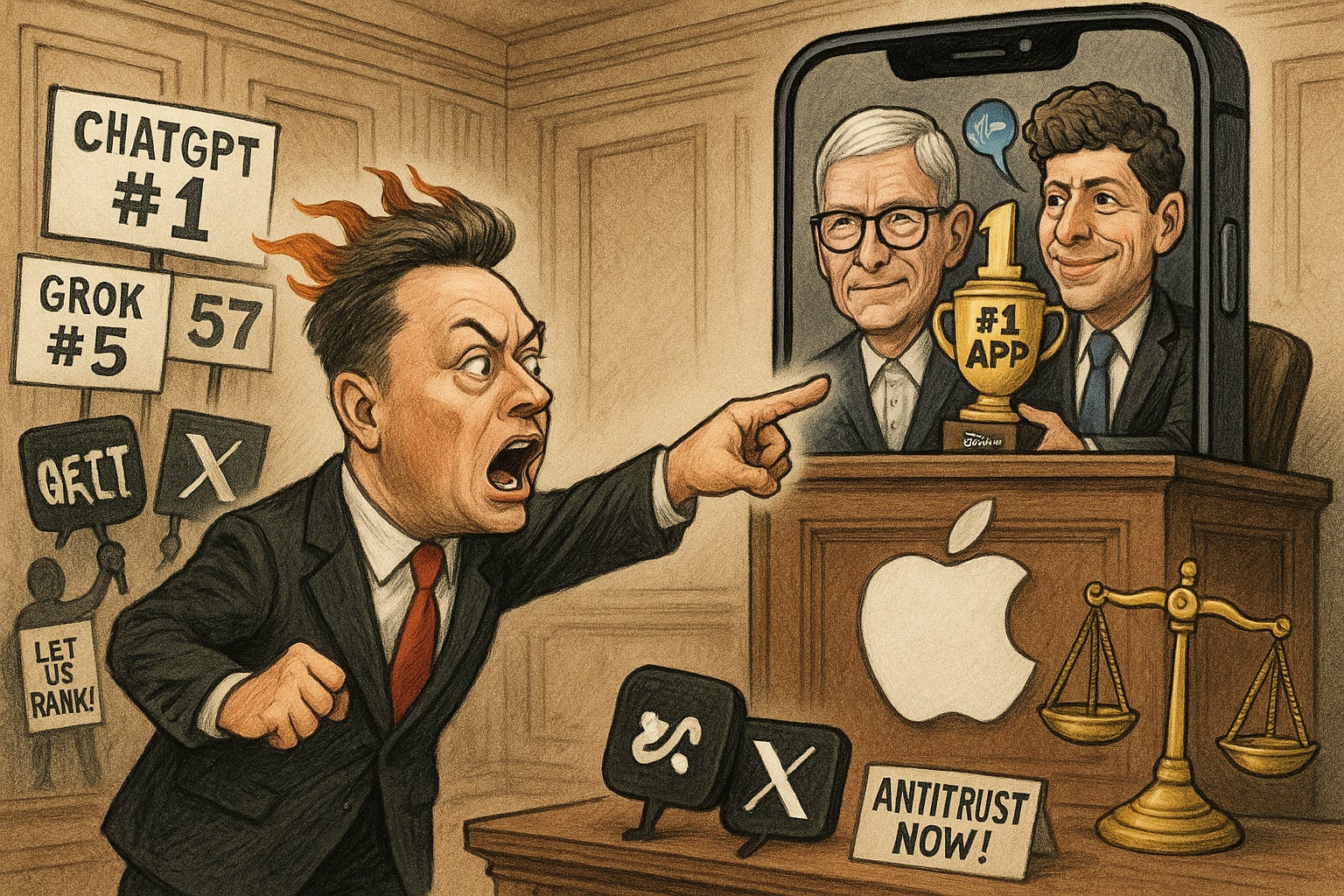
Elon Musk announced Monday that his AI company xAI will pursue “immediate legal action” against Apple, accusing the tech giant of antitrust violations for allegedly favoring OpenAI’s ChatGPT in App Store rankings (Reuters, The Hindu Business Line). Musk claimed Apple makes it “impossible for any AI company besides OpenAI to reach #1 in the App Store” and questioned why his apps X and Grok are excluded from Apple’s “Must Have” section despite X ranking as the top news app and Grok sitting at fifth overall. Currently, ChatGPT holds the number one spot in “Top Free Apps” while Grok ranks fifth, with Google’s Gemini at 57th. The dispute stems from Apple’s June 2024 partnership with OpenAI that integrated ChatGPT into iOS, iPadOS, and macOS through Apple Intelligence features, embedding it directly into Siri and Writing Tools for native access to Apple’s billion-user ecosystem without requiring separate downloads (OpenAI, Apple).
OpenAI CEO Sam Altman countered Musk’s claims, suggesting Musk manipulates his own X platform to benefit his companies while harming competitors, referencing reports about prioritizing his own tweets (Republic World, Best Media Info). This legal threat underscores intensifying battles over platform control in AI and could set precedent for antitrust cases involving app store curation. Apple is already facing a $500M EU fine over competition violations and ongoing DOJ litigation over smartphone market dominance (Economic Times, Independent).
Sensei’s Insight: This fight isn’t about better AI — it’s about who controls the storefront. In the AI era, distribution power may matter more than the tech itself.
UK Jobs Decline, Wage Growth Stays Stubbornly High
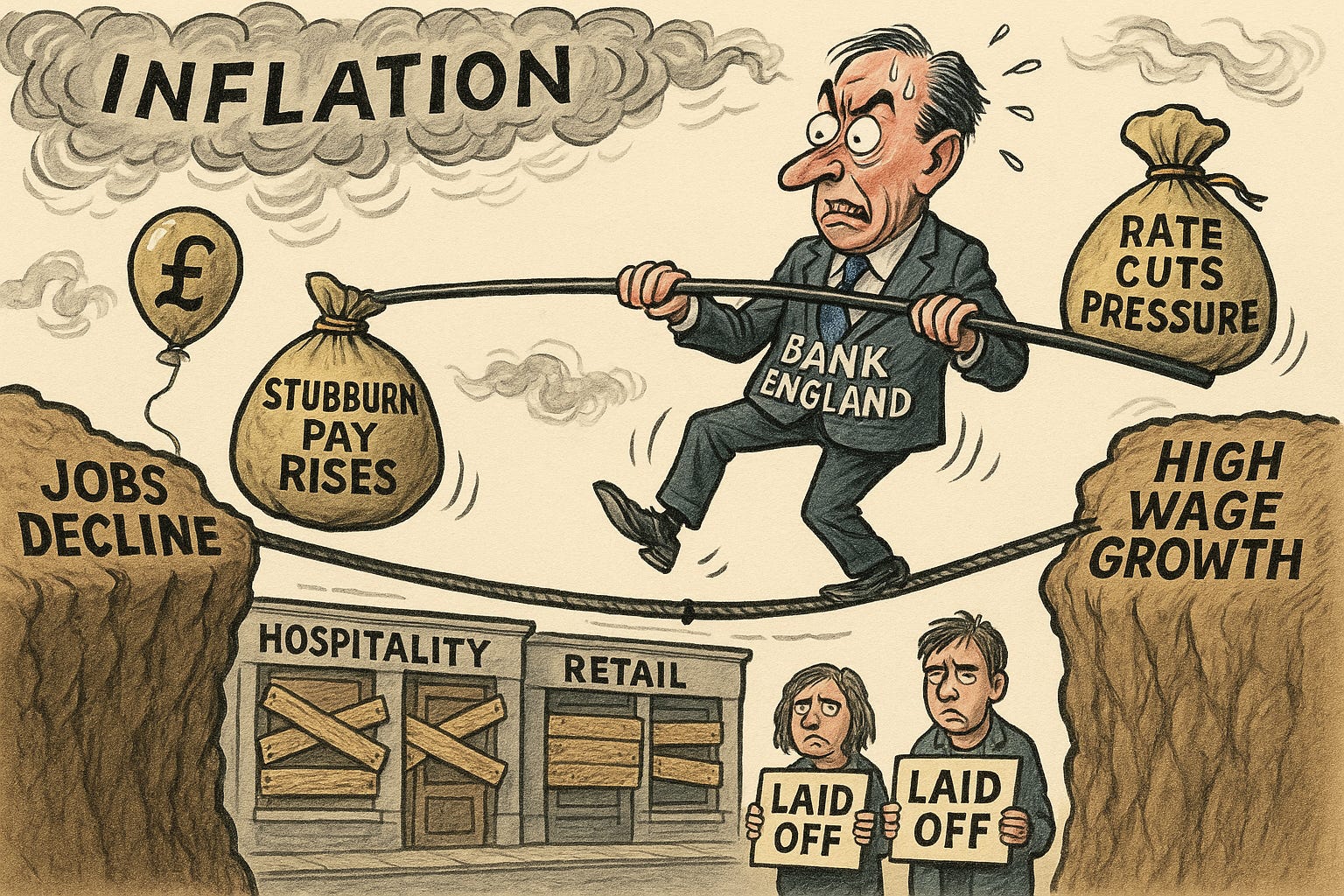
Britain’s labor market weakened for the sixth straight month in July, with payroll employment down 8,000 to 30.3 million, the smallest monthly drop since February. Average weekly earnings growth held at 5.0% year-on-year—well above the Bank of England’s inflation-compatible range. Private sector regular pay growth eased slightly to 4.8% in the three months to June, while vacancies fell 44,000 to 718,000, the lowest since April 2021. Hospitality and retail saw the biggest losses, pressured by April’s National Insurance rise (from 13.8% to 15%) and minimum wage hikes (Reuters, ONS).
Investor Implications — The combination of cooling hiring and persistent wage growth points to a stagflationary environment complicating the Bank of England’s rate path. Last week, the MPC narrowly voted 5–4 to cut rates to 4%, but markets now see the next reduction only in February 2026. Persistent wage growth at double the BoE’s inflation threshold limits room for aggressive easing, suggesting borrowing costs may remain elevated—pressuring interest-sensitive sectors while supporting the pound (Reuters, Yahoo Finance).
Sensei’s Insight: Wage growth at 5% keeps inflation risks alive, forcing the BoE into a “hawkish cut” stance. Expect firmer sterling, supported gilt yields, and pressure on rate-sensitive stocks.
Trump-Backed Crypto Treasury Deal Secures $1.5 Billion
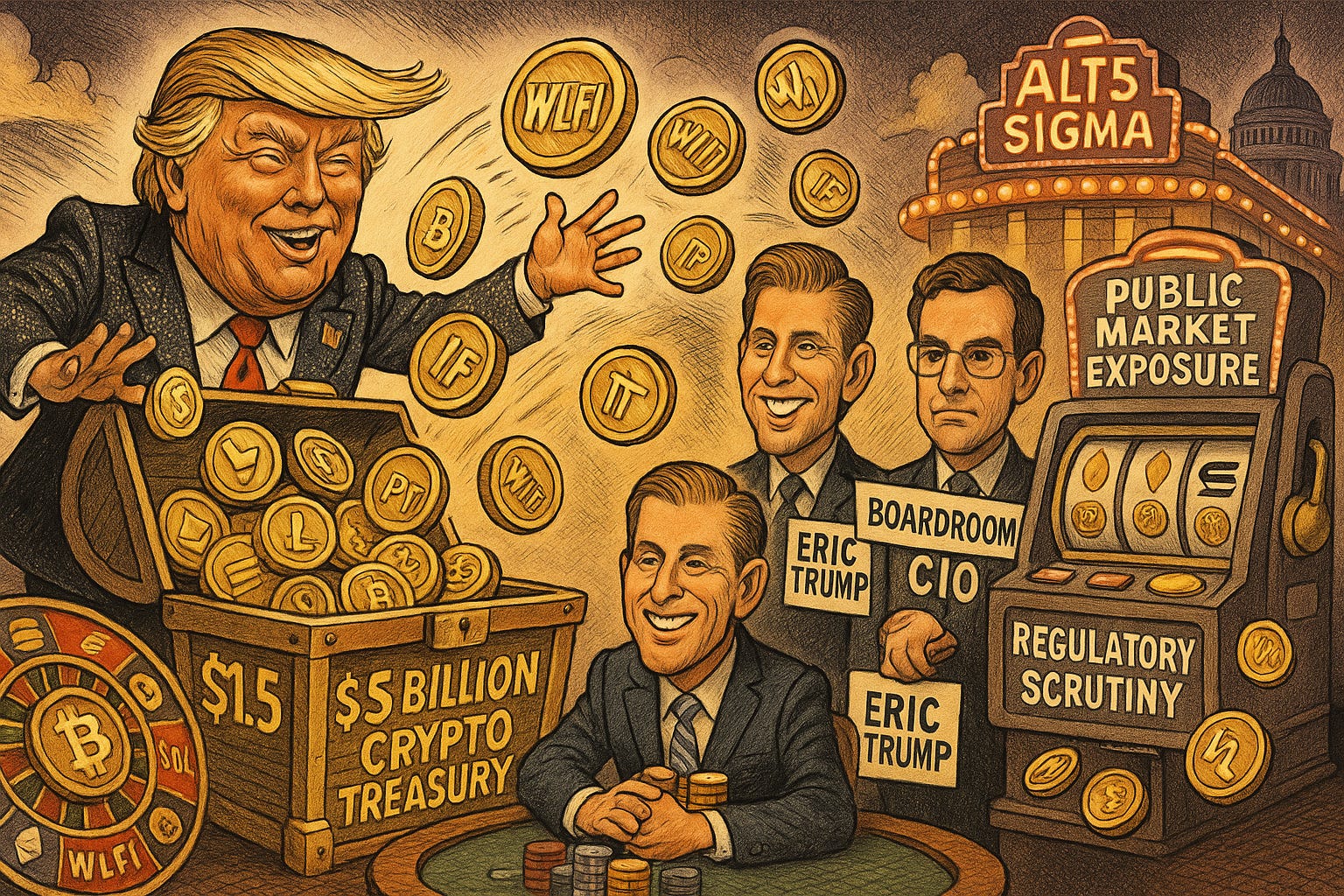
World Liberty Financial has set up a $1.5 billion crypto treasury via Las Vegas-based ALT5 Sigma Corporation, marking the largest corporate acquisition of the Trump family’s WLFI token. ALT5 will sell 200 million shares at $7.50 each through a registered direct offering and private placement, with half funded by WLFI tokens valued at $0.20 each—the first official pricing since the token’s October launch (Cointelegraph, DLNews). The deal gives ALT5 7.5% of WLFI’s total supply. Eric Trump joins ALT5’s board as director, World Liberty CEO Zach Witkoff becomes chairman, and crypto advisor Matt Morgan is named chief investment officer. The August 12 closing will fund further WLFI acquisitions, debt repayment, litigation settlements, and crypto treasury operations (CryptoSlate).
The move legitimizes WLFI with public market exposure and mirrors MicroStrategy’s approach of using corporate treasuries for crypto accumulation. WLFI tokens—recently approved for trading by 99.94% of holders (CryptoRank, CoinDesk)—gain liquidity infrastructure after being restricted to governance functions. This corporate treasury model is expanding beyond Bitcoin into Ethereum, Solana, and now politically connected tokens, potentially creating new institutional crypto channels while prompting scrutiny over intersections between presidential family business interests and regulatory policy (Bloomberg, NYT).
Sensei’s Insight: By anchoring WLFI in a public company’s balance sheet, the Trump family is importing a Bitcoin-style corporate treasury play into the realm of politically connected tokens. This expands the institutional crypto playbook beyond blue-chip assets—potentially normalizing “family brand” coins in capital markets—while intensifying questions about where business strategy ends and political influence begins.
🔗 Connect with Us
Stay plugged in across platforms:
Sensei on X: sensei_crypto_
Martyn Lucas on X: MartynInvestor
Vaz on X: eVTOLHUB
💎 Premium Discord Access: Join the Discord
📺 YouTube Channel (Live & Replays): Martyn Lucas Investor
👕 Limited Merch: Shop Here

🔍 Deeper Dive: The Fed's Most Critical Inflation Test Yet