


👋 A Quick Recap — And a Warm Welcome to New Joiners
If you're new here, welcome to the upgraded Martyn Lucas newsletter!
And if you’ve been reading for a while, here’s a quick refresher on what you now receive each trading day:
✅ The 5 most important things to know before markets open
📉 Chart of the Day with key levels and technical context
🧠 Deep Dives into the big stories moving stocks and crypto
🚀 Coverage of emerging trends like AI, eVTOL, BRICS & macro shifts
📬 If this landed in your junk or promotions folder, make sure to move it to your inbox so it arrives reliably every morning before the bell.
Our goal is to make this the most useful market read of your day — clear, actionable, and built to sharpen your thinking.
If you're still on the free version, you're only seeing part of the picture.
Start your free 7-day trial and unlock the full experience:
🔓 Full daily briefings
🔓 Premium chart setups
🔓 Exclusive research and deep dives
🔓 Access to the full archive
🔓 Member Q&A, chart room, and exclusive groups
👉 Start Your Free Trial Now
Enjoy the rest of today’s newsletter — and see you in tomorrow’s issue.
– Sensei
🧠 One Big Thing
Bitcoin smashed through multiple all-time highs this week, peaking at $118,404 on July 11 amid a record wave of institutional demand. U.S. spot Bitcoin ETFs saw $1.18 billion in inflows in a single day, led by BlackRock’s IBIT and Fidelity’s FBTC. With over 60 public companies now holding BTC as a treasury asset, Bitcoin is rapidly evolving from a speculative play into a mainstream financial reserve.
💰 Money Move of the Day
Consider tracking institutional buying trends—not just price moves—when evaluating long-term conviction plays like Bitcoin. When companies and ETFs start loading up, it often signals a shift in asset class perception that can reshape the risk-reward calculus.
📊 Market Snapshot
Cryptocurrencies:
Bitcoin (BTC): $117,995 (▲ +1.68%)
Ethereum (ETH): $3,003 (▲ +1.72%)
XRP: $2.65 (▲ +3.93%)
Equity Indices (Futures):
S&P 500 (SPX): 6,238 (▼ -0.60%)
NASDAQ 100: 22,879 (▼ -0.58%)
FTSE 100: 8,925 (▼ -0.63%)
Commodities & Bonds:
10-Year US Treasury Yield: 4.383% (▲ +0.76%)
Oil (WTI): $67.47 (▲ +0.12%)
Gold: $3,346 (▲ +0.66%)
🕒 Data as of UK (BST): 12:00 / US (EST): 07:00 / Asia (Tokyo): 20:00
✅ 5 Things to Know Today
🇬🇧 UK-France ‘One In, One Out’ Migrant Deal Highlights Brexit Constraints

British Prime Minister Keir Starmer and French President Emmanuel Macron have agreed to a “one in, one out” pilot program aimed at tackling illegal migration across the English Channel. Starting within weeks, the UK will return up to 50 migrants per week to France in exchange for accepting the same number of asylum seekers from France with family connections or legal claims in Britain. The deal, announced July 10, comes as Channel crossings reach a record 21,000 so far in 2025. The initiative is part of a broader effort to disrupt people-smuggling operations and strengthen border controls, with scope for expansion depending on early outcomes (Politico, Independent, Al Jazeera.)
However, the pact also reveals the post-Brexit limitations in UK-EU relations. Despite being hailed as a diplomatic breakthrough, the arrangement addresses only a small portion of current migration flows, which average 700 arrivals per week. It has drawn criticism from UK right-wing politicians and French officials citing legal and logistical hurdles. Alongside the migration deal, the leaders also unveiled plans for enhanced defense and nuclear cooperation, including joint Storm Shadow missile procurement and coordinated nuclear deterrence planning (Independent, Reuters, Al Jazeera) .
Sensei’s Insight: For markets, the symbolic progress underscores lingering Brexit-era barriers. The capped migrant return quota will likely maintain pressure on UK services and labor markets, particularly in sectors reliant on migrant workers. Political volatility and slow policy alignment with the EU remain key risk factors for UK asset sentiment.
🚗Tesla Moves to Enter Phoenix Robotaxi Market

Tesla has officially filed with Arizona regulators to operate its Robotaxi service in the Phoenix metro area, aiming to challenge Waymo, which has been offering commercial driverless rides there since 2020. The Arizona Department of Transportation confirmed Tesla’s application, submitted on June 26, 2025, for autonomous vehicle testing and commercial operations—both with and without a safety driver. A decision is expected by the end of July. This expansion follows a limited Robotaxi pilot in Austin, Texas, and precedes a planned move into the San Francisco Bay Area, pending regulatory approval (Reuters, Bloomberg, Benzinga).
Waymo’s Dominance and Tesla’s High Stakes
Alphabet-owned Waymo currently operates 24/7 across 315 square miles in Metro Phoenix and delivers around 250,000 paid, driverless rides per week across U.S. cities. Tesla's push into the market is part of its larger pivot toward autonomous mobility, with analysts projecting the segment could add up to $1 trillion in market value if scaled successfully. However, Tesla’s Full Self-Driving (FSD) system remains under scrutiny due to recent incidents in Austin, and financial pressures persist—Tesla’s net income fell 52.5% in 2024 amid ballooning R&D and capex outlays (Monexa, CNBC, Ainvest).
Sensei’s Insight: Tesla’s Phoenix push underscores rising stakes in the U.S. robotaxi arms race. While the addressable market is massive, so are the costs, execution risks, and regulatory minefields. Investors should watch this move closely—it could be either Tesla’s next trillion-dollar catalyst or a costly detour.
Reeves Halts Cash ISA Reform After Industry Backlash
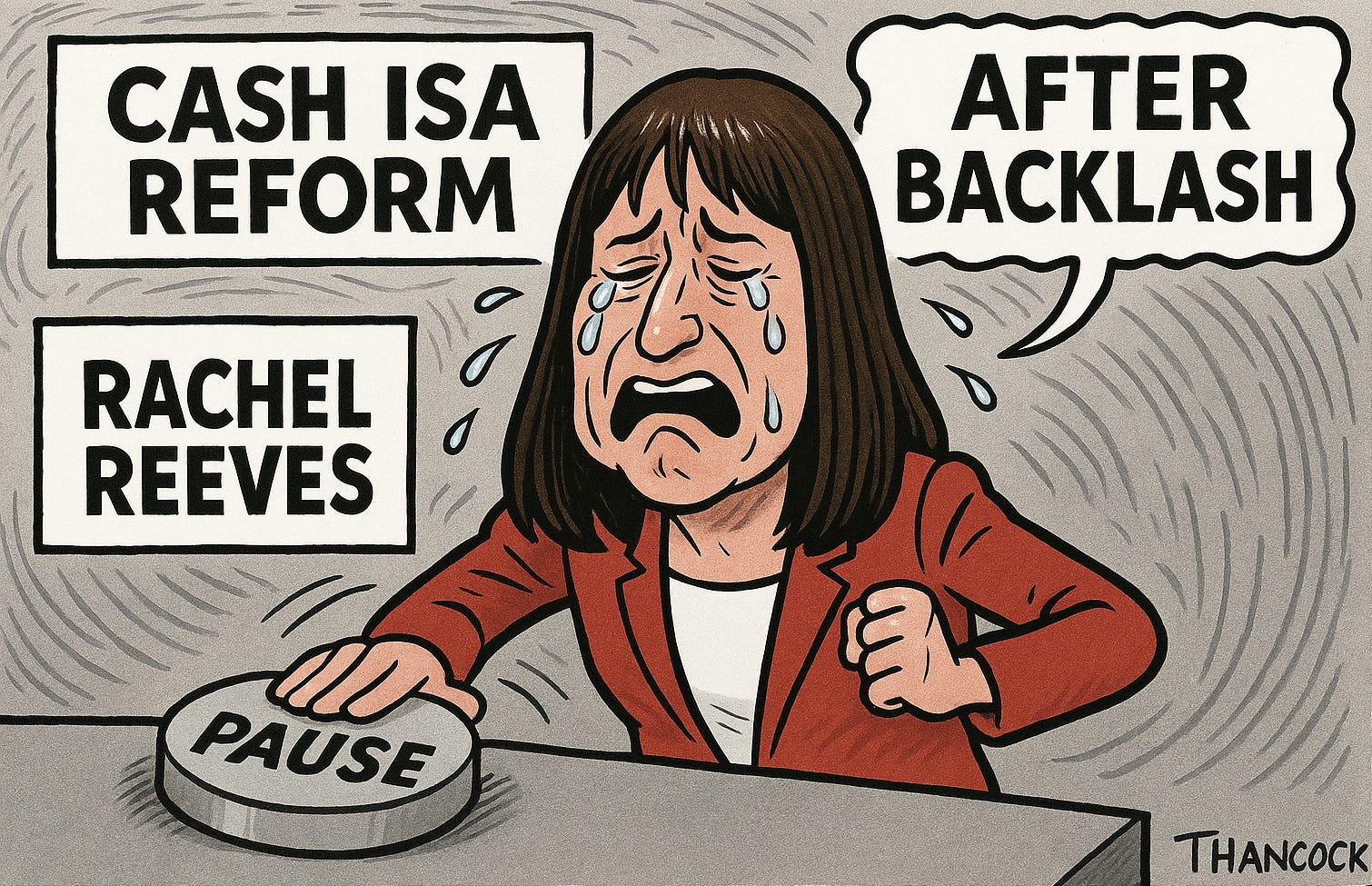
Chancellor Rachel Reeves has shelved plans to cut the £20,000 annual tax-free allowance for UK cash ISAs following intense resistance from banks, building societies, and consumer advocacy groups. The Treasury had been weighing a significant reduction—potentially to £5,000—as part of a broader effort to redirect savings into stocks and shares ISAs. The reform was expected to feature in Reeves’s Mansion House speech on July 15 but will now undergo further consultation with industry stakeholders (FT, BBC, Independent).
The policy rethink reflects broader concerns that slashing the ISA cap could discourage household saving, shrink mortgage funding sources, and increase tax burdens on prudent savers. With over £300 billion held in cash ISAs, critics—including the Building Societies Association—warned that the change risked destabilising retail finance markets. For now, the £20,000 cap remains untouched, preserving a vital tax shelter for millions of UK savers (Telegraph, Yahoo Finance).
Sensei’s Insight: Retail investors just dodged a stealth tax. While this pause offers breathing room, the Treasury’s intent is clear: shift UK savings toward risk assets. Keep your ISA strategy nimble—reforms may return dressed in different clothes.
🇷🇺 Trump Signals Major Russia Announcement, Sanctions in Play

President Donald Trump announced plans to deliver a “major statement” on Russia this Monday following a sharp uptick in Russian aerial attacks on Ukrainian cities. The U.S. has resumed weapons shipments to Ukraine through a new arrangement: arms are sold to NATO, which then transfers them to Ukraine while covering all costs. Trump also voiced support for a bipartisan Senate bill proposing aggressive new sanctions, including up to 500% tariffs on Russian oil, gas, and uranium imports, though he emphasized final implementation rests with him (Forbes, The Telegraph, Kyiv Post).
The sanctions bill, spearheaded by Senators Lindsey Graham and Richard Blumenthal, would also penalize countries purchasing Russian energy—mainly China and India, which represent nearly 70% of Russian oil and gas exports. Backed by more than 80 co-sponsors, the legislation is expected to head to a Senate vote soon. Trump’s rhetoric has notably hardened, with criticism of Vladimir Putin and frustration over stalled ceasefire negotiations and continued aggression in Ukraine. Markets are reacting: Brent crude rose 0.4% to $68.90 and WTI 0.54% to $66.90 Friday morning. Analysts are eyeing possible price volatility in energy and commodity markets, along with broader inflation and trade impacts if sanctions move forward (Fox News, The National, Bloomberg).
Sensei’s Insight: The market’s early reaction to Trump’s tariff threats hints at the outsized influence geopolitical pivots can have on global pricing. Watch Monday’s announcement closely—sanction specifics could set off ripple effects in energy and inflation-sensitive sectors.
🚨 Bitcoin Breaks All-Time Highs Amid Record Institutional Demand
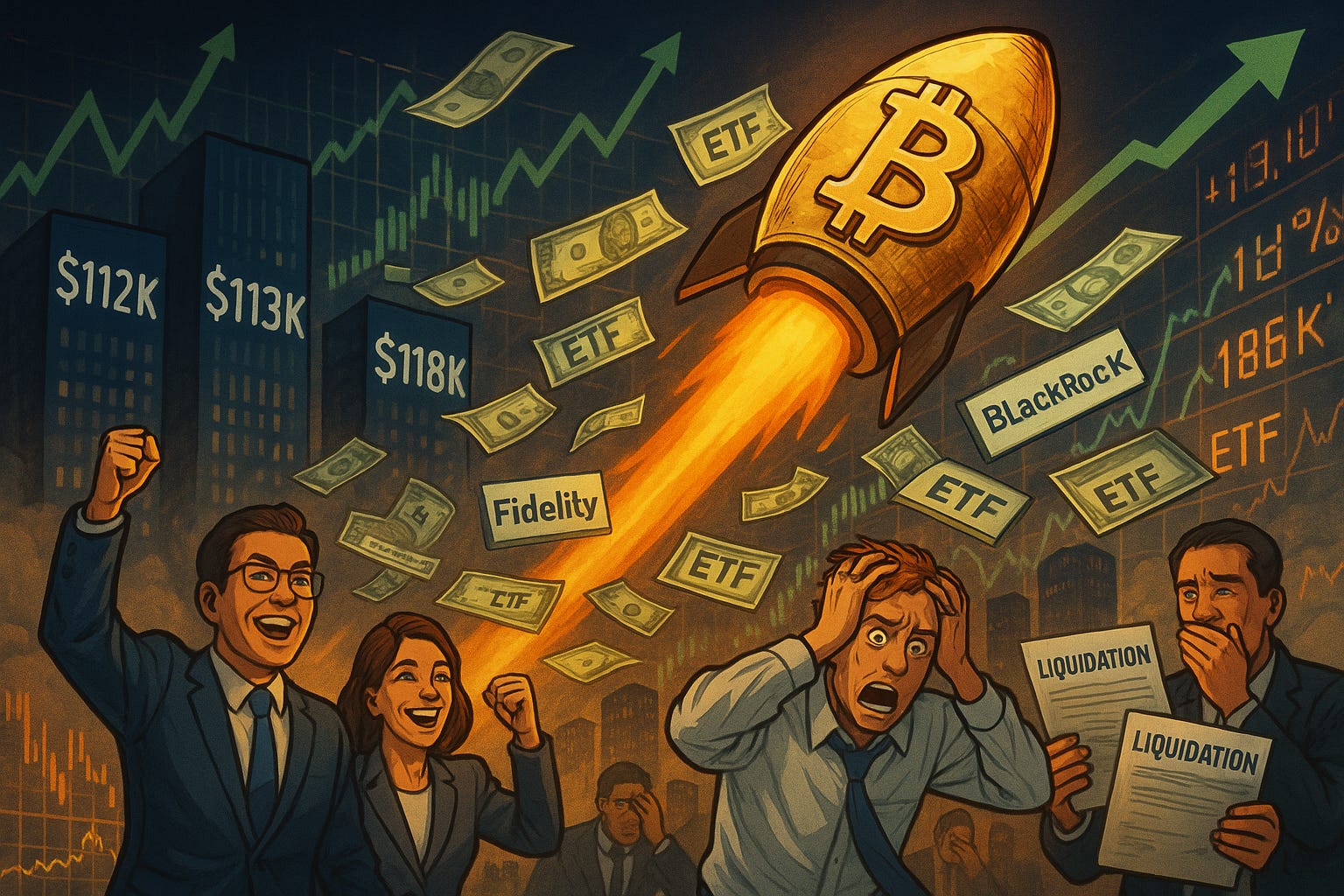
Bitcoin surged past multiple all-time highs over three consecutive days, peaking at $118,404 on July 11, 2025. The rally began July 9 when Bitcoin broke the $112,000 barrier, followed by $113,000 on July 10, culminating in the new record price high on July 11. Year-to-date, Bitcoin is up 21.3%, and it has more than doubled—rising 106.61%—compared to the same time last year. The breakout occurred as U.S. spot Bitcoin ETFs logged their sixth straight day of inflows, reaching $1.18 billion on July 10. BlackRock's IBIT led with $448.5 million in inflows, followed by Fidelity's FBTC at $324.34 million. Bitcoin ETFs have attracted $13.5 billion in net inflows in 2025, approaching $50 billion in total cumulative flows. The surge triggered over $1.13 billion in liquidations, with 237,000 traders caught on the wrong side—90% of them short sellers.
The price spike reflects growing institutional adoption. More than 60 publicly traded companies now hold Bitcoin on their balance sheets, doubling their combined holdings to nearly 100,000 BTC in just two months, as part of treasury strategies. This institutional wave has pushed Bitcoin into uncharted price discovery territory. Regulated ETFs and corporate treasury participation have redefined Bitcoin’s narrative, transitioning it from speculative asset to long-term strategic reserve. But volatility remains intense—single trader losses have reached as high as $88.5 million in recent liquidations, and with little technical support at these levels, sharp corrections remain a serious risk.
Sensei’s Insight: The structure of this rally—driven by ETF inflows, not leverage—suggests Bitcoin’s ascent has entered a fundamentally different phase. Keep your eyes on treasury activity and ETF volume.
🔗 Connect with Us
Stay plugged in across platforms:
Sensei on X: sensei_crypto_
Martyn Lucas on X: MartynInvestor
Vaz on X: eVTOLHUB
💎 Premium Discord Access: Join the Discord
📺 YouTube Channel (Live & Replays): Martyn Lucas Investor
👕 Limited Merch: Shop Here
