🧠 One Big Thing
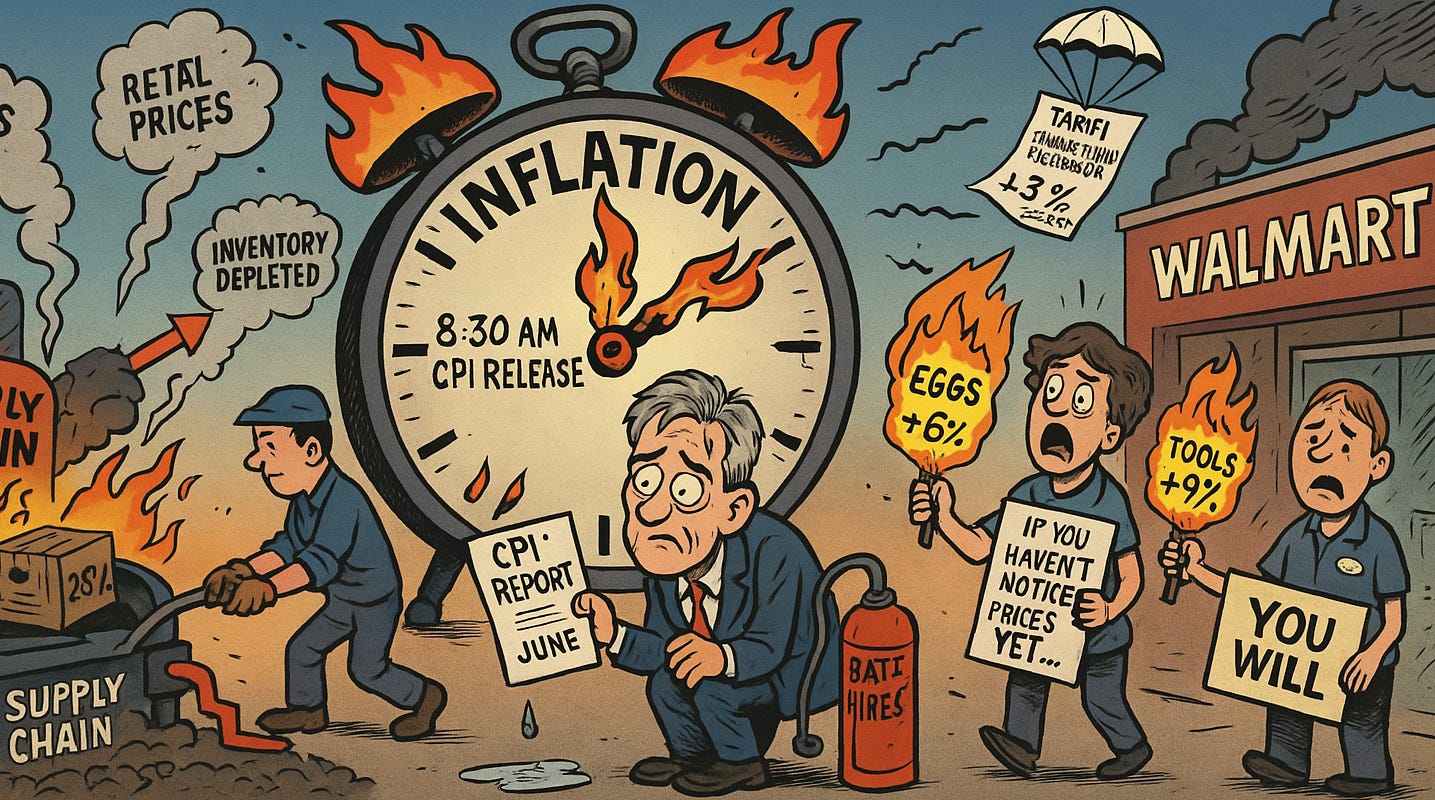
$31,400 — that’s the new average price of a used car in America, up $317 in just a month. With 25% tariffs hitting auto imports, consumers are stampeding into the used market, driving inflation at the ground level—and signaling that the tariff effect is no longer theoretical, it’s happening now.
💰 Money Move of the Day
When inflation rises, revisit your recurring expenses. Even trimming one or two automatic charges—like overpriced insurance or app fees you rarely use—can free up cash to offset rising living costs. Small audits = big resilience.
📊 Market Snapshot
Cryptocurrencies:
Bitcoin (BTC): $116,422 (▼ -2.89%)
Ethereum (ETH): $2,965 (▼ -1.66%)
XRP: $2.89 (▼ -2.32%)
Equity Indices (Futures):
S&P 500 (SPX): 6,296 (▲ +0.46%)
NASDAQ 100: 23,178 (▲ +0.62%)
FTSE 100: 8,995 (▼ -0.31%)
Commodities & Bonds:
10-Year US Treasury Yield: 4.429% (▼ -0.18%)
Oil (WTI): $66.99 (▼ -0.32%)
Gold: $3,359 (▲ +0.48%)
🕒 Data as of UK (BST): 12:23 / US (EST): 07:23 / Asia (Tokyo): 20:23
✅ 5 Things to Know Today
🇷🇺 Trump Threatens 100% Tariffs Over Ukraine War
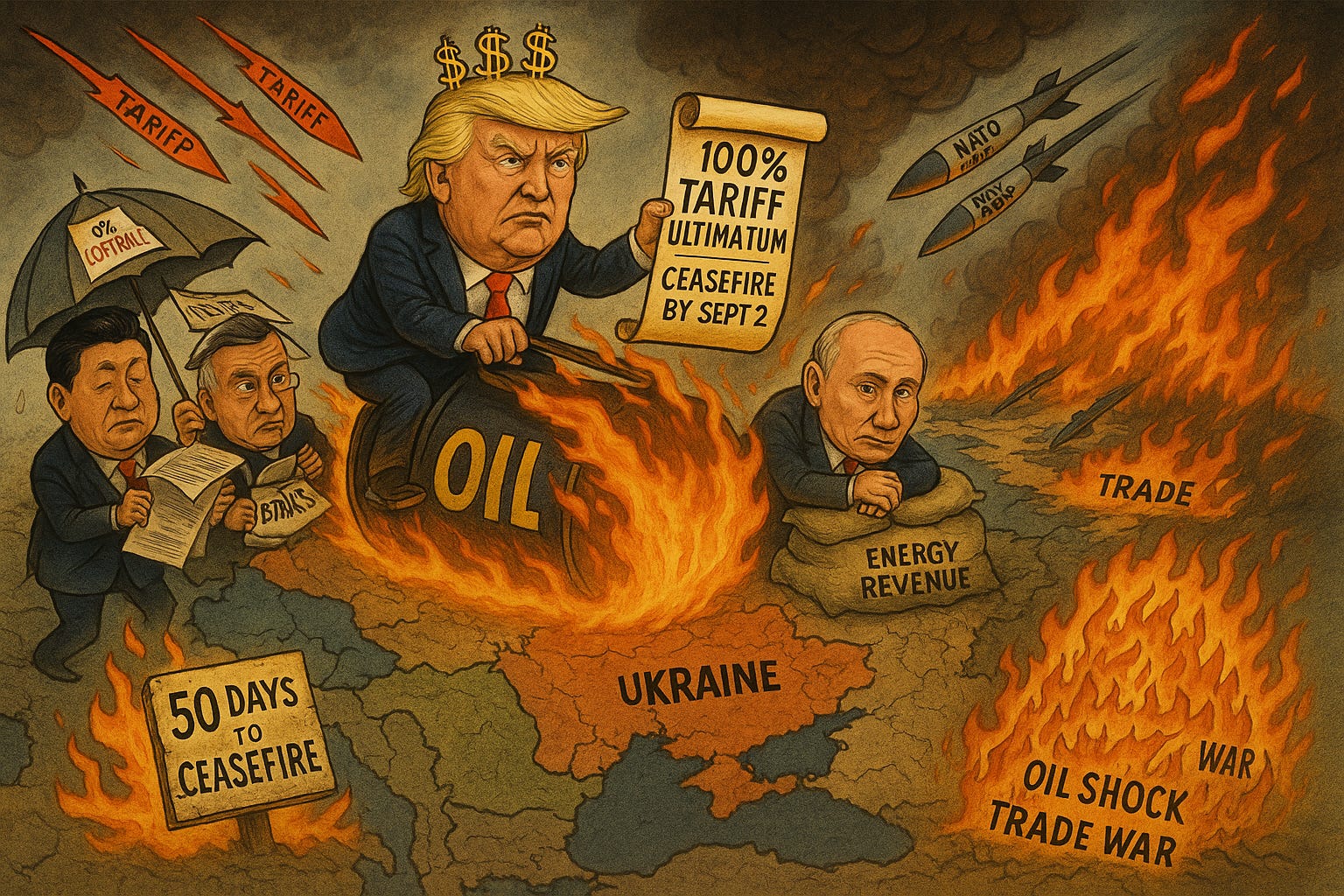
President Trump issued a bold ultimatum to Russia’s trading partners, vowing to impose 100% “secondary tariffs” on any country continuing trade with Moscow unless a Ukraine ceasefire is secured within 50 days—setting a de facto deadline of September 2 (NPR, AP, The Hill). The threat zeroes in on China and India, which collectively account for 85% of Russia’s oil exports (Forbes, Economic Times). Alongside this threat, Trump unveiled a $10 billion NATO arms package for Ukraine—marking a pivot from his earlier hesitations about military support. Standing beside NATO Secretary General Mark Rutte at the White House, Trump voiced frustration with President Putin’s perceived duplicity during phone negotiations (Politico, CNN, Euromaidan Press).
The military aid includes up to 17 Patriot air defense systems and other advanced systems, funded by European allies and restocked by the U.S. (Sky News). Markets responded swiftly, with oil prices rising on fears of supply disruption (Reuters). Analysts warn the tariff threat could hasten deglobalization, prompt retaliatory trade measures—particularly from China—and accelerate shifts in global payment systems and energy flows (TimeTrex, IntelliNews).
Sensei’s Insight: Weaponizing market access this aggressively is rare and risks massive blowback. Investors should prepare for extreme volatility in energy and trade-related sectors as September 2 approaches.
📈 Nvidia Rebound Sparks Global Stock Rally
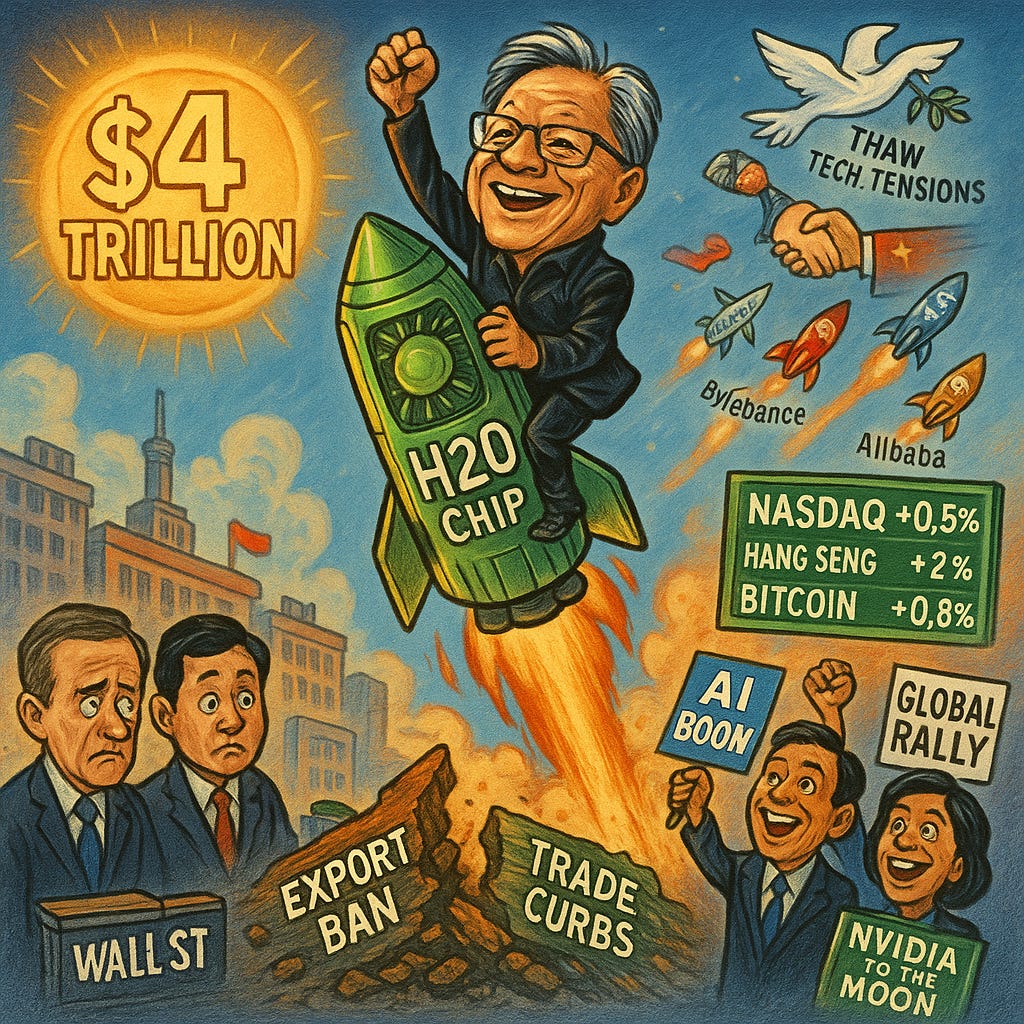
Global equities advanced after the U.S. reversed an export ban on Nvidia’s H20 AI chips to China, a move that could restore up to $15–16 billion in lost revenue. Originally designed to comply with earlier trade curbs, the H20 had been caught in a broader April 2025 crackdown. Now, with direct assurances from Washington, Nvidia expects to resume shipments imminently. CEO Jensen Huang, speaking from Beijing, confirmed the approval and announced a new RTX Pro chip tailored for China. Nvidia shares jumped as much as 4% in pre-market trading, boosting Chinese tech names like Alibaba and the Hang Seng Tech Index (Yahoo Finance, TechCrunch, Economic Times, Bloomberg).
This development helped Nvidia become the world’s first $4 trillion company, surpassing the milestone on surging AI demand and a rebound in China-linked revenues (Reuters). The policy shift also signaled a thaw in U.S.-China tech tensions, benefiting major Chinese AI players like ByteDance and Tencent. Broader markets followed suit: European stocks rose 0.2%, Nasdaq 100 futures gained 0.5%, and S&P 500 futures added 0.3%. Asian indices, especially tech-heavy Hong Kong, climbed as much as 2%. Bitcoin slipped and U.S. Treasuries edged up on a softer dollar. With CPI data due and expectations of a 0.3% monthly rise in both headline and core inflation, investors are eyeing the Fed’s next move closely (SwissInfo, MarketPulse).
Sensei’s Insight: Nvidia’s restored China pipeline and $4T valuation crown it the undisputed AI king—for now. But with inflation data imminent, the mood can flip fast.
🏛️ FTSE 100 Breaks 9,000 Barrier for First Time in Historic Milestone
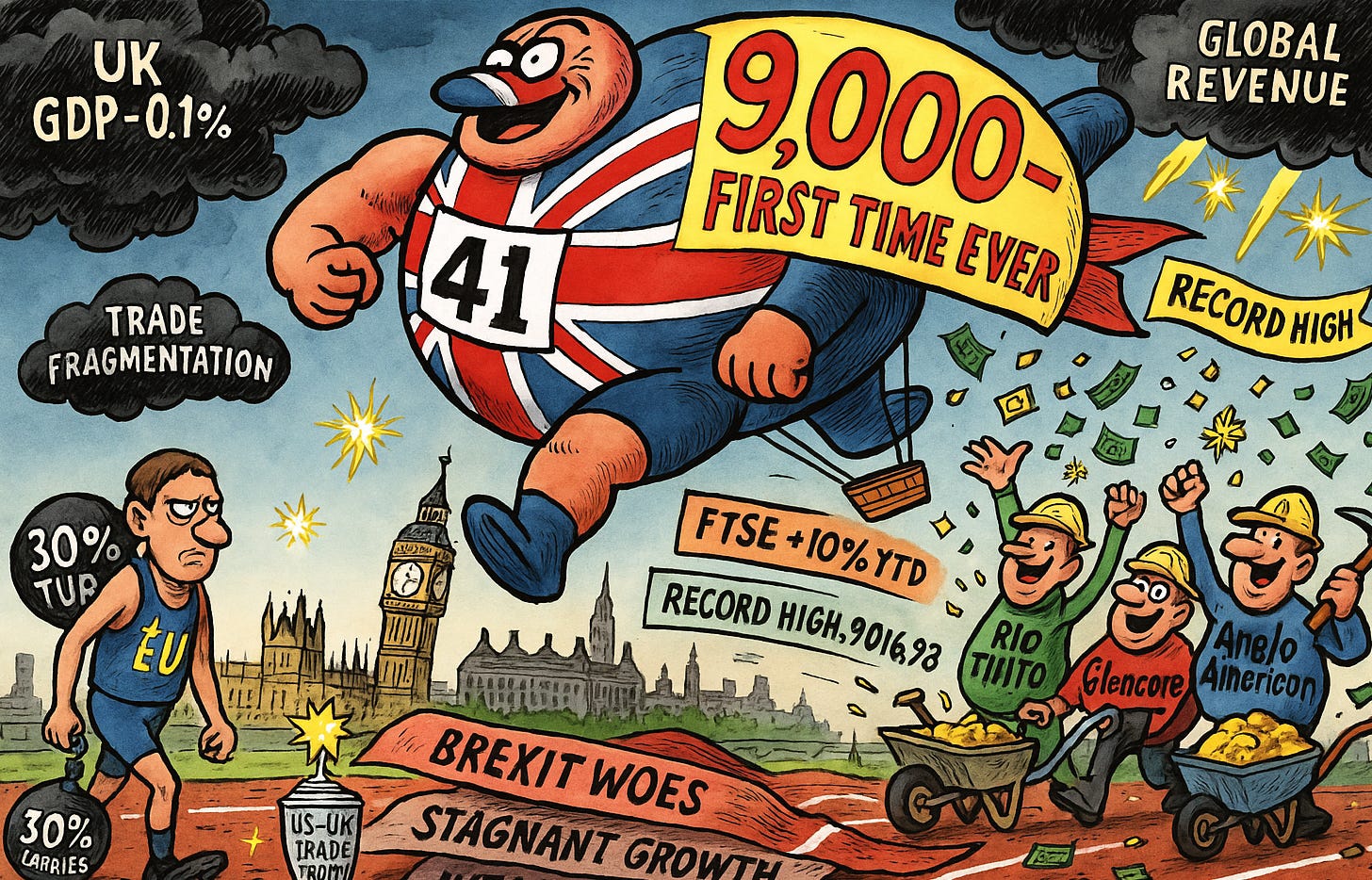
The FTSE 100 surged past the 9,000-point mark for the first time in its 41-year history during Tuesday morning trading, peaking at an intraday high of 9,016.98 points. This milestone followed Monday’s record close of 8,998.06, with the index gaining 10% year-to-date. The spike was attributed to early trading momentum, underpinned by a confluence of positive forces, including a weaker pound that enhances overseas earnings and revived corporate earnings optimism. Mining stocks led the rally, with Rio Tinto, Glencore, and Anglo American advancing 3.7% to 4.0%.
The UK’s fresh trade agreement with the US, which slashed car export tariffs from 27.5% to 10%, offered a distinct edge over European counterparts facing a 30% US tariff threat. In contrast to EU market woes, the FTSE 100's performance signals a growing divergence, positioning UK equities as relatively more attractive. Nonetheless, headwinds loom: the UK economy contracted by 0.1% in May, and global investors remain cautious about the broader implications of trade fragmentation. The index’s global revenue exposure and heavy commodity tilt continue to act as natural buffers against domestic economic softness.
Sensei’s Insight: The FTSE 100’s breach of 9,000 isn't just a number—it’s a reflection of shifting capital tides in a world reordering around bilateral trade deals and inflation hedges.
📜Congress Moves to Define Crypto: House Votes on CLARITY Act
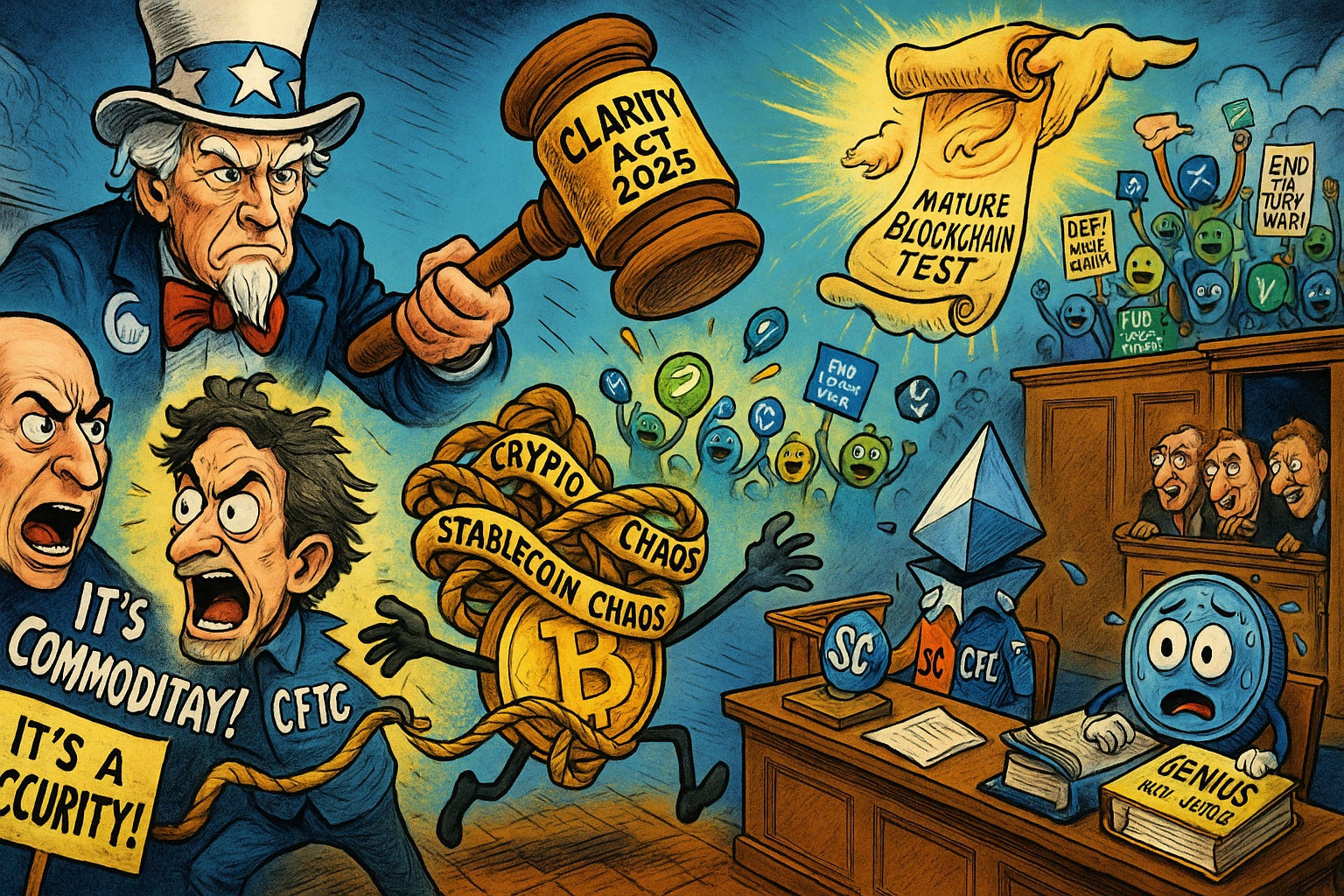
The U.S. House of Representatives is set to vote this week on the Digital Asset Market CLARITY Act of 2025 (H.R. 3633), a sweeping proposal to establish a comprehensive regulatory framework for digital assets. Passed out of the House Financial Services Committee by a 32-19 bipartisan vote and by the Agriculture Committee by 47-6, the bill delineates responsibilities between the SEC and CFTC over the digital asset ecosystem. It introduces statutory definitions for “digital commodity,” “digital asset,” and “mature blockchain system,” and outlines new rules for custody, exchange registration, and broker-dealer obligations. Alongside, the House is expected to take up the GENIUS Act regulating payment stablecoins, as part of a broader legislative package dubbed “Crypto Week.”
The CLARITY Act divides digital assets into securities (under SEC oversight), digital commodities (under CFTC oversight), and permitted payment stablecoins (jointly regulated). A key innovation is the “mature blockchain system” test—allowing decentralized networks to fall under commodities jurisdiction. The bill also includes exemptions for specific investment contracts and addresses secondary market classification—tackling regulatory ambiguity that has stifled U.S. crypto development. Analysts note the Act could reduce regulatory risk, enabling new offerings and greater institutional activity. Final outcomes will hinge on Senate negotiations and implementation specifics, particularly how projects transition from security to commodity status.
Sensei’s Insight: If passed, CLARITY could be the regulatory north star U.S. crypto markets have long awaited—aligning innovation with structure, and unlocking long-dormant momentum.
🇹🇼 Taiwan Turns City Blocks into Battlefields in Record 10-Day Han Kuang Drills
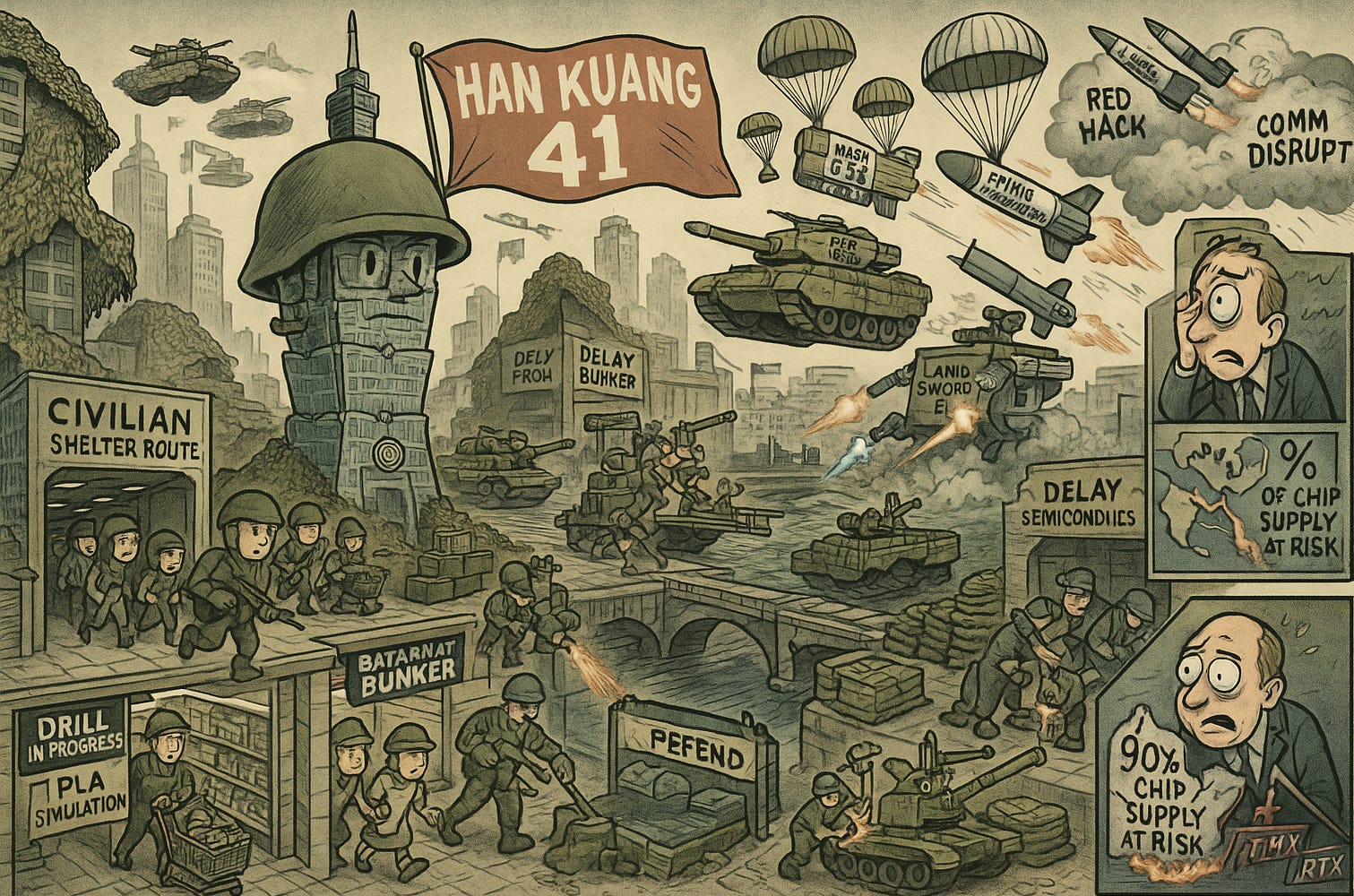
Taiwan has launched its largest-ever Han Kuang 41 military exercise, involving 22,000 troops over 10 consecutive days of live-fire and urban warfare drills. The scenarios push deep into dense cityscapes—troops redeploy through Taipei’s metro system, shoppers are directed into basement shelters in closed supermarkets, and engineers fortify bridges and ports to delay a simulated PLA advance (TWZ, Focus Taiwan, Reuters, Taipei Times). These war games mark the debut of U.S.-supplied HIMARS launchers, Stinger missiles, and Abrams tanks, alongside domestically developed Hsiung Feng-III and Land Sword II defense systems, all underpinned by cyberattack simulations targeting command infrastructure (Newsweek, Janes).
With Taiwan’s defense budget climbing to approximately US$20 billion (≈2.5% of GDP) and ambitions to exceed 3%, a US$19 billion U.S. arms backlog is set to benefit firms like Lockheed Martin and RTX (GlobalData). Analysts warn that any sustained cross-strait conflict would choke off 90% of global advanced semiconductor output and disrupt vital East Asian shipping lanes (Oxford Economics). This intensifying focus on civil defense and asymmetric warfare signals investment tailwinds for drone manufacturers, defense contractors, and semiconductor fabs—but also introduces fresh geopolitical risk premia for Taiwan-exposed equities and debt (AINVEST).
Sensei’s Insight: War games in Taipei’s subways aren’t just drills—they’re a signal. Taiwan’s whole-of-society defense posture is now priced into global supply chains and capital flows.
🔗 Connect with Us
Stay plugged in across platforms:
Sensei on X: sensei_crypto_
Martyn Lucas on X: MartynInvestor
Vaz on X: eVTOLHUB
💎 Premium Discord Access: Join the Discord
📺 YouTube Channel (Live & Replays): Martyn Lucas Investor
👕 Limited Merch: Shop Here

🔍 Deeper Dive: Markets on Edge Before Today's Critical CPI Report