


👀 Today’s Stories at a Glance
🚗 Tesla shareholders approved Elon Musk’s $1T pay deal, betting on autonomous cars, robots, and chips.
💥 Crypto markets erased 2025 gains as Bitcoin dropped 20%, breaking key support after mass liquidations.
🏭 China’s exports fell 1.1% YoY, ending months of trade resilience amid fading demand and tariff impact.
✈️ Archer Aviation raised $650M but widened losses; certification delays push profitability beyond 2027 despite strong liquidity.
📉 U.S. jobs report canceled again; shutdown leaves Fed and markets flying blind ahead of key decisions.
🔍 Bitcoin’s 200DMA break, vanishing liquidity, and silence in media signal we’re entering a full crypto bear market.
🧠 One Big Thing
Tesla shareholders just approved Elon Musk’s $1 trillion pay deal, tied to sky-high targets like a $8.5T valuation and mass production of humanoid robots by 2026. It’s a bold bet on Tesla transforming from EV maker to AI and robotics giant—if Musk can deliver.
💰 Money Move of the Day
Big corporate pivots—like Tesla’s into AI—can shift investor sentiment and valuation. Some look beyond the stock itself to themes like robotics ETFs or suppliers. The key isn’t chasing hype, but spotting where money might move next.
📊 Market Snapshot
Cryptocurrencies:
Bitcoin (BTC): $99,715.62 (▼ -1.61%)
Ethereum (ETH): $3,199.78 (▼ -3.48%)
XRP: $2.1623 (▼ -2.30%)
Equity Indices (Futures):
S&P 500 (US500): 6,704.7 (▼ -0.48%)
NASDAQ 100 (NQ1!): 25,160.75 (▼ -0.33%)
FTSE 100: 9,667.05 (▼ -0.50%)
Commodities & Bonds:
10-Year US Treasury Yield: 4.097% (▲ +0.24%)
Oil (WTI): $60.236 (▲ +0.92%)
Gold: $3,998.48 (▲ +0.54%)
Silver: $48.612 (▲ +1.26%)
🕒 Data as of UK (BST): 12:30 / US (EST): 07:30 / Asia (Tokyo): 20:30
✅ 5 Things to Know Today
🚗 Tesla’s $1 Trillion Bet: Musk’s Mega Pay Deal Tied to Audacious 2026 Roadmap
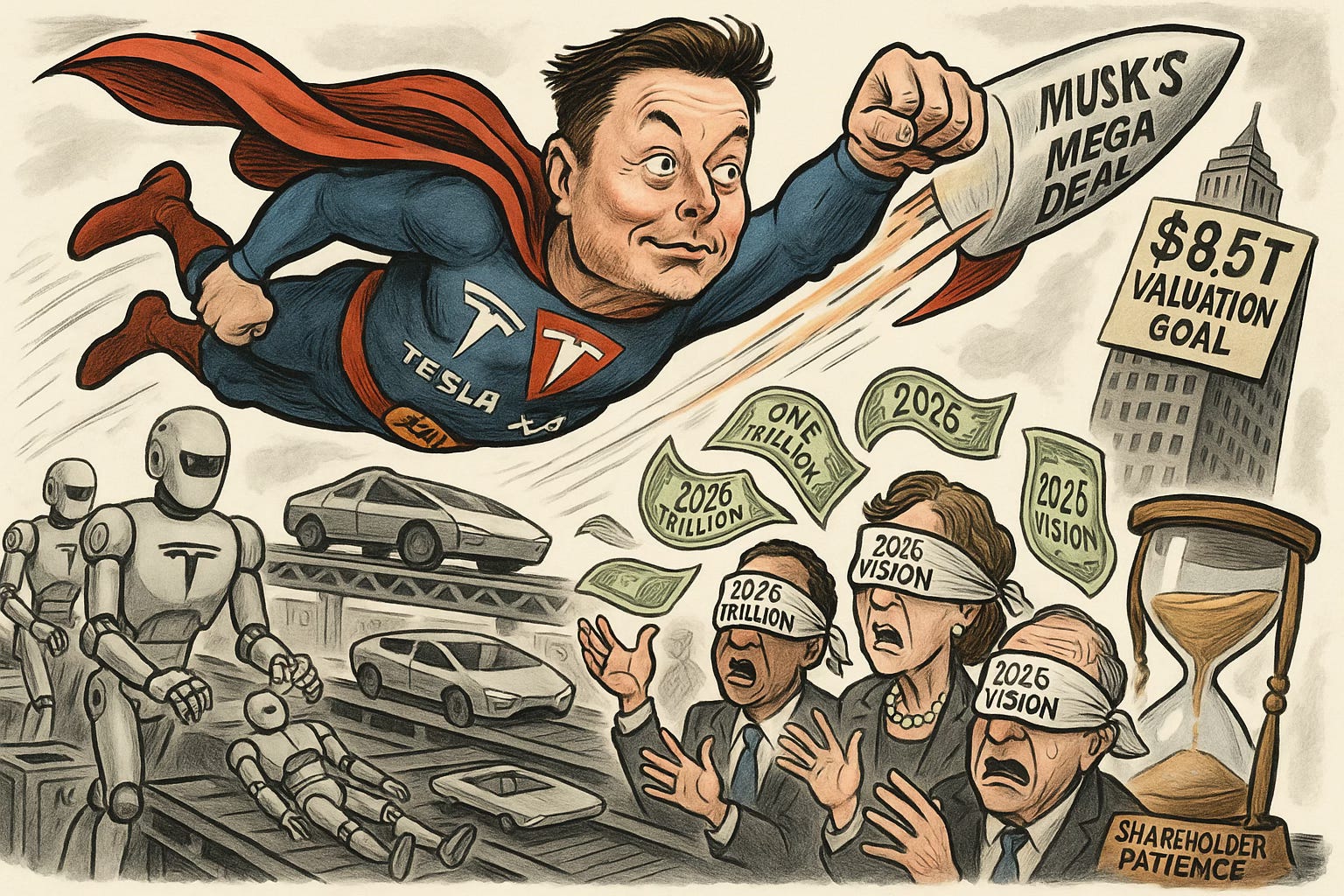
Tesla shareholders have approved Elon Musk’s record $1 trillion compensation package, with over 75% backing the decade-long incentive plan that could lift his stake from 13% to 25% (Bloomberg). The deal hinges on Tesla meeting escalating valuation targets from $2 trillion to $8.5 trillion, alongside operational milestones that stretch far beyond its electric vehicle core. Musk outlined a “three-product blitz” for 2026, including mass production of the Tesla Semi, rollout of the Cybercab (a steering-wheel-free autonomous EV), and the industrial-scale debut of Optimus, Tesla’s humanoid robot. Musk said Optimus will evolve from warehouse work to “performing surgery” and confirmed plans for a million-unit production line by late 2026 (Humanoids Daily).
Amid a two-year sales slump, Musk pledged to boost vehicle output 50% by 2026, partly through cheaper Model 3 and Y variants targeted at China (TechNode). Tesla may also build its own “terafab” semiconductor plant to offset chip shortages, further deepening vertical integration. Critics including ISS, Glass Lewis, and U.S. pension funds condemned the package’s size and dilution risk, while Musk warned he might shift focus to SpaceX or xAI without greater control (Forbes). Supporters see the vote as an all-in wager that Tesla can transform from an EV maker into a robotics and AI conglomerate, if Musk’s execution keeps pace with his vision.
Sensei’s Insight: Tesla’s trillion-dollar bet isn’t just about compensation, it’s a referendum on whether AI and robotics can scale as profit engines before shareholder patience runs out.
💥 Crypto Bull Turns Bear: 2025 Gains Wiped Out in Sudden Reversal

The crypto market’s record-breaking run has come full circle. After touching a $4.4 trillion market capitalization in early October, digital assets have surrendered nearly all of 2025’s year-to-date gains in less than five weeks. Bitcoin, which peaked near $126,000 amid institutional inflows and regulatory optimism, has since fallen over 20%, now trading just above $101,000; its worst stretch since March. The downturn began with a $19 billion liquidation wave that forced leveraged traders out of positions and sparked a cascading selloff across exchanges. The broader crypto index is now up only 2.5% year-to-date, effectively erasing the bull run that had defined much of the year (Reuters, Bloomberg).
The damage has extended well beyond Bitcoin. Altcoins and DeFi tokens have underperformed sharply, with analysts citing limited new capital inflows, persistent security breaches, and fading retail participation. Bitcoin has also broken below its 200-day moving average; a key technical level that had held since the 2022 bear market bottom, signaling deeper structural weakness. While Thursday saw $253 million in fresh inflows to U.S. Bitcoin and Ethereum ETFs, market sentiment remains cautious. Exchange executives warn that a correction in overvalued AI stocks could spill over further into crypto valuations, as both asset classes draw from the same pool of risk-on capital (CNBC, IMF).
Sensei’s Insight: Momentum-driven rallies can unravel in weeks when leverage unwinds. Bitcoin’s loss of its 200-day support suggests volatility will stay elevated until institutional inflows stabilize meaningfully.
🏭 China’s Exports Fall for First Time Since “Liberation Day” Tariffs

China’s exports unexpectedly declined 1.1% year-on-year in October, marking the first contraction since the U.S. imposed “liberation day” tariffs in April (Reuters). The drop sharply contrasts with September’s 8.3% growth and defied expectations for a modest increase, underscoring renewed pressure on global trade momentum. The decline comes despite months of frontloaded shipments by Chinese exporters bracing for tariff escalations during heightened U.S.–China tensions. Although Presidents Trump and Xi reached a one-year trade truce last week, the effects of earlier tariffs and disputes, such as Beijing’s rare earth export controls, continue to disrupt trade flows. Exports to the U.S. plunged 25% in October, while shipments to the EU rose just 0.9% and those to Southeast Asia gained 11%, the weakest increase since February (Bloomberg).
Imports edged up 1% year-on-year, missing forecasts and signaling both softer global demand and cautious domestic consumption. Analysts, including Larry Hu of Macquarie, noted that while exports remain relatively resilient for the year, October’s stumble highlights the limits of China’s diversification strategy as alternative markets lose momentum. The broader outlook hinges on whether non-U.S. demand can offset trade headwinds and if domestic recovery can withstand the ongoing property downturn and weak consumer sentiment.
Sensei’s Insight: The data reinforce how fragile China’s trade recovery remains; frontloaded exports and fading regional demand suggest global supply chains are entering a cooling phase before year-end.
✈️ Archer Aviation’s Q3: Big Cash Raise, Bigger Losses
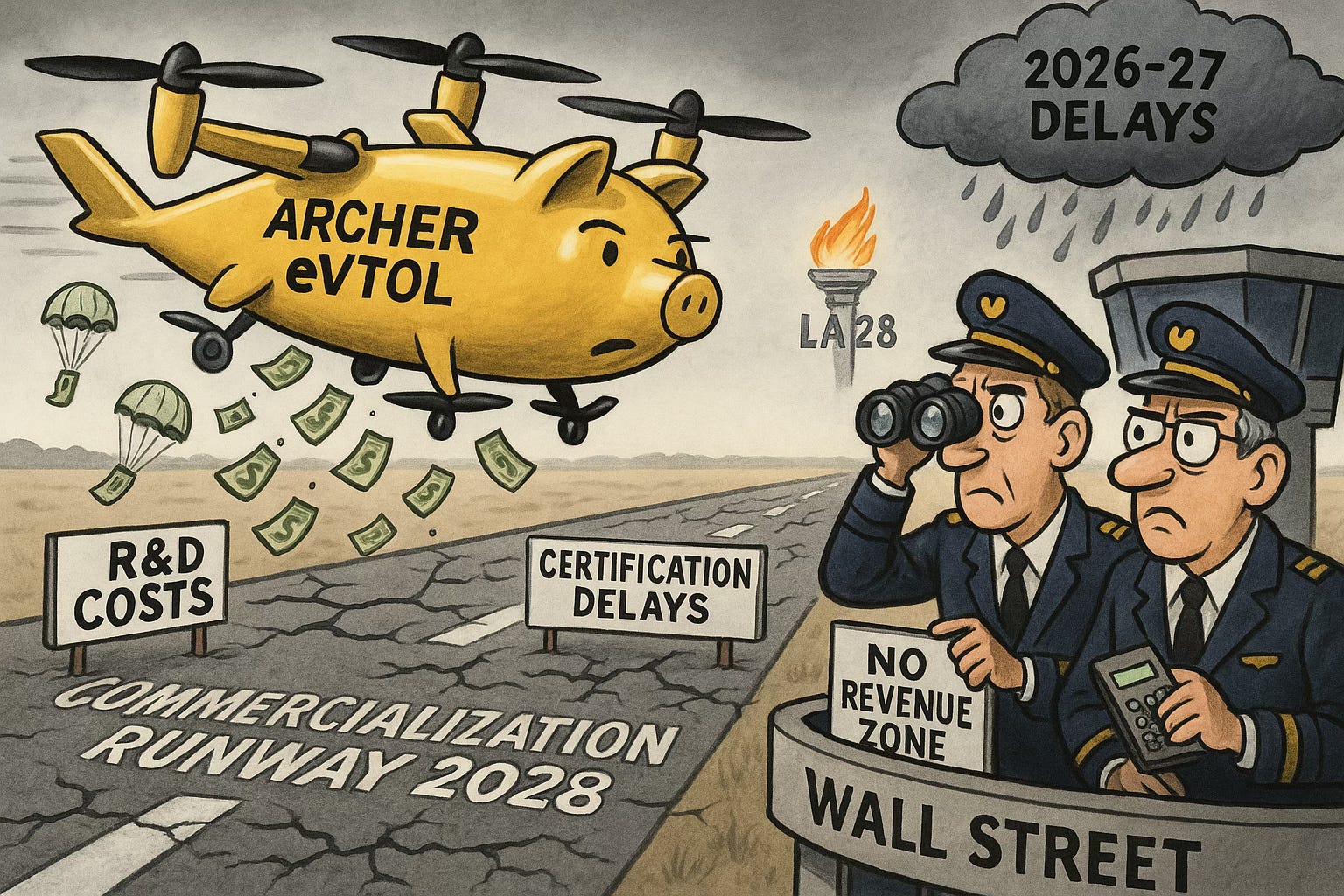
Archer Aviation (NYSE: ACHR) reported a $129.9 million net loss for Q3 2025, widening 13% from last year as the eVTOL pioneer continues its push toward commercialization. The company’s stock dropped 7.2% to $8.88, then slid further to $7.84 after hours, as investors reacted to a fresh $650 million equity raise at $8 per share, its third this year, bringing total 2025 funding to about $1.8 billion. Operating expenses rose to $174.8 million, led by $120.7 million in R&D, while adjusted EBITDA came in at a $116.1 million loss (MarketBeat). Despite being pre-revenue, Archer guided Q4 adjusted EBITDA losses between $110 million–$140 million.
Archer ended the quarter with $1.64 billion in liquidity, boosted by the new raise to over $2 billion, giving it one of the strongest balance sheets in the eVTOL sector (Bloomberg). The company also announced plans to acquire Hawthorne Airport in Los Angeles for $126 million, transforming it into a hub for air taxi operations ahead of the LA28 Olympic Games (Aviation Week). Archer’s Midnight aircraft achieved a 50-mile range milestone, and its Lilium patent acquisition added 300 assets to its IP portfolio. Still, certification delays (now expected in 2026–27) and a mounting cash burn remain key risks as the firm seeks to commercialize by 2028.
Sensei’s Insight: Archer’s liquidity buyback buys time, but not certainty. Investors face a long runway: certification delays push profitability into 2027+, testing patience even with $2B in reserves.
📉 U.S. Jobs Report Canceled Again Amid Historic Data Blackout
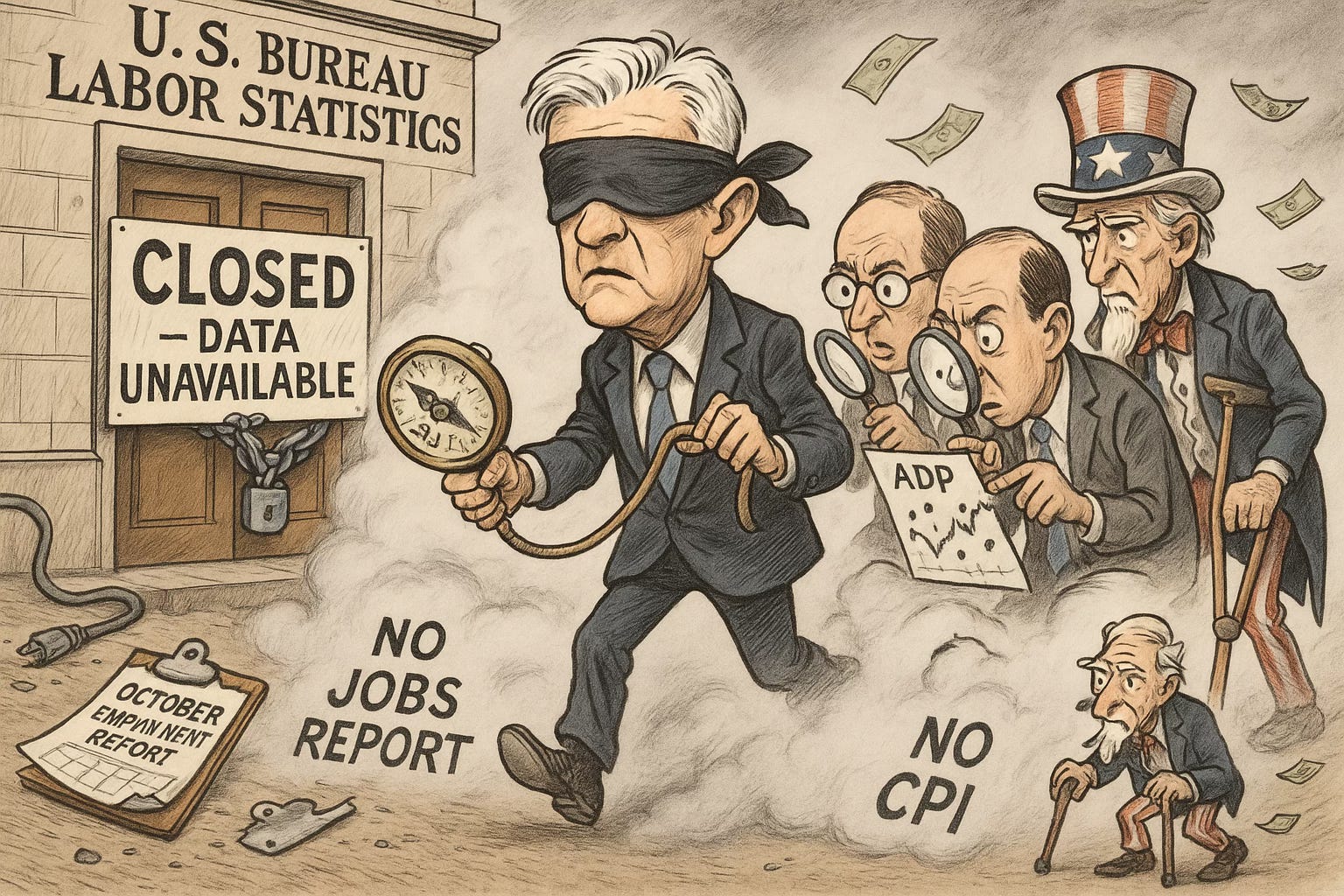
For the second consecutive month, the U.S. Labor Department will not publish its employment report, marking an unprecedented data lapse caused by the ongoing government shutdown, the longest in U.S. history (Reuters). Economists warn that October’s jobs data may be irretrievable, as key surveys couldn’t be conducted while the Bureau of Labor Statistics (BLS) was closed. The establishment survey, which measures payrolls, might be reconstructed using company records, but the household survey (the basis for the unemployment rate) is likely lost due to missed in-person interviews by the Census Bureau. Former BLS Commissioner Erica Groshen said the gaps could make it impossible to calculate an accurate unemployment rate for October. Similar issues threaten the October CPI report, leaving policymakers and markets without the two most critical economic indicators.
The shutdown’s economic toll is mounting. Goldman Sachs cut Q4 GDP growth forecasts to 1%, citing the data freeze as a major drag (CNN). The Congressional Budget Office estimates the shutdown could shave up to 2% off annual GDP, erasing up to $14 billion in output. Private firms like ADP and Revelio Labs have filled some gaps, showing slowing hiring and job losses, but analysts stress their data lacks the scope and reliability of official reports (NBC News). With the Fed’s December meeting approaching, Chair Jerome Powell faces policy decisions “in the fog,” potentially delaying further rate cuts until credible labor and inflation data return.
Sensei’s Insight: Markets now lack the two anchors—jobs and inflation—that guide Fed policy. Expect volatility as investors trade on incomplete private data and speculation about the December rate decision.
🔗 Connect with Us
Stay plugged in across platforms:
Sensei on X: sensei_crypto_
Martyn Lucas on X: MartynInvestor
Vaz on X: eVTOLHUB
💎 Premium Discord Access: Join the Discord
📺 YouTube Channel (Live & Replays): Martyn Lucas Investor
👕 Limited Merch: Shop Here
