


👀 Today’s Stories at a Glance
🚀 OpenAI Hits $500B Valuation
OpenAI becomes the world’s most valuable startup after a $6.6B share sale and revenue surge.🛡️ EU Slaps 50% Tariffs on Steel
Brussels doubles tariffs and slashes import quotas to protect EU steelmakers from Chinese overcapacity and U.S. pressure.🚨Trump Threatens Federal Layoffs
A historic shutdown escalates as Trump eyes permanent job cuts, delaying data and shaking markets and agencies.🪙 Robinhood Bets on Tokenization
CEO Vlad Tenev calls tokenization a “freight train,” pushing for 24/7 asset trading and global on-chain finance.🇹🇭 Thailand Expands Crypto ETFs
Thai SEC plans multi-asset crypto ETFs to boost adoption and offset equity outflows amid market volatility.💊 Pfizer Resets for Post-COVID Era
Pfizer strikes a White House pricing deal, boosts pipeline with Metsera, and bets on high-yield turnaround.
🧠 One Big Thing
OpenAI just hit a $500 billion valuation, making it the most valuable startup on the planet—leapfrogging SpaceX in the process. That’s a half-trillion-dollar bet on the future of artificial intelligence.
💰 Money Move of the Day
Not every massive valuation signals profitability. OpenAI’s sky-high worth comes with a $2.5B burn rate—an example of how investors often prioritize long-term potential over short-term returns. Watching where the smart money flows can help decode where the market thinks the future is headed.
📊 Market Snapshot
Cryptocurrencies:
Bitcoin (BTC): $118,818 (▲ +0.18%)
Ethereum (ETH): $4,386 (▲ +0.87%)
XRP: $2.99 (▲ +1.48%)
Equity Indices (Futures):
S&P 500 (SPX): 6,723 (▲ +0.26%)
NASDAQ 100: 25,109 (▲ +0.37%)
FTSE 100: 9,461 (▼ -0.05%)
Commodities & Bonds:
10-Year US Treasury Yield: 4.090% (▼ -0.24%)
Oil (WTI): $61.77 (▼ -0.43%)
Gold: $3,881 (▲ +0.41%)
🕒 Data as of UK (BST): 11:44 / US (EST): 06:44 / Asia (Tokyo): 19:44
✅ 5 Things to Know Today
🚀OpenAI Becomes World’s Most Valuable Startup at $500 Billion Valuation
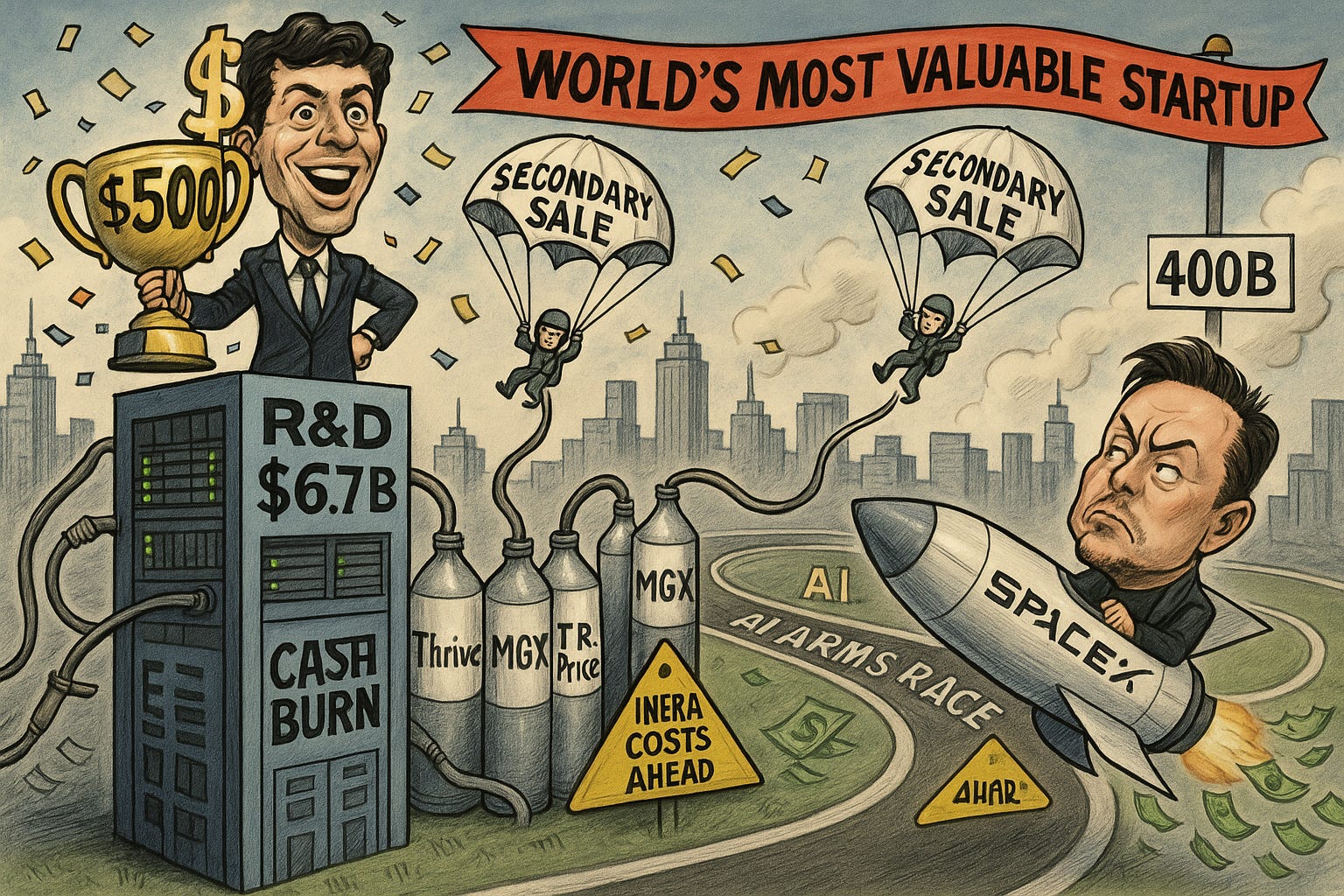
OpenAI has surpassed SpaceX to become the world’s most valuable private company following a $6.6 billion secondary share sale, which valued the ChatGPT creator at $500 billion. The transaction allowed current and former employees to offload shares to major backers including SoftBank, Thrive Capital, Dragoneer Investment Group, Abu Dhabi’s MGX, and T. Rowe Price. This marks a dramatic jump from OpenAI’s prior $300 billion valuation earlier this year, also led by SoftBank. The new valuation now eclipses SpaceX’s $400 billion, which Elon Musk’s firm reached via its own internal share sales in July, according to Bloomberg and Reuters.
The sale highlights OpenAI’s accelerating financial performance, with the company pulling in $4.3 billion in revenue in H1 2025—already 16% higher than its full-year 2024 total, per CNBC. While it burned $2.5 billion in cash during the same period, primarily toward its $6.7 billion R&D budget, OpenAI still held $17.5 billion in cash and securities mid-year. The company projects $13 billion in full-year revenue with a targeted $8.5 billion ceiling on annual cash burn. Notably, only two-thirds of the approved $10.3 billion in shares were actually sold, a signal insiders view as employee confidence in OpenAI’s long-term trajectory, according to The Information.
Sensei’s Insight: While the valuation milestone cements OpenAI’s dominance in the AI arms race, its soaring costs and unprofitable trajectory mirror a broader trend of speculative overvaluation in the sector—where infrastructure, not immediate returns, remains the real battleground.
🛡️ EU Proposes Doubling Steel Tariff Rate to 50% in Trade Protectionism Pivot
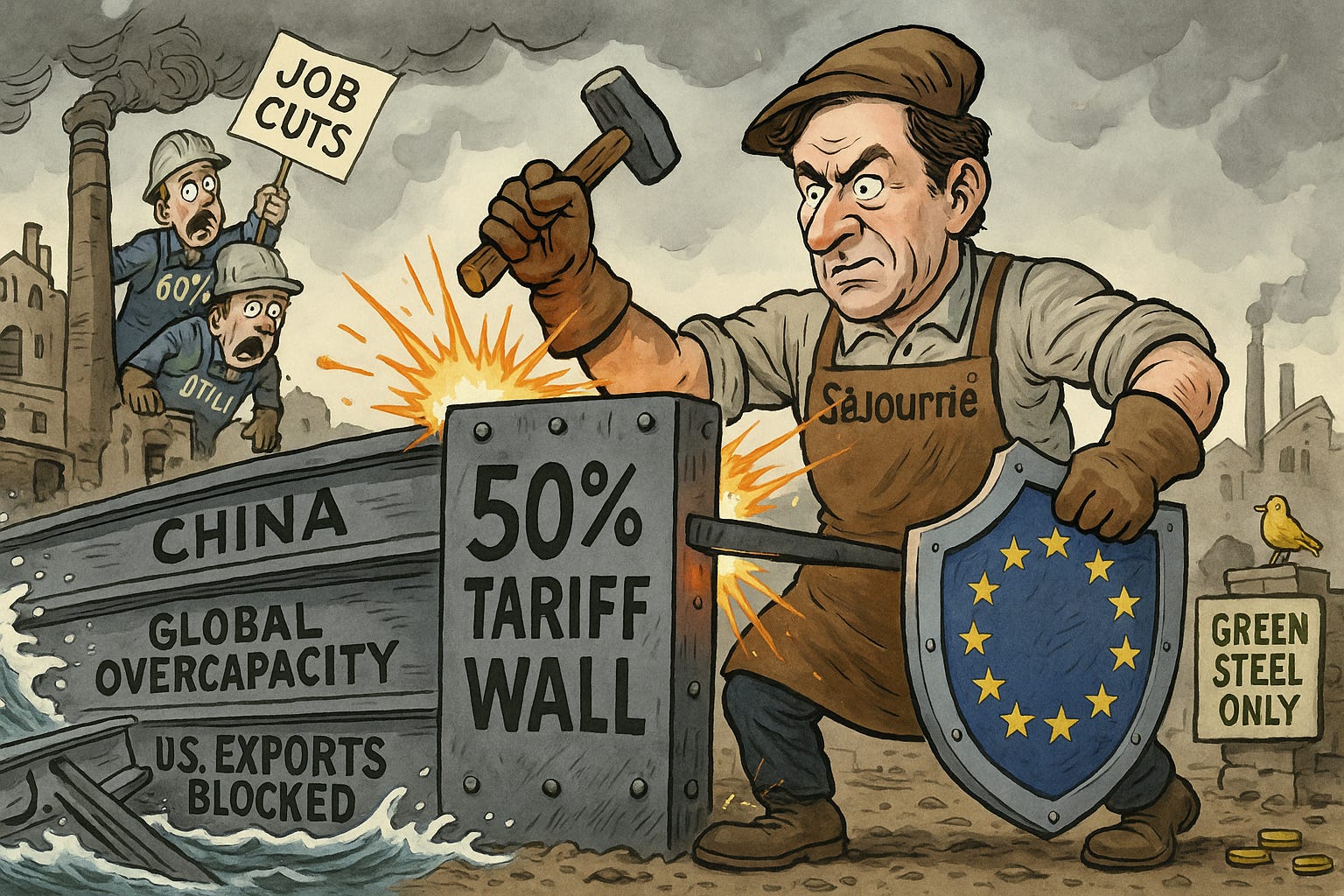
The European Commission is set to unveil on Oct. 7 a proposal to nearly halve steel import quotas and apply a 50% tariff to imports above those quotas—broadly aligning with recent U.S. and Canadian measures. Executive Vice President for Industrial Strategy Stéphane Séjourné briefed steel industry groups ahead of the announcement, describing the bloc’s most forceful intervention in the steel market in years. These new measures will replace the EU’s existing safeguards, which expire on June 30, 2026. Brussels had already tightened quota volumes by 15% starting April 1. The policy shift comes amid unprecedented global overcapacity, with surplus steel hitting 551 million tonnes in 2023—four times the EU’s output—and projected to reach 700 million tonnes by 2026. Meanwhile, Chinese exports are expected to hit a record 115–120 million tonnes in 2024. Adding pressure, the U.S. has maintained 50% tariffs on EU steel since March, contributing to a drop in EU steel exports to the U.S. from 4.6 million tonnes pre-2018 to 3.8 million tonnes this year.
Europe’s steel sector is reeling: capacity utilization has collapsed to 60%, and 18,000 job cuts have already been announced in 2024—on top of 100,000 positions lost over the past 15 years. The new measures aim to recalibrate the bloc’s trade exposure, with imports now making up 27–30% of flat steel consumption versus a historical average of 15%. The proposal is aligned with broader EU-U.S. “metals alliance” talks to shield both markets from Chinese oversupply. Policymakers also view the plan as vital to defending the EU’s €300 billion steel industry and enabling a successful transition to greener steel. However, downstream sectors—especially automotive and machinery—are bracing for cost pressures as supply chains adapt to the new tariff regime.
Sensei’s Insight: With global steel oversupply intensifying and green transition costs mounting, Brussels has chosen survival over free trade.
🚨 Shutdown Goes Nuclear: Data Blackout Meets Layoff Threats
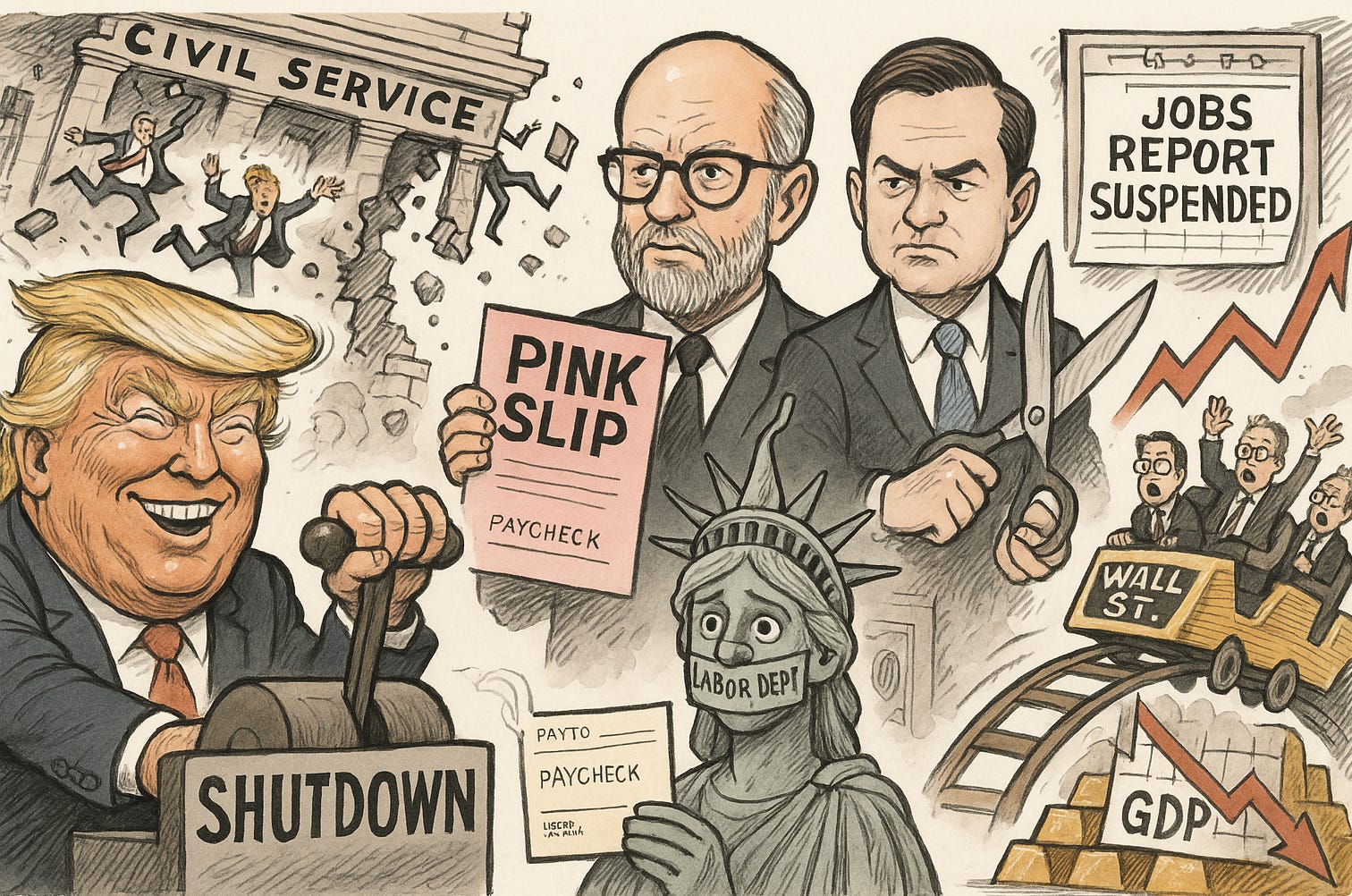
President Donald Trump has triggered a full government shutdown following the collapse of political negotiations, and now signals a dramatic escalation: mass layoffs across federal agencies. Top White House figures, including OMB Director Russell Vought and Vice President JD Vance, have warned that terminations could begin “imminently,” potentially affecting over 750,000 workers. Unlike prior shutdowns, which involved temporary furloughs, this administration is exploring permanent job cuts. The move has sparked immediate legal challenges from public-sector unions and coincides with selective defunding of $26 billion in infrastructure programs in Democratic-led states—a strategy the White House confirmed is deliberate.
Fresh labor data highlight the tension. Initial jobless claims registered 218,000 last week, with continuing claims holding near 1.93 million, signaling a still-resilient labor market. But the broader picture is set to blur: the Department of Labor confirmed that the Bureau of Labor Statistics will suspend release of its monthly employment report during the shutdown, cutting off one of the most important indicators of U.S. economic health (Reuters).
Markets are already adjusting. Gold has hit record highs, the 10-year Treasury yield slipped 4 basis points, and equities are rallying on safe-haven momentum. Analysts warn that every week of shutdown could shave ~0.1% off GDP, while prolonged federal layoffs may weaken the dollar and weigh on global exports. Ratings agencies such as Fitch maintain U.S. credit stability for now—but caution that the outlook could deteriorate if the crisis drags on.
Sensei’s Insight: The shutdown isn’t just a political fight — it’s a data blackout. With the September jobs report shelved, the Fed is flying blind into its October meeting. That shifts market focus to the only numbers still flowing: jobless claims, ADP, and private surveys. Traders should expect heightened volatility, because when the Fed lacks hard data, markets start guessing policy moves in real time.
🪙 Robinhood CEO: Tokenization Will ‘Eat the Entire Financial System’
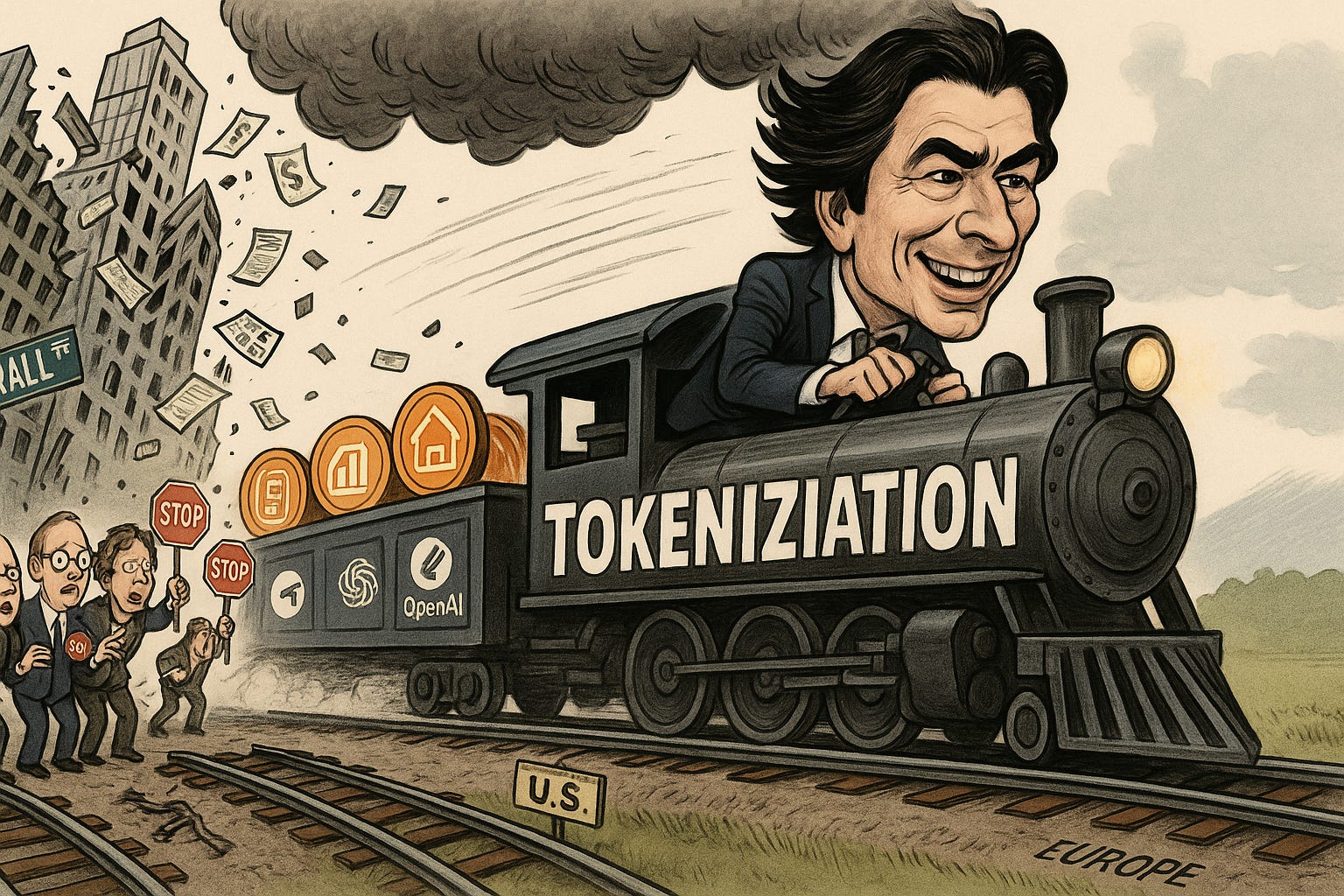
Robinhood CEO Vlad Tenev made waves at the Token2049 conference in Singapore, predicting that asset tokenization is an unstoppable “freight train” poised to transform global finance. He claimed that crypto and traditional finance will fully converge, with all assets eventually moving on-chain. Robinhood is already leaning into the shift, launching tokenized stocks in Europe and offering private shares of companies like OpenAI and SpaceX. Tenev said these innovations pave the way for 24/7 global trading, asserting that tokenized stocks could become the default for international access to U.S. equities, akin to the rise of stablecoins for digital dollar usage (CoinDesk, CoinCentral).
Tokenization is gaining serious institutional momentum, with the real-world asset (RWA) market hitting $24 billion in 2025—up 308% in just three years (Forbes). The broader tokenization sector is expected to grow from $865.54 billion in 2024 to $1.24 trillion in 2025, and could reach $5.25 trillion by 2029. Major funds like BlackRock’s BUIDL now manage over $2.88 billion in tokenized assets. Despite trailing Europe on regulatory readiness—a gap Tenev compared to the U.S. lacking high-speed rail—he believes American markets will eventually adopt tokenization at scale. Robinhood’s roadmap includes expanding tokenization into real estate, viewing property tokens as functionally similar to private company shares. While offering access, liquidity, and fractional ownership, Tenev cautioned that operational risks remain, especially around 24/7 market-making and regulatory clarity (Yahoo Finance, TokenPost).
Sensei’s Insight: Robinhood isn’t just embracing tokenization—it’s betting its future on it. As global markets move toward on-chain infrastructure, Tenev’s “freight train” metaphor may prove less hype and more early warning.
🇹🇭 Thailand Expands Crypto ETF Menu Beyond Bitcoin
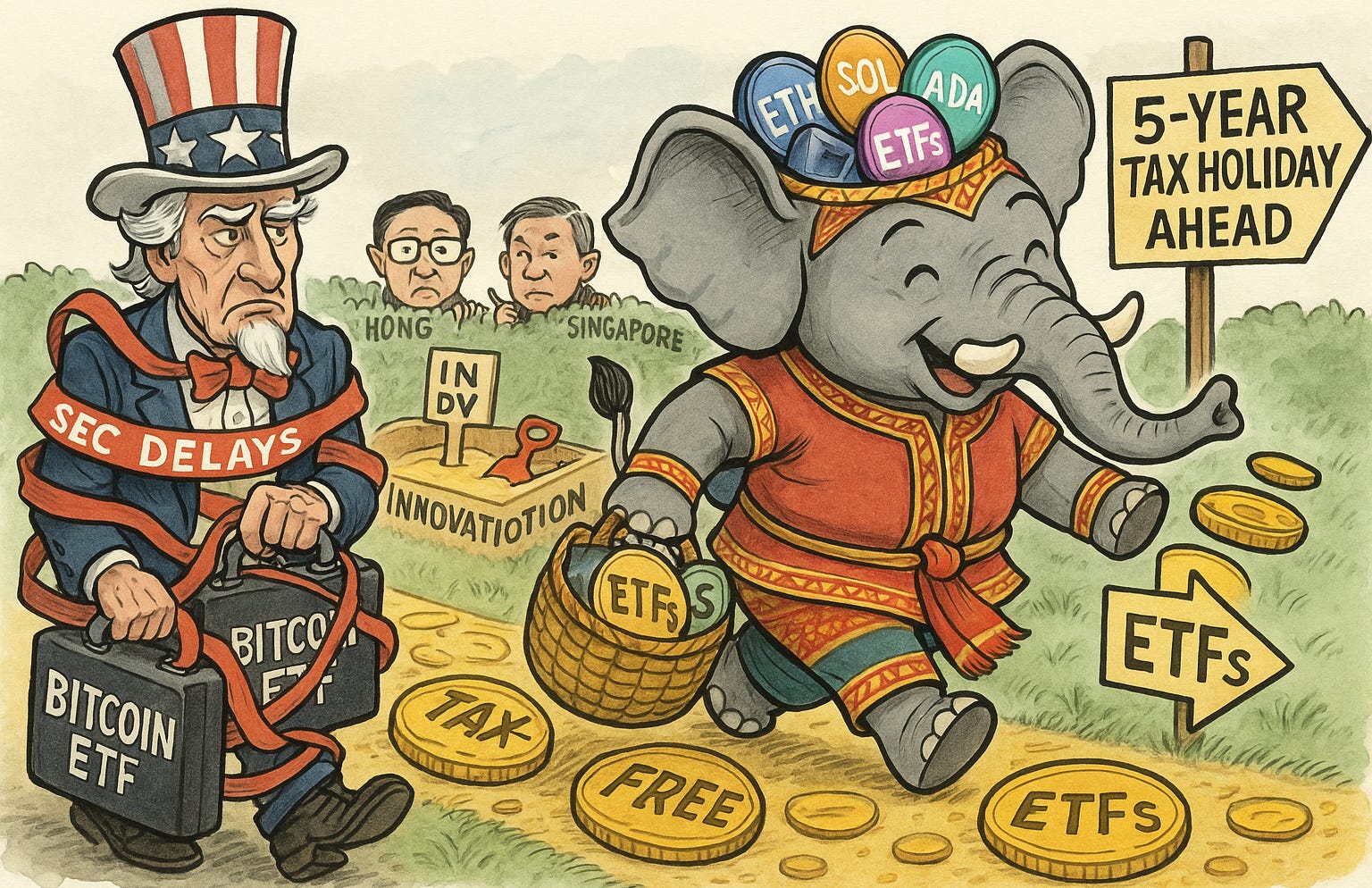
Thailand is emerging as a global crypto outlier with proactive, innovation-friendly regulations that diverge sharply from the restrictive posture of the U.S. and other major economies. While the SEC in the U.S. recently shortened crypto ETF approval timelines from 270 to 75 days, Thailand has already launched a Bitcoin ETF and is preparing to expand into altcoin ETFs within 18 months. Most notably, the Thai government is implementing a five-year capital gains tax exemption from January 2025 through December 2029 on crypto profits via SEC-licensed platforms, a move unmatched in Western markets.
Thailand’s dual regulatory sandbox framework—operated by the Bank of Thailand and SEC—allows unlicensed crypto entities to test products under formal supervision for up to one year. This stands in contrast to the U.S. environment, where crypto firms face regulatory uncertainty and long compliance timelines. The Thai sandboxes currently host eight programmable payment projects and seven digital asset services, offering a controlled environment for innovation. While general crypto payments remain discouraged, Thailand permits them within its sandbox ecosystem, reflecting a flexible but measured stance. The five-year tax exemption could draw back as much as $59 billion in overseas Thai crypto assets to domestic platforms, shifting regional capital flows. Neighboring hubs like Hong Kong and Singapore are now reassessing their policies in response to Thailand’s aggressive lead.
Sensei’s insight: Watch how regional dynamics shift as Thailand’s policy clarity pressures neighboring regulators. It’s no longer a race to regulate—it’s a race to attract capital.
🔗 Connect with Us
Stay plugged in across platforms:
Sensei on X: sensei_crypto_
Martyn Lucas on X: MartynInvestor
Vaz on X: eVTOLHUB
💎 Premium Discord Access: Join the Discord
📺 YouTube Channel (Live & Replays): Martyn Lucas Investor
👕 Limited Merch: Shop Here
