👀 Today’s Stories at a Glance
💸 Paxos Accidentally Mints $300 Trillion PYUSD
Paxos briefly minted $300T PYUSD due to an internal error, exposing the risks of centralized stablecoin issuance.💥 Bessent Draws a Line: Market Declines Won’t Stop U.S. From Hitting China Hard
U.S. Treasury warns that stock market drops won’t soften trade policy toward China amid tariff tensions.💰 Kraken Expands U.S. Derivatives Business With $100 Million IG Deal
Kraken’s $100M purchase of Small Exchange secures it a CFTC license and deepens U.S. regulated crypto access.🍫 Nestlé Rallies 8% After Announcing 16,000-Job Cut Plan
Nestlé stock jumped after announcing 16,000 job cuts to boost margins and restructure under new leadership.🇮🇳 India’s Exports to U.S. Plunge as Trump’s 50% Tariffs Bite
India’s U.S. exports dropped 11.9% in September after steep tariffs hit key sectors like textiles and jewellery.🔍 Deep Dive: The Psychology of Market Mistakes in a Bubble Era
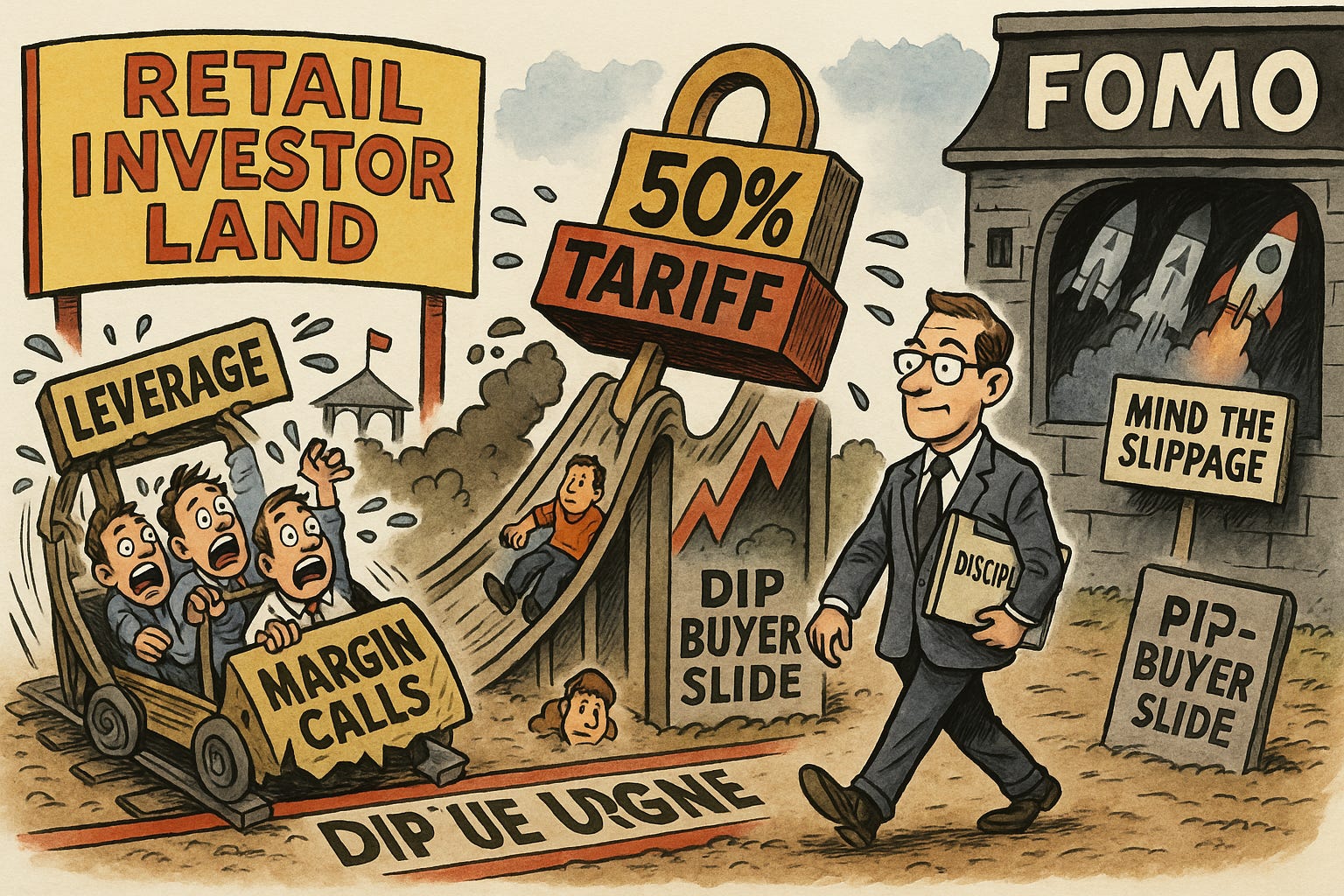
Retail investors often underperform due to emotional trading—discipline and risk management are key in volatile markets.
🧠 One Big Thing
Treasury Secretary Scott Bessent made it clear: U.S. trade policy won’t bend to market drops. After tariff threats rattled stocks, Bessent called the sell-off “noise”—signaling a hard shift away from markets influencing geopolitics.
💰 Money Move of the Day
Tariff tension is shaking up trade-sensitive sectors like semis and autos. Keep an eye on sharp pullbacks—not as signals to act, but as cues to track longer trends over short-term panic.
📊 Market Snapshot
Cryptocurrencies:
Bitcoin (BTC): $111,446.90 (▲ +0.56%)
Ethereum (ETH): $4,053.95 (▲ +1.66%)
XRP: $2.44 (▲ +1.19%)
Equity Indices (Futures):
S&P 500 (US500): 6,701.50 (▲ +0.44%)
NASDAQ 100 (NQ1!): 25,053.50 (▲ +0.52%)
FTSE 100: 9,418.05 (▼ -0.04%)
Commodities & Bonds:
10-Year US Treasury Yield: 4.022% (▼ -0.15%)
Oil (WTI): $58.51 (▼ -0.48%)
Gold: $4,237.74 (▲ +0.69%)
Silver: $52.98 (▼ -0.13%)
🕒 Data as of UK (BST): 11:30 / US (EST): 06:30 / Asia (Tokyo): 19:30
✅ 5 Things to Know Today
💸 Paxos Accidentally Mints $300 Trillion PYUSD
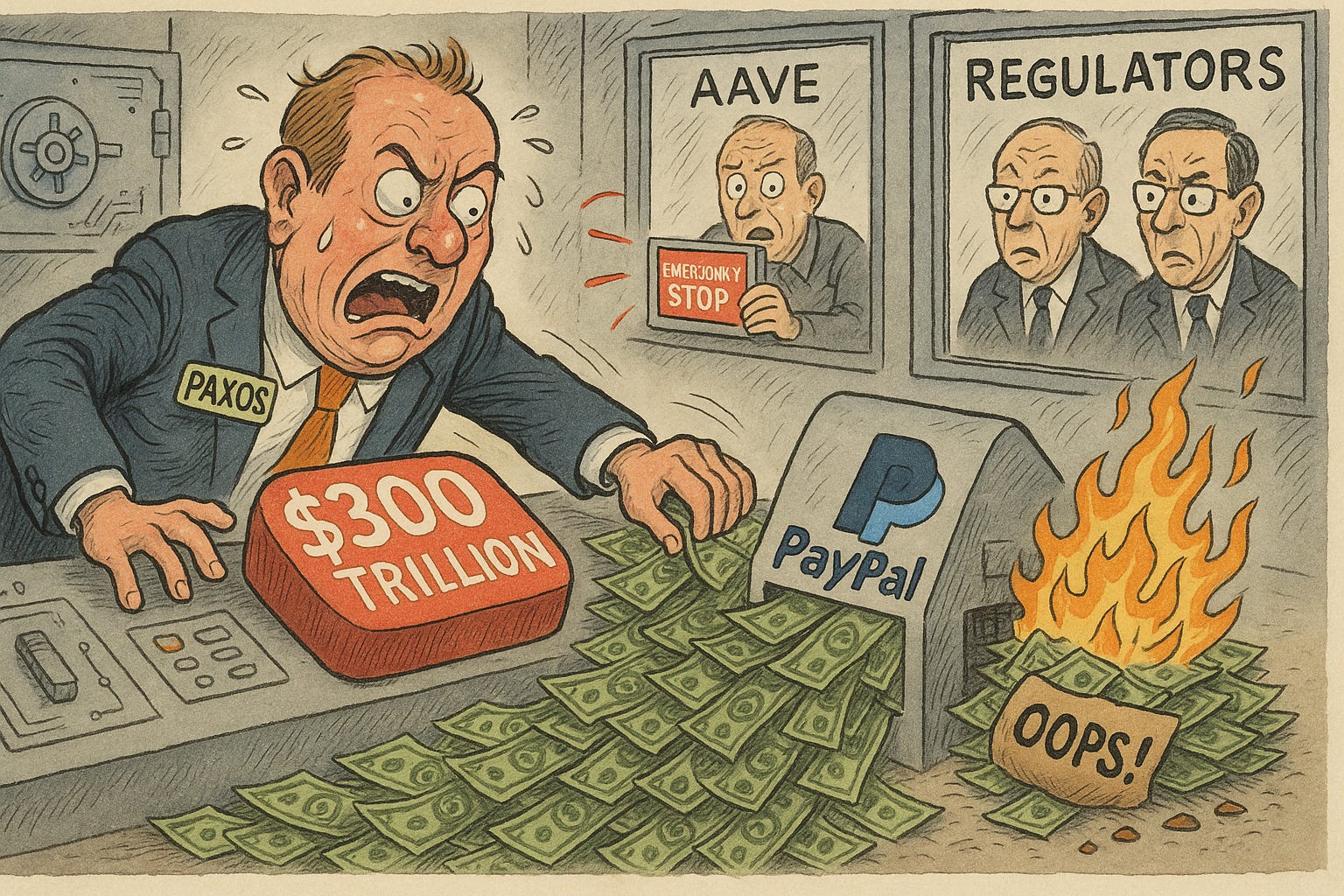
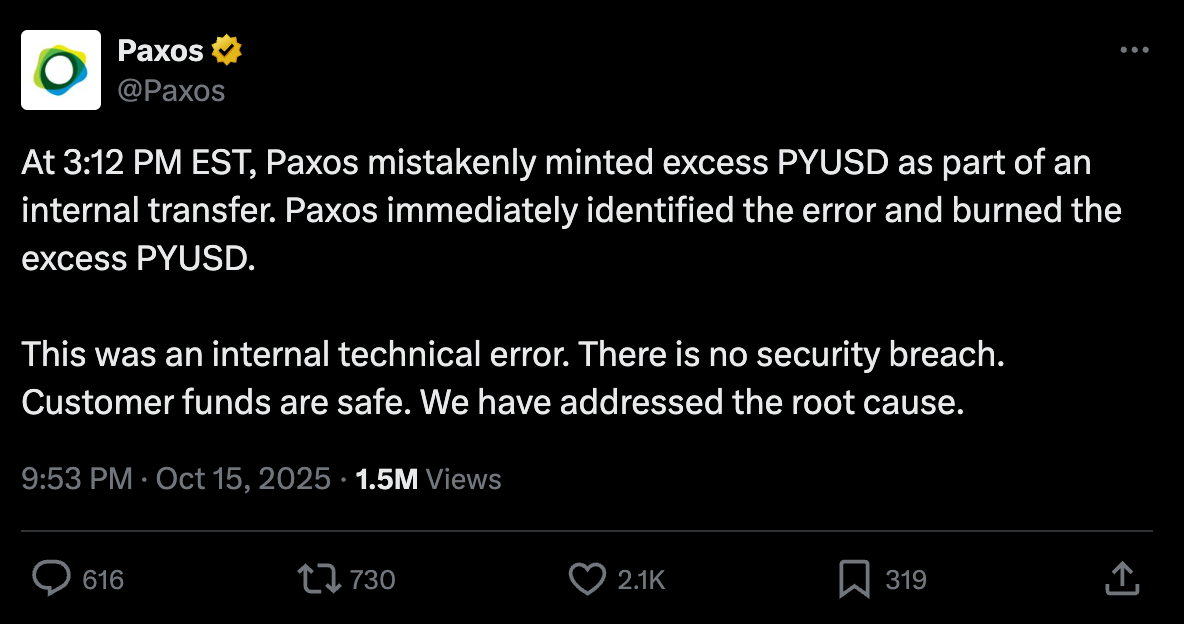
In a striking on-chain incident, Paxos, the issuer of PayPal’s U.S. dollar-backed stablecoin (PYUSD), accidentally minted $300 trillion worth of tokens during an internal transfer on October 15, before burning the excess within about 30 minutes (Bloomberg). The erroneous mint was briefly visible on Etherscan, prompting Aave to freeze PYUSD deposits as a precaution (Cointelegraph). Paxos confirmed it was a technical internal error, not a hack, adding that no customer funds or reserves were affected (ForkLog). The scale of the error — equivalent to more than double global GDP — dwarfed PYUSD’s roughly $3 billion circulating supply, briefly causing a 0.5% depeg before stabilization (Decrypt). The company’s ability to mint and then destroy trillions of tokens within minutes underscores the extraordinary control centralized issuers maintain over digital money supply.
For investors, this episode highlights three critical risks in the stablecoin ecosystem: (1) centralized control over issuance and redemption, allowing supply changes of any magnitude; (2) operational fragility, where internal system or human errors can ripple through DeFi platforms in seconds; and (3) the absence of automated safeguards, meaning trust still depends on an issuer’s discretion and integrity rather than immutable code. Although Paxos’ quick response contained the issue, it exposed how even fully collateralized assets can behave like fiat when governance fails. Regulators may now push for multi-signature issuance protocols, real-time transparency dashboards, and third-party verification to prevent repeat events — as the line between “digital dollars” and “digital printing presses” grows thinner.
Sensei’s Insight: This wasn’t just a “fat finger” — it was a reminder that stablecoins, by design, can operate like programmable money. The power to create—or destroy—vast sums instantaneously means that risk lies not only in what is on-chain, but in who controls the rails and what guardrails they’ve built.
💥 Bessent Draws a Line: Market Declines Won’t Stop U.S. From Hitting China Hard
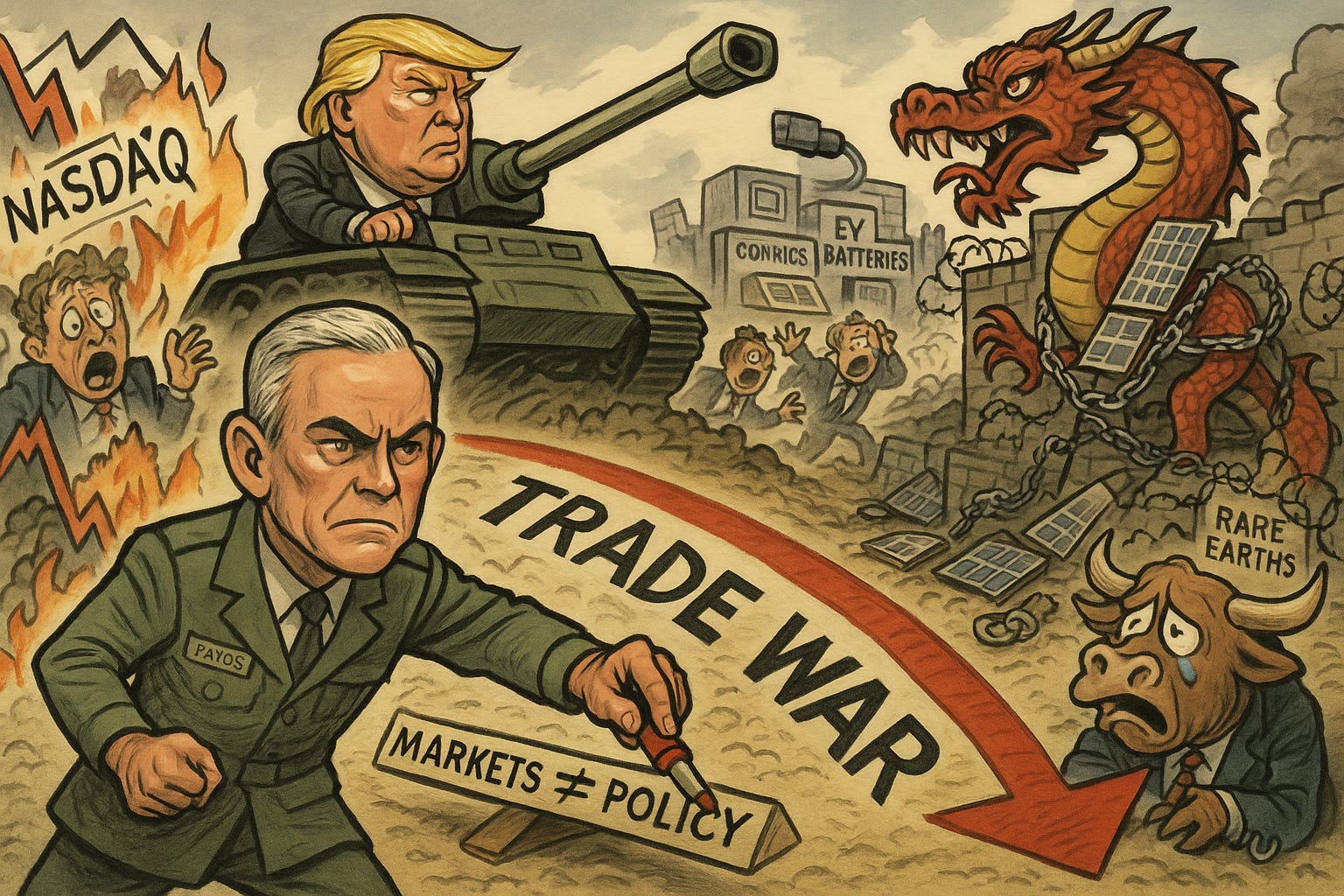
Treasury Secretary Scott Bessent has put markets on notice that Washington will not back down from its tough trade stance toward China, even in the face of equity volatility. Speaking at CNBC’s Invest in America Forum, Bessent said bluntly: “We won’t negotiate because the stock market is going down.” (Business Insider) He emphasized that U.S. strategy will be driven by long-term national and economic priorities, not short-term market swings, calling recent sell-offs “noise, not policy input.” The statement followed days of volatility triggered by President Trump’s proposal of 100% tariffs on Chinese imports—a move that briefly sent the S&P 500 down 2% before partially rebounding on speculation of a softer stance. Bessent’s comments mark a decisive signal that market reactions will no longer dictate U.S. policy direction, reinforcing the administration’s view that strategic resilience outweighs near-term market comfort.
Behind the scenes, Washington’s rhetoric toward Beijing has hardened further. Bessent and U.S. Trade Representative Jamieson Greer accused China of weaponizing its export restrictions on rare earths and high-tech materials, describing the measures as a “coordinated supply-chain power grab.” (Reuters) The administration is preparing counter-measures, including expanded export controls and targeted tariffs on sectors such as semiconductors, EV batteries, and solar components. While Bessent left the door open for extending the current 90-day tariff pause if Beijing steps back, he stressed that any diplomatic resolution must be earned through negotiation, not triggered by market pressure. (FT) Analysts view this as a clear signal that the U.S. is decoupling trade and financial policy — a shift that could reshape the feedback loop between geopolitics and investor sentiment.
Sensei’s Insight: With Washington taking a harder line, investors can no longer rely on market declines to prompt a policy pivot. The decoupling of trade strategy from equity performance raises the likelihood of sustained volatility, especially across supply-chain-sensitive sectors like tech, autos, and energy. Markets may now need to price in real geopolitical persistence rather than short-term relief rallies.
💰 Kraken Expands U.S. Derivatives Business With $100 Million IG Deal
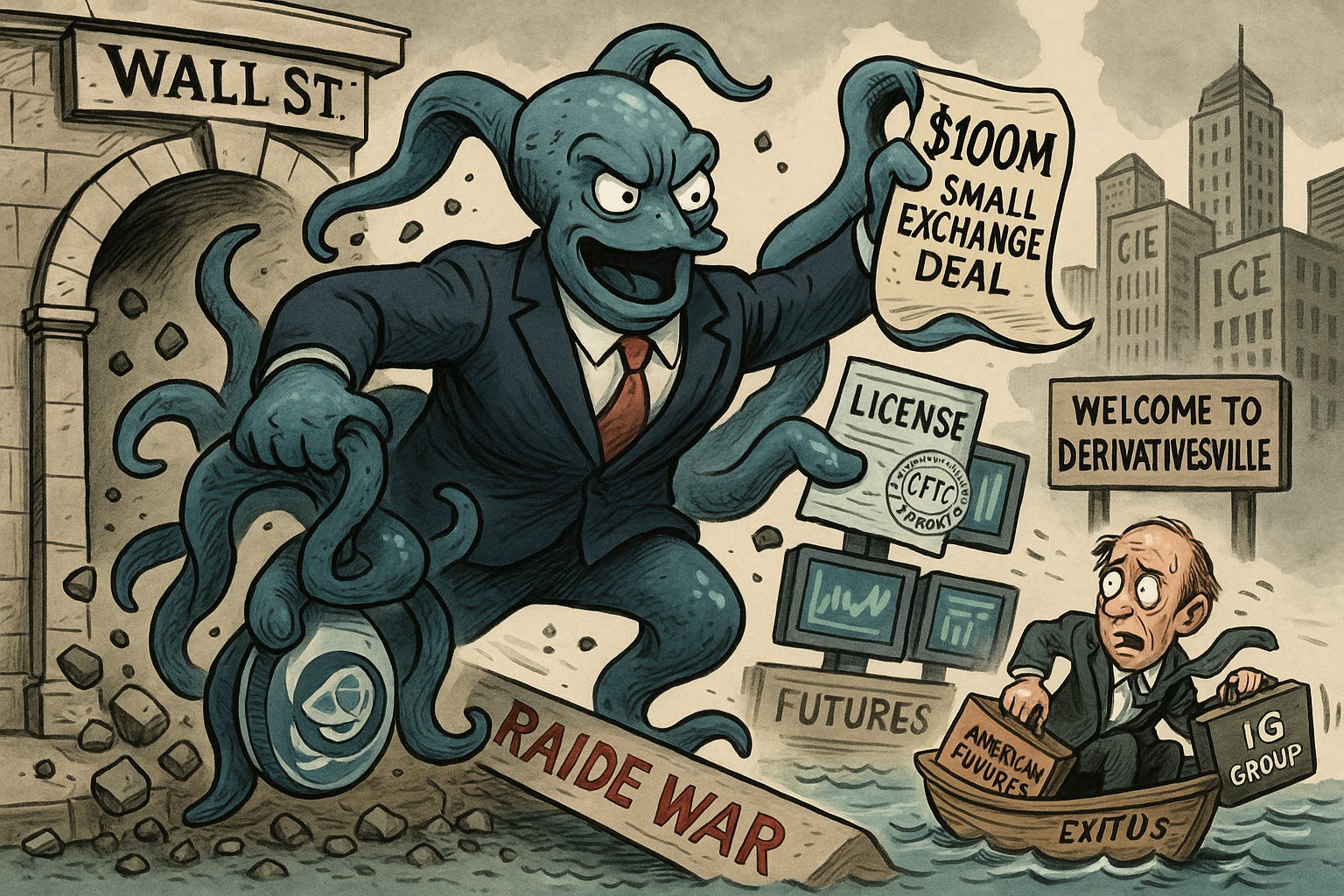
Kraken has agreed to acquire The Small Exchange from London-listed IG Group (LSE: IGG) in a $100 million deal, marking a major expansion of the crypto firm’s regulated footprint in the United States. The transaction gives Kraken control of a CFTC-licensed Designated Contract Market (DCM) and Futures Commission Merchant (FCM), enabling it to offer regulated futures and options products directly to U.S. retail and institutional clients for the first time (Reuters). IG Group said the sale completes its withdrawal from the U.S. derivatives market and will deliver a pre-tax gain of roughly $100 million on disposal. The Chicago-based Small Exchange was originally launched in 2020 with backing from TD Ameritrade and Interactive Brokers to make futures contracts more accessible to individual traders but struggled to scale volumes in a competitive market. The deal underscores Kraken’s intent to strengthen its compliance and infrastructure base at a time when U.S. regulators are tightening oversight of offshore crypto trading venues.
With the acquisition, Kraken joins a small group of U.S. crypto firms holding both spot and derivatives licenses—a strategic advantage as global derivatives volumes now represent more than 70% of total crypto trading activity (Bloomberg). The move positions Kraken to compete with established traditional finance players by integrating regulated futures clearing and matching functions under one roof. It also signals confidence that the U.S. regulatory landscape will gradually evolve toward a unified framework for digital asset derivatives, creating room for onshore growth. For IG Group, the exit allows renewed focus on core CFD and spread-betting markets in Europe and Asia, while Kraken gains a scalable U.S. gateway to institutional liquidity and risk management products. The deal is expected to close later this quarter pending final CFTC review.
Sensei’s Insight: Kraken’s purchase reflects a maturing shift in crypto markets—away from offshore leverage and toward regulated infrastructure. It’s a strategic positioning play that brings institutional credibility and future regulatory optionality.
🍫 Nestlé Rallies 8% After Announcing 16,000-Job Cut Plan

Nestlé shares surged nearly 8% after the world’s largest consumer goods company announced plans to cut 16,000 jobs — about 5.8% of its global workforce — as part of a sweeping restructuring under new CEO Philipp Navratil. The company said the layoffs, including roughly 12,000 office roles and 4,000 manufacturing and supply-chain jobs, will occur over the next two years and are expected to deliver SFr 3 billion in cost savings by 2027, up from its prior SFr 2.5 billion target (Reuters). Nestlé reported organic sales growth of 4.3% in Q3 and real internal growth of 1.5%, even as total revenue slipped due to currency effects. Investors cheered the stronger margin outlook, seeing the plan as a signal of renewed discipline and efficiency.
The cuts come amid broader corporate changes at the Swiss food giant. Navratil, who took over in August after Laurent Freixe’s departure, is leading an overhaul of Nestlé’s sprawling portfolio, reviewing underperforming units in water, vitamins, and frozen foods (FT). Chairman Paul Bulcke also stepped down earlier this month, marking a leadership reset after years of slower growth and margin pressure. Nestlé reaffirmed its 2025 profit margin target of at least 16% and said the restructuring would improve long-term competitiveness. The announcement underscores a strategic pivot toward profitability over expansion — a move analysts say could reshape cost structures across the global consumer staples sector.
Sensei’s Insight: Nestlé’s overhaul mirrors a broader shift in Big Food toward leaner, cash-efficient operations. Execution risk remains high, but early investor reaction shows markets rewarding decisive cost discipline over scale.
🇮🇳 India’s Exports to U.S. Plunge as Trump’s 50% Tariffs Bite
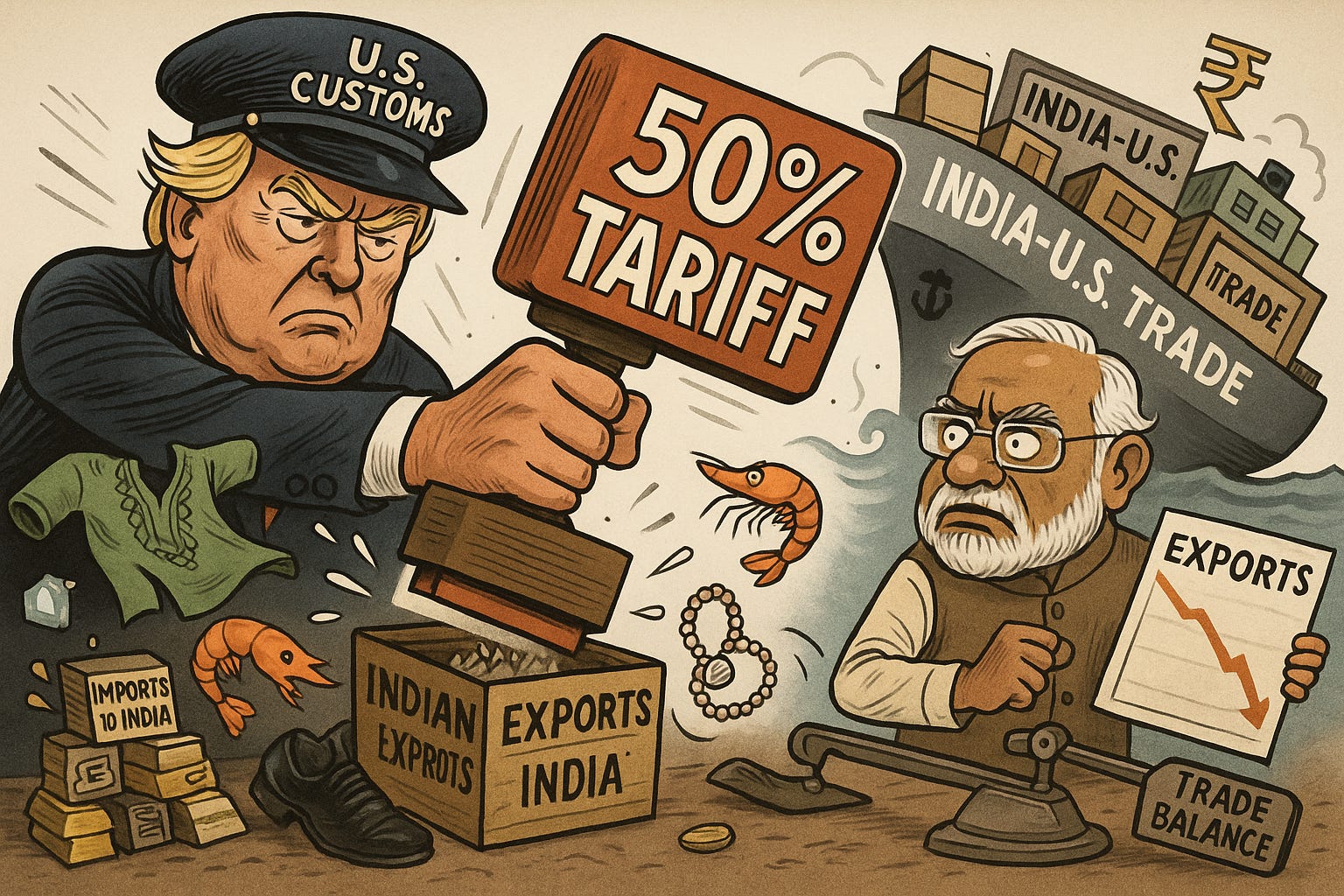
India’s goods exports to the United States fell 11.93% year-over-year to $5.46 billion in September 2025, representing the first full monthly data point after the Trump administration imposed 50% tariffs on most Indian imports as of August 27.(Reuters) U.S. imports from India in the same month, by contrast, rose 11.78% to $3.98 billion, widening the trade imbalance.(The Times of India) The decline in U.S. demand was especially acute in textiles, gems & jewelry, shrimp and leather goods—sectors hit hardest by the punitive tariffs.(Reuters) Exporters had anticipated some of the damage: many firms front-loaded shipments before the August 27 deadline to mitigate tariff exposure.(Reuters)
According to Indian trade authorities, the tariffs affect ~55% of India’s $87 billion in U.S.-bound merchandise exports, or roughly $48.2 billion in trade exposure.(Reuters) The country’s trade deficit surged to a 13-month high of $32.15 billion in September, driven by rising imports of gold, silver, fertilisers and electronics.(Reuters) India has resumed postal services to the U.S. after suspending them due to new U.S. import regulation on low-value shipments, formalising a flat 50% duty on declared package values.(Reuters) Meanwhile, ongoing trade dialogue is signaling cautious optimism: in a recent call, Prime Minister Modi and President Trump discussed “good progress” in negotiations even as the tariff standoff continues.(Reuters)
Sensei’s Insight: This trade shock crystallizes how swiftly punitive tariffs can hollow out export flows and widen external deficits. Investors in Asia, commodities, and EM currencies should watch for supply-chain shifts and currency volatility as countries adjust to sudden trade deterrents.
🔗 Connect with Us
Stay plugged in across platforms:
Sensei on X: sensei_crypto_
Martyn Lucas on X: MartynInvestor
Vaz on X: eVTOLHUB
💎 Premium Discord Access: Join the Discord
📺 YouTube Channel (Live & Replays): Martyn Lucas Investor
👕 Limited Merch: Shop Here

🔍Deep Dive: Sensei’s Insights: The Psychology of Market Mistakes in a Bubble Era