🧠 One Big Thing
Fidelity International says gold could surge to $4,000/oz by 2026, driven by a dovish Fed, a weaker dollar, and aggressive central-bank buying—a price that would mark nearly a 20% jump from current record highs.
💰 Money Move of the Day
Consider how adding non-correlated assets, like precious metals or commodities, can smooth portfolio volatility. Even a small allocation—just a few percentage points—can act as a hedge when equities wobble.
📊 Market Snapshot
Cryptocurrencies:
Bitcoin (BTC): $118,429 (▲ +0.29%)
Ethereum (ETH): $3,831 (▲ +0.84%)
XRP: $3.13 (▲ +0.12%)
Equity Indices (Futures):
S&P 500 (SPX): 6,406 (▲ +0.25%)
NASDAQ 100: 23,599 (▲ +0.46%)
FTSE 100: 9,141 (▲ +0.59%)
Commodities & Bonds:
10-Year US Treasury Yield: 4.396% (▼ -0.41%)
Oil (WTI): $67.58 (▼ -0.55%)
Gold: $3,320 (▲ +0.19%)
🕒 Data as of UK (BST): 12:16 / US (EST): 07:16 / Asia (Tokyo): 20:16
✅ 5 Things to Know Today
Starmer–Trump Summit: Energy, Gaza, and Trade Take Center Stage
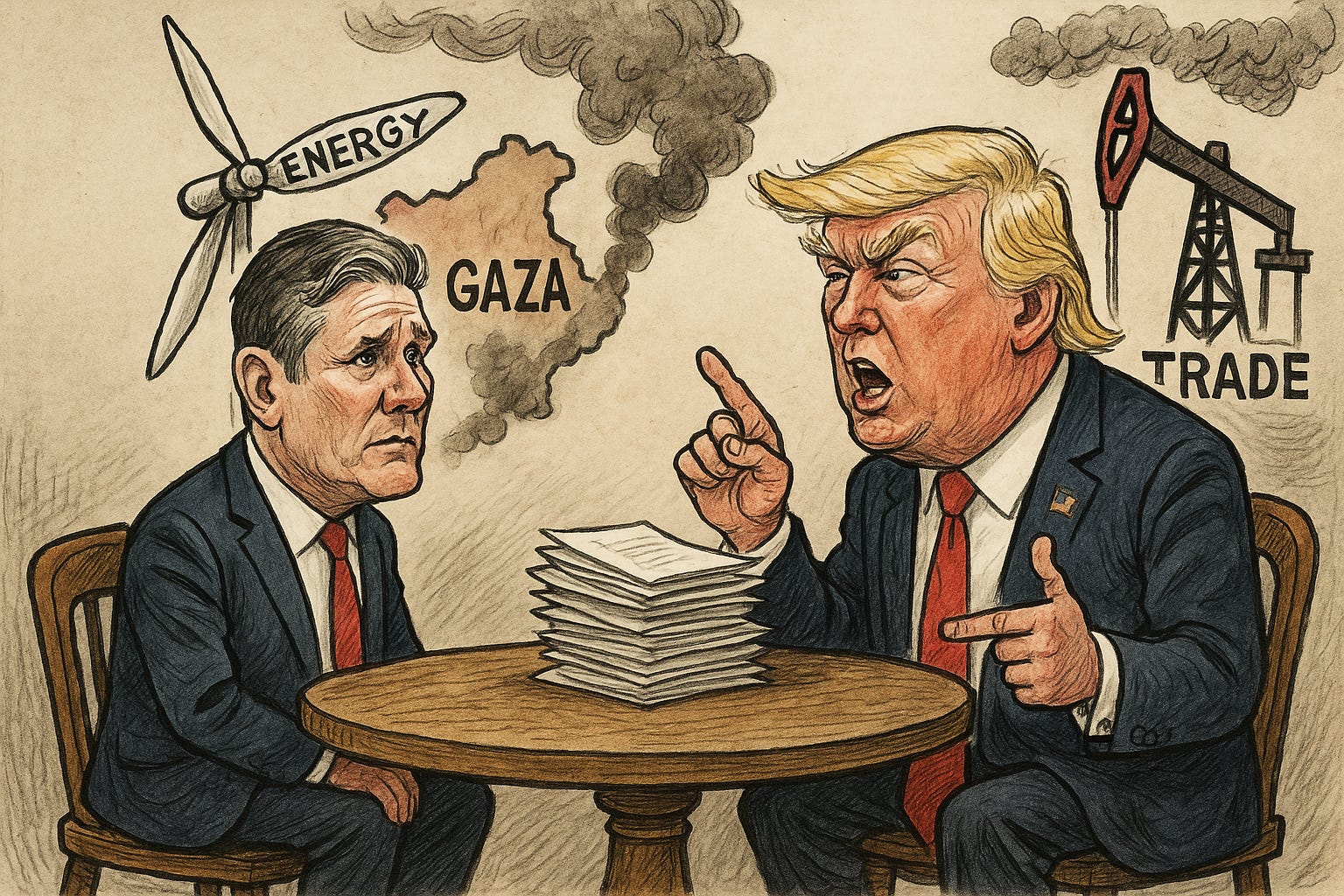
Prime Minister Keir Starmer’s meeting with U.S. President Donald Trump took place on 28 July 2025 at Trump’s Turnberry golf resort in Ayrshire, Scotland. The 90-minute televised session tackled Gaza’s worsening famine, Russia’s war in Ukraine, North Sea energy policy, and tariff disputes under the U.K.–U.S. Economic Prosperity Deal (Sky News; Reuters). Trump shortened his self-imposed deadline for brokering a Ukraine cease-fire from 50 days to “about 10 or 12” (Telegraph), while Starmer pressed for expanded humanitarian corridors and an immediate Gaza cease-fire following Washington’s $60 million food aid pledge (PBS).
Key Outcomes and Discussions:
Gaza Crisis: Commitment to accelerate aid delivery; Trump proposed “food centers” to expand relief efforts (YouTube).
Ukraine Timeline: Trump cut his cease-fire ultimatum to 10–12 days and threatened secondary sanctions on Russia (Telegraph).
Trade Accord: Leaders reaffirmed the May Economic Prosperity Deal, which scrapped U.S. aerospace tariffs and cut auto duties from 25% to 10% (Gov.uk).
Energy Dispute: Trump slammed Britain’s 78% North Sea oil tax as “too high” and called offshore wind “a disaster,” while Starmer defended a balanced energy mix (Bloomberg).
Tariffs & Whisky: Talks on Scotch whisky duties and a 25% steel levy remain unresolved; potential relief could follow Trump’s new EU tariff framework (BBC).
Immigration: Trump advised Starmer to tighten visa rules to counter Nigel Farage’s Reform UK challenge (Independent).
Market Implications: Trump’s snap sanctions threat adds headline risk for European defense, LNG, and grain stocks, while his push for North Sea drilling pressures Brent futures and U.K. renewables. The $11.4 billion U.S. trade surplus with Britain gives Washington leverage in future tariff talks (PBS).
Sensei’s Insight: This summit delivered clear signals rather than new policies: Trump’s compressed Ukraine deadline, renewed trade commitments, and aggressive energy rhetoric create volatility across oil, defense, and agricultural markets. Watch for potential adjustments to North Sea taxation, Scotch and steel tariffs, and GBP/USD stability as both leaders balance economic cooperation with political posturing.
Fidelity Flags $4k Gold on Dovish Fed and Softer Dollar
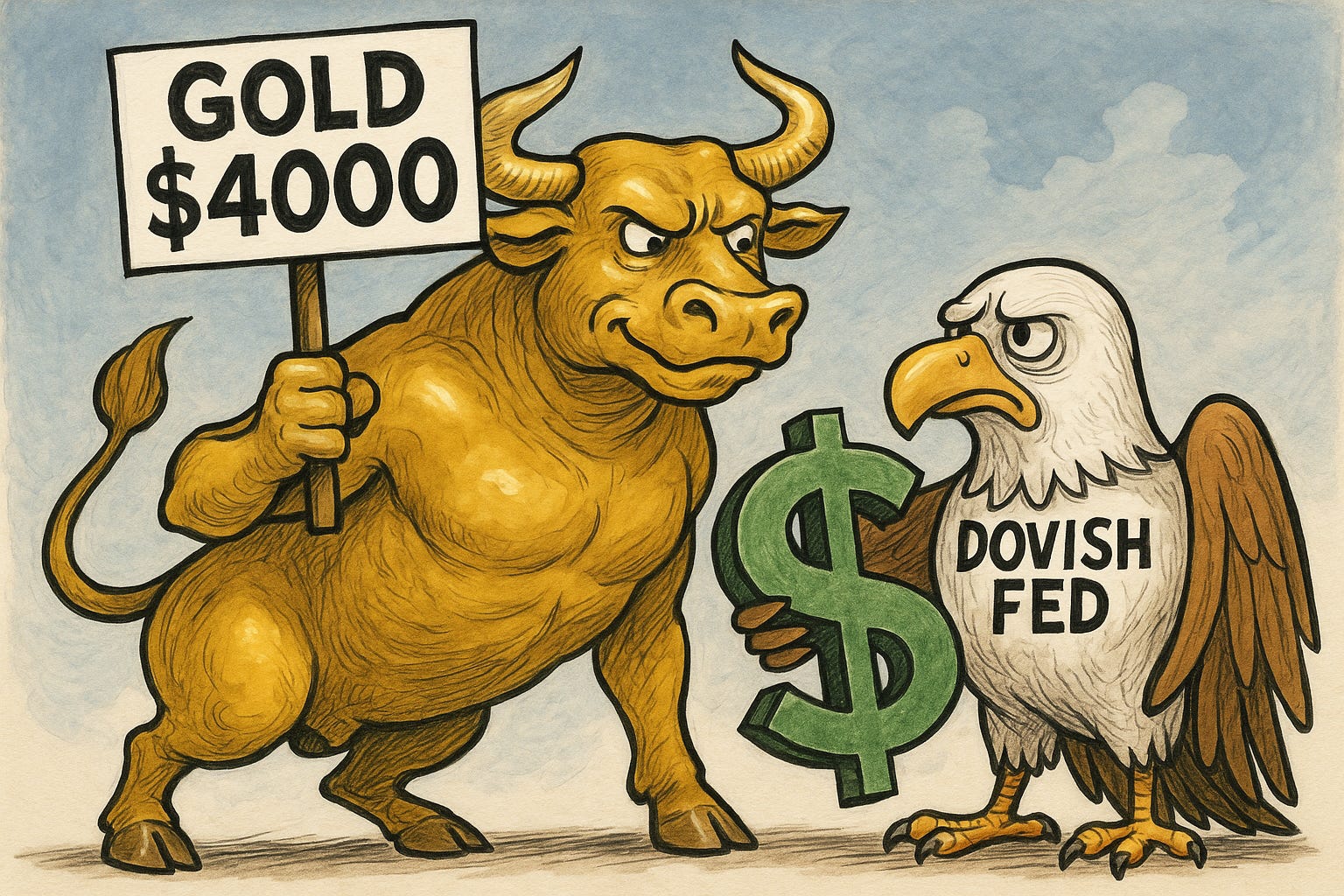
Gold could climb to $4,000 an ounce by the end of 2026, according to Fidelity International’s multi-asset fund manager Ian Samson (Bloomberg, Straits Times). The forecast hinges on a “clearer path” to U.S. rate cuts, a weakening dollar, and sustained central-bank buying. Spot bullion trades near $3,308/oz, slipping 0.2% overnight but still up over 25% year-to-date after hitting an April record of $3,500/oz (Straits Times).
Fidelity says some cross-asset portfolios have doubled their typical 5% gold allocation after the April pullback, betting lower real yields will prolong bullion’s rally (Straits Times). Its $4k target aligns with bullish forecasts from Goldman Sachs and J.P. Morgan, reinforcing a broad buy-side consensus that policy easing and geopolitical risks will keep non-yielding assets in demand (J.P. Morgan). A $4,000 print would bolster gold-linked ETFs and miners, while signaling deeper skepticism over U.S. growth and fiscal stability. Key watchpoints include Fed guidance, dollar trajectory, and central-bank purchases—if all tilt dovish, the current consolidation could break higher, squeezing shorts and pulling flows from equities into hard assets.
Sensei’s Insight: Fidelity’s $4k call is a loud signal that the market expects policy easing, weaker USD, and persistent geopolitical risk xto keep gold bid. Watch for any hawkish pivot from the Fed or a dollar rebound—either could derail this trajectory.
FIS–Circle Tie-Up: USDC Rails Enter U.S. Banking
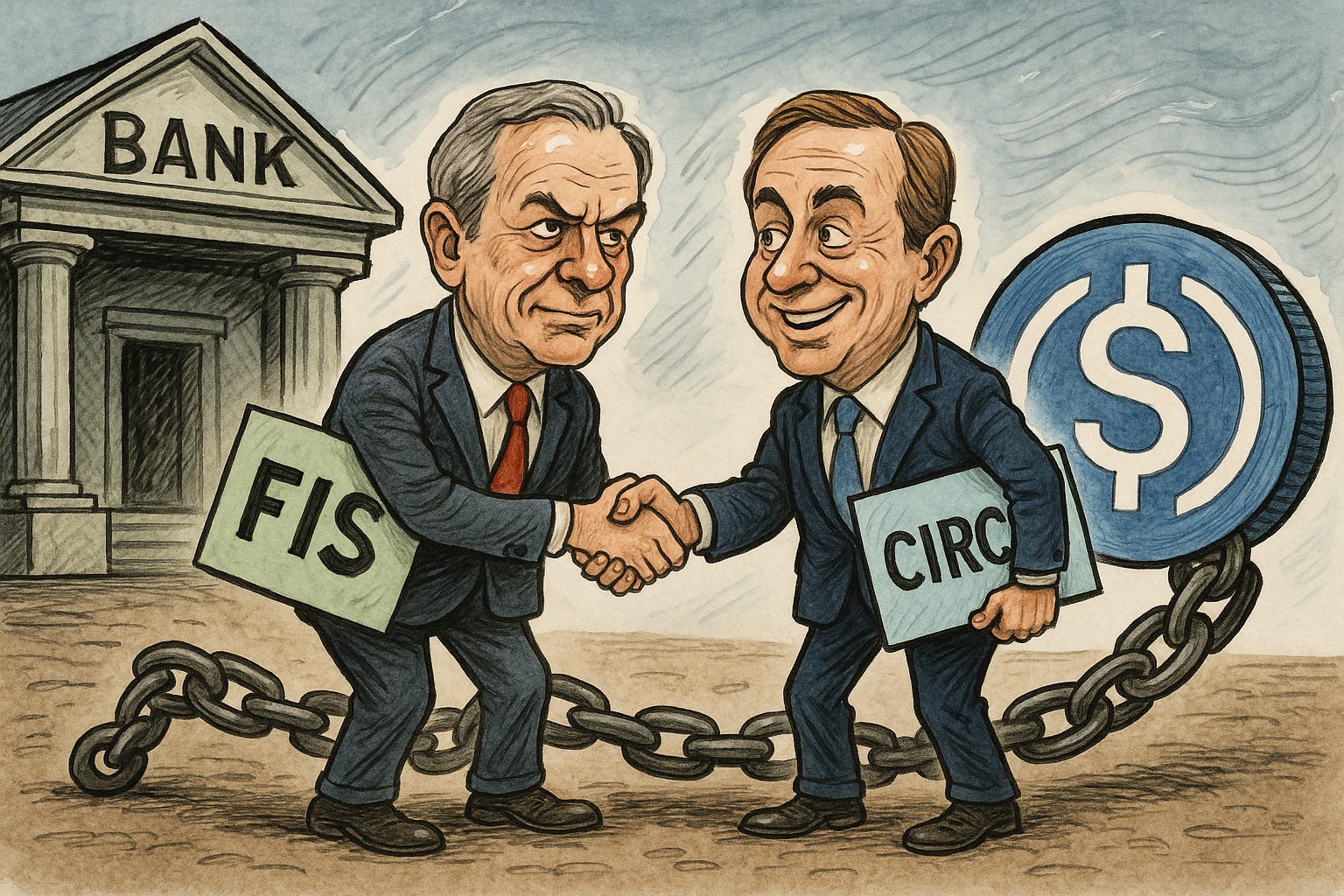
Fidelity National Information Services (NYSE:FIS) has partnered with newly-public Circle Internet Group (NYSE:CRCL) to integrate USD Coin (USDC) into FIS’s cloud-native Money Movement Hub, enabling thousands of U.S. banks to send and receive fully reserved stablecoins over blockchain rails by year-end (Bloomberg). The deal arrives just ten days after President Trump signed the GENIUS Act, the first federal regulatory framework for payment stablecoins, which transforms USDC from a “shadow” crypto asset into a legally recognized settlement instrument for traditional finance (White House). With $65 billion USDC in circulation and FIS processing over $10 trillion annually, the collaboration positions stablecoins for mainstream banking adoption, leveraging the Hub’s universal API and fraud-detection stack to enable near-instant, 24/7 transfers that settle 1:1 in cash (FIS). A pilot is expected in Q4 2025 with a full rollout in 2026, pending individual bank compliance reviews under the new regime (Sidley).
The deal offers both revenue and strategic upside: FIS earns network fees on USDC settlements, while Circle benefits from interest income on its Treasury-backed reserves. The GENIUS Act exempts compliant stablecoins from securities law, clearing a key legal hurdle for banks and accelerating institutional adoption (WilmerHale). USDC’s near-instant, low-cost transfers threaten to disrupt costly cross-border wire services, while every new USDC minted adds demand for short-term U.S. Treasuries, potentially influencing front-end yield curves (Bitget). FIS gains first-mover advantage over competitors like Fiserv and JPMorgan by embedding a top-three stablecoin directly into its infrastructure (Mitrade). However, rapid adoption introduces risks, including cybersecurity threats, reserve management stress, and regulatory constraints that may compress Circle’s net interest margin.
Sensei’s Insight: This partnership marks a pivotal moment in the convergence of banking and blockchain. With federal backing via the GENIUS Act, USDC is now on track to become a mainstream settlement asset. Watch Q4 pilot volumes, early bank adoption, and Circle’s reserve disclosures—these metrics will signal how quickly tokenized dollars can capture traditional payment flows.
Trade Deal Rallies Lose Steam as Market Fatigue Sets In
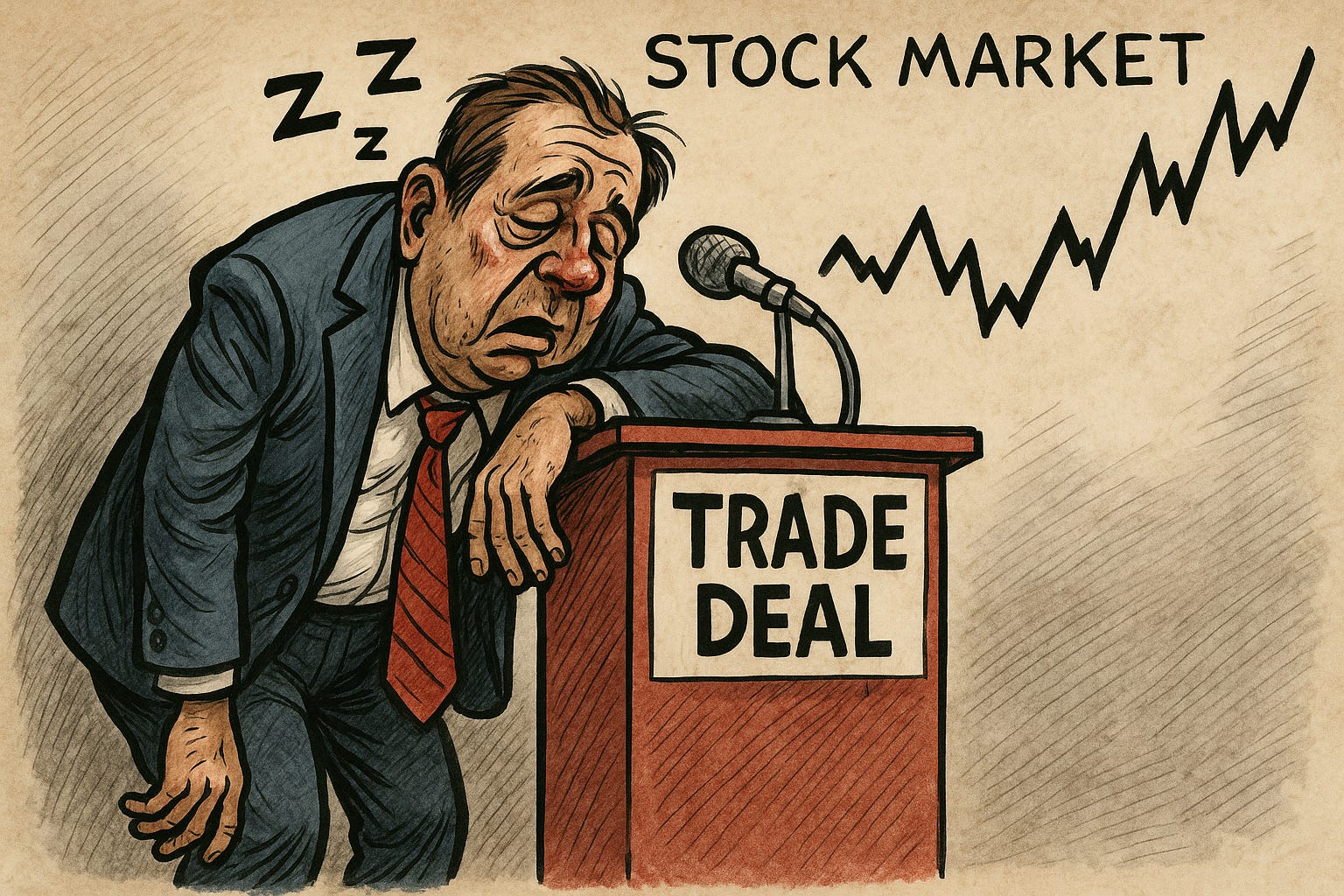
Wall Street’s enthusiasm for trade agreements appears to be fading, with the latest US-EU trade pact sparking only muted reactions. The deal—introducing 15% tariffs on most European goods instead of the previously threatened 30%—failed to ignite the sharp rallies once common after such announcements. European equities slipped slightly, and the euro dropped around 0.7% against the dollar (Reuters; Bloomberg). In the U.S., stocks closed essentially flat, a stark contrast to the surge seen after Trump’s recent US-Japan framework agreement. The S&P 500 edged up just 0.1%, weighed down by losses in energy shares and nearly flat chipmaker gains (Swissinfo).
The subdued market response underscores a growing sense of “crisis fatigue” among institutional investors, who have endured a relentless cycle of policy shocks and trade headlines. Many professional money managers are opting to sit tight rather than aggressively reposition portfolios. Trading volumes remain flat, lacking the conviction-driven moves seen in past rallies, while the VIX volatility index has remained “suspiciously quiet” despite persistent policy uncertainty (Yahoo Finance; M&G). This pattern suggests that markets may have reached a saturation point, where additional trade deals provide diminishing marginal benefits and leave equities more vulnerable to negative surprises as the euphoria from tariff relief continues to wane.
Sensei’s Insight: Investors should take note—when good news stops moving markets, it often signals an inflection point. A quiet VIX may be a warning, not a comfort.
BoE Governor Halts Reeves–Revolut Summit, Exposing Regulatory Tensions
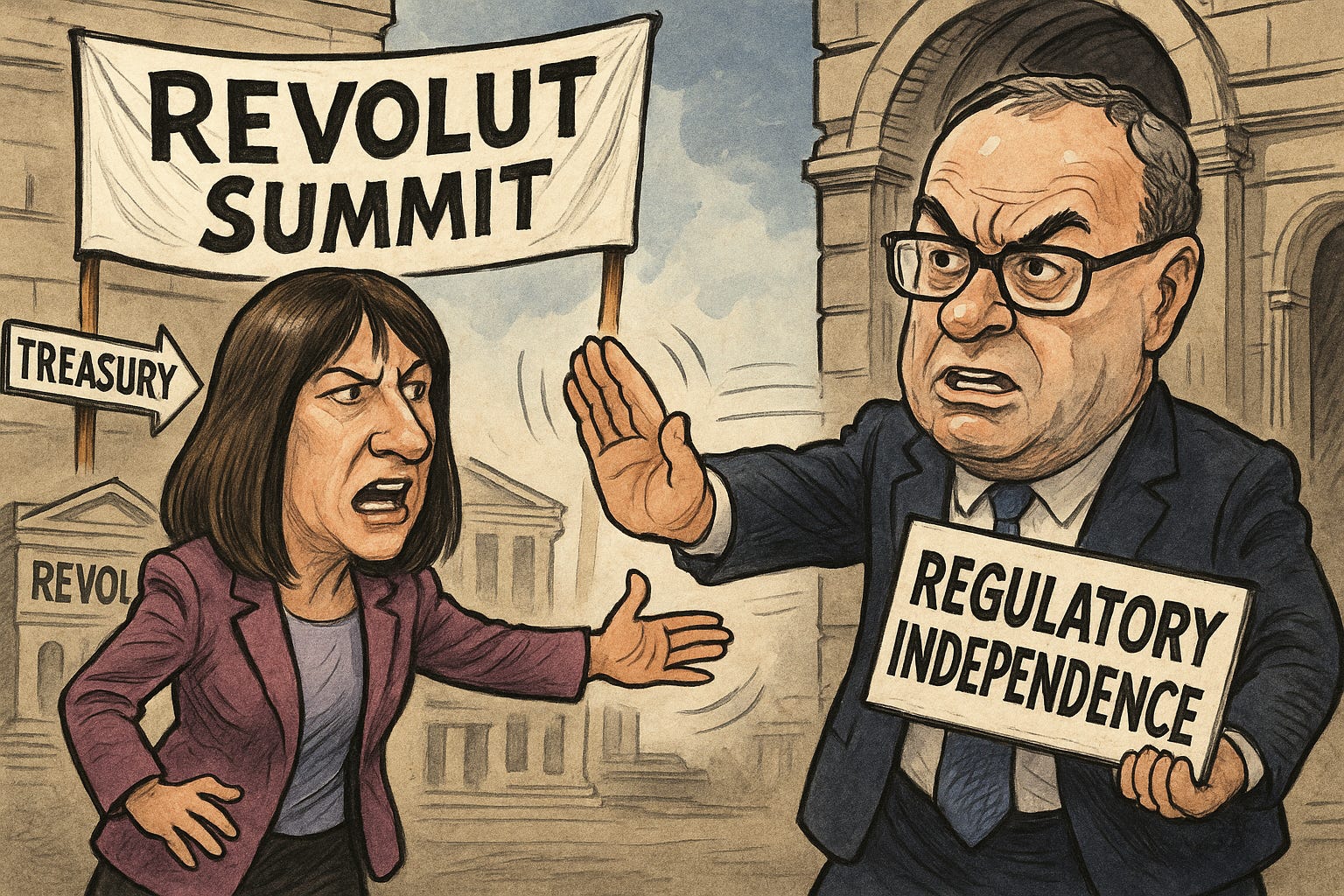
Bank of England governor Andrew Bailey has cancelled a meeting arranged by chancellor Rachel Reeves that would have included Treasury officials, the Prudential Regulation Authority (PRA), and Revolut, citing the importance of maintaining regulatory independence (FStech, City A.M.). Reeves had sought the high-level discussion to push forward Revolut’s bid for full UK banking authorisation, which has been pending for more than three years.
Revolut—valued at approximately £65 billion and serving nearly 11 million UK customers—secured preliminary approval last year but remains in a “mobilisation” phase, restricting deposits to £50,000 per customer until its risk controls are fully implemented. The 12-month window for this phase expired on 25 July without PRA sign-off, prolonging uncertainty over the fintech’s licence timeline (Finextra, FT). The standoff highlights tensions between the Treasury’s “regulate for growth” agenda and the BoE’s cautious stance, raising questions about how political pressure might influence licensing decisions and the broader competitive landscape of UK retail banking.
Sensei’s Insight: The Revolut impasse is more than a fintech licensing delay—it’s a litmus test for the balance of power between political ambition and regulatory autonomy. Any perceived tilt could ripple through investor sentiment across the City.
🔗 Connect with Us
Stay plugged in across platforms:
Sensei on X: sensei_crypto_
Martyn Lucas on X: MartynInvestor
Vaz on X: eVTOLHUB
💎 Premium Discord Access: Join the Discord
📺 YouTube Channel (Live & Replays): Martyn Lucas Investor
👕 Limited Merch: Shop Here

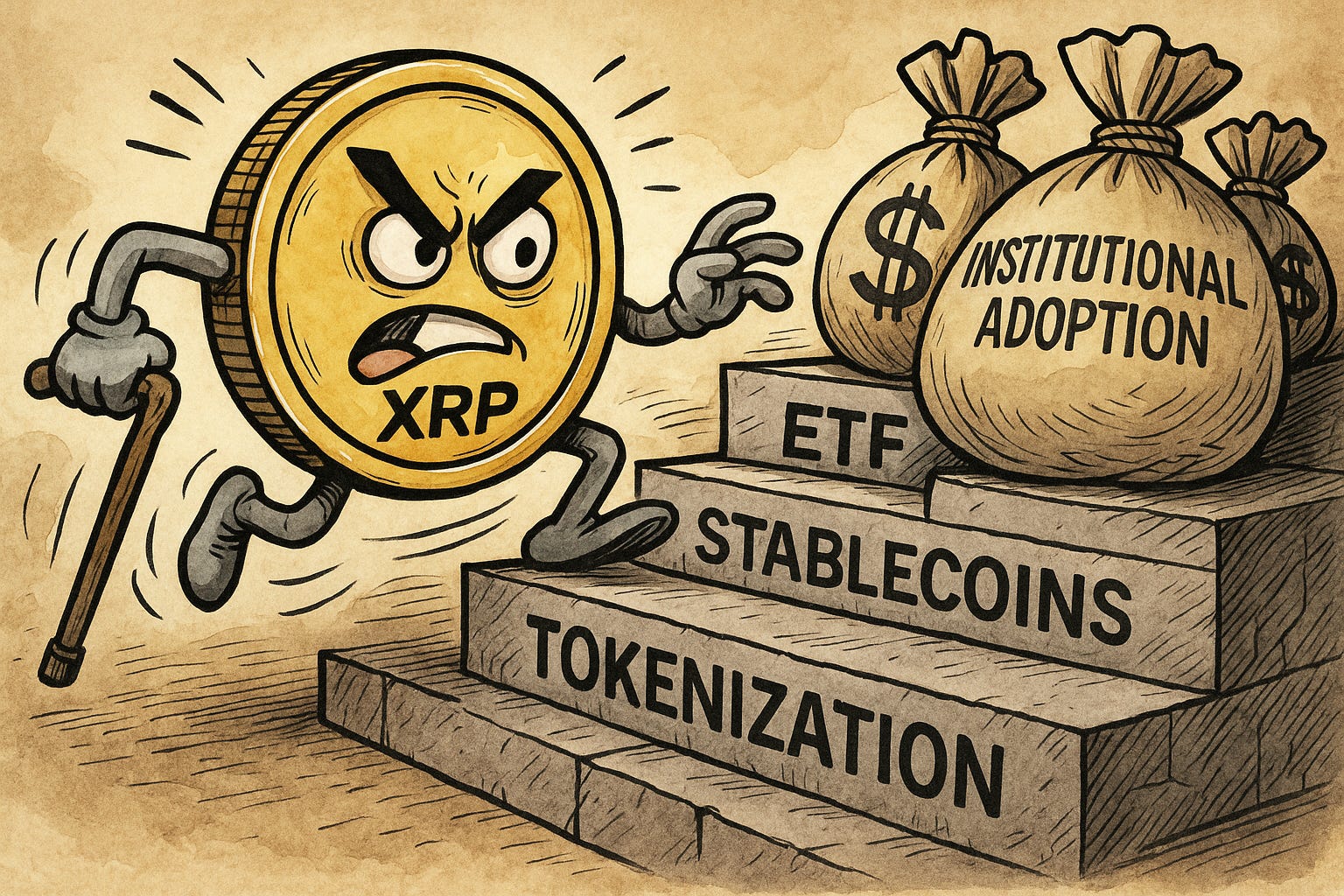
🔍 Deeper Dive: XRP’s Institutional Playbook – ETFs, Stablecoins & Tokenization