

On January 30, 2026, the U.S. Department of Justice released over 3.5 million pages, more than 2,000 videos, and 180,000 images tied to Jeffrey Epstein under the Epstein Files Transparency Act. Within hours, a single screenshot from that mountain of documents set the XRP community on fire.
The screenshot showed an email. The names on it: Jeffrey Epstein, Reid Hoffman, Joichi Ito, and a man named Austin Hill. The subject line: Stellar isn’t so Stellar. And buried in the body of that email, two words that made every XRP holder stop scrolling: Ripple and Stellar.
But this story isn’t what crypto Twitter made it out to be. It’s bigger. The email doesn’t show Ripple working with Epstein. It shows a Bitcoin company executive writing to Epstein, arguing that Ripple and Stellar were enemies that needed to be stopped. And the questions that raises are far more interesting than any conspiracy theory.
The Email That Started It All
On January 31, Ripple CTO Emeritus David Schwartz known on X as @JoelKatz posted the actual email from the Epstein files with a comment that surprised everyone.
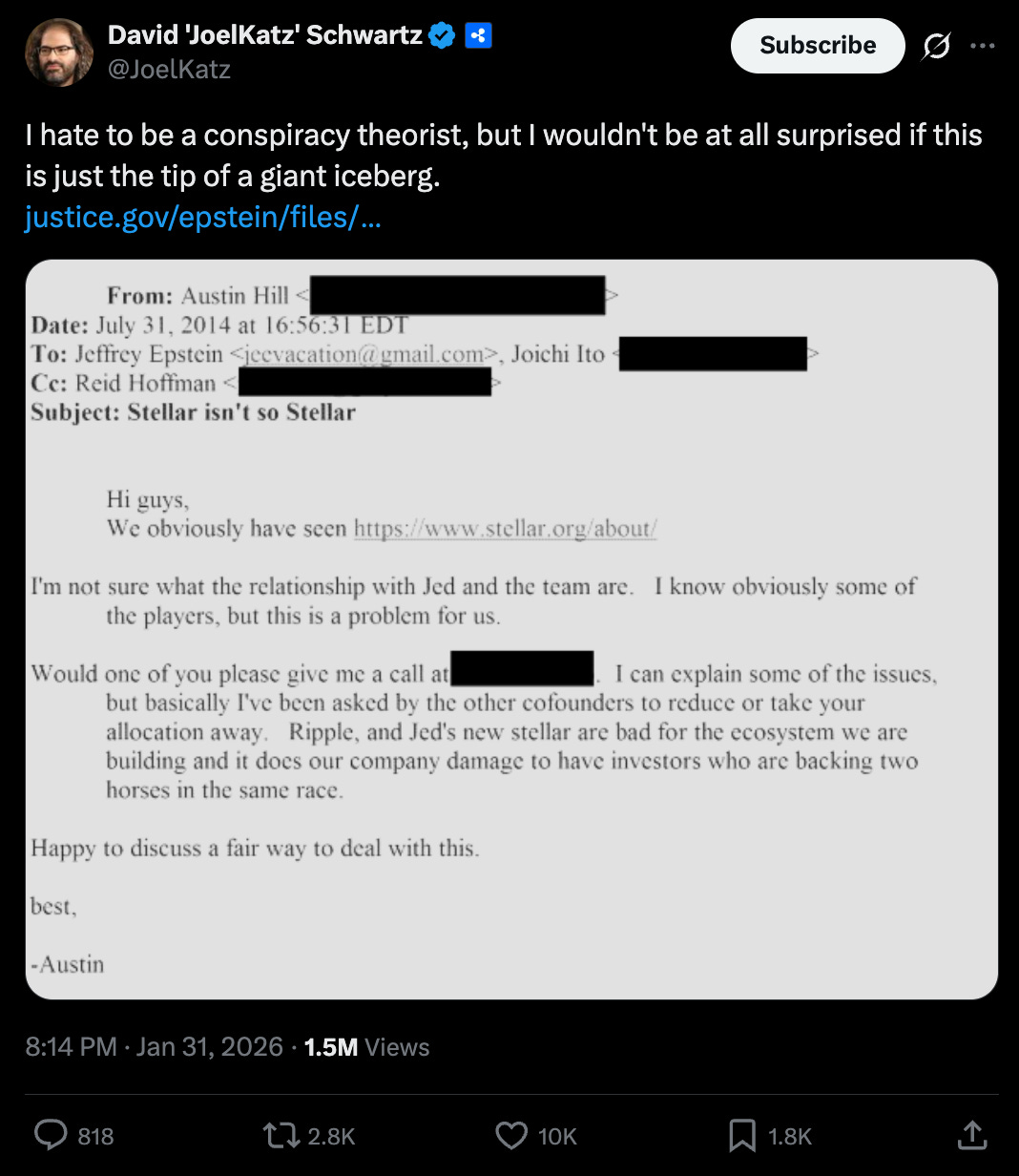
David Schwartz (@JoelKatz) posts the Austin Hill email from the Epstein files on X, writing: “I hate to be a conspiracy theorist, but I wouldn’t be at all surprised if this is just the tip of a giant iceberg.” The post received 1.5 million views. The embedded email shows the July 31, 2014 message from Austin Hill to Jeffrey Epstein and Joichi Ito, cc’ing Reid Hoffman, with subject line “Stellar isn’t so Stellar.”
Read that caption again. Schwartz (Ripple’s former CTO) didn’t dismiss this as nothing. He called it the tip of a giant iceberg.
The email itself, dated July 31, 2014, was sent by Austin Hill, then-CEO of Blockstream, a Bitcoin infrastructure company. Hill was writing to Epstein and Joi Ito (the former MIT Media Lab director), with LinkedIn co-founder Reid Hoffman copied. Hill’s message was blunt: he had been asked by Blockstream’s co-founders to pressure these investors to abandon Ripple and Jed McCaleb’s newly launched Stellar project, arguing both were “bad for the ecosystem” Blockstream was building.
The key detail: this email shows a Bitcoin-aligned executive pressuring Epstein to cut off support for XRP and Stellar. It doesn’t show Ripple seeking Epstein’s help. In fact, Ripple appears only as the target - the project that needed to be eliminated.
Does This Show Who Created Bitcoin?
This is the question the XRP community has been debating since the files dropped and it’s worth taking seriously, even if the answer isn’t simple.
The Epstein files don’t contain a document that says “Jeffrey Epstein created Bitcoin.” But they do reveal something that raises real questions: Epstein was deeply embedded in the network of people who shaped Bitcoin’s early development, funding, and institutional support.
Consider what the documents show. As early as June 2011, tech investor Jason Calacanis was emailing Epstein directly about Bitcoin’s creators, referencing Gavin Andresen and Amir Taaki; two of the earliest and most prominent Bitcoin developers.
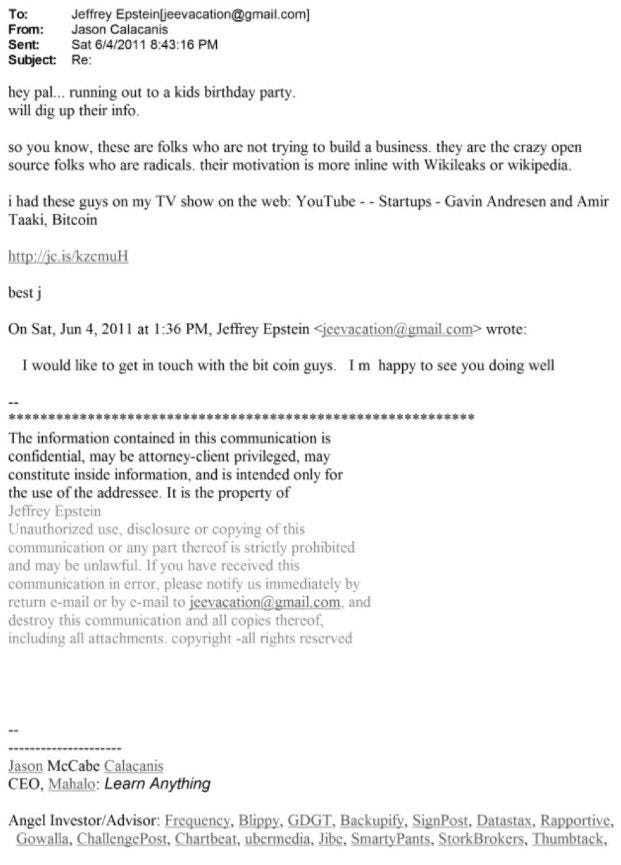
A June 4, 2011 email from Jason Calacanis to Jeffrey Epstein (jeevacation@gmail.com). Calacanis describes Bitcoin’s early developers as “radicals” whose “motivation is more inline with Wikileaks or wikipedia.” He references having Bitcoin figures Gavin Andresen and Amir Taaki on his TV show. The bottom of the email shows Epstein had written: “I would like to get in touch with the bit coin guys. I m happy to see you doing well.”
Look at the bottom of that email. Epstein wrote: I would like to get in touch with the bit coin guys. This was 2011, just two years after Bitcoin launched. The creator, Satoshi Nakamoto, had only recently disappeared from public forums. And here was Epstein actively seeking access to Bitcoin’s founding circle.
Then there’s Joi Ito. The same Joi Ito who received Austin Hill’s 2014 anti-Ripple email was the director of MIT’s Media Lab; which housed the Digital Currency Initiative (DCI), one of the most important institutional supporters of Bitcoin Core development. Ito resigned from MIT in 2019 after it was revealed that he had accepted funding from Epstein and concealed the relationship. The money Epstein funnelled through MIT went, in part, to fund the very infrastructure that kept Bitcoin running.
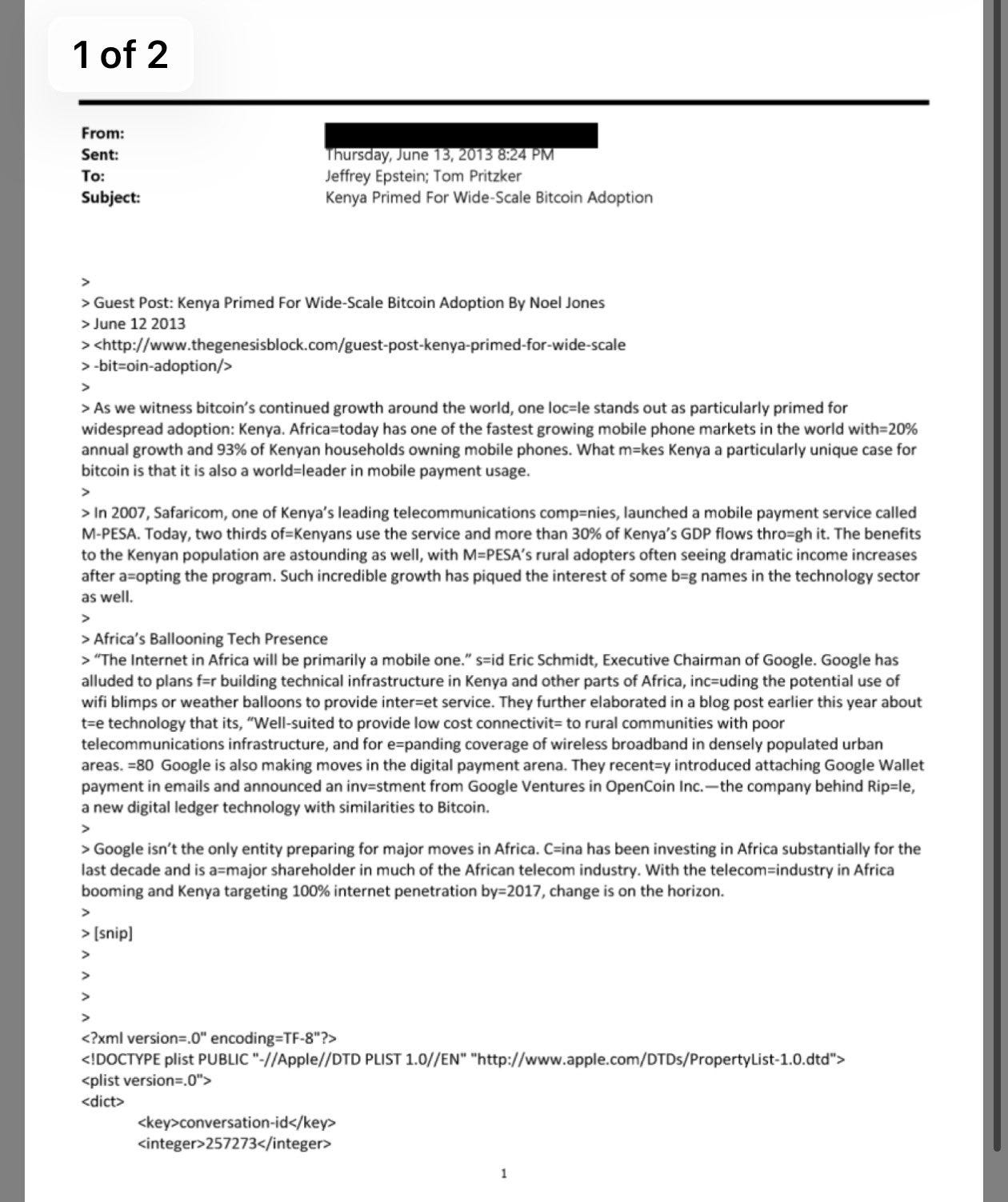
Another email from the files, dated June 2013, shows someone sending Epstein and billionaire Tom Pritzker an article about Bitcoin adoption in Kenya. The subject line: Kenya Primed For Wide-Scale Bitcoin Adoption. By 2013, Epstein wasn’t just curious about Bitcoin, he was being briefed on its global expansion potential.
But perhaps the most striking document is an October 2016 email from Epstein himself. Writing to two contacts Raafat Alsabbagh and Aziza Alahmadi about digital currencies and the Middle East, Epstein casually dropped a line that has set the crypto world alight: Ive spoken to some of the founders of bitcoin who are very excited.
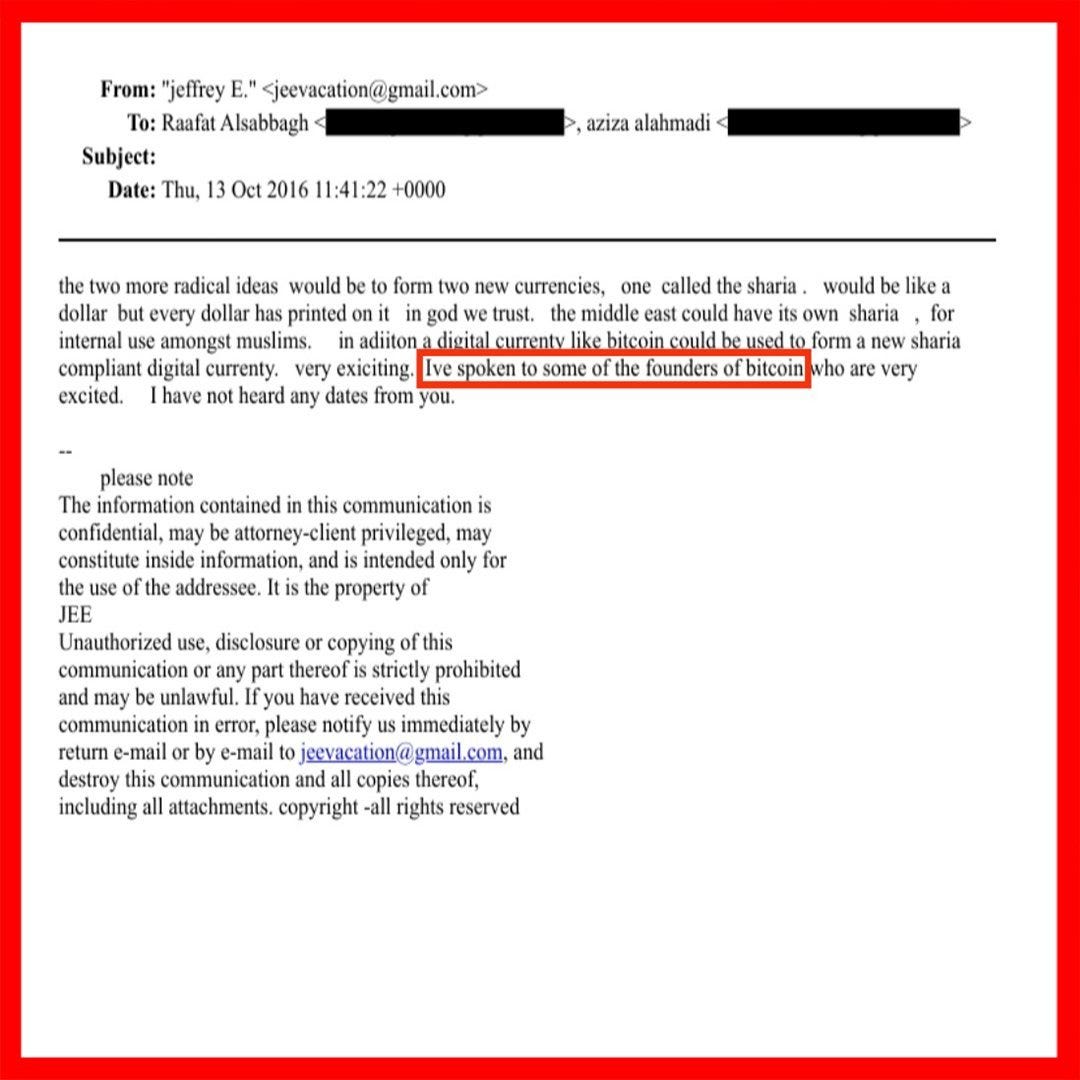
An email from the DOJ Epstein files. From: jeffrey E. (jeevacation@gmail.com). To: Raafat Alsabbagh, Aziza Alahmadi. Date: October 13, 2016. Epstein discusses creating a Sharia-compliant digital currency using Bitcoin’s technology. The key line, highlighted: “Ive spoken to some of the founders of bitcoin who are very excited.” The email suggests Epstein claimed direct personal contact with Bitcoin’s creators.
Read that again. Epstein didn’t say he’d spoken to Bitcoin developers or investors. He said founders. Plural. Satoshi Nakamoto’s identity is the single biggest unsolved mystery in technology. No one has ever publicly confirmed who created Bitcoin. And yet here was Epstein, in a private email never meant to be seen, claiming he had spoken directly to the people who built it and that they were “very excited” about his plans.
Did Epstein actually know who Satoshi was? Or was he exaggerating his connections, as powerful people often do? The files don’t answer that. But combined with everything else: his 2011 outreach to Bitcoin’s developers, his funding of MIT’s crypto infrastructure, his network of people like Ito and Hoffman who shaped the industry the claim can’t simply be dismissed. At minimum, Epstein believed he was in direct contact with Bitcoin’s creators. At maximum, he actually was.