

This content is for informational and educational purposes only and does not constitute financial advice. Always do your own research. Not financial advice (NFA).
This Week
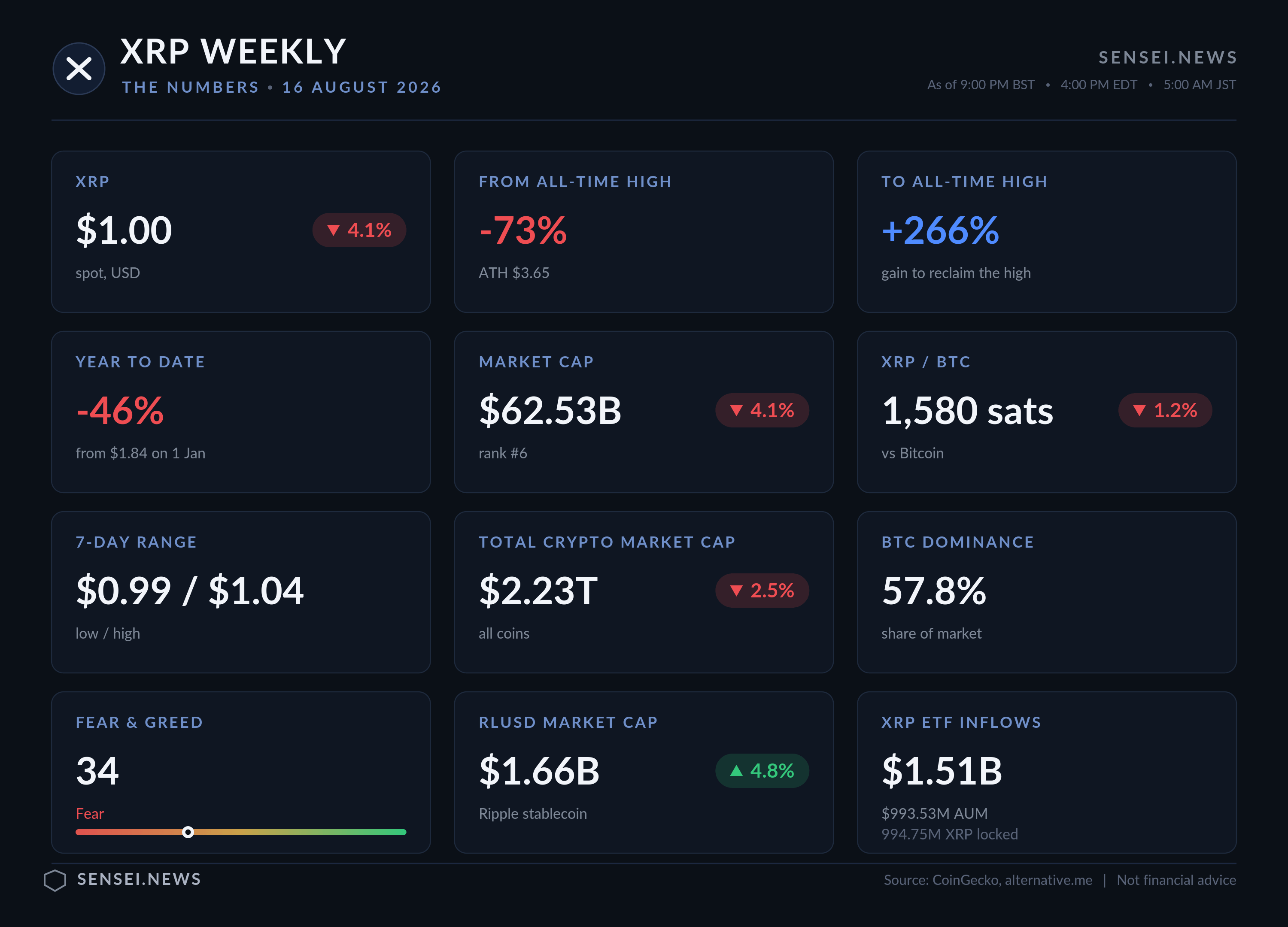
XRP finished the week at $1.00, inside a range of 99 cents to $1.04, and on Tuesday it did something it had not done in 635 days. It traded below a dollar. Total crypto market value fell about 2.5 percent to $2.23 trillion, Bitcoin dominance rose to 57.8 percent, and sentiment sat at 34 on the Fear and Greed Index, still in Fear.
That break gave the week its shape. XRP printed 99.15 cents on Tuesday, went under again on Friday, and at the low it was worth less than RLUSD, the dollar stablecoin Ripple issues on the same ledger.
Underneath the price, four other things landed. A bridge lost almost all of its XRP in 97 minutes, and no holder was affected. Quarterly filings showed the world’s biggest banks own almost none of the XRP funds. Solana started trading on the XRP Ledger’s own exchange. And Ripple gets three days in front of American regulators from Tuesday, 26 days before the Senate votes.
The Consensus
💔 XRP broke a dollar. A 635 day streak ended on Tuesday at 99.15 cents, and it went under again on Friday.
🕳️ A bridge lost 199,916 XRP in 97 minutes. The flaw was in the bridge’s own software, and the XRP Ledger was never touched.
🏦 JPMorgan disclosed $1,356 in the Bitwise XRP fund. Around 113 shares, from a bank running $5.1 trillion.
🔗 Solana is now tradable on the XRP Ledger. Axelar is the only legitimate issuer, and copycat tokens are the risk.
🏛️ Ripple’s week in Washington. Jackson Hole Tuesday, the White House Wednesday, the CFTC Thursday.
The Numbers
The Chart Watch
The Ripple Effect
💔 XRP Traded Below a Dollar for the First Time in 635 Days
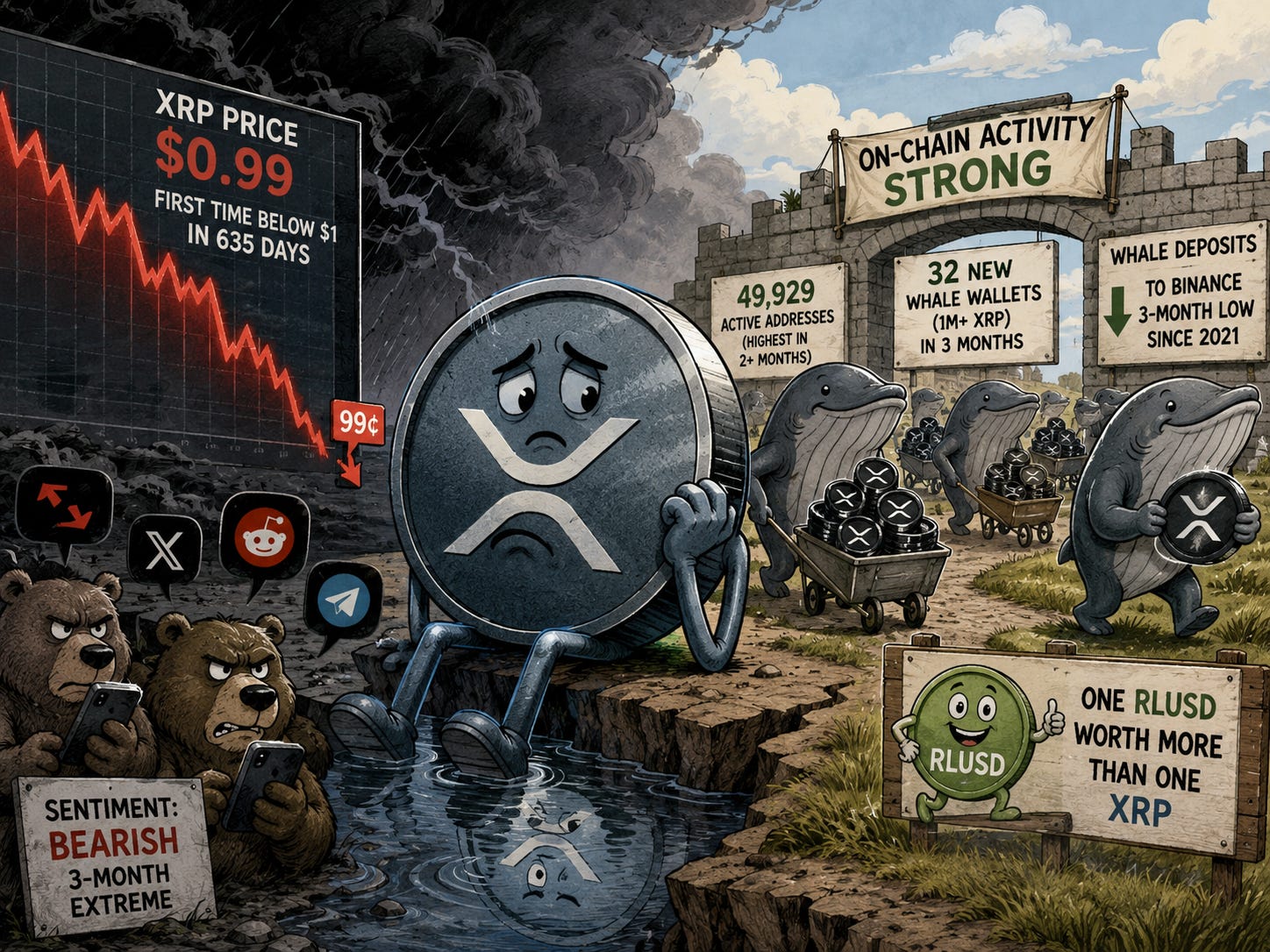
At 3:00pm UK / 10:00am ET on Tuesday 11 August, XRP printed 99.15 cents on Binance. That ended a run of 635 straight days above a dollar going back to 16 November 2024, and it went under again on Friday. Round numbers matter more than they logically should, because a dollar is where people set their alerts and park their orders, and a level that holds for 635 days becomes the one everybody is watching. There was a second detail at the Tuesday low, and it stung more than the first. One XRP was worth less than one RLUSD, which is Ripple’s own dollar token, engineered to be worth exactly a dollar at all times (Forbes).
The fund flows explain most of the fall. A spot ETF is a stock market listing that holds the real asset behind it, so when money goes into the fund, the fund has to go out and buy actual XRP with it. That buying has dried up. US spot XRP ETFs took in $131.94 million in May, $59.46 million in June and $27.29 million in July. Halfway through August they have taken $3.27 million, and $2.25 million of that arrived on one day. Even doubled to fill the month, August comes out at roughly a twentieth of May. Total assets across the seven funds have slipped to about $942 million from a peak above $1.25 billion (CryptoSlate).
Here is the part that sits awkwardly against the price. Active addresses count the wallets doing something on a network in a day, which is the closest thing crypto has to a footfall figure for a high street. On Friday the XRP Ledger logged 49,929 of them in 24 hours, its highest in over two months and about 3 percent above the 48,453 it managed in May, when XRP traded above $1.54. More people are using the ledger at a dollar than were using it at $1.54. Santiment counted 32 new wallets holding at least a million XRP over three months while XRP’s market value fell 29 percent, though one owner can run several wallets, so treat that as a hint rather than a headcount. And watch the flow you would expect to see if whales were queuing up to sell. Deposits from big holders into Binance have dropped to a three month average near $61 million, the lowest since 2021, against $456 million in January 2025 (CryptoSlate).
The mood went the other way entirely. Santiment tracks what people post about a coin across X, Reddit and Telegram, and negative commentary on XRP hit a three month extreme in the days to 14 August, the most bearish reading since mid-May (The Crypto Times).
🕳️ A Bridge Lost 199,916 XRP in 97 Minutes, and the Ledger Was Never Touched
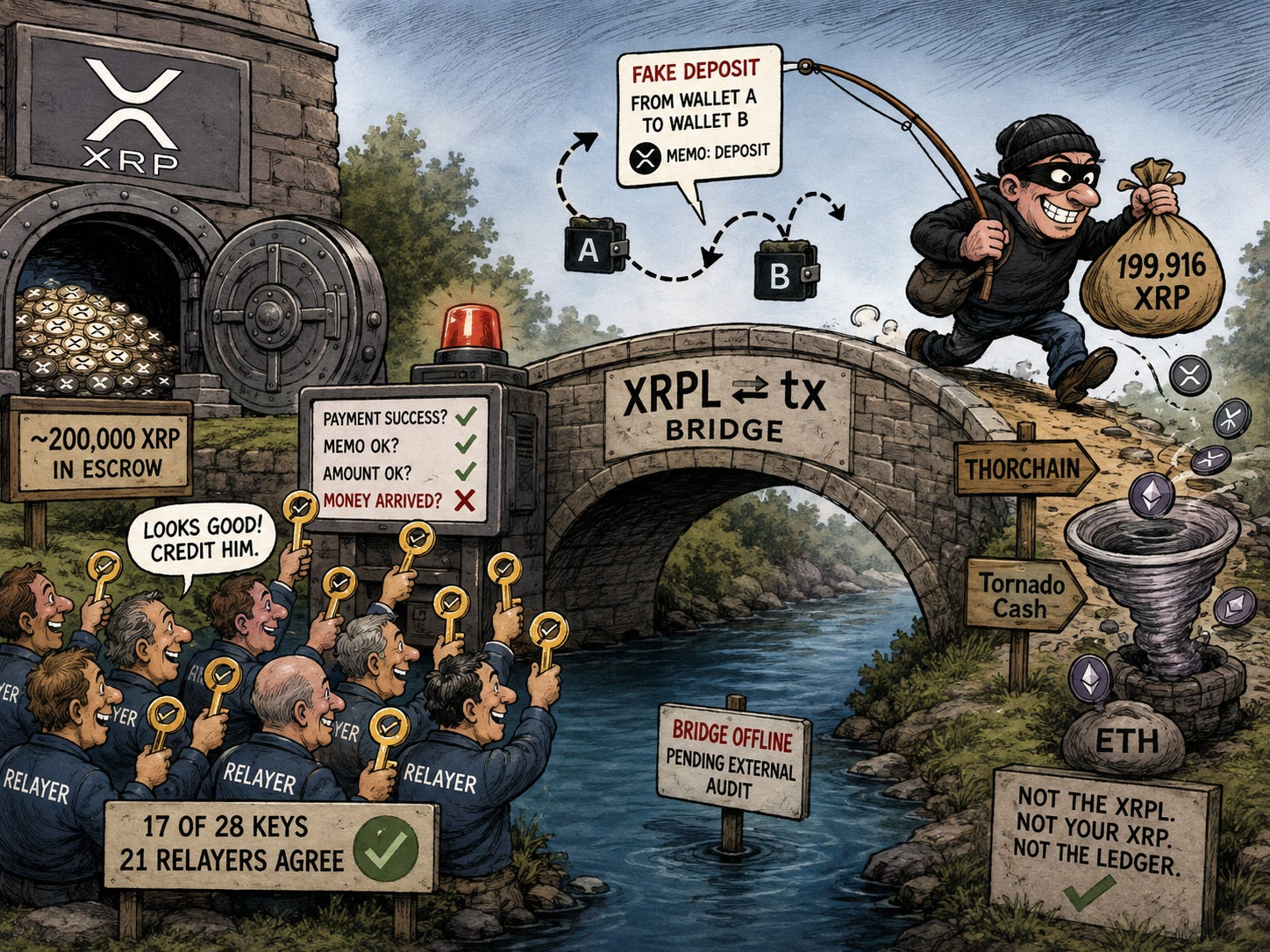
Start with the bit that actually affects you, because most of the coverage buried it. If you hold XRP in a wallet, on an exchange, or through one of the spot funds, none of it was ever at risk. What got emptied on Sunday 9 August was a bridge: a piece of software that lets you move XRP off the XRP Ledger and use it on a different network. Ninety-four payments over 97 minutes drained the one connecting the XRP Ledger to tx, the network formerly called Coreum. The account held about 200,410 XRP when it started and 493.5 when it stopped, roughly $500 left of a reserve worth about $200,000 (CoinDesk).
How it happened is simpler than it sounds. A bridge is a cloakroom: you hand over real XRP, it gets locked in a vault, and you get a ticket on the other network that you can swap back later. A program called a relayer is the cloakroom attendant, watching for arrivals and writing the tickets. This attendant checked that a payment had gone through, read the note saying who to credit, and read the amount. It never checked that the coat had actually been handed in. Because the bridge issues its own token, the attacker’s transfers between two wallets he already owned showed up in the bridge’s books carrying a note that looked like a deposit. He was written tickets for coats he never handed over, then walked up to the counter and claimed real XRP with them (crypto.news).
One detail settles what kind of failure this was. Every payment out was signed off by 17 of the bridge’s 28 operator keys, and 21 separate operators independently waved that first fake deposit through as genuine. Stolen keys do not make honest operators agree with each other. Shared software that looks right and is wrong does exactly that. The team halted the bridge, patched the code, hired forensics specialists and filed a complaint with the FBI’s Internet Crime Complaint Center. The stolen XRP was converted to Ether and pushed through Tornado Cash, a service that pools coins together to break the trail back to their owner. The bridge had passed multiple internal and outside audits before it went live, and none of them caught this (Protos).
Keep the scale honest and keep the blame in the right place. Two hundred thousand dollars is small money against Ronin’s $624 million, Wormhole’s $326 million or Nomad’s $190 million, and bridges have lost billions since 2021 because they are the weakest joint in the whole system. The XRP Ledger itself did exactly what it was built to do throughout, no ledger keys were compromised, and Ripple neither built nor ran this bridge. As of Sunday it is offline indefinitely pending an outside audit, and tx says it is working on compensation without yet naming an amount or a date (Crypto Briefing).
🔗 Solana Started Trading on the XRP Ledger, With One Warning Attached
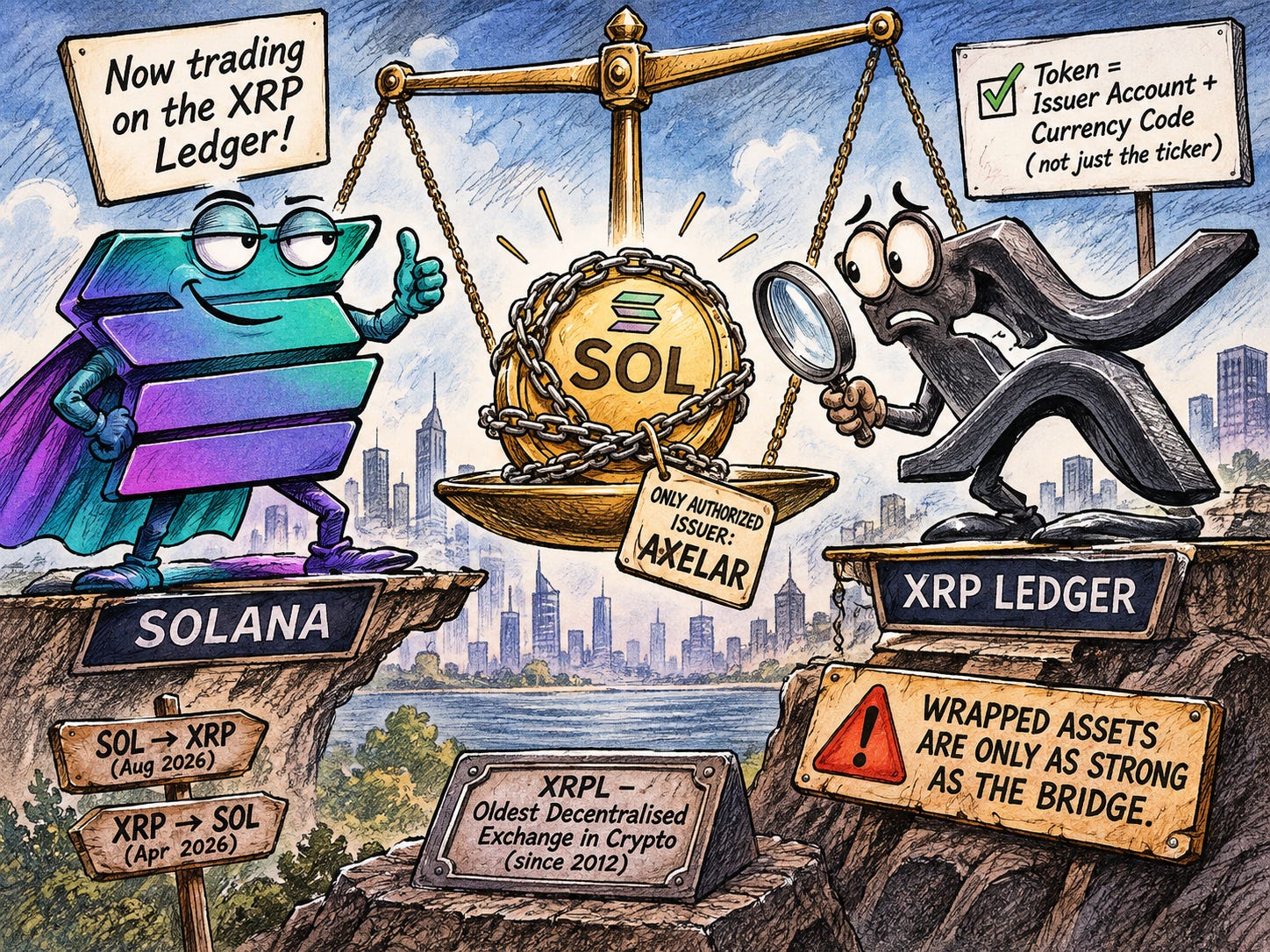
You can now buy Solana on the XRP Ledger. Not the real thing, and the difference matters: what went live on Friday 14 August is wrapped SOL, which is the cloakroom ticket from the bridge story above. Real Solana gets locked away on its own chain, and a token representing it gets issued on the XRP Ledger, swappable back one for one. Axelar, a routing network linking more than 70 blockchains, does the locking and the issuing. The result trades against XRP on the ledger’s own built-in exchange through XPMarket, First Ledger and Magnetic, and swaps inside the Xaman wallet (The Crypto Times).
Now the warning, which Hussein Zangana of the XRP Ledger Foundation spent his whole announcement post on. Anyone at all can create a token on the XRP Ledger and call it SOL. The ledger identifies a token by who issued it, never by its name, so the ticker on your screen proves nothing. The genuine one comes from the account starting rfmS3zqr, which the XRP Ledger’s own documentation lists as Axelar’s gateway. The verification ticks you see are labels the trading sites add themselves, helpful but not a guarantee from the network. In practice: check the issuer before you trade, and treat a matching name as meaningless on its own (crypto.news).
Traffic has been running the other way for four months already. Wrapped XRP went live on Solana on 17 April, issued by Hex Trust, arriving with over $100 million of liquidity and access to Jupiter, Phantom, Meteora and Titan. Different bridges, different builders, opposite directions.
Two things to watch from here. Nobody has published any trading volume for wrapped SOL on the XRP Ledger yet, so whether this becomes a real market or just a listing is genuinely unknown. And a wrapped token is only ever as sound as the bridge holding the original, which is the lesson two stories up. The XRP Ledger has had a trading exchange built directly into it since 2012, making it the oldest in crypto, and a rival chain’s token now trades on it.
🏛️ Ripple Gets Three Days in Front of the Regulators
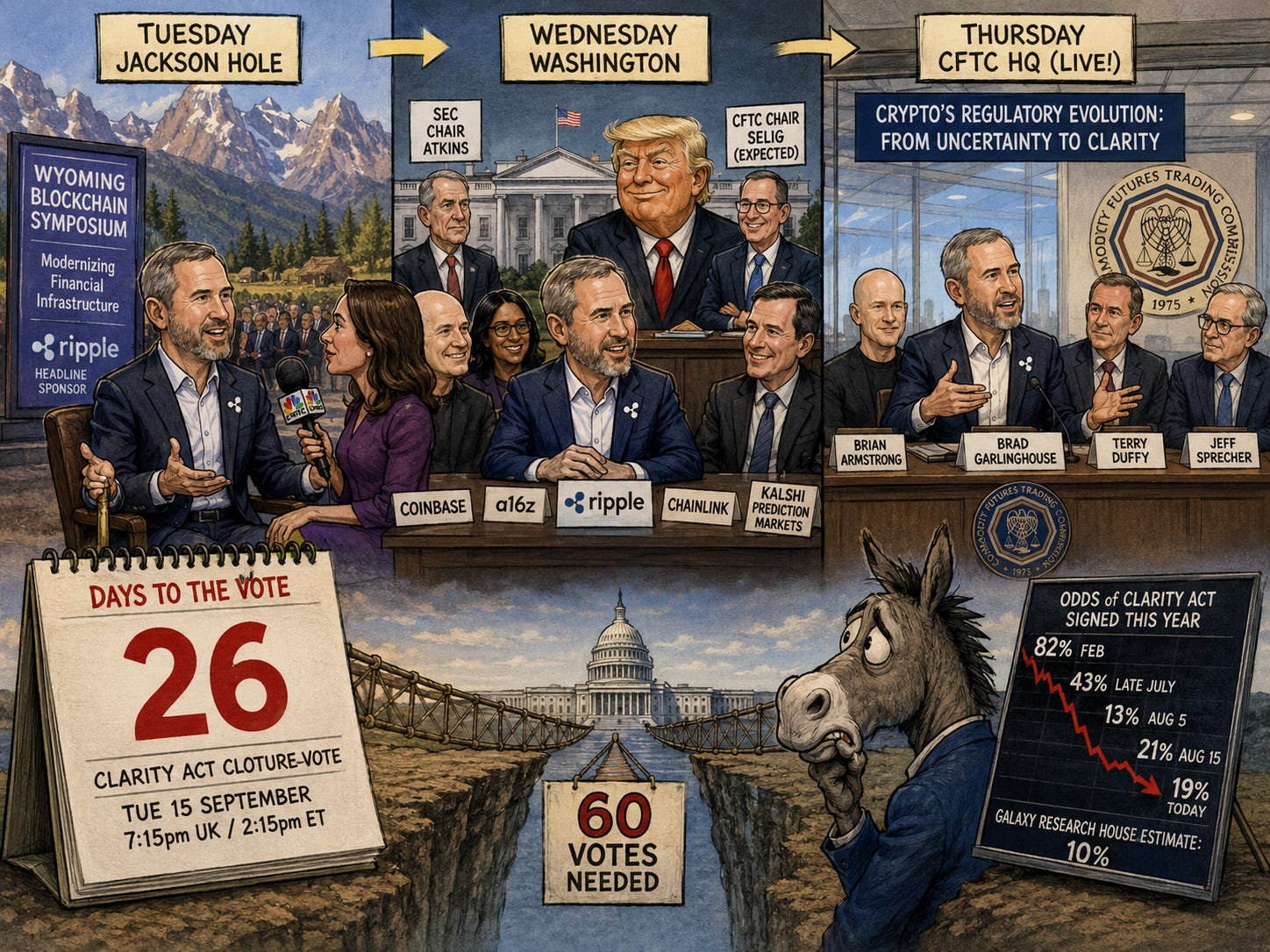
Tuesday takes Brad Garlinghouse to Jackson Hole, where he speaks at the Wyoming Blockchain Symposium at 10:05pm UK / 5:05pm ET on a panel called Modernizing Financial Infrastructure. It is invitation only, 500 people at the Four Seasons, hosted by SALT and Kraken, with Ripple as a headline sponsor and Securities and Exchange Commission (SEC) Chair Paul Atkins speaking the same morning. Wednesday moves to Washington, where the White House hosts crypto executives at 7:30pm UK / 2:30pm ET. Ripple is on the guest list alongside Coinbase, a16z, Chainlink, Kalshi and Paradigm. Atkins is confirmed, Commodity Futures Trading Commission (CFTC) Chair Michael Selig is expected, and President Trump is expected rather than confirmed. No outlet has named Garlinghouse personally for that one, so read it as Ripple rather than the boss (SALT, The Block).
Thursday is the one you can actually watch, free, from your sofa. The CFTC’s Innovation Advisory Committee holds its first ever meeting from 6:00pm to 9:00pm UK / 1:00pm to 4:00pm ET, streamed live on cftc.gov. Garlinghouse sits on that committee as one of 35 members, alongside Coinbase’s Brian Armstrong, the bosses of Nasdaq and the New York Stock Exchange’s parent, and the head of CME Group. The opening 50 minutes is titled Crypto’s Regulatory Evolution: From Uncertainty to Clarity (CFTC).
All three days land 26 days before the vote everything hangs on. The Senate returns at 8:00pm UK / 3:00pm ET on Monday 14 September, and at 7:15pm UK / 2:15pm ET the next afternoon it votes on the Digital Asset Market CLARITY Act. That vote decides only whether the Senate may start debating the bill, and it needs 60 of the 100 senators. Republicans hold 53 seats, so seven Democrats have to cross. Now be precise about what the bill would and would not do for XRP, because most coverage gets this part wrong. XRP is not sitting around waiting to learn whether it is a security. A federal court answered that years ago. In July 2023 Judge Analisa Torres ruled that XRP sold on exchanges is not a security, the SEC dropped its appeal, Ripple dropped its cross-appeal, and the Second Circuit closed the case in August 2025 with her ruling left standing as the final judgment. That is the law of the land, and no other major token has anything like it (The Block).
CLARITY does a different job. It decides who regulates spot crypto trading in America, what rules exchanges and custodians have to follow, and where the CFTC’s authority starts and the SEC’s stops. XRP has its answer on the legal question and is still waiting on the rulebook built around it, which is what unlocks the products and the trading desks. On Polymarket, where people bet real money on political outcomes, the odds of the bill being signed this year sit at 19 percent today, down from 82 percent in February and a low of 13 percent on 5 August. Galaxy Research cut its own estimate to 10 percent this week (Polymarket, Cointelegraph).
Seen on X


Sensei’s Insight: Read those two numbers together. Sentiment at its most bearish in three months, and the ledger busier than it has been since May, when XRP was over $1.50. More people using it at a dollar than at a dollar fifty. I am not going to dress that up as a bottom signal, because I am still bearish and my orders are still sitting where they are. But usage going up while the price goes down is worth knowing, and almost nobody posted it this week.

Sensei’s Insight: The SEC pushed its tokenisation exemption back, and part of the reason is that nobody wants to move first while the CLARITY Act is still being negotiated. That is the pattern for the next month. Washington will keep circling and nothing gets settled before 15 September. If you are waiting on a headline to save this chart, understand what you are actually waiting for and how slowly it moves.
Debunked

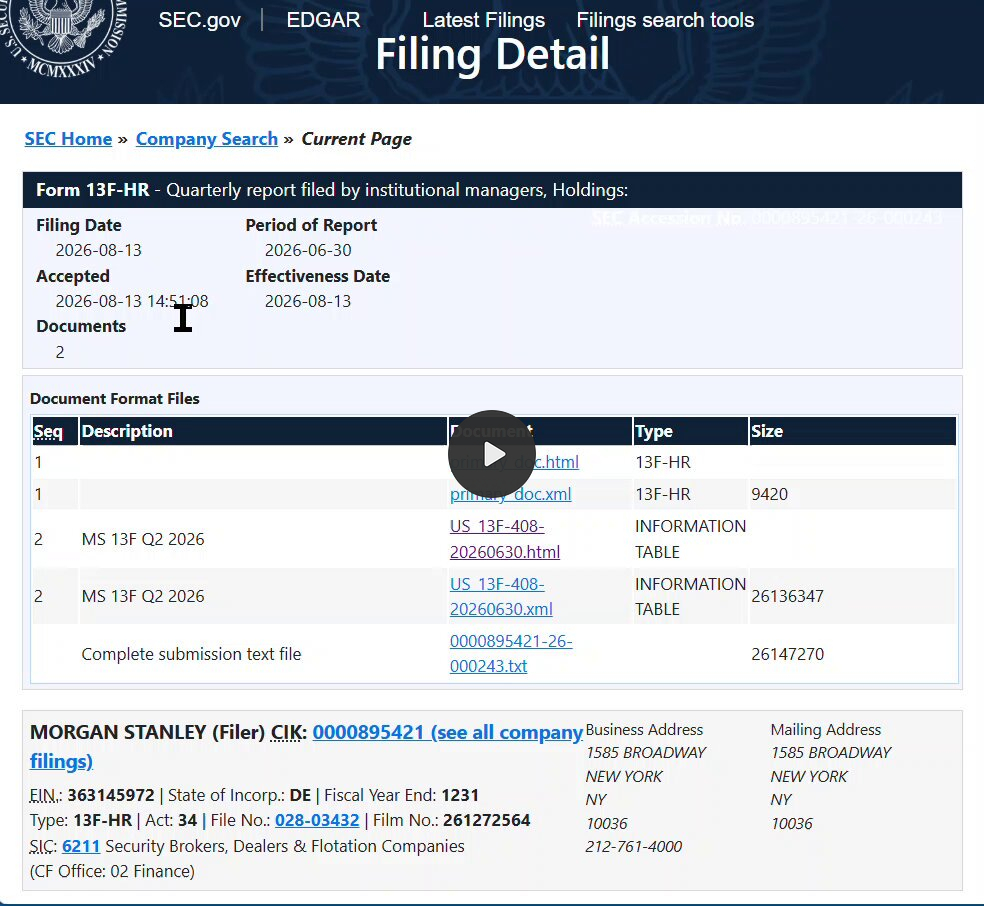

The post reads: “MORGAN STANLEY JUST FILED A 13F SHOWING XRP ETF HOLDINGS! Positions confirmed across FRANKLIN XRP ETF, REX-OSPREY XRP ETF, and BITWISE XRP ETF straight from Wall Street’s own paperwork. Big money doesn’t disclose exposure it doesn’t want.” That last sentence is the whole trick, and it is exactly backwards. A Form 13F is not a choice. It is a legal requirement, and every manager running $100 million or more has to file one whether they feel like it or not. Morgan Stanley did not decide to tell you about its XRP position. Federal law made it. Presenting a compelled filing as a voluntary signal is how you turn a rounding error into a headline.
Then read what was actually in it. Sixty-seven shares of the Bitwise fund. Not 67,000. Sixty-seven, alongside 255 of the REX-Osprey fund and 6,715 of Franklin’s, from a firm managing over $1.9 trillion. JPMorgan’s filing landed the same day: $1,356 of the Bitwise XRP fund and $3,763 of Grayscale’s, against $355.7 million in its Bitcoin fund in the same document. That is roughly seventy thousand times more Bitcoin than XRP, disclosed on the same page, and not one account posting the screenshots mentioned it. These are also 30 June figures published six weeks late, so they describe a day in June, not a decision this week. Anyone selling you that as Wall Street arriving is either not reading the filings or counting on you not to.