

This content is for informational and educational purposes only and does not constitute financial advice. Always do your own research. Not financial advice (NFA).
This Week
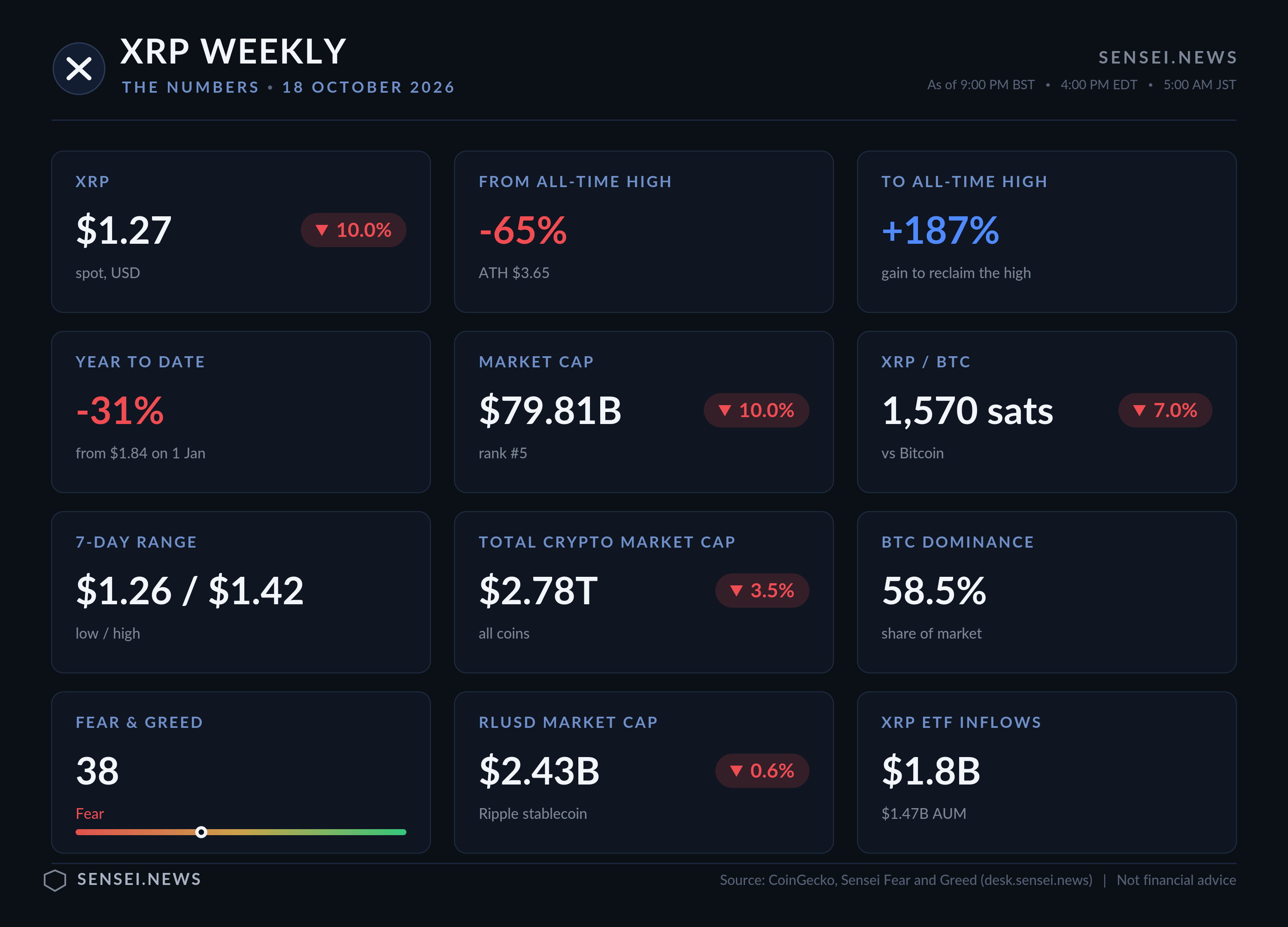
XRP ends the week around $1.27, down 10%. It traded between $1.42 on Monday and $1.26 at the weekend. It fell harder than bitcoin too, losing 7% against it. Crypto as a whole shed 3.5% to $2.78 trillion. Bitcoin now holds 58.5% of it. The Sensei Fear and Greed reads 38 for crypto. That is Fear.
The shape of the week came from what happened under the price. A floor that had held twice gave way on Wednesday. Coins piled onto exchanges, and the XRP funds stopped buying. The lead story below lays out the evidence that a bigger move is building, and which way it could break.
Ripple spent the same week signing banks and brokers to RLUSD, from Standard Chartered in Dubai to Cross River in New Jersey. And Evernorth finished its first week on Nasdaq with a plan to put its XRP to work.
The Consensus
🌀 XRP’s floor at $1.31 gave way as coins moved onto exchanges and the ETF buyers went quiet.
🏛️ RLUSD’s bank week signed up Standard Chartered and Cross River. None of the deals needs anyone to hold XRP.
🏦 Evernorth’s first Nasdaq week ended at $15.45 a share, with a plan to start deploying its XRP this quarter.
The Numbers
The Chart Watch
The Ripple Effect
🌀 XRP Lost $1.31. Now Everything Points to a Big Move
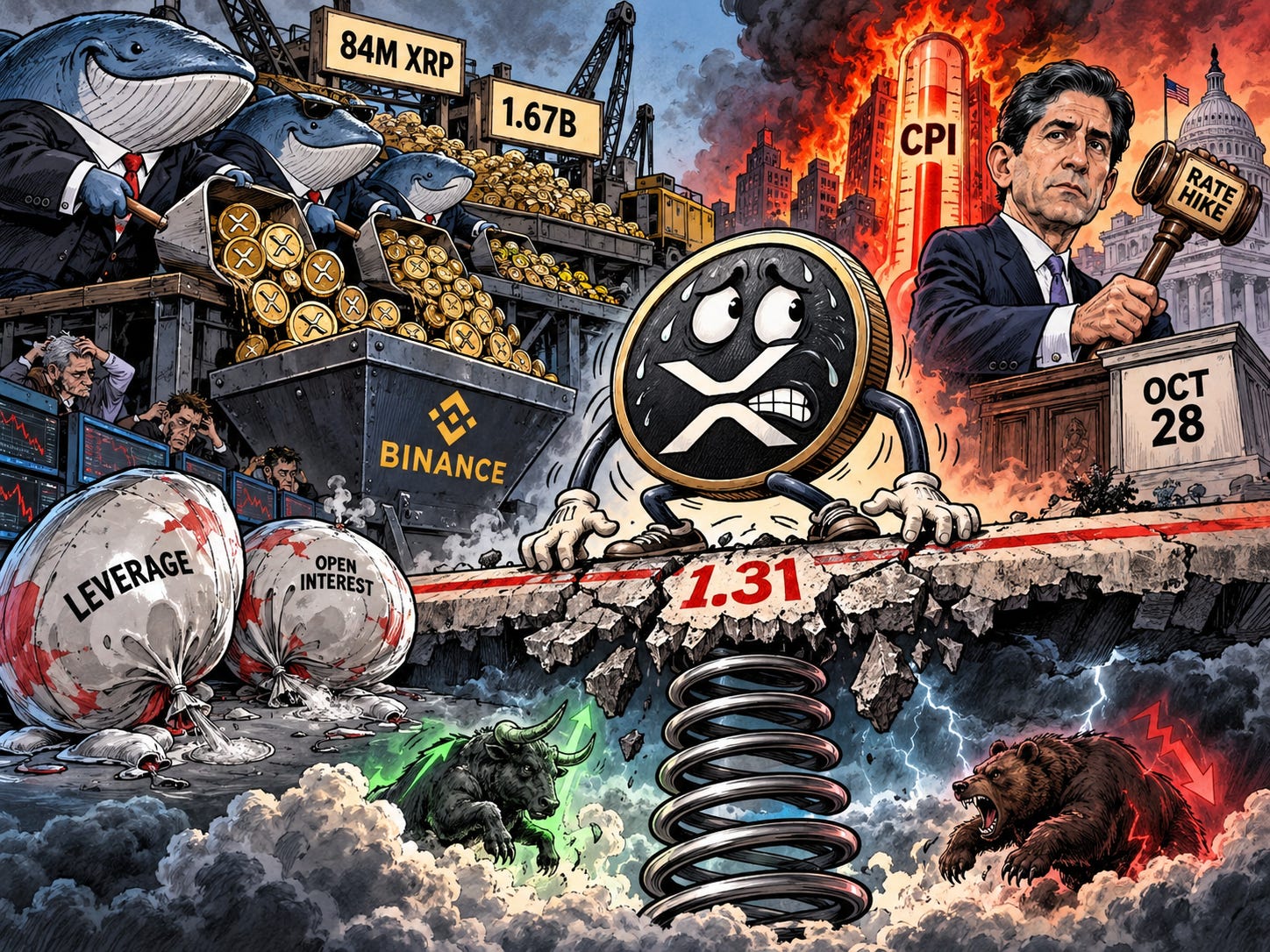
For a week, $1.31 was the line XRP would not cross. Buyers stepped in there on Thursday 8 October. They stepped in again on Tuesday 13 October. Then came Wednesday. US inflation came in hotter than forecast, at 3.7% against 3.6%, and the line gave way (CoinDesk). By the weekend XRP was at its lowest since the CLARITY Act vote failed in mid-September.
So who was selling? The first clues sit on the exchanges. A coin has to be moved onto an exchange before it can be sold, which makes deposits an early warning. Between 13 and 15 October, tracked exchange wallets took in about 84 million XRP. Binance alone took 54.61 million over the week. The biggest holders were moving too. Large wallets sent 1.67 billion XRP to Binance over 30 days, the most in 7 months on CryptoQuant’s data. A deposit is still not a sale. Those 84 million coins are about 0.4% of the 22 billion already sitting in exchange wallets (CryptoSlate, Bitcoin.com News).
The order books show the selling itself. One gauge tallies trades where buyers paid up against trades where sellers gave way. Across the big exchanges it has run about $2 billion further into the red since 23 September. Sellers have been in charge for most of a month (TokenPost).
The steadiest buyer of the past 3 months went quiet at the same time. US spot XRP funds had taken money in for 13 straight weeks. This week they lost $1.84 million. Friday alone saw $2.47 million leave Canary’s fund. It is a rounding error against roughly $1.8 billion put in since launch. The size is small. The streak was the point.
The ledger went quiet as well. Payments on the XRP Ledger fell to 119.5 million XRP on Saturday 17 October. That was down 72% in a day, and far below the 30-day average of 629.3 million. Weekends are always slower, so one day proves little on its own.
Is the whole market turning over? Bitcoin sits around $82,000. That is about 35% below its record of roughly $126,000, set in October 2025. It briefly slipped under $80,000 on Thursday, and US bitcoin funds lost $228.6 million over the week. The on-chain firms read it as a pullback inside a recovery. Glassnode says this year’s bear market never closed below the realised price, the average price at which every bitcoin last moved. It says the cycle “looks early in a recovery”, and called the selling near $80,000 a possible local bottom. The ceiling is close by. Glassnode puts the average cost of the past year’s buyers at about $88,000 (Glassnode).
Then there is oil. Brent closed on Friday at $109.86, its highest since May, and up 4.9% on the week. The world is spending its backup barrels to hold it there. The IEA agreed this week to speed up about 100 million barrels of emergency releases. That comes on top of roughly 330 million already let go since March, under the largest stock release on record. The IEA says oil held in tanks on land is at its lowest since at least 2016. Dearer fuel feeds inflation, and inflation is what keeps a rate rise on the table.
Now the other side. The futures market has been quietly clearing itself out. Open interest, the value of futures bets still open, is down 26.5% on Binance and Bybit since 23 September. Less borrowed money means fewer traders who can be forced to sell. The traders who remain still lean one way. On Binance, 2.7 accounts are betting on a rise for every 1 betting on a fall. Crowded bets like that can unwind fast in either direction (Bitcoin.com News).
The price has gone quiet too. The average daily range is down to about 6 cents, and XRP is leaning on its lower Bollinger Band at $1.26. Those bands mark how far price normally strays from its recent average. My own read is in The Chart Watch above.
Which way does it break? The answer may come from the Fed. It raised rates in September for the first time since 2023, to a range of 3.75% to 4%. After the hot inflation figure, traders briefly put the odds of another rise on 28 October at about 50%. Fed chair Kevin Warsh then said “I don’t prejudge meetings”, and the odds fell back to between 15% and 30%.
The politics make October harder. The US midterm elections fall on 3 November, 6 days after the decision. UBS’s Simon Penn called an October rise “politically untenable”, and markets now lean towards December. The Fed last raised rates within a week of an election in November 2022. The decision comes on Wednesday 28 October at 2:00pm Eastern. That is 6:00pm in the UK.
🏛️ Standard Chartered, Cross River and DriveWealth Sign Up to RLUSD
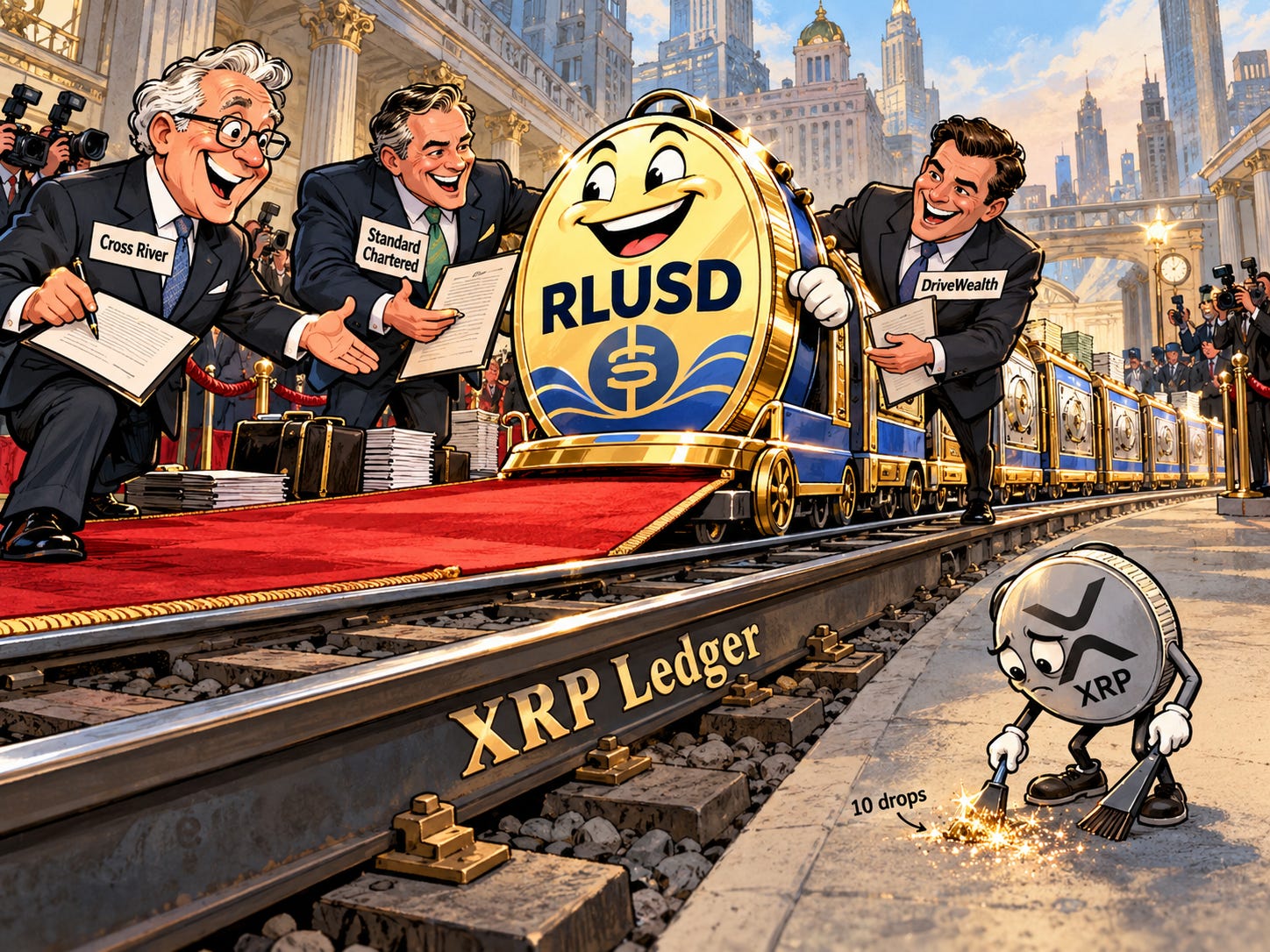
A fintech that banks with Cross River can now send dollars and RLUSD through the same connection. Cross River announced it on Thursday 15 October, with RLUSD running on the XRP Ledger inside its core banking system. It is live only in a limited number of US states. No customers were named. “Businesses shouldn’t have to rely on several different providers to move money across the globe,” said Adam Goller, its head of fintech banking (Cross River).
Cross River’s deal capped a busy 4 days for Ripple.
Monday 12 October. Standard Chartered launched RLUSD custody on the XRP Ledger through its Dubai branch.
Wednesday 14 October. DriveWealth, which powers investing for more than 100 partners, agreed to settle in RLUSD in Europe first.
Wednesday 14 October. Meritz Securities became Ripple’s fourth Korean institution this year, starting with custody and tokenisation.
Thursday 15 October. Ripple Prime opened round-the-clock swaps on more than 100 markets, from stocks to gold, with RLUSD accepted as collateral.
Ripple Prime is the prime broker Ripple built out of its purchase of Hidden Road. The new swaps track perpetual futures listed on Hyperliquid, a crypto exchange, and trade around the clock. Virtu, a market maker, is one early client. “RWA swaps are where traditional and digital markets meet,” said Michael Higgins, Ripple Prime’s international chief executive. RWA stands for real-world assets, meaning stocks, metals and currencies brought onto crypto rails (Ripple).
Naureen Hassan, DriveWealth’s chief executive, explained why it wants RLUSD. “We’ve already enabled 24/5 trading; now we need the funding to match.” Standard Chartered also plans to make RLUSD usable as collateral at the trading venue LMAX. That plan still depends on “final documentation, successful testing” (Ripple, Ripple).
So what does XRP get? None of these deals needs anyone to hold it. The token’s direct link is the fee every XRP Ledger transaction burns, which starts at 10 drops. A drop is a millionth of an XRP. A million RLUSD payments would burn about 10 XRP (CryptoTicker).
RLUSD itself sits at $2.43 billion on CoinGecko, below its 4 October record of $2.5 billion. More than $1 billion of it lives on the XRP Ledger, according to Cross River’s release. No volumes have been disclosed for any of this week’s deals.