

This content is for informational and educational purposes only and does not constitute financial advice. Always do your own research. Not financial advice (NFA).
This Week
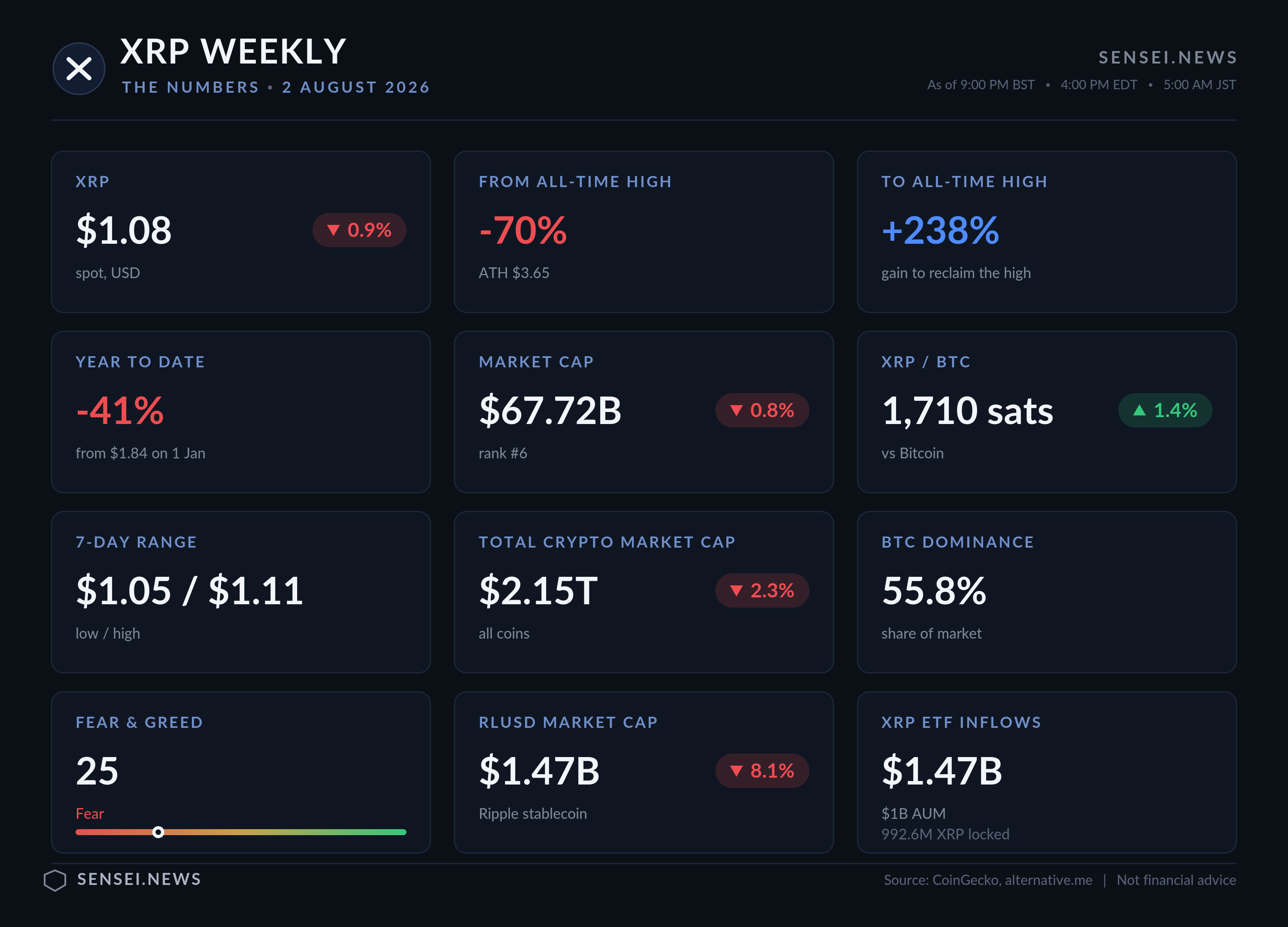
XRP finished the week at $1.08, inside a $1.05 to $1.11 range, after a 2.1 percent bounce on Sunday. Sentiment slipped back to 25 on the Fear and Greed Index, into Fear. The wider crypto market lost about 2 percent to $2.15 trillion.
Washington sets the week again, and this time there is a hard stop. The Senate's last scheduled day before the summer recess is Friday 7 August, with most senators expected to be gone from Thursday. A bipartisan ethics counterproposal reached the White House on Thursday morning, and President Trump's answer to it decides whether the Digital Asset Market CLARITY Act moves at all or waits until September. Senator Cynthia Lummis spent thirteen minutes on the Senate floor reading out everything Democrats have already been given.
Away from Washington, the XRP Ledger ships its v3.3.0 release this week, and the amount of XRP sitting on exchanges fell to a seven-year low.
The Consensus
⚖️ The CLARITY Act has until Tuesday. A bipartisan ethics counterproposal sits with Trump, and his answer decides whether the Senate votes at all.
🔧 XRP Ledger v3.3.0 ships this week, bringing back Batch and Permission Delegation after security flaws forced them out in February.
🪙 Half of XRP’s exchange supply has gone in nine months, a seven-year low, with ETF inflows at a record. The price has not moved.
The Numbers
The Chart Watch
Please upgrade to see this chart section.
All live entries are posted in real time for premium Substack members.
The Ripple Effect
⚖️ The CLARITY Act Has Until Tuesday, and Trump Holds the Answer
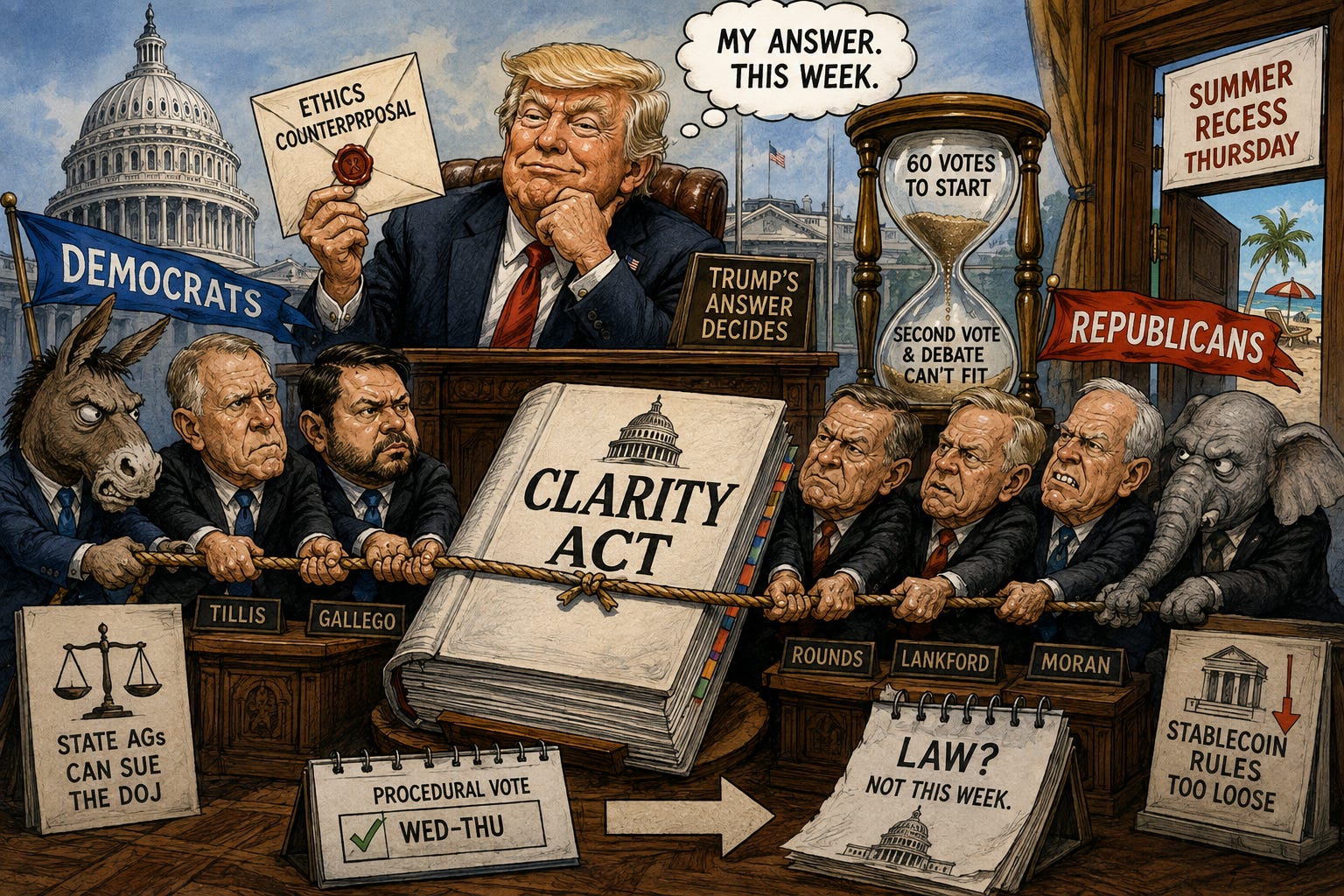
As of Sunday night the Digital Asset Market CLARITY Act has no cloture motion filed, no floor time allocated and no vote on the Senate calendar. The Senate returns Monday at 3pm and its last scheduled day before the summer break is Friday 7 August. Standing in the way is a bipartisan ethics counterproposal that went to the White House on Thursday morning, written by Republican Senator Thom Tillis of North Carolina and Democratic Senator Ruben Gallego of Arizona. Trump’s answer to it decides whether anything moves (The Block).
The whole argument comes down to one question: who enforces the rules. Last week’s deal handed enforcement to the Department of Justice alone. Democrats refused, because the Justice Department answers to the president it would be policing. The Tillis and Gallego version lets state attorneys general sue the Justice Department if it fails to act, borrowing the mechanism from the Laken Riley Act of 2025 (Crypto in America). Senator Cynthia Lummis, eleven months into negotiating this, took the floor on 29 July and spent thirteen minutes listing what Democrats have already been handed: 33 edits to Title One at their request, three entirely new titles, 23 sections on illicit finance, and a first-of-its-kind ban on the president, members of Congress and federal judges issuing digital assets, with Trump agreeing to put his own holdings in a blind trust or sell them. Her verdict on the reply she got: “we’ve now given our Democrat friends the entire cookie factory and a tanker load of milk” (Bitcoin Magazine).
Ethics is one of three locks that have to open together. The other two are the Blockchain Regulatory Certainty Act (BRCA), which stops software developers who never touch user money being regulated like a money transfer business, and the agriculture section covering the Commodity Futures Trading Commission (CFTC). The National Sheriffs’ Association wrote on Friday asking for the BRCA to be deleted, and Treasury Secretary Scott Bessent defended it publicly. Republicans have holdouts of their own, with Senators Mike Rounds, James Lankford and Jerry Moran backing the banking lobby’s claim that the stablecoin rules will drain deposits from local banks.
A procedural vote is not the vote that passes a bill. It decides how the Senate handles the legislation. Two of them matter here and both are called cloture, the step that ends debate. The first asks whether the Senate will start debating. The second asks whether it will stop and decide. Each needs 60 votes out of 100, and with 53 Republicans and 47 Democrats in the chamber, at least seven Democrats have to cross the aisle. The vote that actually passes the bill needs only 51, so the gates are harder to get through than the finish line, and once 60 senators agree to end debate the outcome is rarely in doubt (Congress.gov). Senate passage still would not be the end, because the chamber rewrote the House bill and merged it with the Agriculture Committee’s text, sending it back to the House before it can reach Trump’s desk.
That is why this week can only produce a beginning. Coinbase chief policy officer Faryar Shirzad said a procedural vote could come as early as Wednesday or Thursday and that the bill appears to have the support to advance (Coinpaper). He means the first gate. The second vote and the thirty hours of debate behind it do not fit before Friday, so “the CLARITY Act could get a vote on Wednesday” and “the CLARITY Act cannot become law this week” are both true statements about two different votes. The signal to watch is Senate Majority Leader John Thune filing cloture, and the two-day wait attached to that motion is what makes Tuesday the real deadline rather than Friday. Filed Monday, the vote lands Wednesday. Filed Tuesday, it lands Thursday. Leave the filing until Wednesday and the vote falls on Friday, a getaway day with most senators already heading home. Nothing filed by Tuesday means no vote this week (CryptoSlate).
What comes after is thinner than a calendar makes it look. The Senate returns on 14 September into roughly three usable weeks, and must-pass government funding will take most of them. Then the midterm election on 3 November pulls everything else off the schedule, with every senator facing voters weighing what a controversial crypto vote costs them. One more window opens after polling day, the lame duck session, which parts of the industry treat as the backup, though those few weeks tend to produce either frantic dealmaking or nothing at all. The hard cliff is January 2027. This Congress ends, and a bill that has not passed starts again from reintroduction, hearings and committee votes.
That shrinking runway is what the odds are pricing. Polymarket has the bill signed into law in 2026 at about 34 percent, down from 82 percent in February, and JPMorgan analysts led by Nikolaos Panigirtzoglou put it at 37 percent on 30 July, warning that each delay lets traditional finance build the tokenisation business on its own rails instead (CoinDesk). A third rather than near zero, with no Democrat publicly committed, comes down to how senators behave. Gallego and Angela Alsobrooks both voted this bill out of the Banking Committee in May, and Gallego co-wrote the proposal now sitting with Trump. Saying yes in public before a deal closes gives away leverage, so the count stays at zero right until the moment it does not. The election itself matters less to this bill than it appears, because the January cliff ends it either way. Where November counts is the restart: thirty-three seats are up, twenty of them Republican-held, and the party out of the White House has usually gained ground in a midterm, so a bill reintroduced in 2027 could meet a less receptive Senate than today’s 53 to 47.
For an XRP holder the stake is straightforward. XRP is treated as a commodity today because of agency guidance, and guidance is a policy the next administration can rewrite. The CLARITY Act would write it into law, and undoing a law takes another act of Congress. That is the difference between a rule that holds and a rule that lasts, and it is what banks and asset managers have said they are waiting on before committing properly. The price side deserves less excitement than the politics. This has been the running story all year, XRP has fallen about 41 percent across it, and the odds have already slid from 82 percent to the low thirties, so much of the disappointment sits in the price already. Markets move on the gap between what was expected and what turns up, and expectations here are low, which cuts both ways. A cloture filing on Monday or Tuesday would be the genuine surprise.