

This content is for informational and educational purposes only and does not constitute financial advice. Always do your own research. Not financial advice (NFA).
This Week
XRP ends the week at $1.41, almost exactly where it ended last Sunday. The flat number hides the week. It traded down to $1.31 on Wednesday and up to $1.48 on Thursday, a 13 percent swing that finished nowhere. The wider market did go somewhere. Total crypto market value rose 3 percent to $2.79 trillion and Bitcoin dominance sat at 57.6 percent. The Fear and Greed Index closed at 73, which reads as Greed. It read 69 last Sunday.
The week’s shape came from Washington, and from a calendar rather than a vote. House Republican leaders cancelled 8 voting days this month. That matters because the Senate takes its first vote on the CLARITY Act a week on Tuesday, 15 September. The House now leaves town 2 days after it. A bill needs both chambers. The section below sets out what it decides and what it does not.
Everywhere else, XRP had the kind of week that reads better in a headline than on a chart. The Bank for International Settlements built a working system on the XRP Ledger. Ripple agreed to paint the token’s logo onto a college football field. A fund disclosed a large XRP holding, then showed it had hedged nearly all of it. That is 3 big names in one week, and very little of it looks like demand. A ledger fix activates on Friday.
The Consensus
⚖️ The CLARITY Act gets its Senate vote on 15 September, and the House leaves Washington 2 days later.
🏛️ The BIS built on the XRP Ledger, anchoring official statistics on it in a working paper published on Wednesday.
🏈 Ripple bought the field at Florida, putting the XRP logo on the turf for a reported $5 million a year.
📉 Bitwise hedged 97 percent of its XRP, holding the tokens while shorting an almost identical amount of futures.
🔧 A ledger fix activates on Friday, clearing 11 bugs that validators voted through last month.
The Numbers
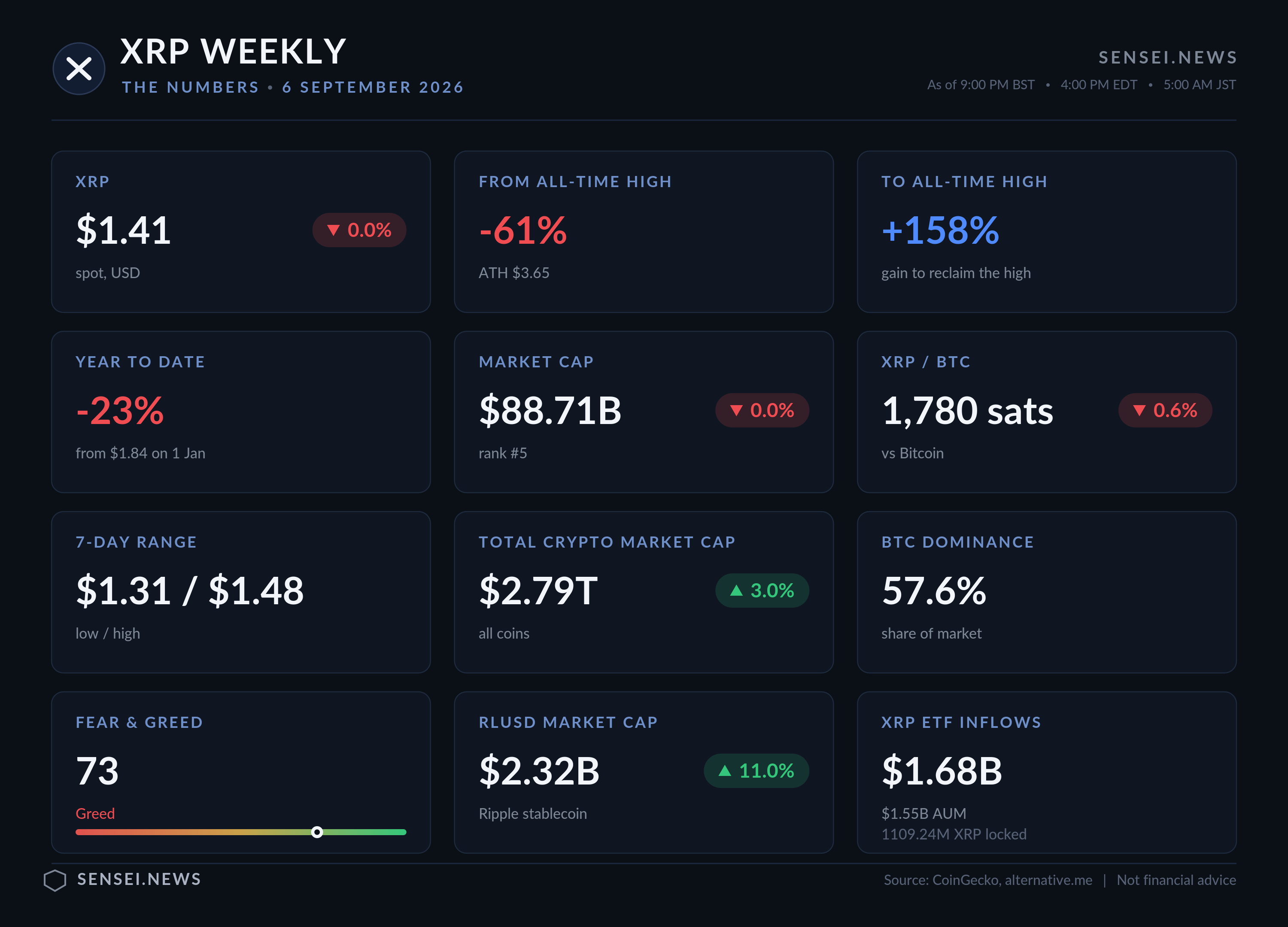
The Chart Watch
All live entries are posted in real time for premium Substack members.
The Ripple Effect
🏛️ The BIS Just Ran Official Statistics Through the XRP Ledger
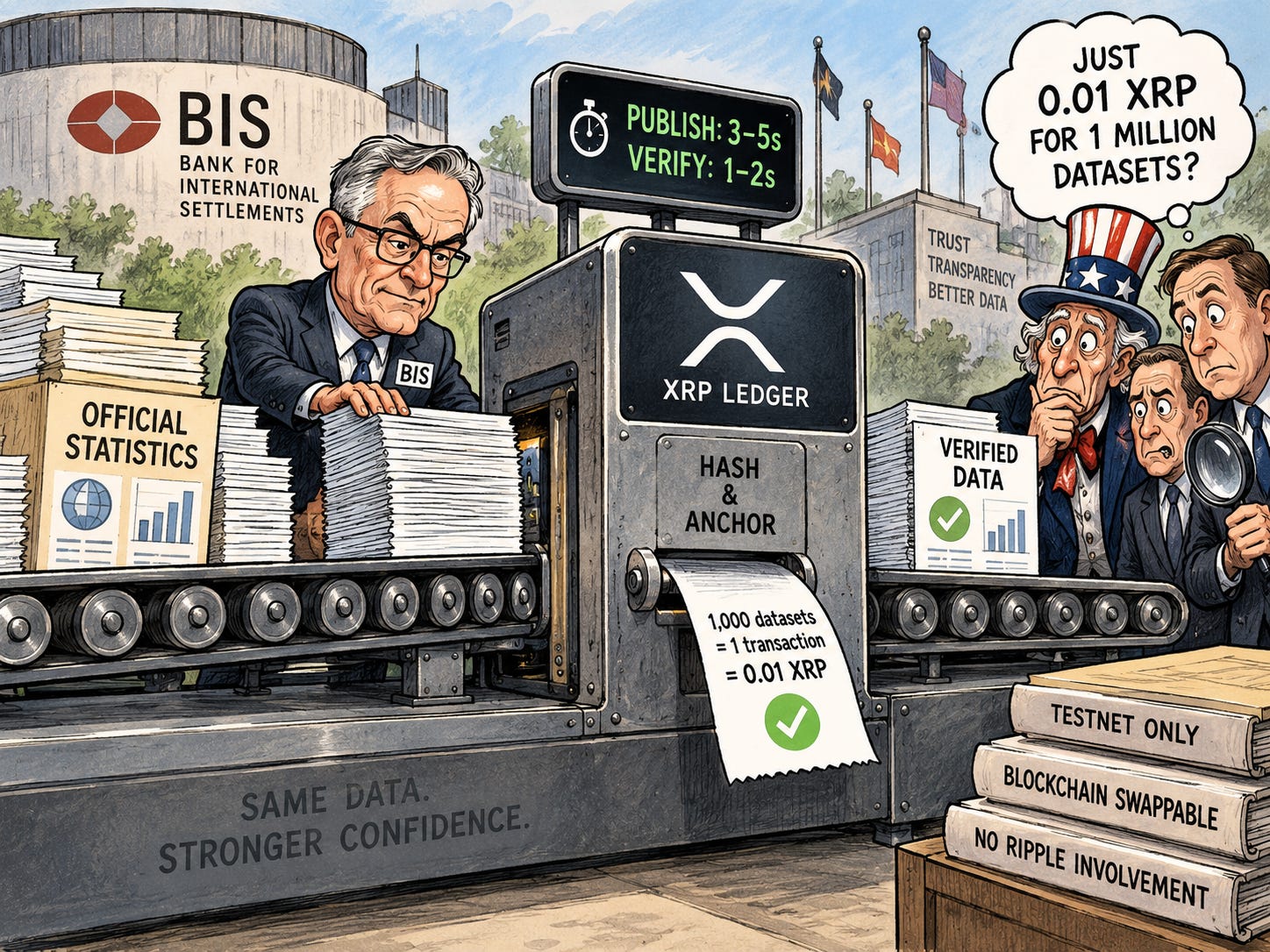
It costs 0.01 XRP to prove that 1 million official datasets have not been tampered with. That is the arithmetic inside a Bank for International Settlements working paper published on Wednesday 2 September. Paper 1374 describes a prototype that lets anyone check whether published economic data came from the institution it claims to, and whether anyone altered it after release. The prototype runs on the XRP Ledger (BIS).
The system reduces a statistical file to a single summary value and writes that value into the memo field of a ledger transaction. The figures themselves never go on chain. Anyone receiving the file rebuilds the summary and compares it against the public record, and a mismatch means the file changed. Median publication came in at 3 to 5 seconds. Verification took 1 to 2 seconds.
Speed was never the doubt. What a holder gets out of it sits somewhere else. Every transaction on the XRP Ledger destroys its own fee, which starts at 10 drops, or 0.00001 XRP. The prototype deliberately bundles many datasets into a single anchoring transaction. Batch 1 million of them 1,000 at a time and the ledger only sees 1,000 transactions. Those burn 0.01 XRP between them.
The paper sets out 2 limits on itself. The tests ran on XRPL DevNet. That is a test network where the XRP carries no value, so the exercise produced timings rather than demand. The authors also built the blockchain layer to be swappable, which means another ledger could perform the same role. Ripple has no disclosed relationship with any of it (CryptoSlate).
That last part cuts in the ledger’s favour. It is the strongest independent signal the XRP Ledger has had this year, and Ripple was not in the room.
🏈 Ripple Is Paying to Paint Its Logo on Grass
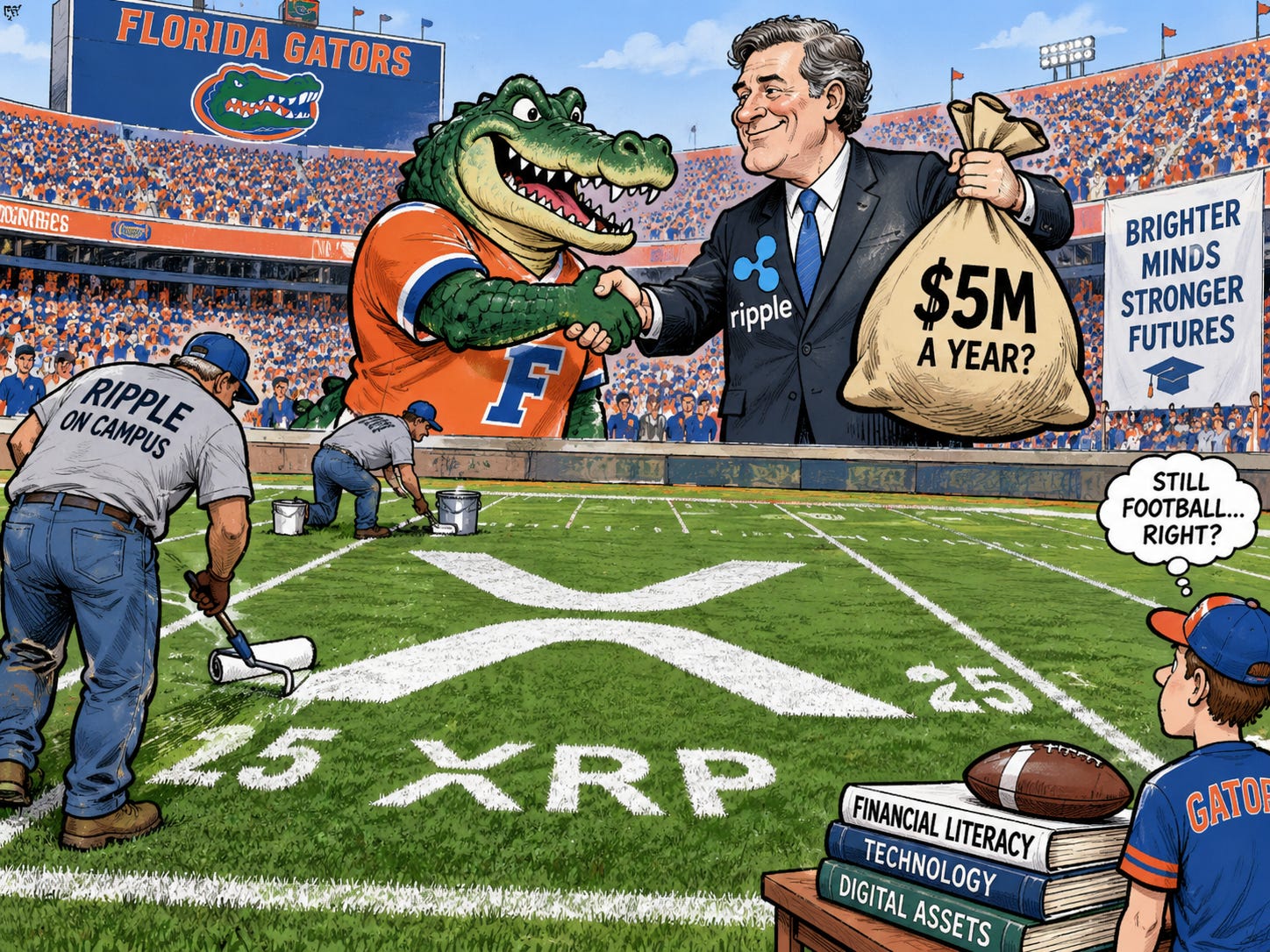
Gator fans will be looking at the XRP logo on the turf at Ben Hill Griffin Stadium this season, on each 25 yard line. Florida Athletics announced the deal with Ripple on Friday 4 September, starting with the 2026 football season. The term is multiple years. It also puts XRP on the university’s website, on its social accounts and on signage at events (Florida Gators).
The reported price is roughly $5 million a year, which would place it among the largest field logo deals in college football. Neither Ripple nor the university has confirmed that number. It comes from a person familiar with the negotiations, quoted in the coverage of the announcement (WCJB).
Ripple has done this before. It signed a comparable arrangement with the University of Kansas, so Florida is the second campus rather than an experiment. The Florida deal also funds financial and technology education for student athletes and the wider campus, covering traditional finance alongside digital assets rather than XRP on its own.
None of it touches the token. Ripple’s own announcement said nothing about the price of XRP or what it is for. A sponsorship moves money from Ripple to a university athletics department. No part of the arrangement requires anybody to own XRP, and no part of it puts XRP into anyone’s hands.
The deal buys attention in front of a stadium and it buys no demand for the token.
📉 Bitwise Owns 10.8 Million XRP and Has Hedged Away Almost All of It
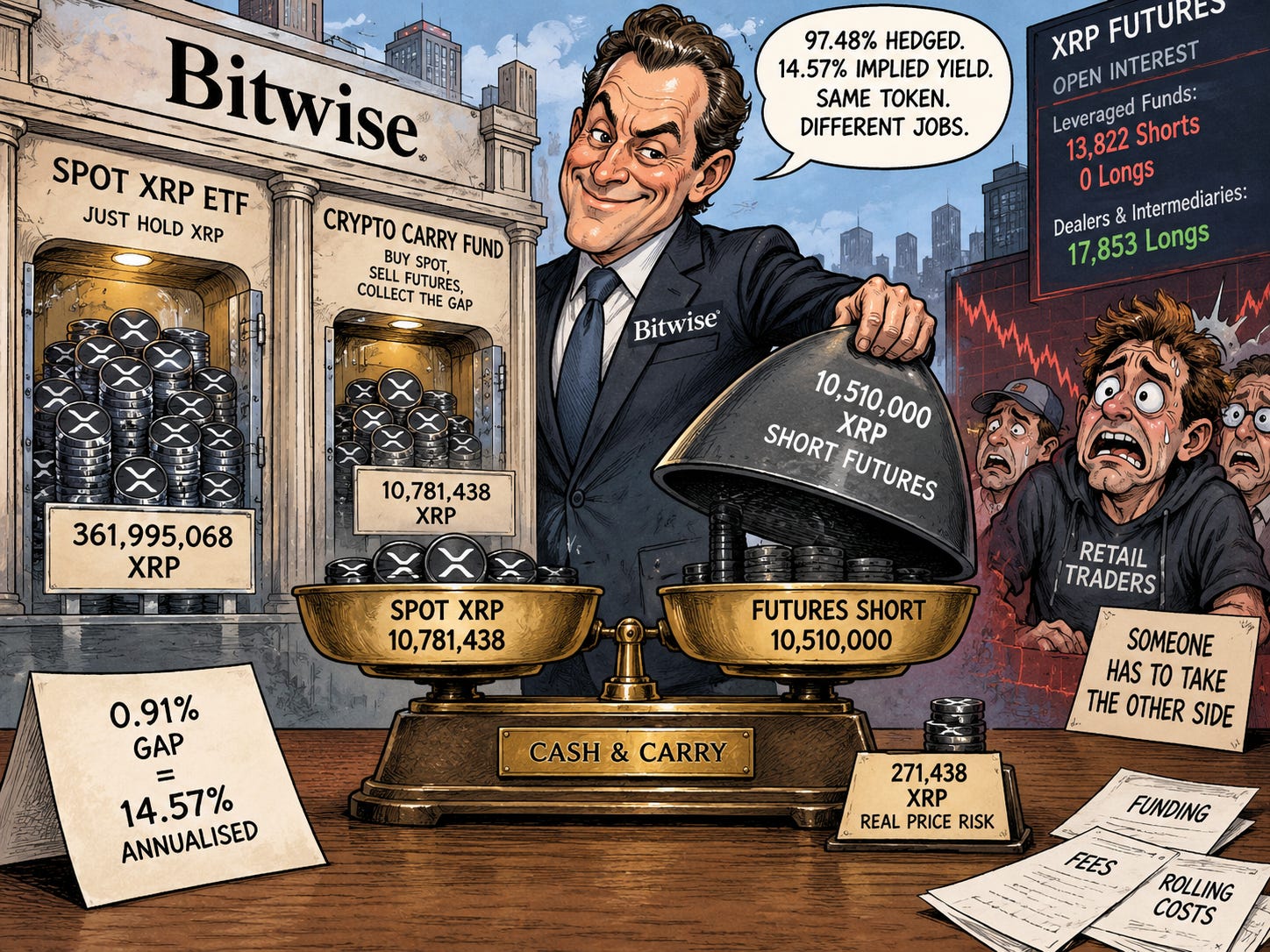
One fund holds 10,781,438 XRP and is exposed to the price of almost none of it. The Bitwise Crypto Carry Fund published a holdings table struck at the New York close on Tuesday 1 September. Against that custody position it carried a short of 10,510,000 XRP in September Coinbase futures (CryptoSlate).
That leaves 97.48 percent of the position hedged and 271,438 XRP carrying real price risk. The trade is called cash and carry. A fund buys the asset, sells a future that is trading above it, and collects the gap when the 2 prices meet at settlement. Whichever way XRP moves in between mostly cancels out across the 2 legs. The gap on that date was 0.91 percent. The fund’s own table annualised that to an implied yield of 14.57 percent, before fees, financing and the cost of rolling.
Somebody has to take the other side of a short. CFTC data at 25 August showed 20,518 contracts of open interest in standard Coinbase XRP futures. Leveraged funds held 13,822 outright shorts and no outright longs at all, which puts that category on the same side as the disclosed hedge. Dealers and intermediaries held 17,853 longs (CFTC).
The same firm shows the opposite pattern in its other product. Bitwise’s spot XRP ETF held 361,995,068 XRP at 2 September, worth about $531.3 million, and its filings define the trust’s only job as holding XRP. One name sits on both products and they use the token for opposite purposes.
One disclosure covers one fund on one date, and it does not settle how the rest of the money sits.
🔧 A Ledger Fix Activates on Friday and Some Servers Will Stop Working
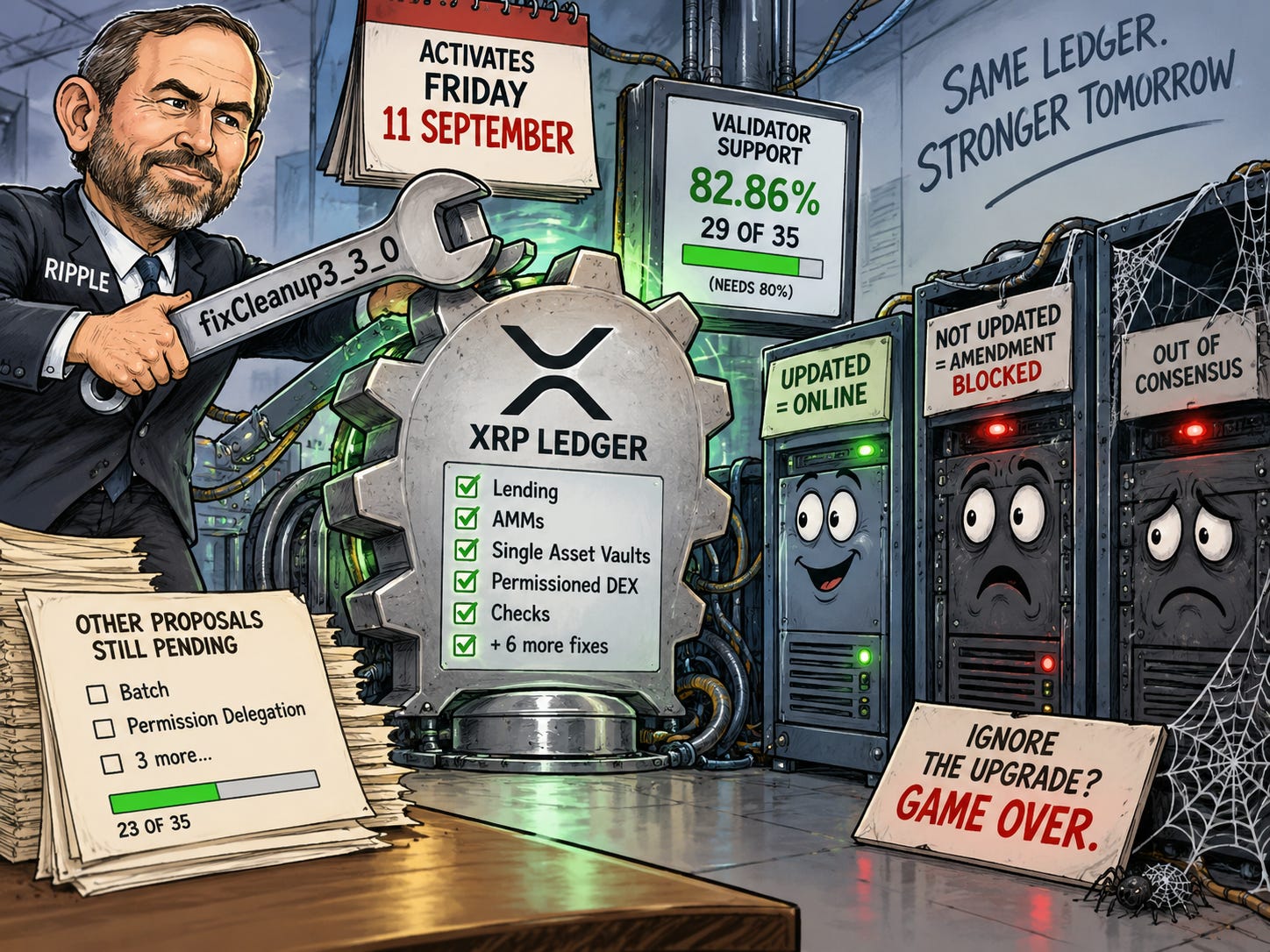
The XRP Ledger changes on Friday 11 September. An amendment called fixCleanup3_3_0 crossed the network’s approval threshold on 28 August. It needs 80 percent of trusted validators. It has 82.86 percent, which is 29 of the 35 on the list (U.Today).
An amendment is how the XRP Ledger changes its own rules. Nobody pushes a change through alone. That includes Ripple, because the servers which validate transactions are the ones that vote, and the vote is what decides. Support has to hold above the 80 percent line for a fixed 2 week window. That window is what the Friday date is counting down.
The amendment carries 11 fixes rather than a new feature. They cover the lending protocol, automated market makers and Single Asset Vaults, with more in the permissioned exchange and the Checks system. None of it changes what the ledger can do, and all of it changes how reliably the existing parts do it.
An operator who ignores it stops being useful to anyone. A server that does not understand an activated amendment becomes amendment blocked, which means it can no longer judge whether a ledger is valid, process transactions or join consensus. That applies regardless of how its operator voted (XRPL).
Another 5 substantive amendments in the same release are still short of the line. They include Batch and Permission Delegation, both of them rewrites of features that validators blocked earlier this year after researchers found authorisation flaws in the originals. Batch has reached 23 of the 35 validators. No funds were ever at risk in either case.