

This content is for informational and educational purposes only and does not constitute financial advice. Always do your own research. Not financial advice (NFA).
This Week
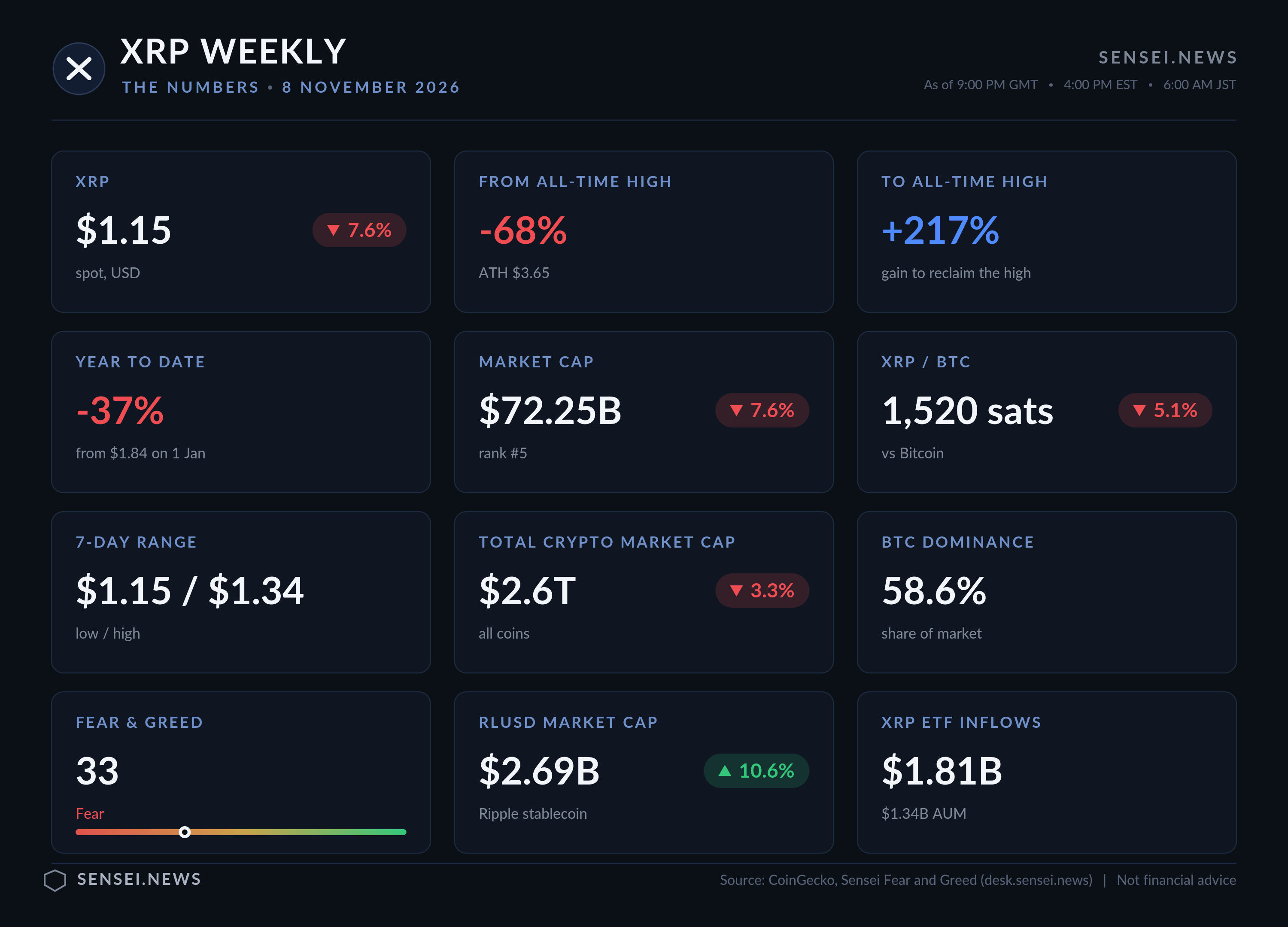
XRP ends the week around $1.15, down 7.6%. It traded between $1.34 early in the week and $1.15 on Saturday, its lowest level since August. It also lost 5.1% against bitcoin. Crypto as a whole fell 3.3% to $2.6 trillion, and bitcoin holds 58.6% of it. The Sensei Fear and Greed reads 33 for crypto. That is Fear, a step colder than last week’s 37.
Democrats won both houses of Congress on Tuesday, and Elizabeth Warren is expected to take over the Senate committee that handles crypto law. XRP rose the day after the vote. A sell-off in tech stocks on Thursday is what took it down. The lead story below sets out what the new Congress can and cannot do.
Evernorth’s shares hit a new low, and the gap between the share price and the XRP behind each share is wider than the usual count suggests. The XRP stolen from Binance started moving, mostly into bitcoin. The spot XRP funds took in nothing from Tuesday to Friday, and the XRP Ledger’s latest bug fix went live on Wednesday.
The Consensus
🏛️ Democrats take Congress and Elizabeth Warren is expected to chair Senate Banking from January.
📊 Evernorth’s shares hit a record low, yet still cost about 1.56 times the XRP behind them.
🕵️ The stolen XRP started moving, and about 86 million had been swapped by Saturday morning.
The Numbers
The Chart Watch
The Ripple Effect
🏛️ Warren, Waters and a Democratic Congress: What Can They Actually Do to Crypto?
Where things stand
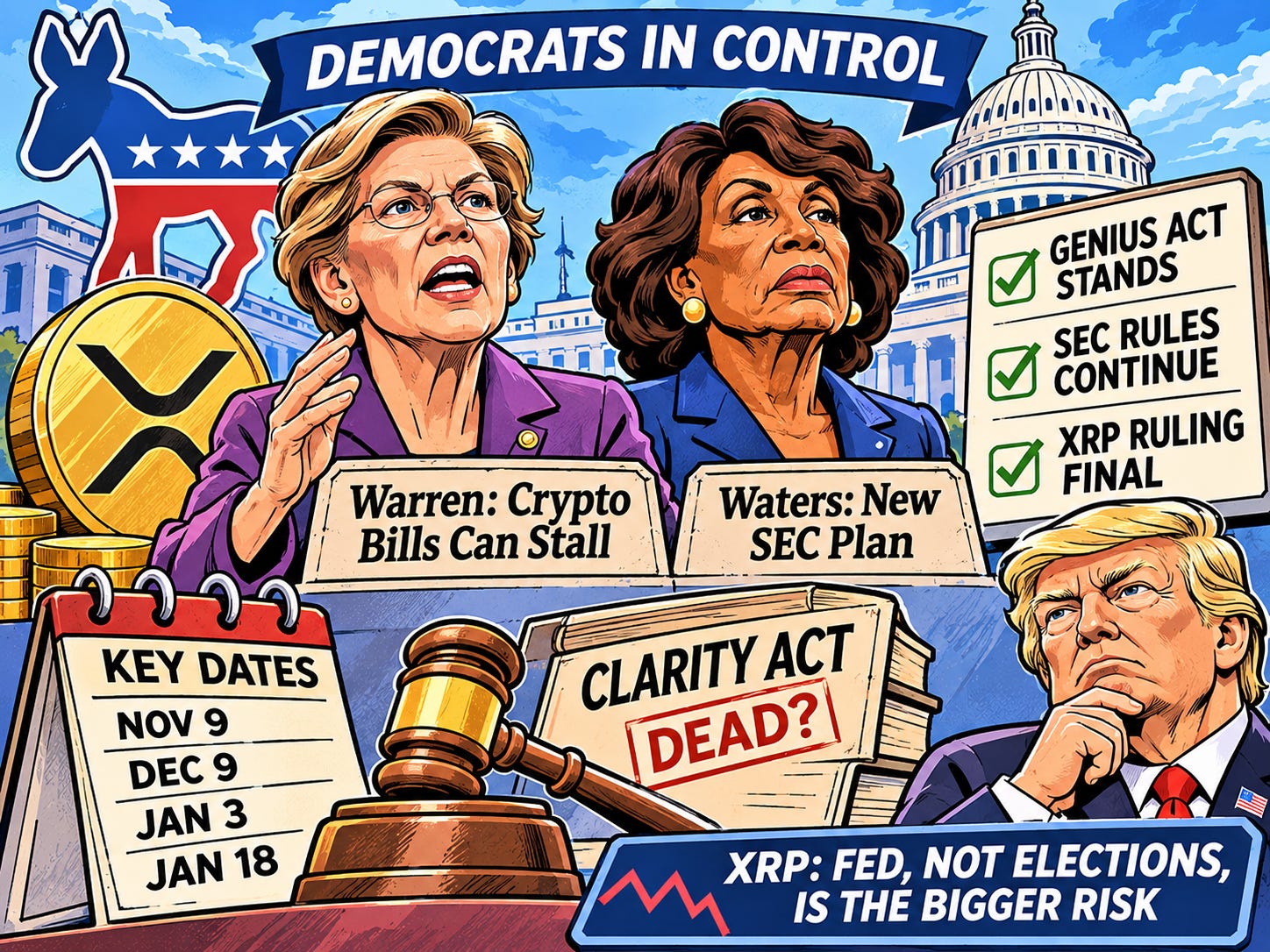
Democrats won both houses of Congress on Tuesday, and they take control on 3 January. The Senate stands at 54 seats to 44 with 2 races left. Scott Colom leads in Mississippi by about 2,500 votes with 97% counted. Prediction markets give him 98%, and that race looks settled. Alaska is the close one. Mary Peltola leads by 637 votes with about 74% counted, and it may go to a ranked-choice count on 18 November. The likeliest result is a Senate of 55 Democrats, or 56 if Peltola holds on. In the House, Democrats are on course for at least 253 seats (CoinDesk).
What Warren can do
Elizabeth Warren is expected to chair the Senate Banking Committee, which every Senate crypto bill has to clear (Bitcoin.com). The chair decides which bills get a vote. That alone makes it unlikely the Republican version of the CLARITY Act gets another committee vote. Warren fought the GENIUS stablecoin law in 2025, calling it “worse than no bill at all”. She called the revised CLARITY Act “dead on arrival” in July and voted against it in September.
Ripple is on her radar too. On 18 May she wrote to the Comptroller of the Currency about the crypto trust charters his office was approving. She called the applicants “crypto banks” built to avoid bank rules, and Ripple was among them (Decrypt). Ripple’s charter won final approval on 26 October anyway. As chair she can call the Comptroller to testify and, with a committee majority, issue subpoenas. She cannot cancel a charter. Only the regulator that granted it can. Ripple’s bank will very likely come up at her hearings, and it will very likely survive them.
She also guards the door for nominees. The SEC and the CFTC have 10 seats between them, and 7 are empty (Forbes). Every nominee needs the Senate. SEC picks go through her committee. CFTC picks go through Senate Agriculture, which Sherrod Brown is likely to chair after he won Ohio despite about $63 million of crypto money against him. TD Cowen’s Jaret Seiberg expects Democrats to use that power to force their own picks onto both boards.
The investigations start with the president’s family. Robert Garcia, the incoming head of House Oversight, posted 2 words after the result: “LAWYER UP”. Richard Blumenthal will run the Senate’s main investigations panel. He has asked World Liberty Financial, Binance and Tether for records by 4 January. He has also written to the company behind the TRUMP memecoin. Ripple is not on that list.
What none of them can do
Congress cannot change the law on its own. Donald Trump keeps his veto for the rest of his term, and overriding it takes two-thirds of both chambers. That protects the GENIUS Act, which takes full effect on 18 January. It also protects the regulators’ rules, because overturning one under the Congressional Review Act needs the president’s signature. So the SEC keeps writing. Its Regulation Crypto Assets proposal, which Ripple backed on 20 October, can be finalised without a vote in Congress. The 2023 court ruling on XRP’s status is final, and no committee can reopen it. Galaxy’s Alex Thorn put it plainly: “We do not expect substantial movement in Congress on key digital assets legislation.”
What happens to the CLARITY Act
It failed in the Senate 49 to 50 on 15 September, and it dies if it has not passed by 3 January. French Hill, its House sponsor, still hopes to pass it in the final weeks. Seiberg does not expect it to pass in the next 2 years. Kalshi traders give it an 18% chance of becoming law before 2028. On those odds, it is dead. Waters’ Democrats are already discussing a replacement that would put the SEC in charge.
The dates that decide it
Monday 9 November. Congress returns for its final weeks, the last window for the CLARITY Act.
Wednesday 9 December. The Fed announces its rate decision, with a rise now the favourite.
Friday 11 December. Government funding runs out unless Congress passes a new bill.
Sunday 3 January. The new Congress sits, and the CLARITY Act dies if it has not passed.
Monday 18 January. The GENIUS Act’s stablecoin rules take full effect.
What it means for the price
So did Washington push XRP lower? The timing says no. XRP rose 3.9% on Wednesday, the day after the vote, to about $1.30. The TRUMP memecoin fell 17% that same day. XRP’s fall came on Thursday, when the Nasdaq dropped 5.5% in a tech sell-off. CoinShares’ James Butterfill said real yields, dollar liquidity and fund flows “still carry more weight than the elections”.
The faster risk is the Fed. Friday’s jobs report showed 165,000 new jobs, against 59,000 expected. Traders now price a 76.8% chance of a rate rise on 9 December, up from 66.9% a week earlier (InvestmentNews). A rise would make borrowing dearer just as crypto is short of buyers. Washington is a slow headwind for Ripple’s business. The Fed is the nearer test for XRP’s price.
History offers some comfort, with a caveat. Bitcoin was 45% higher 12 months after the 2018 midterms. It was 93% higher a year after the 2022 vote. Both times its cycle low came within about 6 weeks of election day. That is 2 cycles, a small sample, and it says nothing about where this one bottoms.
📊 Evernorth Closed at $10.58. Its XRP Is Worth $6.77 a Share

Evernorth closed on Friday at $10.58. The shares set a record closing low of $10.30 on Thursday. That leaves them 45% below the $19.39 high of 12 October, their first official day of trading.
What sits behind each share? Fewer XRP than the Nasdaq listing suggests. Evernorth holds about 473 million XRP. Evernorth has 3 kinds of shares with a claim on it. There are 26.1 million Class A shares, the ones that trade. There are also 31.4 million Class C shares and 22.95 million company units. Insiders hold them, including Arrington, Ripple and the Larsen Lam family trust (SEC). Both convert into Class A one for one, and both share in the XRP. Together that makes 80.44 million shares.
Count all of them and each share holds about 5.88 XRP.
At $1.15, 5.88 XRP is worth about $6.77. Friday’s close was $10.58. So a buyer pays about $1.56 for every $1 of XRP inside the company. Across all 80.44 million shares, the market values Evernorth at about $851 million. Its XRP is worth about $544 million. Where would the share price and the XRP meet? XRP would have to reach about $1.80 for the XRP in each share to be worth $10.58. The shares would have to fall to about $6.77 at today’s XRP price.
Those figures count XRP only. Evernorth has not filed a cash balance since the merger closed on 9 October. It owes $30 million in convertible notes. Its 9.28 million warrants only pay to exercise above $11.50, so they add nothing at today’s price.
The premium is what Evernorth’s plan runs on. Its equity line with Cantor became effective on 30 October, so it can now sell new shares into the market. A share sold at $10.58 brings in more cash than the $6.77 of XRP it represents. Spent on XRP, that cash leaves every remaining share holding slightly more. The resale filing pulls the other way. On 30 October Evernorth registered up to 73.7 million shares for resale by existing holders. Registering shares does not sell them. Arrington, Ripple and the Larsen Lam trust are locked up until about 9 April 2027 (CryptoSlate). SBI is not named in that lock-up.
🕵️ The Stolen XRP Is Moving, and Most of It Is Turning Into Bitcoin

Elliptic counted about 86 million of the stolen XRP swapped by Saturday morning. That is about $100 million. Another 148 million XRP had not moved (Elliptic).
The XRP sat untouched for about 3 days after the 29 October theft. In the early hours of Monday 2 November, UK time, the attacker split it across 6 new wallets in under 2 hours. Whale Alert flagged 2 of the transfers, 40 million XRP each, less than a minute apart. Then nothing moved until Thursday. Elliptic puts the part of the whole theft still sitting in linked addresses at $3.11 billion.
On Thursday afternoon, 2 of the 6 wallets began spraying XRP across dozens of fresh addresses. From there most of it went through THORChain. That is a network that swaps one coin for another across blockchains, with no company in the middle. The XRP came out as bitcoin. By Friday the swaps had produced about 1,650 bitcoin, mostly from XRP (The Block).
None of it has been frozen, for the reason set out here last week: XRP has no issuer that could lock it. THORChain was the one possible choke point. It halted swaps on 10 chains on 31 October because of a software bug, and restarted them late on 3 November. Its developers say the protocol “cannot censor individual transactions.”
Is the selling moving the price? Hardly, on its own. About $100 million sold over 3 days compares with roughly $860 million of XRP traded on a quiet Sunday alone. Binance saw bigger flows. On Wednesday, 418.5 million XRP left the exchange, its biggest outflow day in 9 months (Bitcoin.com). Some of that may be Binance moving its own coins. Its latest proof of reserves, taken on 4 November, covers 44 tokens. Binance said on Friday that customers can now check it. It has not published the list of tokens.
That leaves about 148 million XRP, roughly $170 million, still with the attackers. They have not touched 3 of the 6 wallets at all.
Seen on X

Sensei’s Insight: This is the bill the Democrats would rather write. More SEC, less CFTC, and ethics rules aimed at the president’s own crypto business. There’s no text yet, and Trump would veto anything like it, so I don’t see it becoming law before 2029. What it does tell you is where the fight goes after 3 January. For XRP, the court ruling still stands. For the wider market, the next 8 weeks matter more than anything in this draft.

Sensei’s Insight: Brad’s answering the holders who think Ripple has moved on from XRP, and he says he wants RLUSD’s use cases running on the XRP Ledger. RLUSD is up about 10% this week to $2.69 billion while XRP fell. But about 67% of RLUSD sits on Ethereum. Only around $884 million is on the XRP Ledger. That’s the number I’d watch. If the XRP Ledger’s share of RLUSD grows, Brad’s right. If it keeps shrinking, the holders have a point.