

This content is for informational and educational purposes only and does not constitute financial advice. Always do your own research. Not financial advice (NFA).
This Week
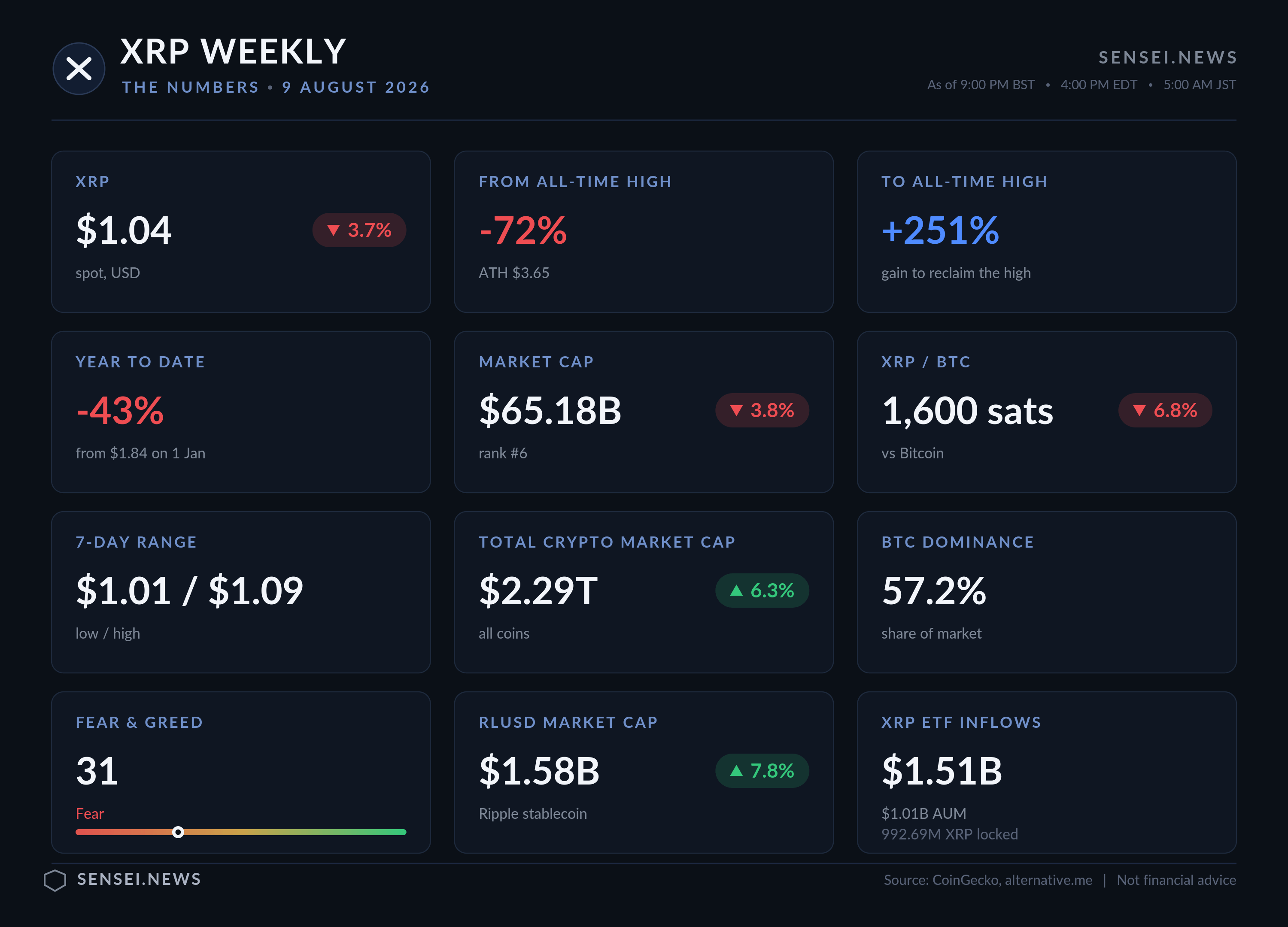
XRP finished the week around $1.04, inside a $1.01 to $1.09 range, and it was the only coin in the top ten to end the week lower while the rest of the market rallied. Total crypto market value rose about 6 percent to $2.29 trillion. Bitcoin dominance climbed to 57.2 percent. Sentiment ticked up to 31 on the Fear and Greed Index, still in Fear.
Washington gave the week its shape and then left town. The Senate went home on 8 August without voting on the Digital Asset Market CLARITY Act, and in the small hours before it left, Majority Leader John Thune filed the paperwork that puts the bill first in the queue in September. There is a full section on that below, laying out what happens next and when.
Away from Washington, three things happened that matter to anyone holding XRP: the ETF bid went missing, the XRP Ledger shipped its biggest technical release of the year, and Ripple bought equity in two British firms that had already built its first tokenised fund.
The Consensus
📉 XRP ETF buying collapsed 93 percent. One million dollars went in all week, against $754 million into Bitcoin funds.
🔧 XRP Ledger v3.3.0 is live. The upgrades now face a validator vote, including encrypted balances built for institutions.
🏦 Ripple took equity in Zilo and Licuido. The two British firms behind the Aviva fund already running on the XRPL.
The Numbers
The Chart Watch
The Ripple Effect
📉 XRP Was the Only Top Ten Coin to Fall, and the ETF Bid Went Missing

XRP slipped below $1.02 on Friday 7 August and closed the week the sole loser in the top ten, while Cardano led the gainers and the wider market added about 6 percent. The number underneath it is worse than the price. US spot XRP ETFs took in $1.01 million across the whole week to 8 August, down 93 percent from $14.86 million the week before, against $754 million into Bitcoin funds and roughly $195 million into Ethereum funds (BeInCrypto).
Two things pulled the money out. The CLARITY Act delay removed the only near-term catalyst anyone was positioned for, and with it gone, institutional flow went to the assets whose legal status nobody argues about. Seven US spot XRP ETFs have now been trading since November, and eleven of July’s twenty-two trading days saw zero flow in either direction. Weekly inflows have gone from roughly $200 million at launch to single-digit millions.
There is a detail in the fund data worth sitting with. Those seven ETFs have taken in about $1.51 billion in total contributions since launch, and they are holding around $1 billion in assets. The gap is not withdrawals. It is loss on the XRP they already bought, because they kept buying while the price fell. One way to read that is institutions accumulating through a drawdown. The other is that everyone who bought an XRP ETF is, collectively, underwater. Both readings come off the same number.
The wallets tell a different story from the funds. More than two million XRP left exchange venues on 6 August, and CryptoQuant’s data shows the 10 million to 100 million XRP cohort buying through the whole decline from $2.40 in January while smaller holders sold (Crypto Economy). Whale deposits to Binance sit near their lowest since January 2025. Large holders are absorbing supply that the funds are no longer taking.
🔧 XRP Ledger v3.3.0 Is Live, and the Upgrades Now Sit With the Validators
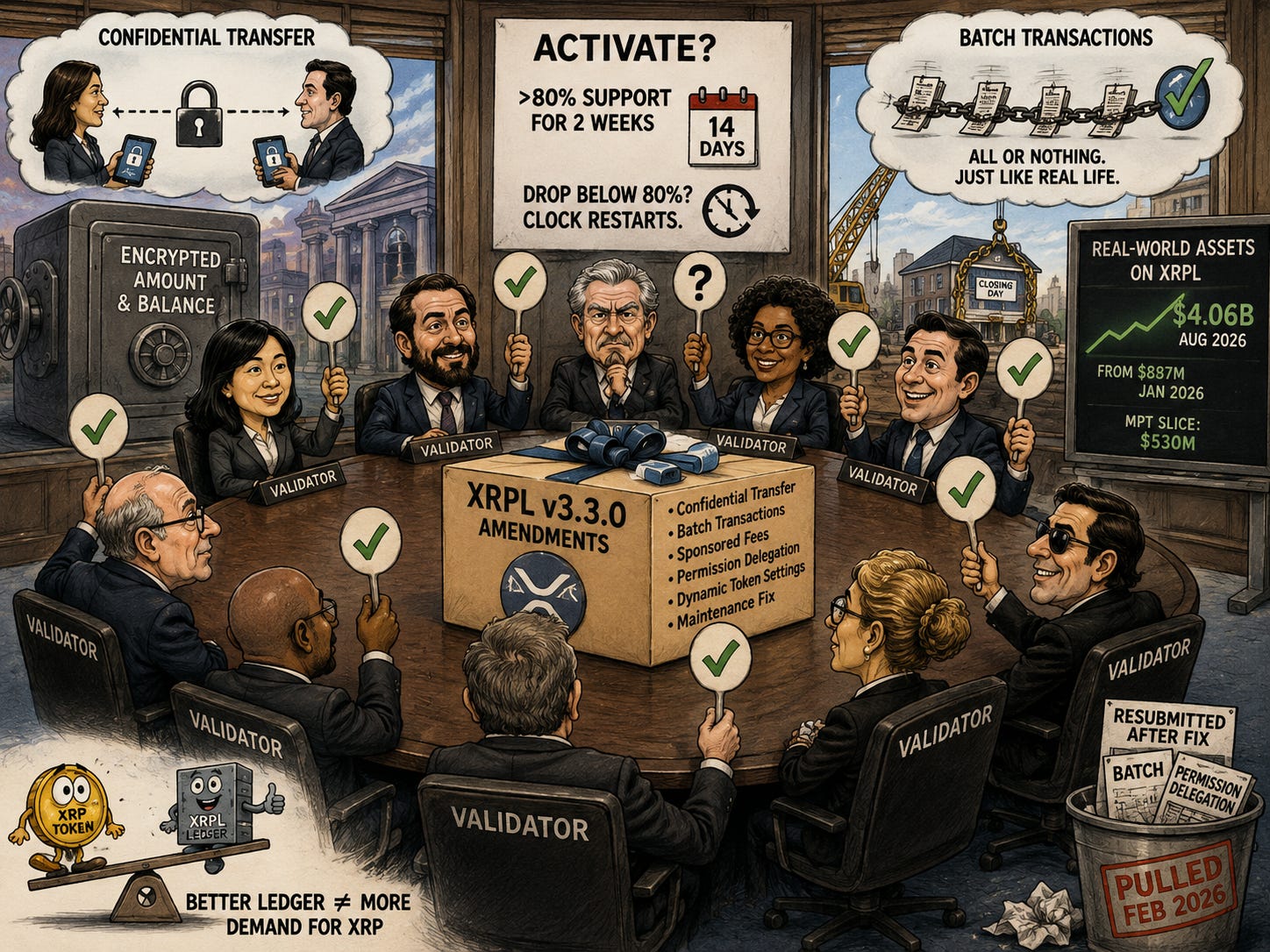
The XRP Ledger’s v3.3.0 software shipped this week and put a package of proposed amendments in front of the network’s validators for a vote (crypto.news). None of them is switched on. Under the XRPL’s own rules an amendment needs more than 80 percent validator support, held continuously for two full weeks, before it activates, and the clock restarts from zero if support slips below that line at any point. So the release date is the start of the process, not the end of it.
Two of them are what institutions have been asking for. Confidential Transfer encrypts both the balance and the payment amount on Multi-Purpose Tokens, the format Ripple has been pitching for funds and bonds. In plain terms, the two parties to a trade see the size of it and the public ledger does not, which is how every other financial market on earth already works. Batch wraps up to eight transactions so they either all complete or none of them does, the same way a house chain either completes on the day or collapses, with no single link left half done. The rest cover sponsored fees, delegated permissions and dynamic token settings, alongside a maintenance fix (Brave New Coin).
The audience for this is visible in the numbers. Tokenised real-world assets on the XRP Ledger passed $4 billion in early August, up from $897 million on 1 January (The Crypto Basic). The Multi-Purpose Token slice that Confidential Transfer actually applies to sits closer to $530 million. That is the honest scale: real assets, real growth, and about one percent of the global tokenisation market.
Worth keeping separate in your head: this is the ledger getting better, not XRP the token getting more demand. Batch and Permission Delegation were pulled in February when security flaws were found in them, and getting them back in a hardened form is a genuine engineering win. Whether any of it moves XRP depends entirely on whether the institutions these features were built for turn up.
🏦 Ripple Took Equity in Zilo and Licuido, the Two Firms That Built the Aviva Fund
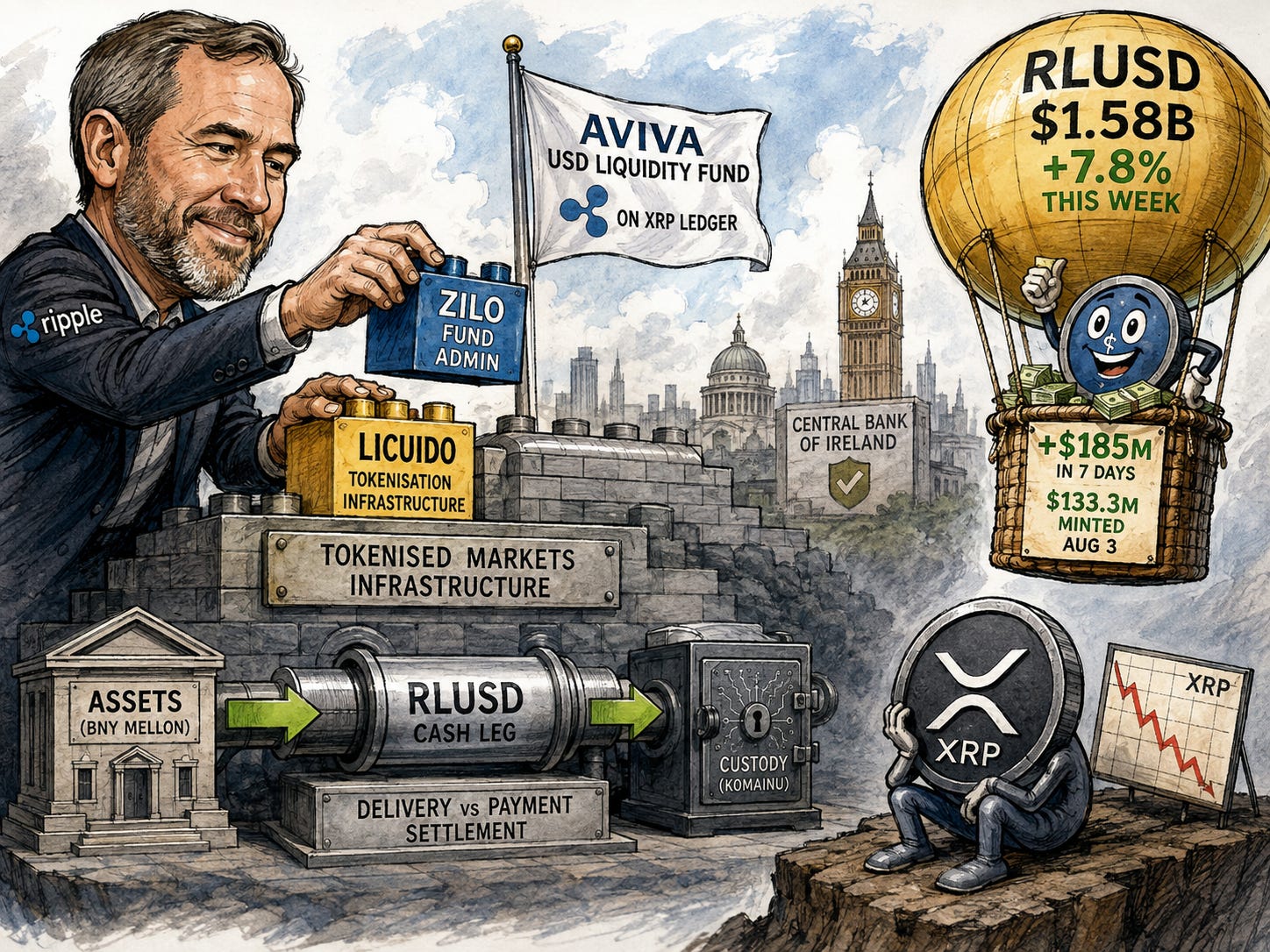
On Monday 3 August Ripple converted two existing commercial relationships into ownership, taking equity stakes in the British firms Zilo and Licuido (Ripple). Zilo runs transfer agency and fund administration software, which is the register that records who owns which units of a fund, the Land Registry of the investment world. Licuido handles issuing tokenised assets and moving them through collateral and liquidity markets. Neither is a household name and both sit in the plumbing that decides whether tokenisation works at all.
The timing gives it away. Days earlier, Aviva Investors launched a tokenised share class of its US Dollar Liquidity Fund on the XRP Ledger, approved by the Central Bank of Ireland, with BNY Mellon holding the underlying assets and Komainu handling digital custody (Ledger Insights). Licuido supplied the tokenisation infrastructure. Zilo did the record keeping. Ripple has now bought into both of them.
Ripple’s own announcement names RLUSD as the cash leg for delivery-versus-payment settlement on the ledger, which means the asset and the money change hands in the same instant so neither side is ever left holding one without the other. That has been the gap in institutional tokenisation for years. Minting a token is easy. Financing it, pledging it and settling it as reliably as a normal holding is not.
Which brings the week to its sharpest point for XRP holders. RLUSD grew about $185 million in seven days, including $133.3 million minted on 3 August alone, and now sits near $1.58 billion, up 7.8 percent on the week (U.Today). Over the same seven days XRP fell. The stack Ripple is assembling settles in its stablecoin, and the token has to earn its place in that stack separately.
⚖️ The CLARITY Act: Where It Actually Stands
The Senate went home on Saturday without voting. Before it left, the Majority Leader put the bill first in the queue for September. Here is what happened, why it matters, how the vote works, and every date that counts.