

The Consensus
🤝 Aviva and Ripple tokenize funds: Aviva Investors will use the XRP Ledger to tokenize traditional fund structures for improved institutional settlement.
🇯🇵 SBI CEO clarifies Ripple stake: Yoshitaka Kitao debunked $10 billion XRP holding rumors, highlighting SBI’s strategic 9% equity stake instead.
📈 XRP outpaces Bitcoin recovery: Following the February crash, XRP surged 50% as exchange reserves hit their lowest level since 2024.
The Chart Watch
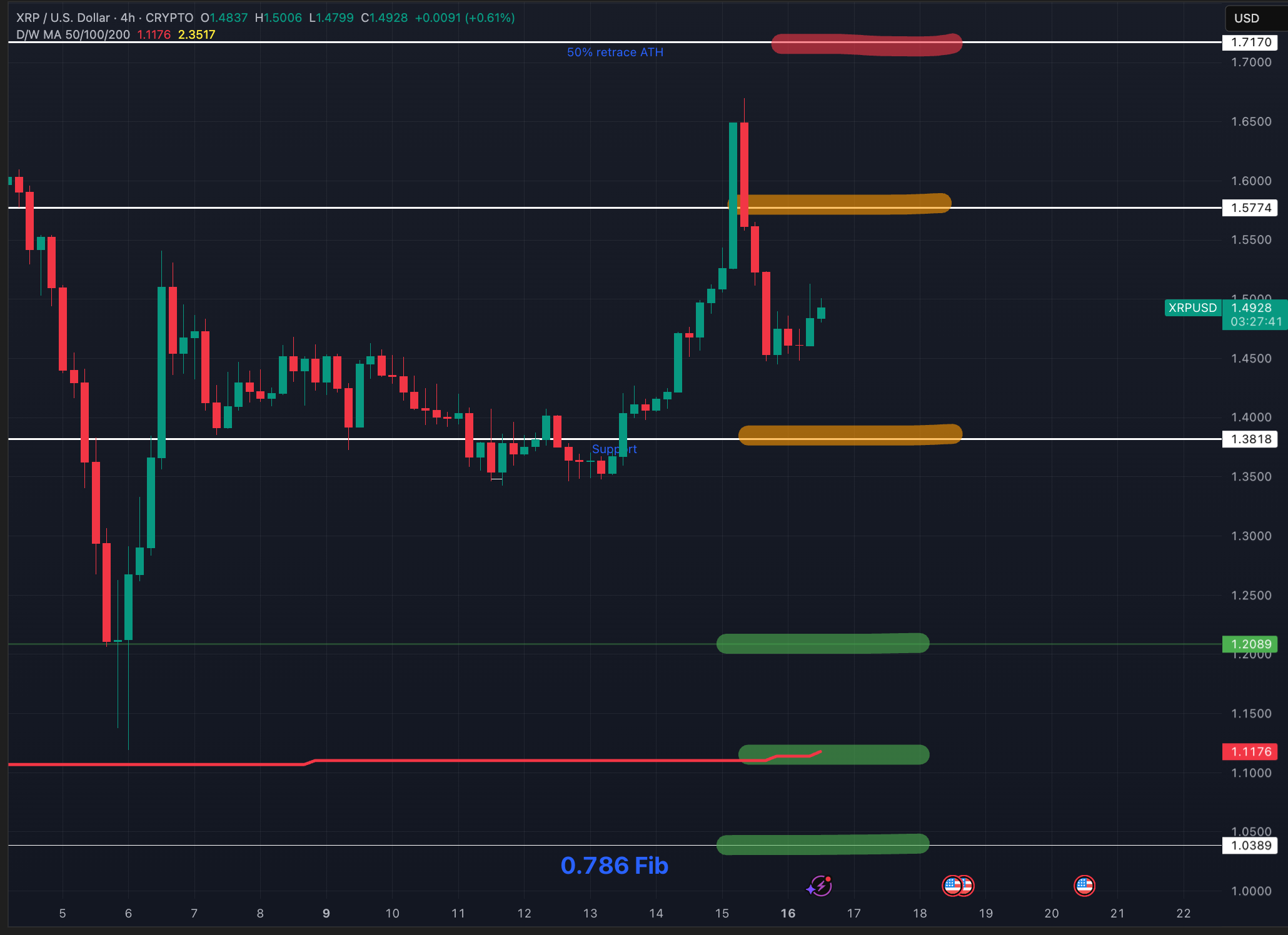
XRP is trading around $1.49, sitting in the middle of a well-defined range between the two orange zones at $1.58 and $1.38. This is the battleground right now. Buyers have defended $1.38 multiple times this month and sellers are capping rallies near $1.58. Until one side wins and price breaks cleanly out of this range, the most likely path is continued chop between these two levels.
Above the range, the red zone at $1.71 is the major resistance. That’s the level that matters for anyone looking for confirmation that the recovery from the February crash has real legs. A daily close above $1.71 would shift the structure meaningfully and open up the conversation about higher targets. Until then, it’s a ceiling.
Below the range, the green zones at $1.21, $1.12 and $1.04 are where the higher-conviction buy opportunities sit. If macro conditions deteriorate and bitcoin drags the market lower, those are the levels where historically large numbers of participants have stepped in and where I’d want to be deploying capital. The $1.04 level in particular sits at the 0.786 Fib and would represent a deep discount that doesn’t come around often.
The broader environment still warrants caution. Bitcoin is hovering below $70,000, the Fear & Greed Index is in single digits, and the wider market hasn’t confirmed a bottom yet. That doesn’t mean XRP can’t push higher from here, especially with the strong post-crash bounce and exchange outflows we’ve seen, but it does mean patience pays. My approach stays the same: wait for price to reach defined zones, manage risk, and keep dry powder for the entries that actually matter. All live entries are posted in real time for premium Substack members.
Poll
Last Week’s Results
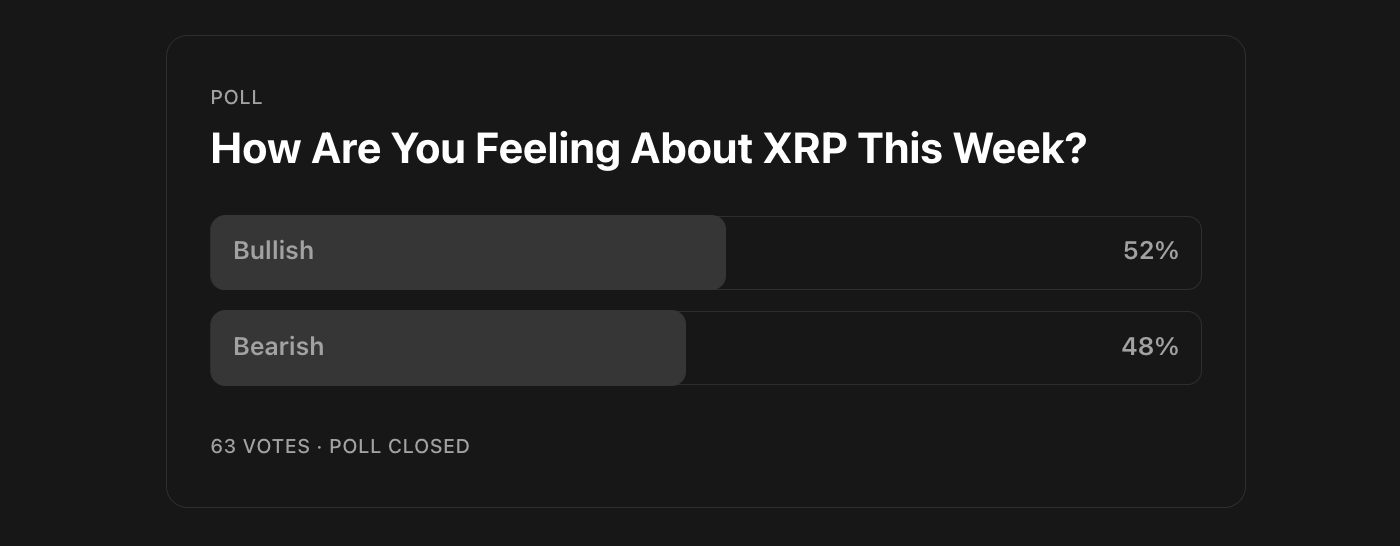
✅ 52% of you were Bullish, and from last Sunday to today XRP is up ~3%.
Please do keep voting, it will be interesting to analyze this data in the future and see if we can draw any trends from this.
The Ripple Effect
Aviva Investors Partners with Ripple to Tokenise Funds on XRPL
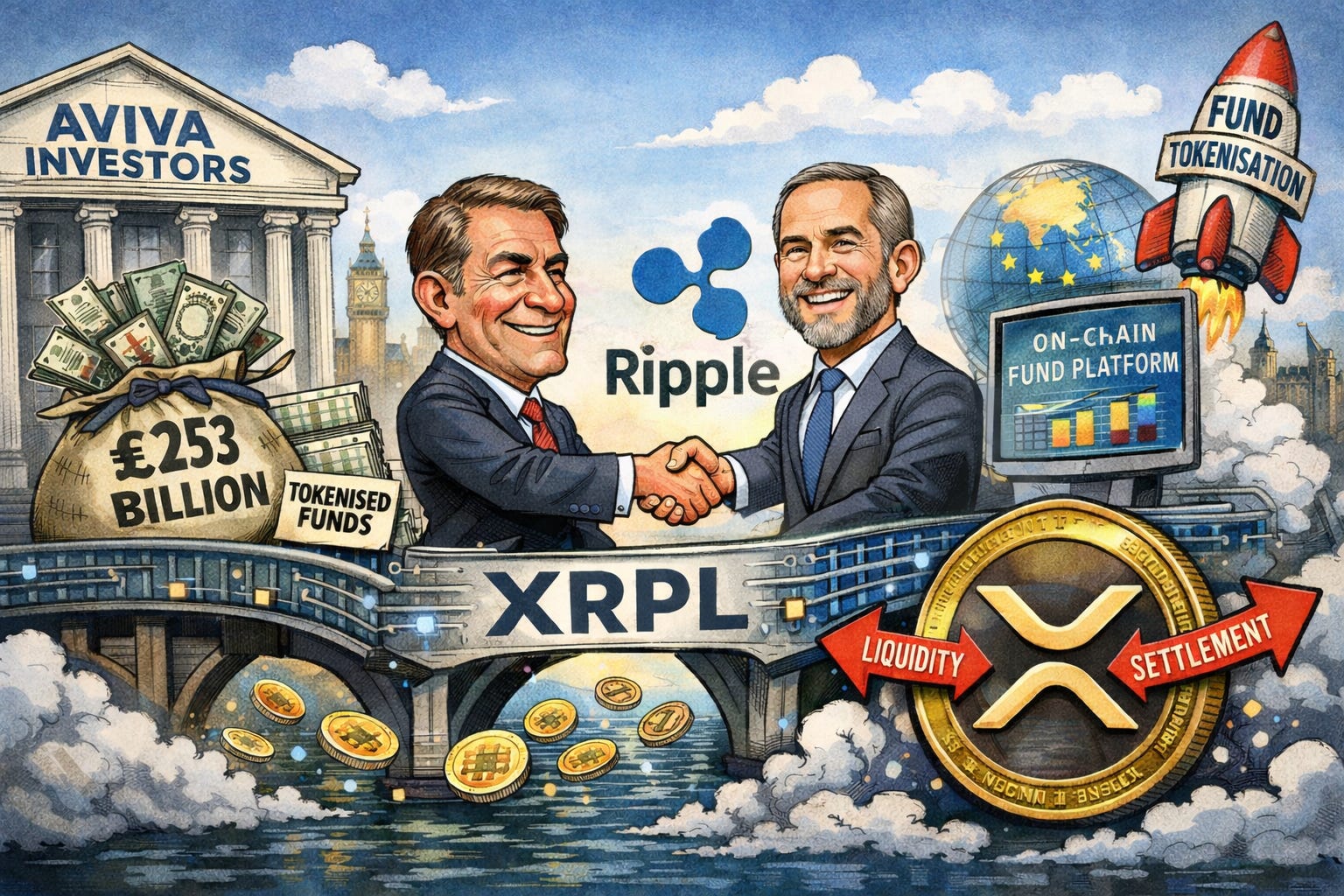
On 11 February, Aviva Investors, the £253 billion asset management arm of FTSE 100 insurer Aviva plc, announced a collaboration with Ripple to tokenise traditional fund structures on the XRP Ledger. It’s Ripple’s first partnership with a European investment manager and Aviva’s first step into tokenised funds.
The idea is to represent ownership in conventional funds (UCITS, OEICs) as on-chain tokens on XRPL, using the ledger for settlement and record-keeping. Ripple provides the infrastructure; Aviva designs and manages the products. This builds on the Archax–abrdn precedent from November 2024, when the first tokenised money market fund launched on XRPL with a $5 million Ripple allocation but the Aviva deal is a clear step up in institutional scale.
The timing fits the UK regulatory trajectory. The FCA’s consultation on fund tokenisation (CP25/28) is expected to produce final rules in H1 2026, giving firms like Aviva the clarity needed to move from exploration to live products.
For Ripple, this is a marquee reference case for pitching XRPL to other asset managers globally. For the XRP Ledger, it grows the network’s institutional footprint and real-world transaction activity. For XRP the token, the benefits are indirect but real: every tokenised fund on XRPL increases network usage and demand for on-ledger liquidity where XRP is the native asset. If later phases involve on-chain FX, cross-border subscriptions, or DeFi-style liquidity, XRP could play a more direct settlement role, though that’s not confirmed yet.
No specific funds, jurisdictions, or go-live dates have been announced. Both firms say they’ll work together through 2026 and beyond.
SBI CEO Debunks $10B XRP Claim, Reveals 9% Ripple Labs Stake as “Hidden Asset”
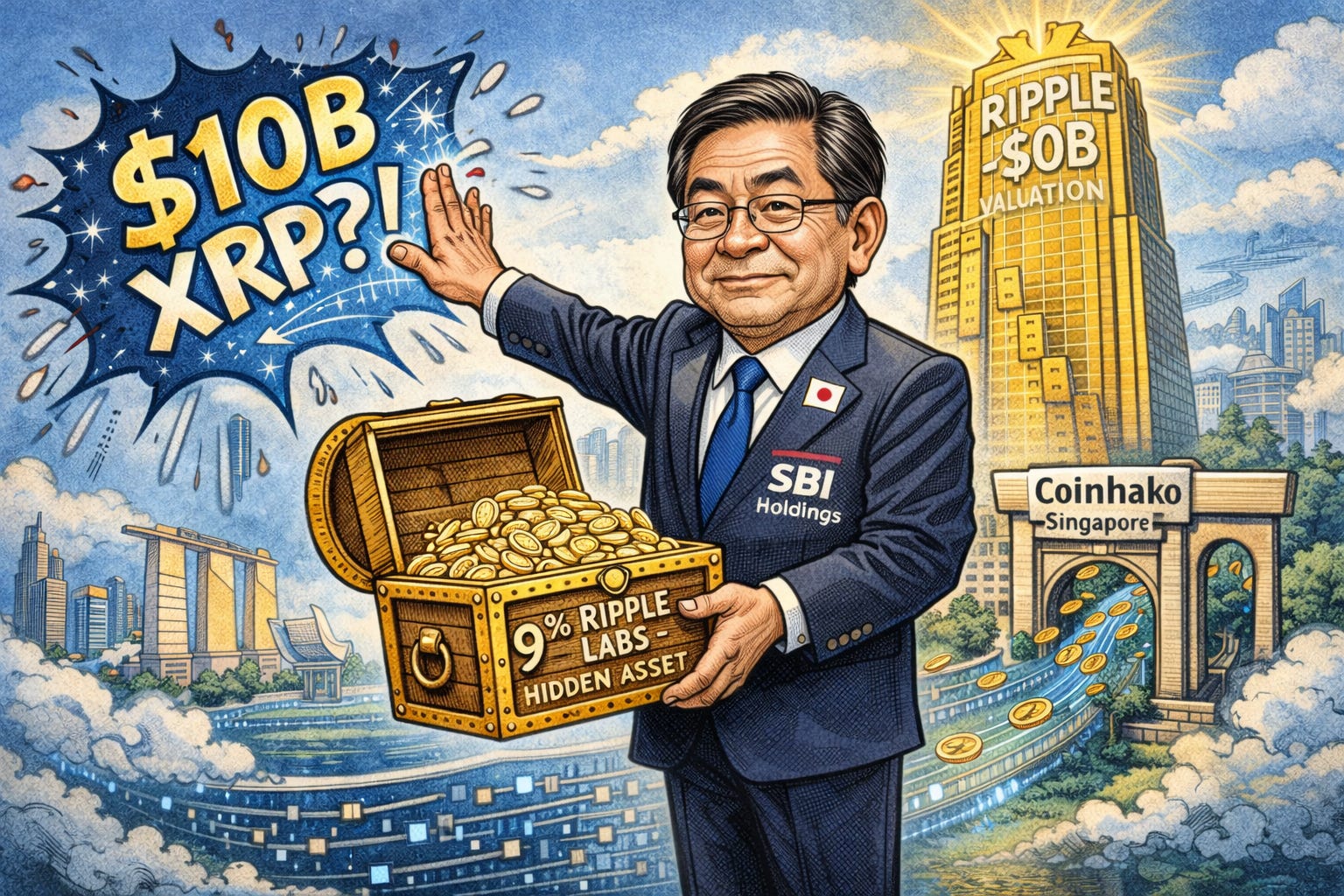
A viral social media post last week claimed Japanese financial giant SBI Holdings is a “holder of $10 billion in XRP,” tying the figure to SBI’s planned acquisition of Singapore crypto platform Coinhako. SBI chairman and CEO Yoshitaka Kitao responded directly on X on 15 February, correcting the record: SBI does not hold $10 billion in XRP tokens. Instead, the company owns approximately 9% of Ripple Labs’ equity. Kitao called the stake a “hidden asset” that “could be much bigger” than the claimed figure, depending on Ripple’s total valuation.
The maths matters here. Based on recent private market estimates placing Ripple’s valuation at around $50 billion following its $500 million funding round, SBI’s 9% equity stake would be worth roughly $4.5 billion on paper — and would scale proportionally if Ripple’s valuation grows. Kitao pointedly noted that Ripple’s valuation includes its full ecosystem, suggesting the market may be underpricing SBI’s position. SBI has been Ripple’s closest strategic partner in Asia since 2016 through the SBI Ripple Asia joint venture, and also holds XRP operationally through its SBI VC Trade exchange and shareholder perks programme, where investors can receive benefits as XRP vouchers.
Separately, SBI announced on 13 February that its subsidiary SBI Ventures Asset is acquiring a majority stake in Coinhako, a Singapore-based exchange holding a Major Payment Institution licence from the Monetary Authority of Singapore. Once complete, Coinhako becomes a consolidated SBI subsidiary, giving the group a regulated gateway into Southeast Asian crypto markets for tokenised assets, stablecoins, and cross-border settlement.
For Ripple and XRPL, having a major Japanese financial conglomerate expanding regulated infrastructure across Asia directly strengthens the network of venues through which XRP and Ripple’s RLUSD stablecoin can be used in real payment flows. For XRP the token, the signal is that SBI’s long-term bet is on Ripple’s ecosystem growing — and that ecosystem runs on XRPL with XRP as its native asset.
XRP Rallies 50% From Feb. 6 Crash Lows, More Than Doubling Bitcoin’s Recovery
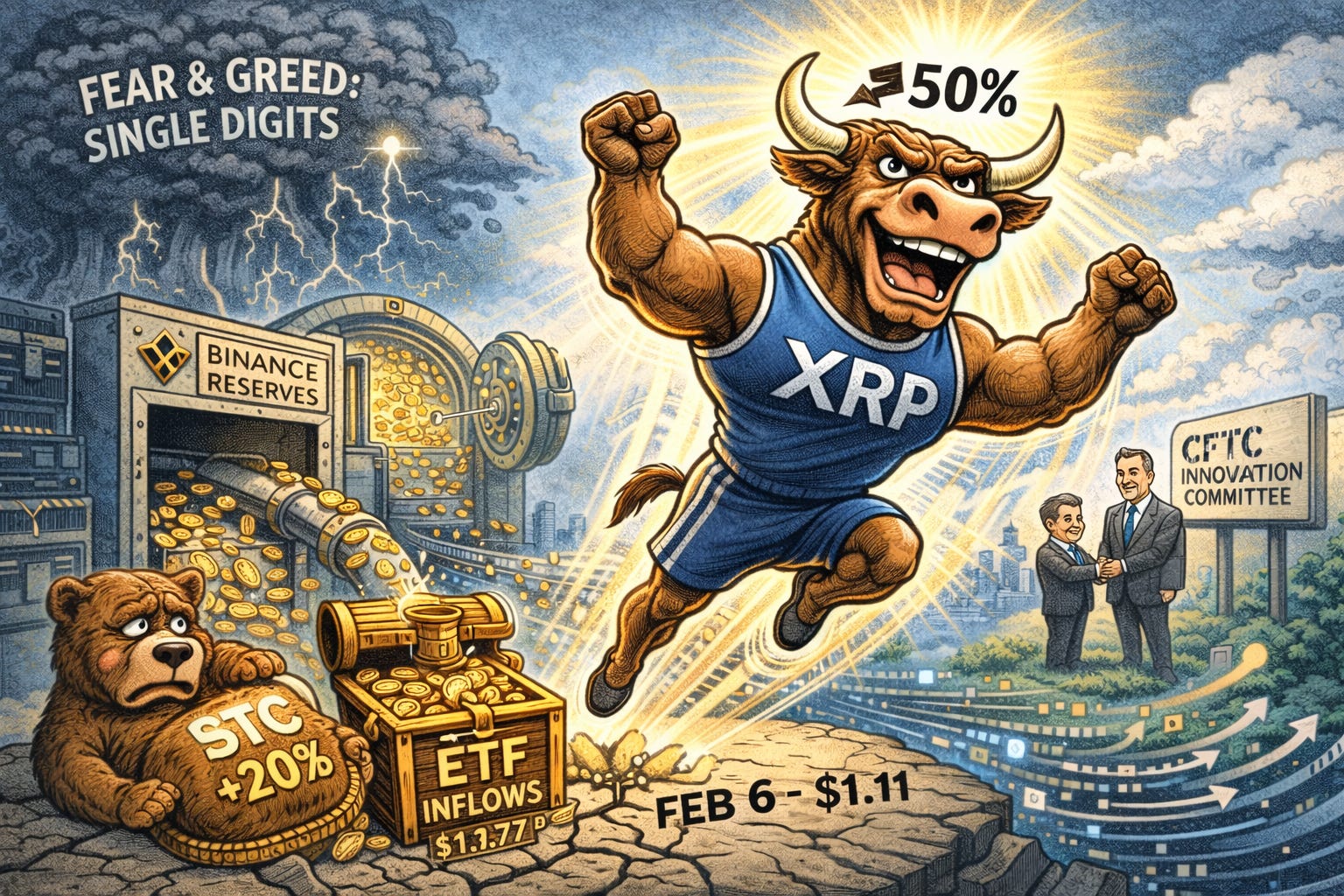
XRP surged as much as 50% from its 6 February crash low of $1.11 to a high of $1.67 on 15 February, more than doubling bitcoin’s roughly 20% recovery over the same period. The sharp outperformance made XRP the standout major-cap token in the post-crash bounce.
The rally tracks on-chain signs of aggressive dip-buying. CryptoQuant data shows Binance’s XRP reserves dropped by 192.37 million tokens to 2.553 billion between 7 and 9 February, a 7% decline that brought holdings to their lowest level since January 2024. Reserves have held steady since. When investors withdraw coins from exchanges into self-custody, analysts typically read it as accumulation rather than preparation to sell. The pattern has precedent: XRP rallied from $0.60 to over $2.40 in the final two months of 2024 as exchange balances declined sharply.
The broader backdrop adds context. XRP spot ETFs, which launched in mid-November 2025, had attracted $1.37 billion in cumulative inflows by early January 2026, reaching $1 billion faster than any crypto ETF except bitcoin. That institutional demand continued even as bitcoin and ether ETFs saw billions in outflows during the same period. Separately, Ripple CEO Brad Garlinghouse was appointed to the CFTC’s new Innovation Advisory Committee on 12 February, a further signal of growing regulatory engagement.
For XRP, the combination of shrinking exchange supply, sustained ETF inflows locking tokens into custody, and a bounce that outpaced bitcoin by more than two-to-one suggests capital is rotating toward the token specifically, not just riding a broad market recovery. Whether that momentum holds depends on whether these structural tailwinds continue to outweigh the macro headwinds dragging on the wider crypto market, where the Fear & Greed Index recently hit single digits.
Seen on X
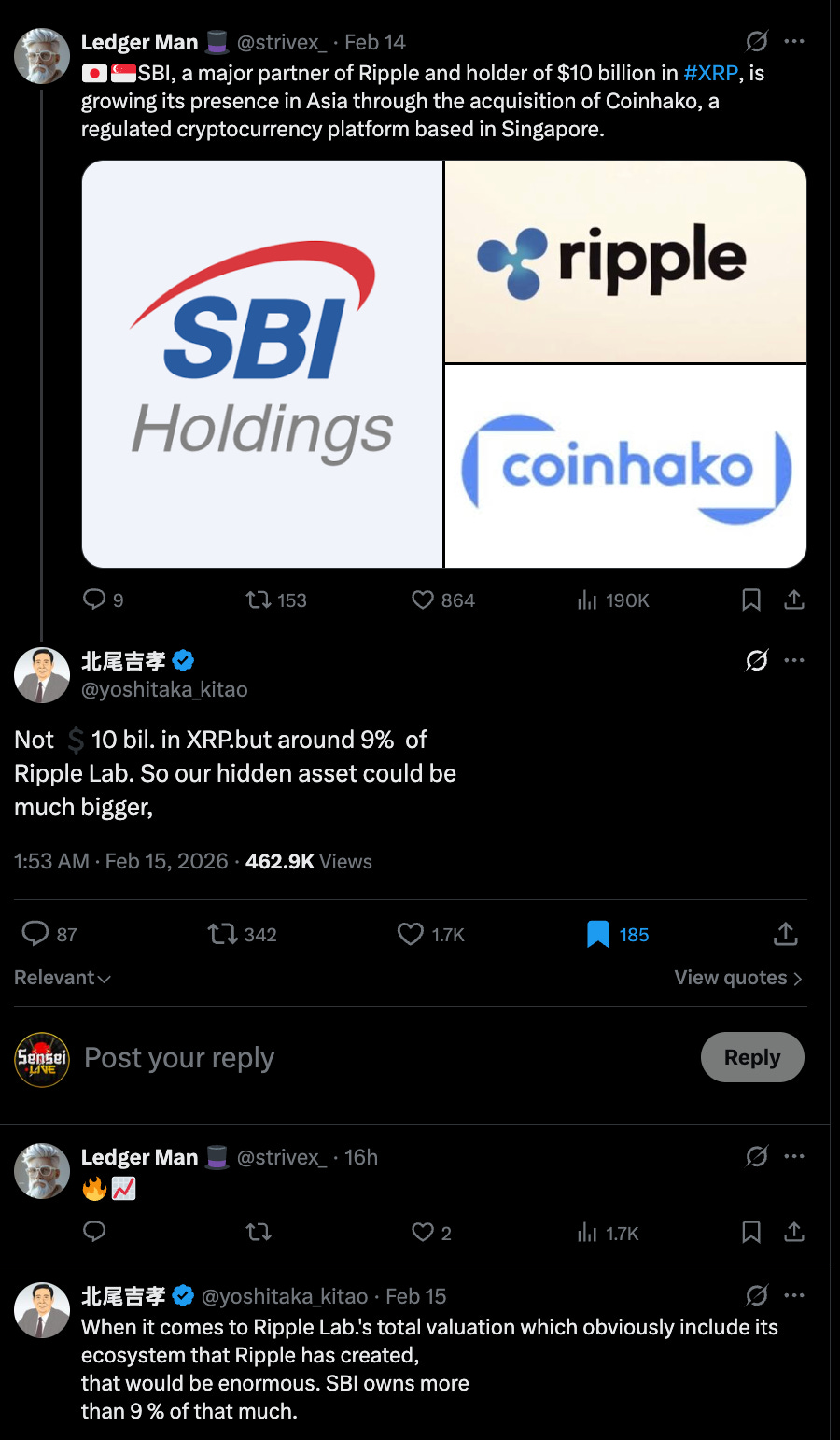
Sensei’s Insight: This exchange between strivex_ and SBI CEO Yoshitaka Kitao is worth paying attention to. Kitao personally stepping in to correct the "$10 billion in XRP" claim and reframe it as a 9%+ equity stake in Ripple Labs tells you something about how seriously SBI takes its positioning here. Calling it a "hidden asset" is deliberate language from the CEO of a major Japanese financial conglomerate. He's essentially saying the market hasn't priced in what SBI's Ripple stake is actually worth, especially when you factor in the broader ecosystem Ripple is building. That's not hype from a crypto influencer, that's a public company CEO putting it on the record.
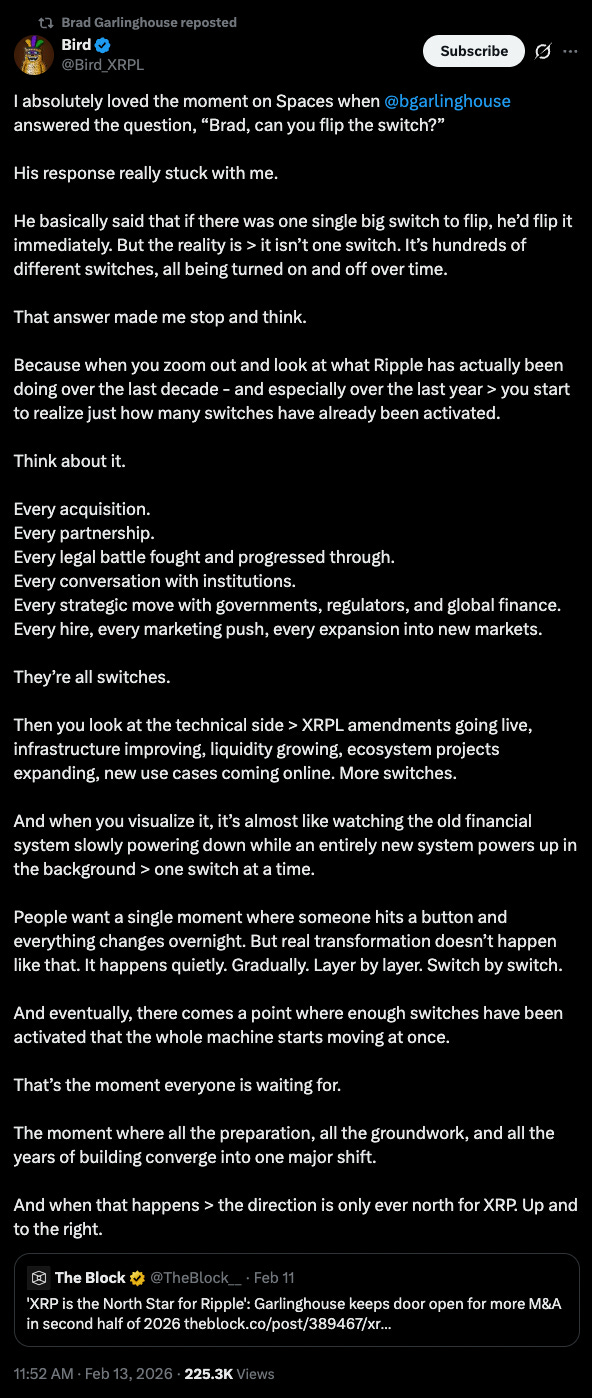
Sensei’s Insight: Brad Garlinghouse reposting this from @Bird_XRPL is notable. The "switches" framing is a useful way to think about where Ripple and XRP actually are right now. This week alone we've covered Aviva Investors partnering with Ripple to tokenise funds on XRPL, SBI expanding into Singapore through Coinhako, Garlinghouse joining the CFTC's advisory committee, and XRP outperforming bitcoin and ether in the post-crash recovery. None of those individually is "the moment," but stack them together and the picture is hard to ignore. The switches are flipping.
Debunked
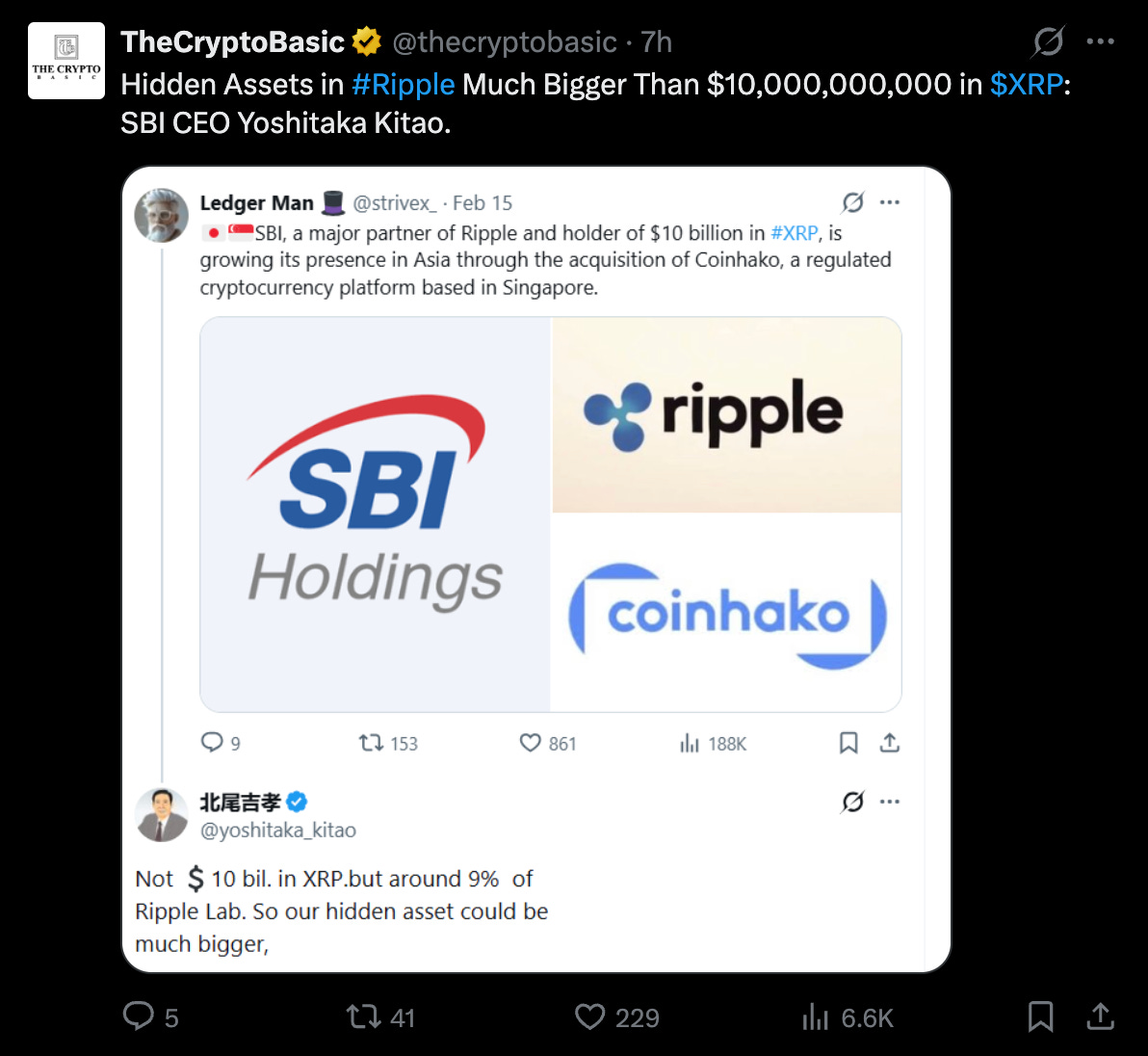
TheCryptoBasic's headline "Hidden Assets in Ripple Much Bigger Than $10,000,000,000 in XRP" misrepresents what Kitao actually said. He wasn't saying SBI's hidden asset is bigger than $10 billion in XRP. He was correcting the original claim entirely: SBI does not hold $10 billion in XRP tokens at all. Their exposure is a 9%+ equity stake in Ripple Labs, which at Ripple's estimated $50 billion valuation is worth roughly $4.5 billion on paper. Kitao's "could be much bigger" comment refers to the potential upside of that equity stake if Ripple's valuation grows, not to some secret XRP stash exceeding $10 billion. The distinction matters: equity in a private company and a token treasury are completely different risk profiles, and conflating the two is exactly the kind of misinformation Kitao was trying to correct in the first place.