

The Consensus
⚖️ Trump Threatens Banks Over Crypto: Trump warns banks of consequences for blocking his agenda; he demands immediate CLARITY Act passage.
🛢️ Oil Spikes Amid Iran Conflict: Brent crude hits $108 after Israeli strikes; markets fear stagflation as global equity futures tumble.
💳 Ripple Payments Hits $100 Billion: Total processed volume crosses a major milestone; the platform adds its first European banking partner.
🏦 Ripple Prime Joins DTCC Plumbing: Hidden Road’s NSCC listing creates a theoretical pathway for institutional post-trade volume on XRPL.
The Chart Watch
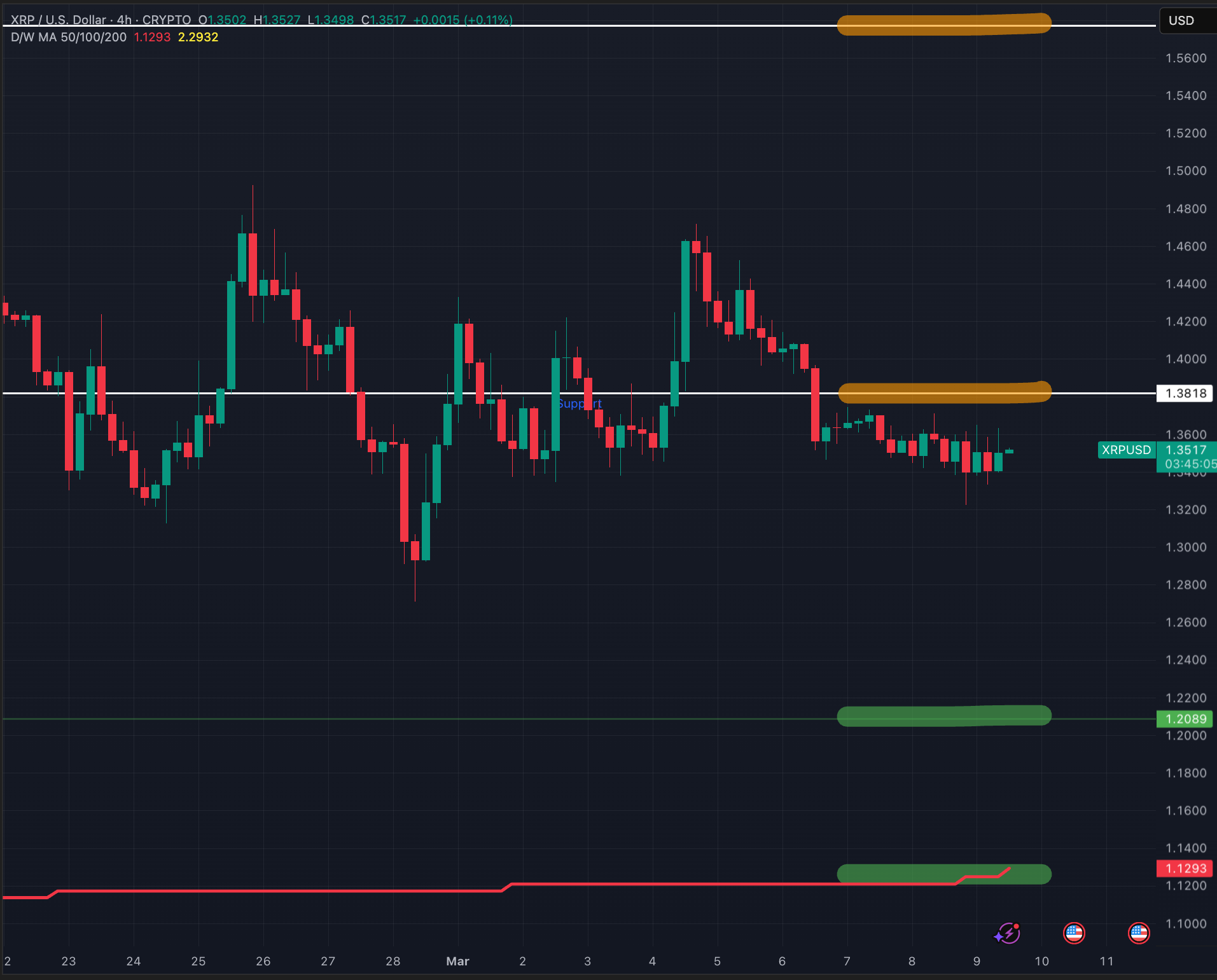
We’re on the 4-hour chart this week and the picture is straightforward: $1.38 is the line in the sand. XRP broke below that level last week and has been grinding beneath it since, currently sitting around $1.35. Below $1.38, the bias is bearish. Above it, I’m bullish. Right now we’re below it, so the path of least resistance points toward $1.20, the next meaningful support zone on the chart. A reclaim and hold above $1.38 flips the target to $1.60. The market is deciding which way it wants to go, and until that question gets answered, there’s no reason to fight the downtrend.
Zooming out, the weekly 200 MA sits at $1.13 now, which shows just how extended this market remains historically even after the selloff from the highs. My working thesis for the year is a potential bounce in March or April, followed by renewed downside into May and a deeper capitulation around October that could push XRP below $1.00. Bounces along the way are real and tradeable if you’re managing risk properly.
Key levels I’m watching:
$1.38 — Key pivot. Bullish above, bearish below
$1.20 — Near-term downside target
$1.13 — Weekly 200 MA; major structural support
$1.60 — Upside target on a confirmed reclaim of $1.38
The broader crypto market hasn’t finished its correction cycle. A couple of final capitulations likely still lie ahead, but that doesn’t rule out a rally in the meantime.
All live entries are posted in real time for premium Substack members.
Poll
Last Week’s Results
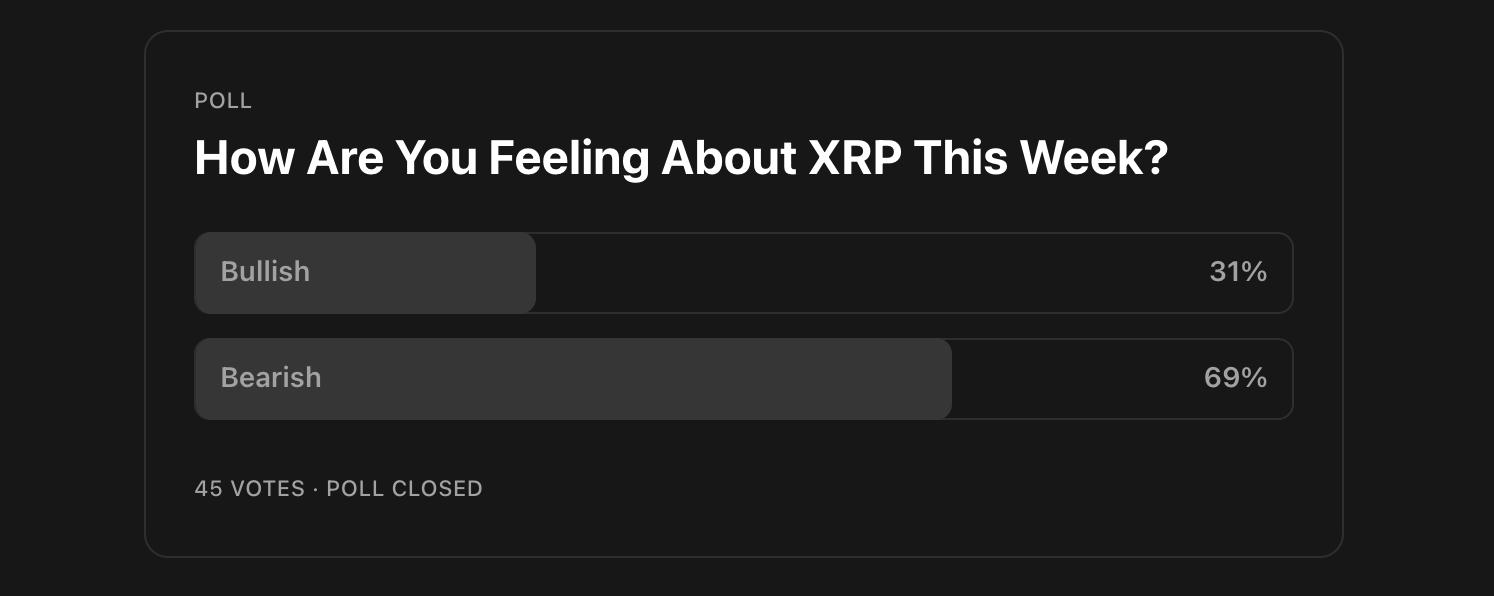
✅ 69% of you were Bearish and from last week to today XRP is down ~1%.
Please do keep voting, it will be interesting to analyze this data in the future and see if we can draw any trends from this.
The Ripple Effect
⚖️ Trump Declares War on the Banks Over Crypto
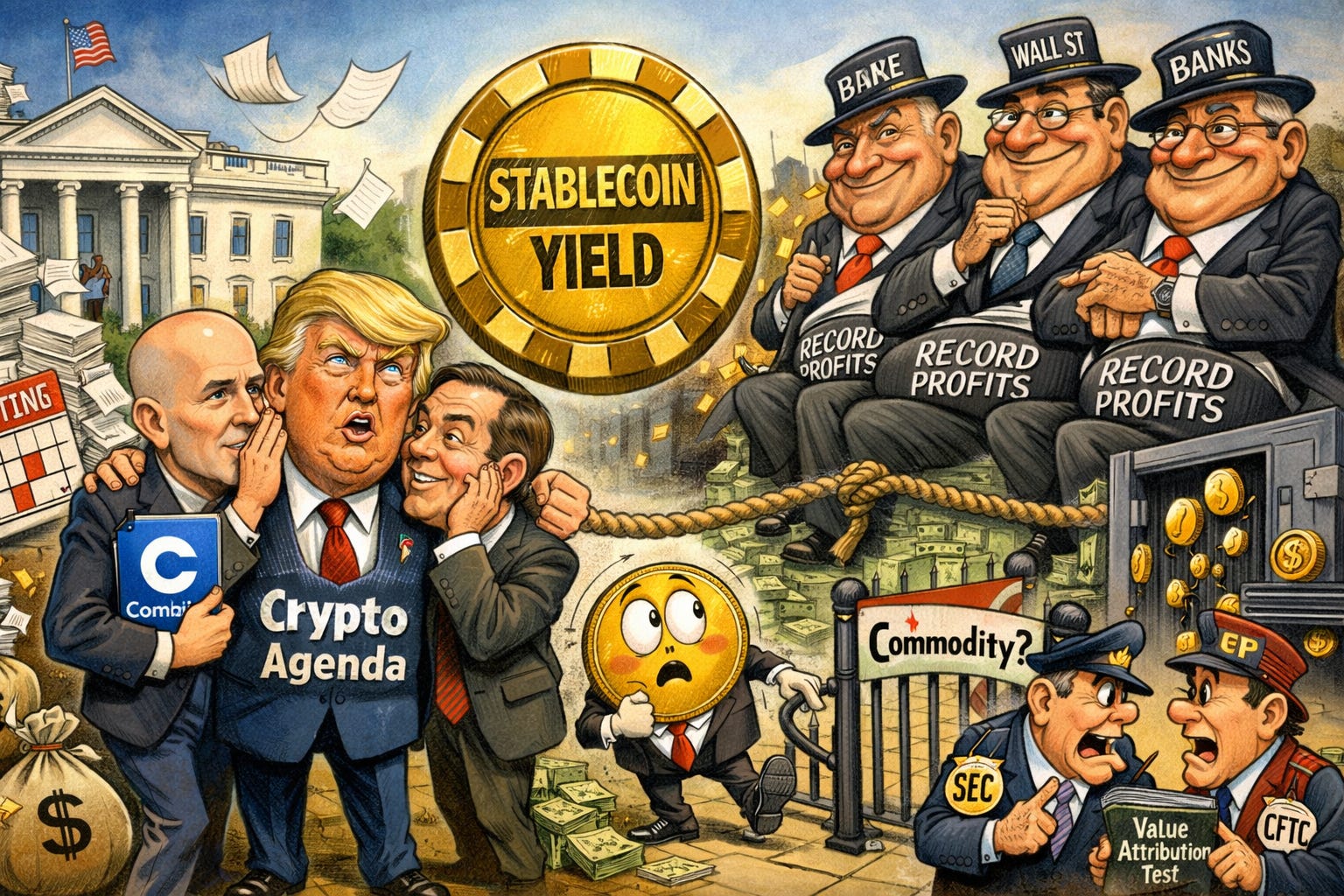
On the evening of March 3, Donald Trump took to Truth Social with an unambiguous threat: banks that block his crypto agenda will answer for it. “The Banks are hitting record profits, and we are not going to allow them to undermine our powerful Crypto Agenda that will end up going to China, and other Countries if we don’t get The Clarity Act taken care of.” Hours earlier, Trump had met privately at the White House with Coinbase CEO Brian Armstrong, whose talking points on stablecoin yield appeared almost verbatim in the presidential posts. Senator Cynthia Lummis echoed within hours: “America can’t afford to wait.” The posts landed just two days after a White House-brokered compromise deadline had passed without a deal (CoinDesk).
The dispute comes down to one question: can stablecoin issuers offer yield to customers? The White House compromise, crafted by crypto czar David Sacks and Patrick Witt, would have allowed “rewards” on transaction-linked activity like peer-to-peer payments and merchant settlements, while banning interest on idle holdings, with penalties up to $500,000 per day for violations. On March 5, the American Bankers Association rejected that framework outright, calling the transaction-linked yield provision “a distinction without a difference” that creates a “massive loophole” for what they described as shadow banking. The ABA cited a Treasury Department projection that banks could lose up to $6.6 trillion in deposits if stablecoins offered yield (CNBC).
For XRP holders, the CLARITY Act carries two concrete stakes. First, formal classification of XRP as a digital commodity under CFTC jurisdiction would codify the 2023 federal court ruling into permanent law, removing the risk that a future SEC leadership could relitigate it. Second, the seven spot XRP ETFs already trading have absorbed roughly $1.24 billion in cumulative net inflows since their November 2025 launch; passage would expand the addressable market by opening the door to pension funds and insurance companies currently blocked by compliance requirements. Ripple CEO Brad Garlinghouse put passage odds at 90% in a Fox Business appearance, a figure significantly more optimistic than former CFTC Chair Christopher Giancarlo’s 60-40 read. Polymarket had priced passage in 2026 at roughly 74% following Trump’s posts (Bloomberg).
The calendar is tightening. The Senate Banking Committee is targeting a mid-to-late March markup window, but faces 130-plus proposed amendments and a competing legislative agenda dominated by Iran military operations. Stifel’s chief Washington strategist Brian Gardner warned last week: “The calendar is becoming the enemy of this bill.” One genuinely underreported risk for the XRP community: under the CLARITY Act’s “value attribution test,” the SEC could demand proof that 50-plus percent of XRP’s appreciation was driven by on-chain utility rather than speculation. With Ripple holding roughly 33.6% of total supply, that decentralization threshold could be contested, and the legal question is untested under the proposed statutory framework. The Fairshake PAC, funded by Coinbase, Ripple, and a16z, holds $193 million for 2026 midterms, and 12 of 22 bill sponsors are backed by that network, but lobbying firepower does not override a shrinking legislative calendar.
🛢️ Oil Shock, Stagflation Fear, and a Crypto Market Already on Its Knees
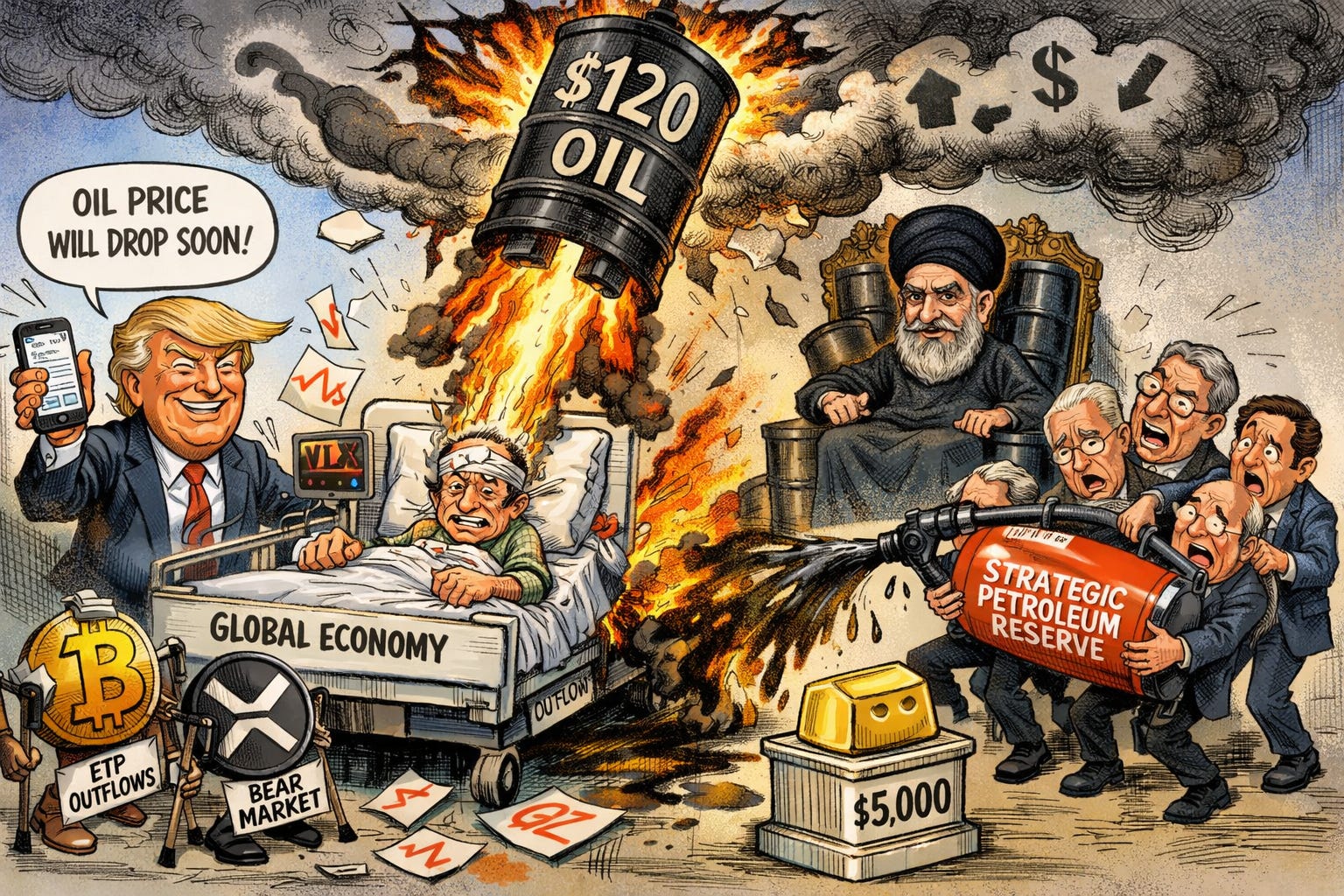
Markets opened Monday March 9 in crisis mode after three catalysts collided over the weekend. Iran’s Assembly of Experts named Mojtaba Khamenei, the hardline son of the slain Ayatollah, as the country’s new Supreme Leader, signaling a more prolonged war than markets had assumed. Israel struck 30 fuel storage sites across Iran on Saturday, the first targeting of Iranian energy infrastructure. Then Trump posted Sunday evening: “Short term oil prices, which will drop rapidly when the destruction of the Iran nuclear threat is over, is a very small price to pay for U.S.A., and World, Safety and Peace.” Brent crude surged as much as 29% on Monday, on course for the biggest single-day dollar gain in futures history. From the pre-war baseline on February 27, oil had surged roughly 66% at Monday’s peak.
The spike pulled back after reports emerged that G7 finance ministers had scheduled an emergency call with the IEA to discuss a coordinated release from strategic petroleum reserves, knocking roughly $15 off the barrel price before Brent stabilised in the $104 to $108 range. That reprieve did little for broader risk assets. Japan’s Nikkei fell over 5%, South Korea’s KOSPI triggered its second circuit breaker, and U.S. equity futures pointed sharply lower with the VIX spiking to its highest level in months. JPMorgan warned production cuts could approach 6 million barrels per day if the Strait of Hormuz remains closed. Goldman Sachs modelled that a disruption lasting 30 or more days could push oil to $140 to $150, “potentially triggering a synchronized global economic downturn.”
The crypto market reaction was negative but more contained than equities. Bitcoin touched lows near $65,000 before recovering slightly, roughly 47% below its late 2025 peak. XRP was down around 26% year-to-date and 64% below its all-time high. The total crypto market cap has shed nearly half its value from its 2025 peak. The Fear and Greed Index sat deep in extreme fear territory. The “Bitcoin as safe haven” framing is not supported by current data: gold hit new highs while Bitcoin continues to trade with an 85% correlation to the Nasdaq, behaving as a leveraged tech asset rather than digital gold.
XRP carries specific risks beyond the macro headwinds. In prolonged bear markets, altcoins historically underperform Bitcoin as institutional capital concentrates in the perceived safest crypto asset. The Iran conflict also threatens to crowd out the CLARITY Act from Congressional floor time. The underreported escalation risk remains uranium: Bloomberg reported Trump was briefed on deploying special forces to seize Iran’s stockpile enriched to near-weapons-grade levels, with Secretary of State Rubio telling Congress: “People are going to have to go and get it.” Markets are not yet fully pricing the tail risk of a ground operation, and Allianz projects no rate cuts in 2026 if oil stays elevated.
💳 Ripple Payments Crosses $100 Billion and Adds Its First European Bank
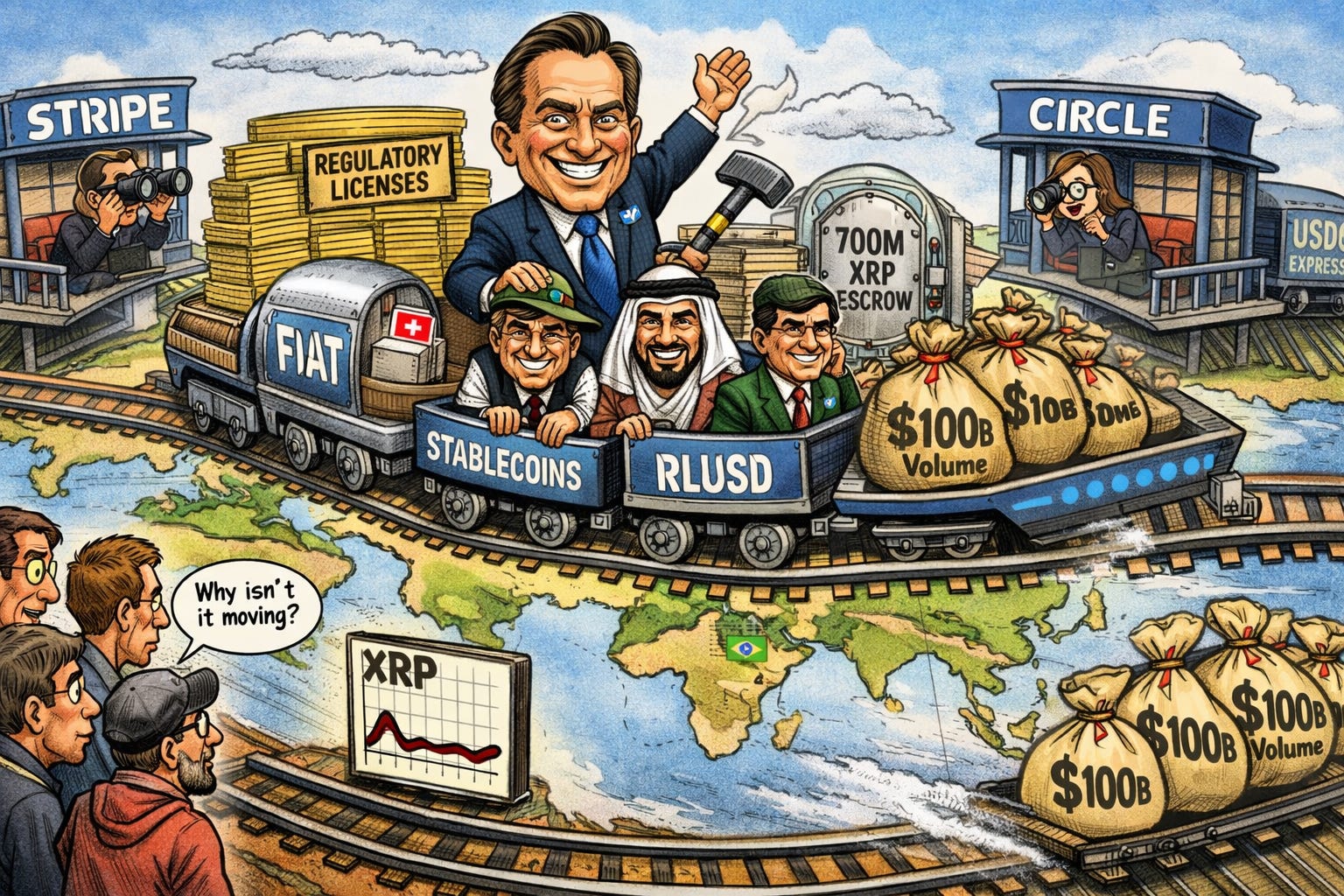
On March 3, 2026, Ripple announced a significant expansion of its Ripple Payments platform into an end-to-end infrastructure layer for fiat and stablecoin money movement. The expansion integrates two recent acquisitions: Palisade, which powers managed custody and wallet provisioning, and Rail, a virtual accounts and collections platform. The combined platform allows businesses to collect, hold, exchange, and pay out in both fiat and stablecoins through a single integration, removing the need for separate vendors across the payment stack. The announcement arrived with a roster of named institutional clients: AMINA Bank of Switzerland (the first European bank on the platform), Zand digital bank in the UAE, Banco Genial in Brazil, and several Southeast Asian partners. Ripple also disclosed that total processed volume has now exceeded $100 billion.
The geographic spread reflects deliberate expansion into corridors where Ripple has built regulatory standing, and these are regulated financial institutions rather than speculative crypto startups. A related development reinforcing the RLUSD ecosystem: the Soil protocol launched as the first compliant real-world-asset-backed yield protocol on XRPL, offering holders fixed returns from private credit and tokenized Treasuries. Its initial pools filled in under 72 hours. XRPL’s tokenized real-world asset transfers have surged significantly over the past 30 days, and XRPL has surpassed Solana in total tokenized RWA value.
The competitive context keeps Ripple’s position honest. Stripe acquired Bridge for $1.1 billion and announced stablecoin-linked cards with Visa across 100+ countries. Circle reported strong revenue growth with USDC sitting at $75 billion in market cap against RLUSD’s roughly $1.5 billion. The race for institutional stablecoin rails is intensifying, and Ripple is not the dominant force. The $100 billion in total processed volume is a legitimate milestone but is a cumulative lifetime figure, not annual throughput. CoinDesk flagged the tension XRP holders have to sit with: “The payments business operates largely independently of the token’s price.” Ripple the company can grow its enterprise revenues and expand RLUSD circulation without necessarily moving XRP’s price. The link between Ripple’s enterprise success and XRP’s value depends on actual on-chain volume growth, not client announcements.
On the supply side, Ripple re-locked 700 million XRP into escrow on March 1 as part of its routine monthly cycle. Looking ahead, the Kurv XRP Enhanced Income ETF filed for a March 11 launch, a derivatives-based income product using XRP volatility for monthly payouts, adding another institutional layer to an asset navigating a macro bear market, legislative uncertainty, and a corporate parent building at a pace the token’s price has so far declined to reflect.
🏦 Ripple Prime Just Plugged Into the Core of Wall Street’s Plumbing
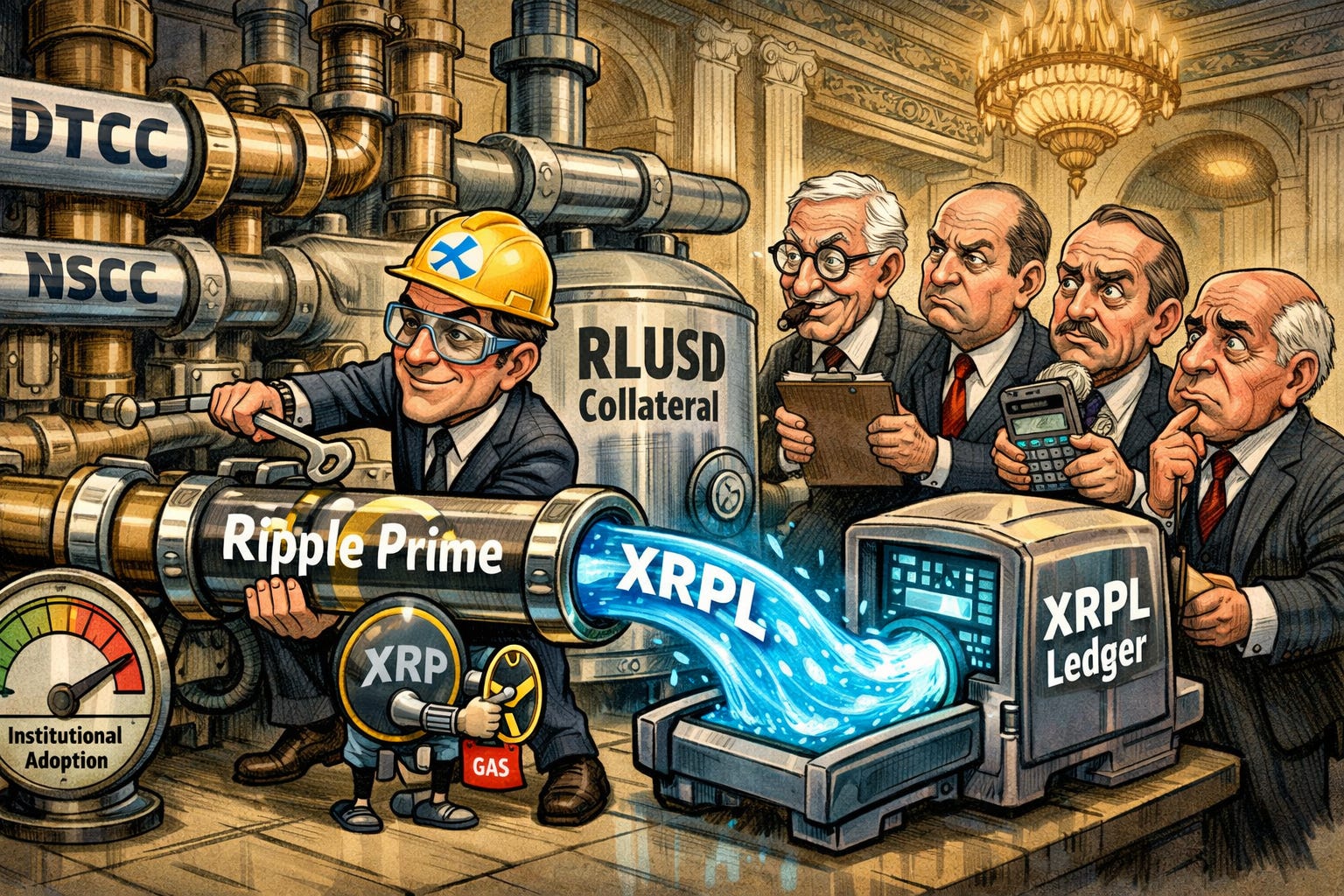
On March 2, 2026, the Depository Trust and Clearing Corporation added Hidden Road Partners to the National Securities Clearing Corporation’s Market Participant Identifiers directory. For those unfamiliar: the DTCC is the backbone of U.S. securities clearing and settlement, processing quadrillions of dollars in transactions annually. The NSCC is its subsidiary handling the clearing and netting of virtually all U.S. equity and fixed-income trades. Getting listed means a firm has cleared the regulatory and operational requirements to participate directly in this core financial plumbing. Ripple acquired Hidden Road in April 2025 for $1.25 billion and rebranded it as Ripple Prime. Prior to acquisition, Hidden Road cleared roughly $3 trillion annually for over 300 institutional clients. Ripple CTO Emeritus David Schwartz responded on X with two words: “Seems important.”
No cryptocurrency company has ever been embedded inside the NSCC’s production infrastructure before. The listing creates a legal and technical pathway for institutional post-trade volume to eventually flow through the XRP Ledger. Ripple has stated its intention to migrate post-trade activities onto XRPL using RLUSD as collateral for cross-margining between traditional and crypto markets. The relevant mechanism: RLUSD acts as collateral on Ripple Prime’s platform while XRP serves as the gas fee asset for XRPL infrastructure, meaning institutional flows routed through the ledger would generate structural, utility-driven XRP demand rather than speculative. The listing also arrived on the back of three XRPL protocol amendments passed in February 2026 that together built an institutional finance stack: permissioned domains, token escrow extended to RLUSD, and a permissioned DEX for regulated institutions.
The community excitement needs calibration. NSCC membership does not mean the NSCC uses XRPL. It means Ripple Prime has the standing to process OTC trades through NSCC’s centralised clearing system. The potential to route post-trade settlement through XRPL is a future possibility, not a current reality, and there is no public data showing institutional volumes actually flowing through the ledger yet. The approval is also narrower than some posts suggested, covering OTC trades only. That said, Finance Magnates noted: “The DTCC listing of March 2 is the first real evidence that this is moving from theory to live infrastructure. The market has not priced that in yet.”
XRP fell to $1.34 by March 9 amid the broader Iran-driven selloff. The market is either appropriately skeptical that the token will benefit from Ripple’s enterprise buildout, or it simply has not absorbed the development while processing overwhelming macro noise. Whether institutional post-trade activity eventually migrates onto XRPL will depend on Ripple executing a plan that has no public timeline and has never been attempted at this scale inside regulated securities infrastructure.
See you tomorrow for the return of the normal Morning Forecast. Depending on your time zone, it may arrive an hour earlier than usual.