

The Consensus
⚔️ US and Israel Strike Iran: Joint attacks across 24 provinces killed Iran’s Supreme Leader, triggering widespread Middle East retaliation.
🛢️ Oil Prices Surge Amid Crisis: Brent crude jumped 12% as Iran threatened to block the critical Strait of Hormuz gateway.
📉 XRP Breaks Key Support Levels: Massive liquidations and a 40% slide from January highs fueled the token's worst February performance.
🏛️ CLARITY Act Hits Legislative Impasse: US stablecoin yield disputes stalled a crucial bill that would codify XRP as a commodity.
🇦🇺 Garlinghouse Headlines Sydney Crypto Summit: Ripple’s CEO emphasized incremental industry growth through “a thousand switches” at the Australia 2026 conference.
War in the Middle East: What You Need to Know Before Futures Open Tonight
On Saturday, the US and Israel launched joint strikes on Iran across 24 of its 31 provinces. Iran’s Supreme Leader Khamenei was killed. Iran retaliated with missiles and drones hitting Israel, US bases in Kuwait, and targets across the UAE, Bahrain, Qatar, Saudi Arabia, Jordan, and Iraq. Three US soldiers were killed. Dubai International Airport was damaged. Multiple countries closed airspace. The conflict is ongoing.
The Oil Crisis
This is what matters most for your portfolio. Iran’s Revolutionary Guard warned all ships: “no passage through the Strait of Hormuz.” The Strait carries 20% of the world’s oil. Here’s where things stand:
Tanker traffic through the Strait has effectively halted. Hundreds of tankers are anchored or stationary at both ends
Three vessels have been struck so far. The oil tanker Skylight is on fire off Oman’s coast, crew evacuated, four injured. Two more ships (MKD Vyom and Sea La Donna) also reported attacks
Maersk, Hapag-Lloyd, and CMA CGM have all suspended Strait crossings. Greece and Japan ordered their merchant fleets to avoid the area entirely. CMA CGM is rerouting via the Cape of Good Hope
Marine insurers are cancelling war risk coverage for the entire Persian Gulf region. Without insurance, ships can’t sail even if they wanted to
Brent crude jumped 10-12% to ~$80 in OTC trading on Sunday. Goldman Sachs projects $110. JP Morgan sees $120-130 if disruptions continue
OPEC+ met Sunday and agreed to raise output by 206,000 barrels per day from April, but that’s less than 0.2% of global supply. Even Saudi Arabia and the UAE will struggle to export while Hormuz is disrupted
Iran’s foreign minister says they have “no intention” of closing Hormuz, but the IRGC is broadcasting the opposite and ships are already burning
Trump recently announced the US has sunk 9 Iranian warships and “largely destroyed” their naval headquarters. CENTCOM (United States Central Command) confirmed at least one corvette sinking. If true, Iran’s ability to enforce any Hormuz blockade is rapidly diminishing
The real move comes when futures open tonight. If Hormuz stays shut for weeks, we’re looking at $100+ oil and genuine recession risk.
Why does expensive oil cause a recession? It's simple. Oil touches everything. When oil prices spike, it costs more to ship goods, fuel factories, and transport people. Companies pass those costs on. Prices rise across the board. That's inflation. Central banks respond by keeping interest rates high or raising them further, which makes borrowing more expensive for businesses and consumers. Spending slows. Hiring freezes. Growth stalls. Every major oil shock in modern history (1973, 1979, 1990, 2008) was followed by a recession or severe slowdown. The playbook hasn't changed.
Tonight’s Futures Open (6pm ET / 11pm GMT)
Equities: Expected to gap down 1%+. S&P and Nasdaq were already weak last week. Wall Street is in “haven-first” mode (Bloomberg)
Oil/Energy: The obvious winner. Energy stocks should surge at the open
Gold: Already up 22% in 2026. Safe haven buying could push it higher
Crypto: Bitcoin dropped 6.4% to $63,500 on Saturday, bounced to ~$68,000 Sunday on de-escalation hopes. XRP fell 9.4% to $1.29 before recovering to ~$1.40. Over $500M in liquidations in 24 hours. If equities dump Monday, crypto likely sees another leg down.
The “Domino Theory” Check-In
If you follow the XRP community, you’ll have seen the “domino theory” doing the rounds again. The idea is that an oil spike pressures Japan as a major energy importer, forces the BOJ (Bank of Japan) to raise rates, unwinds the yen carry trade, and through a chain of events repositions XRP as critical global infrastructure at prices of $100 or $1,000+.
Some of the macro logic here isn’t wrong. Oil is spiking. Japan does import nearly all its energy. The carry trade is a genuine systemic risk, and we saw in August 2024 how quickly it can rattle global markets. These aren’t bold predictions. They’re observable risks that most macro analysts have been flagging for months.
The problem is the final step. The idea that all of this somehow reprices XRP to three or four figures requires institutional adoption and infrastructure readiness that doesn’t exist. When the strikes hit Saturday, XRP dropped 9.4% with everything else. It traded like a risk asset, not like the backbone of global finance. The macro risks are real. The XRP price conclusion attached to them isn’t.
Stay safe.
This is not financial advice. Sources: Al Jazeera, Reuters, CNBC, Bloomberg, CNN, NPR, Fortune, CoinDesk.
The Chart Watch
XRP is closing the week at $1.35, and this is now officially the lowest weekly close since early November 2024. The 3-day chart tells the story without any ambiguity: we’re in a downtrend. Lower highs, lower lows. We called this bear market months ago when it wasn’t the popular take, and the chart continues to confirm it. Nothing has changed structurally.
The descending parallel channel from the July 2025 highs near $3.80 remains the dominant feature on this timeframe. Price is hovering around the midline of that channel right now. A reclaim of $2.00 and a break above the upper channel boundary would be the first credible signal that the trend is shifting. Until then, every bounce is a potential lower high until proven otherwise.
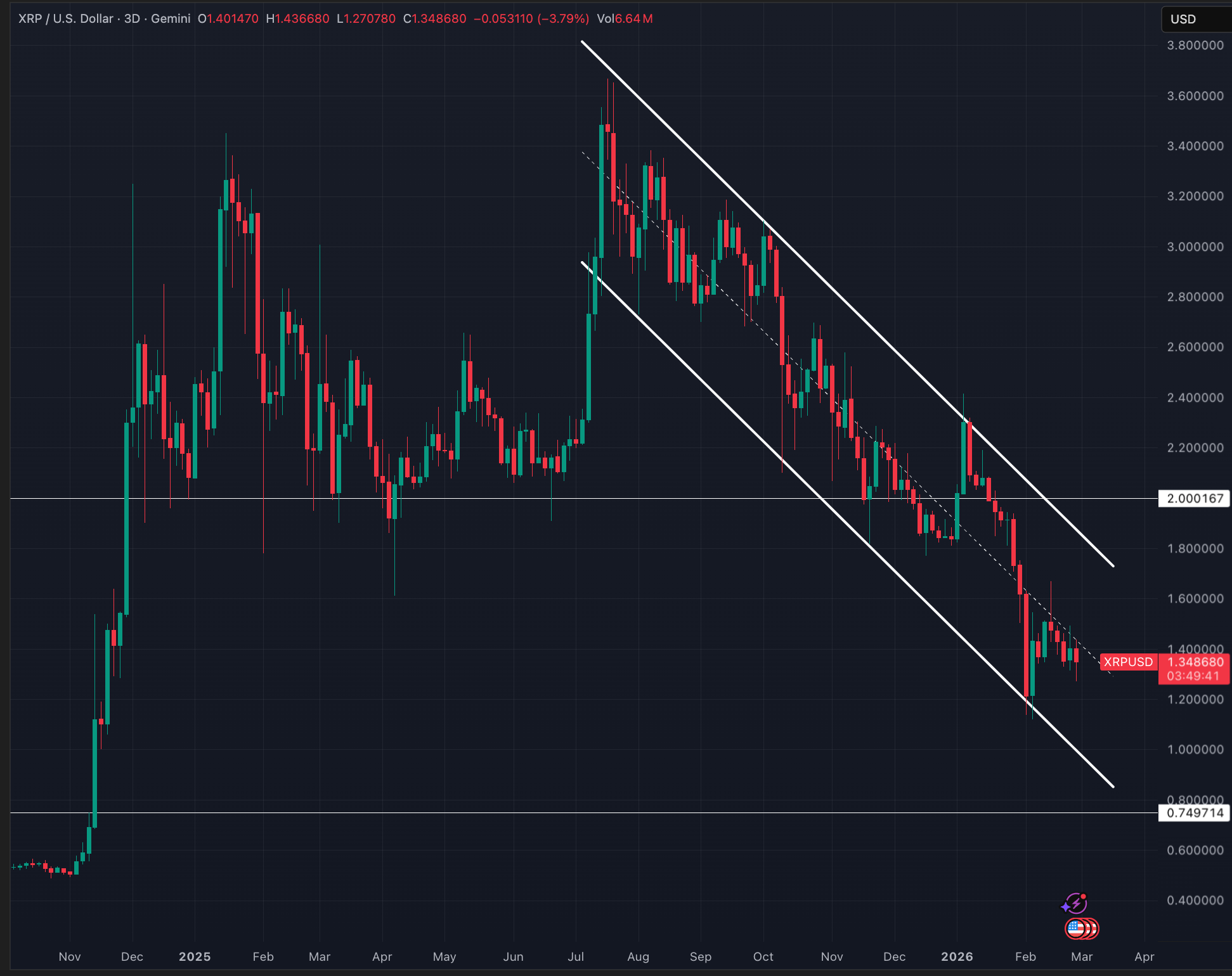
Every pump inside this channel has faded. That reality hasn’t changed, and it’s the single most important thing to keep in mind right now. Can we get a squeeze toward $1.80 or even $2.00? Absolutely, the structure allows for it. But confusing a bounce for a bull market reversal is how people get hurt in downtrends. Let the chart confirm a shift before assuming one.
If the trend continues, lower prices remain on the table:
Below $1.00 is still a realistic scenario within this channel
A break of $1.00 puts $0.75 in focus, which lines up with the lower channel boundary and late 2024 price structure
That’s not a prediction, it’s preparation
All live entries are posted in real time for premium Substack members.
Poll
Last Week’s Results
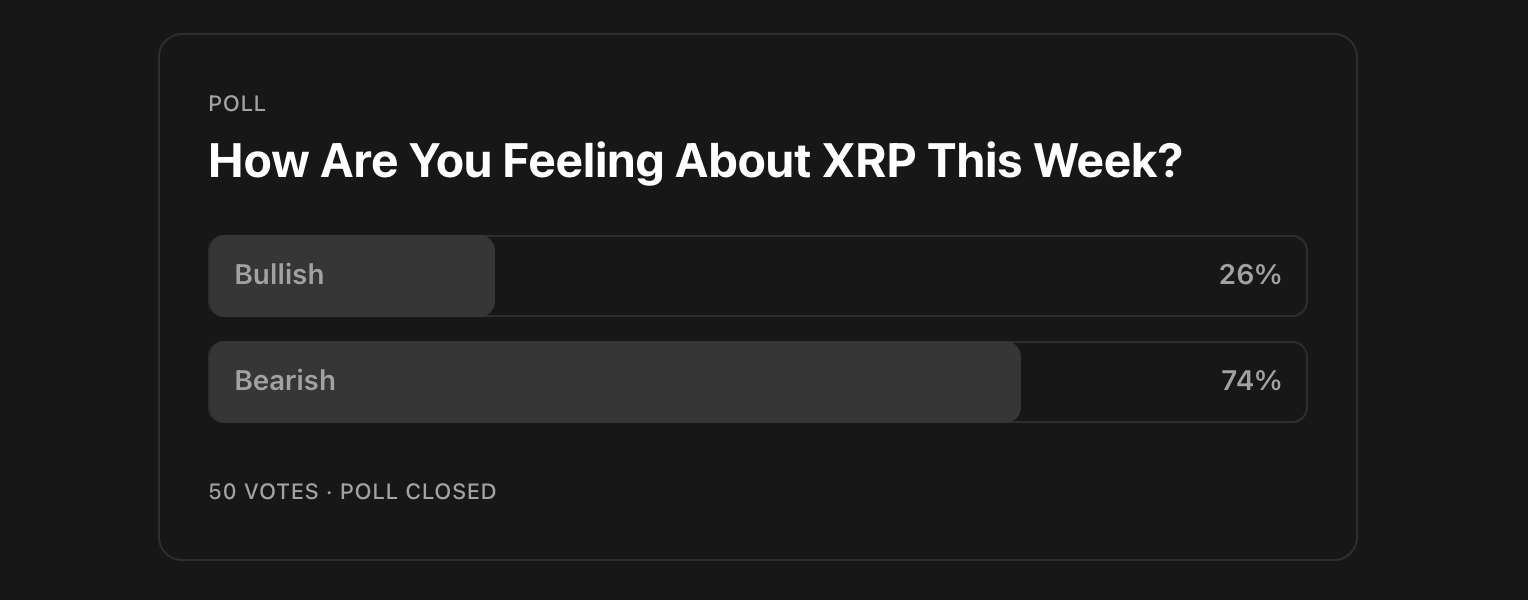
✅ 74% of you were Bearish and from last week to today XRP is down ~10%.
Please do keep voting, it will be interesting to analyze this data in the future and see if we can draw any trends from this.
The Ripple Effect
💥 XRP Crashes 17% as Iran Strikes Cap the Worst February on Record
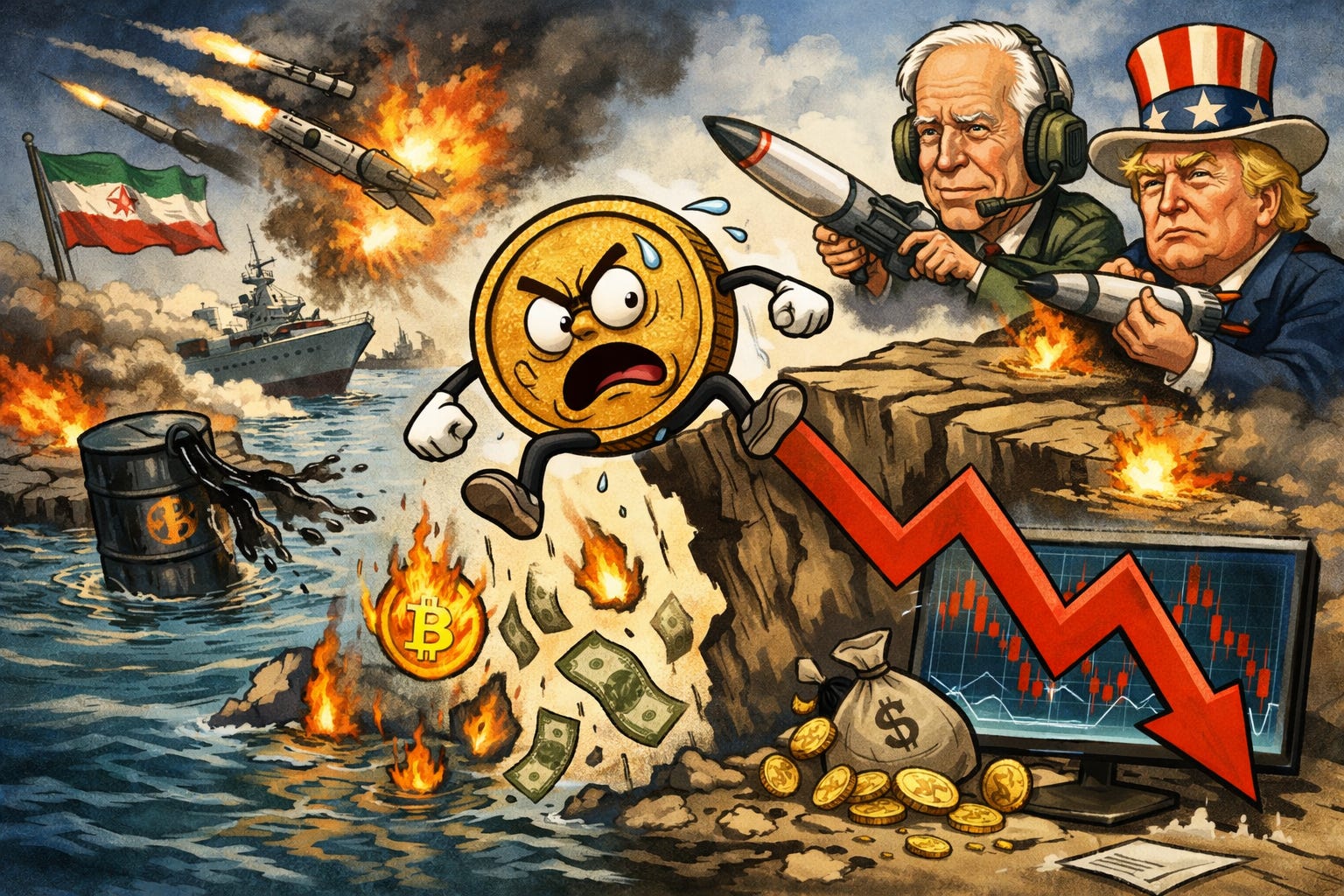
On Saturday, February 28, 2026, XRP plunged sharply after President Trump confirmed the U.S. military had begun coordinated strikes against Iran alongside Israel. With traditional markets closed for the weekend, crypto absorbed the full force of global risk-off sentiment. XRP fell approximately 9.4% on February 28 alone, dropping from ~$1.42 to $1.29 and breaking below the $1.36 support on surging volume. Measured from the week’s high to the deepest trough, losses exceeded 17%. Total crypto market capitalisation shed approximately $128 billion, with over $515 million in liquidations across more than 153,000 traders. XRP-specific derivative liquidations totalled $46 million in 24 hours, $43 million of that from leveraged long positions (CoinDesk).
The crash capped XRP’s worst February on record, a 30%+ monthly decline, and marked five consecutive red monthly candles, a bearish streak not seen since 2016-2017. XRP now sits roughly 62% below its July 2025 all-time high of $3.65. Iran’s closure of the Strait of Hormuz further escalated global risk fears, with crude oil futures jumping 6%. By March 1, XRP had partially recovered to approximately $1.38 (TheStreet).
The Iran strike was the proximate cause, but XRP was already weakened. The token had declined from ~$2.40 in early January to ~$1.42 pre-crash, a roughly 40% slide driven by broader crypto weakness, tariff concerns, and macro uncertainty. What stands out structurally: despite the carnage, XRP spot ETFs continued to attract net inflows. Cumulative net inflows have reached approximately $1.24 billion since their November 2025 launch, with seven U.S. spot XRP ETFs now trading with combined AUM (Assets under management) of approximately $1 billion and 795 million XRP tokens locked. That persistent institutional accumulation, even through a 17% single-week crash, is a structural signal worth watching (The Crypto Basic).
On-chain indicators suggest the market may be approaching a potential inflection point. The NUPL (Net Unrealized Profit/Loss) indicator shows XRP in capitulation territory, and historically these phases have lasted approximately one month before reversing. Binance funding rates hit -0.028%, a ten-month low last seen in April 2025, which preceded the rally from $1.60 to the $3.65 all-time high. Seasonality data shows March has delivered an average 18% return for XRP over the past 12 years. None of that guarantees a reversal, especially with an active military conflict reshaping risk appetite globally, but the setup is forming (BeInCrypto).
🏛️ The CLARITY Act Stalls on Stablecoin Yield as March Deadline Passes Without a Deal
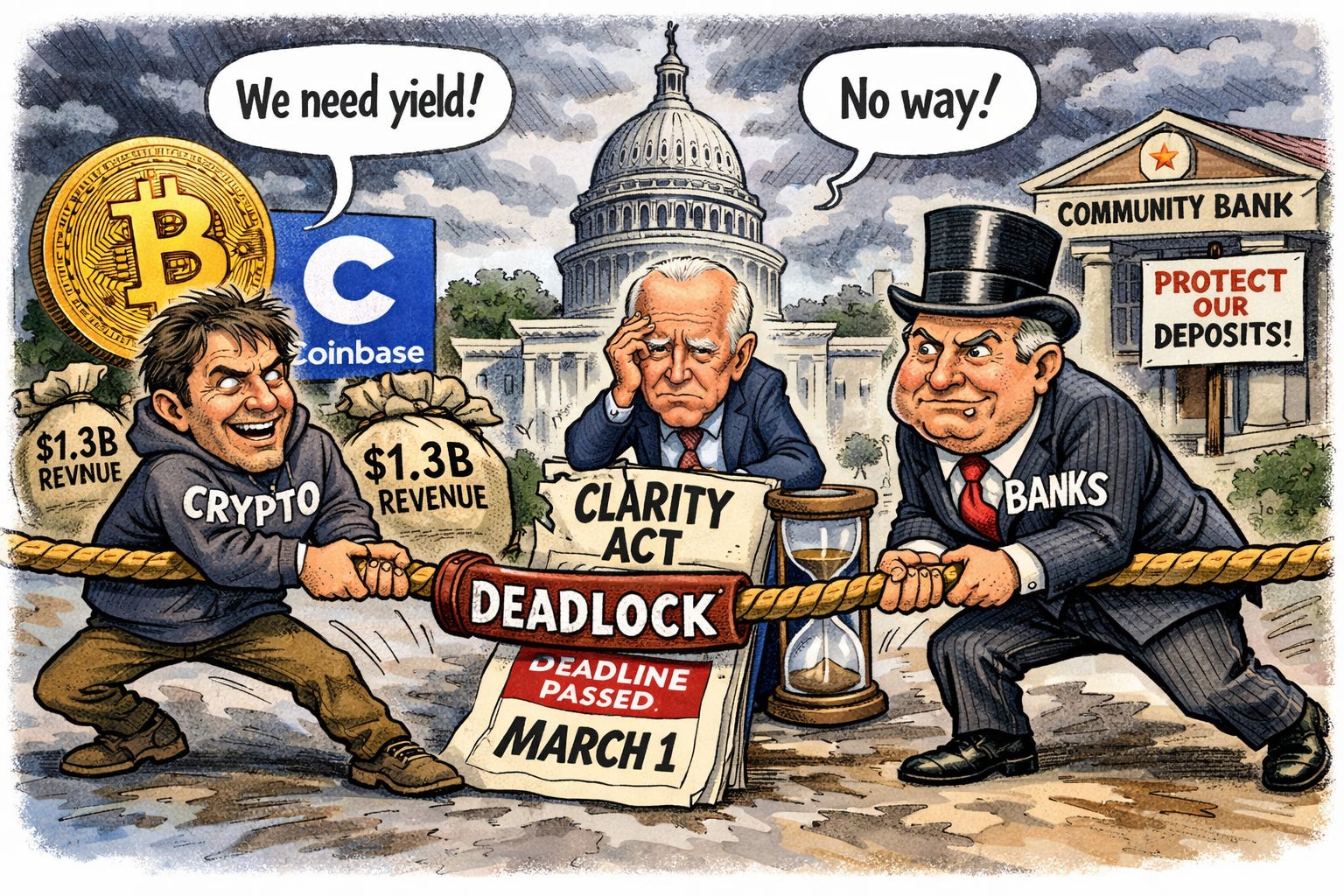
The Digital Asset Market Clarity Act (H.R. 3633), the most consequential piece of crypto market structure legislation in the United States, has hit a critical impasse. The bill passed the House with a commanding 294-134 vote on July 17, 2025, attracting 76 Democratic crossover votes, but its progress through the Senate has stalled over a single contentious issue: whether crypto platforms can offer yield on stablecoin holdings. March 1, 2026 was set as a pressure deadline for resolving the dispute. That deadline has now passed without a deal (Reuters).
The central dispute pits billion-dollar revenue streams against trillion-dollar deposit bases. The American Bankers Association arrived at White House meetings in February advocating a complete ban on any stablecoin yield, arguing it would siphon deposits from community banks. The crypto industry, led by Coinbase (whose stablecoin rewards generated roughly $1.3 billion in 2025 revenue), pushed back hard. The White House proposed compromise language banning yield on idle stablecoin balances but permitting activity-based rewards tied to transactions or network participation. At least three White House meetings took place in February, with Ripple Chief Legal Officer Stuart Alderoty attending all three (Disruption Banking).
For XRP specifically, the CLARITY Act is potentially the single most significant regulatory development since the SEC lawsuit. Under the bill’s framework, XRP would be classified as a “digital commodity,” placing it under CFTC jurisdiction and legislatively codifying XRP’s non-security status in federal law. While the SEC case concluded in August 2025, that was a single court precedent. The CLARITY Act would make it permanent. Practical implications include greenlighting U.S. banks for Ripple’s On-Demand Liquidity product, removing compliance barriers for institutional investors, and providing full regulatory confidence for exchange listings.
Ripple CEO Brad Garlinghouse publicly estimated an 80% chance of passage by end of April on Fox Business on February 20, later raising that to 90% following a productive White House meeting the same day. Those figures are significantly more bullish than prediction markets suggest: Polymarket odds currently sit around 63%, having swung wildly from 90% to as low as 44% over the past two weeks. Garlinghouse’s stance has been pragmatic: “Don’t let perfection be the enemy of progress.” There is a genuine risk that if the bill does not pass before the 2026 midterm cycle intensifies, legislative attention shifts to campaigning and the bill could be delayed for months or years. Treasury Secretary Bessent has called for a spring signing, citing midterm urgency. The window is narrowing (Fox Business).
🇦🇺 Garlinghouse’s “Thousand Switches” Speech Headlines XRP Australia 2026
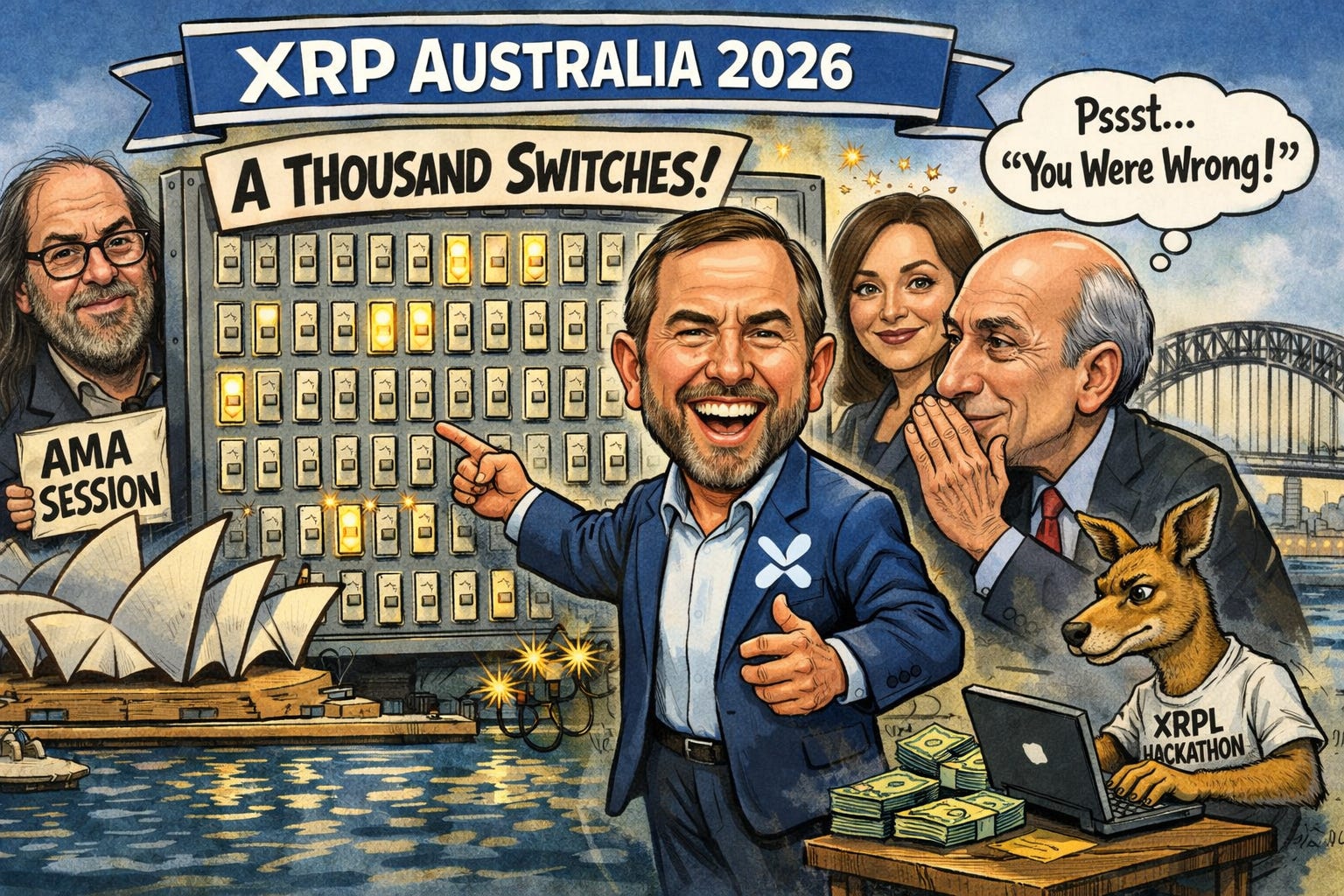
The XRP Australia Sydney 2026 conference took place on February 27, 2026, at Crown Sydney in Barangaroo, with organisers targeting more than 400 industry professionals and C-level executives. Ripple CEO Brad Garlinghouse delivered the headline keynote, a speech attendees are calling the “A Thousand Switches” address. His central message: crypto’s transformation is incremental, not driven by any single breakthrough. He framed Ripple’s progress as the accumulation of hundreds of small wins, each “flipping a switch” that compounds over time. Ripple President Monica Long and CTO Emeritus David Schwartz also spoke, with Schwartz headlining a closed-session AMA to close out the event (U.Today).
The speaker list ran deep: Asheesh Birla (CEO, Evernorth), John O’Loghlen (Managing Director Australia, Coinbase), Adrian Przelozny (CEO, Independent Reserve), Hugo Philion (Co-founder and CEO, Flare), and pro-crypto lawyer Bill Morgan, among others. A panel titled “Beyond Traditional Finance” featured Philion and Ripple’s Ross Edwards discussing decentralised finance and institutional adoption on XRPL. The conference was followed by an XRPL Hackathon on February 28 through March 1 at UNSW Kensington Campus, a 24-hour sprint focused on DeFi, privacy, and programmability with a prize pool of 6,250 AUD (Wave of Innovation).
The media cycle was largely dominated by Garlinghouse’s keynote: that a “senior U.S. official” approached him at the White House and said he was wrong about Ripple. Some outlets identified this person as former SEC Chair Gary Gensler. Gensler has not publicly confirmed or commented on the alleged exchange. Meanwhile, the more substantive announcements about developer tooling, ecosystem strategy, and XRPL’s expansion beyond payments were largely overshadowed (CryptoTimes).
The real story in Australia is the maturation of an APAC developer community around XRPL, supported by institutional partners like Independent Reserve and Coinbase Australia. Australia’s crypto adoption rate hit 31% in 2025, and self-managed super fund crypto exposure reached A$1.7 billion, a sevenfold increase since 2021. ASIC has adopted a sector-wide no-action stance until June 2026 while new digital asset legislation debates in Parliament. Whether the ecosystem pivot Garlinghouse announced translates into meaningful on-chain activity remains the question that matters most.
Seen on X

Sensei’s Insight: Ripple has now deployed over $550 million into the XRPL ecosystem since 2017, and the 2026 pivot toward community-led funding, regional hubs, and expanded accelerator programs signals a maturing network. This is the kind of structural investment that doesn't make price charts move overnight, but it builds the foundation that serious developers and institutions need to see before committing. More pathways for builders means more projects, more utility, and a broader ecosystem that doesn't rely solely on Ripple writing checks. I'm always bullish on XRP, and moves like this reinforce why: the infrastructure story keeps getting stronger even when the market isn't paying attention.

Sensei’s Insight: All four spot ETFs posting positive inflows on the same day is a good look, but let's keep it honest. Bitcoin pulled in $254 million while XRP brought in $1.22 million. That's not a comparison anyone should spin into an XRP-flipping-BTC narrative; Bitcoin is king in the ETF space and these numbers make that clear. That said, XRP more than doubled Solana's $0.5 million inflow, which is worth paying attention to. For an asset that only recently entered the ETF arena, outpacing SOL on inflow days is a quiet signal that institutional interest is building. Still bullish, but with eyes wide open about where we actually stand.
Debunked
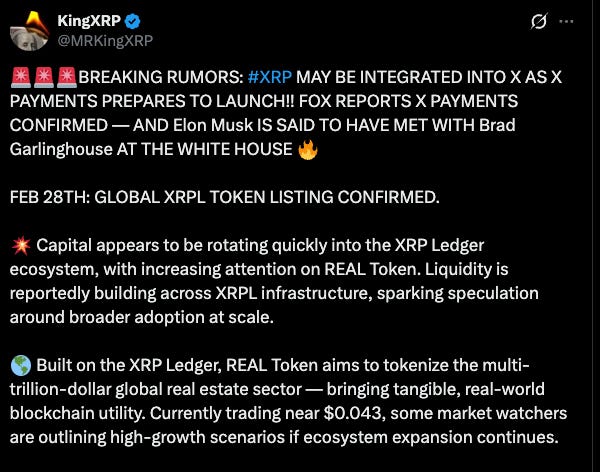
The post from MRKingXRP bundles several unverified claims into one hype package. The headline assertions: XRP “may be integrated” into X Payments, Fox News “confirmed” the launch, and Elon Musk met with Brad Garlinghouse at the White House. Here is what is actually confirmed: Musk revealed during an xAI presentation in February 2026 that X Money is in closed internal beta, with a limited external beta expected within months (IBTimes). That is real. What is not real is any official confirmation that XRP will be part of it. X has not announced crypto as a native payment method, and its initial rollout is focused on fiat transfers through its Visa partnership (Yahoo Finance). Fox Business reported on X Money’s existence back in late 2024; that is not a confirmation of XRP integration (Fox Business).
The Musk-Garlinghouse White House meeting has no credible source behind it. The “REAL Token global listing confirmed for February 28” traces back to a single tweet from @CryptoGeekNews, not from Ripple, Musk, or BTCC Exchange. Neither Ripple nor any Musk-affiliated company has issued statements supporting these claims (Blockonomi). Posts like this exploit real developments and attach fabricated details to drive engagement and, likely, pump low-cap tokens. The confirmed facts are straightforward: X Money exists in testing, XRP has no announced role, and REAL Token’s narrative is built on social media speculation, not corporate disclosures.