

The Consensus
🏦 Société Générale launches euro stablecoin: The $1.8 trillion bank deployed its MiCA-compliant stablecoin to XRPL for institutional scaling.
🔐 XRPL activates permissioned DEX: New XLS-81 infrastructure allows regulated institutions to trade on-chain using KYC-verified order books.
🇯🇵 SBI Holdings issues XRP bonds: Japan’s financial giant launched a ¥10 billion bond offering XRP rewards to onboard retail investors.
The Chart Watch
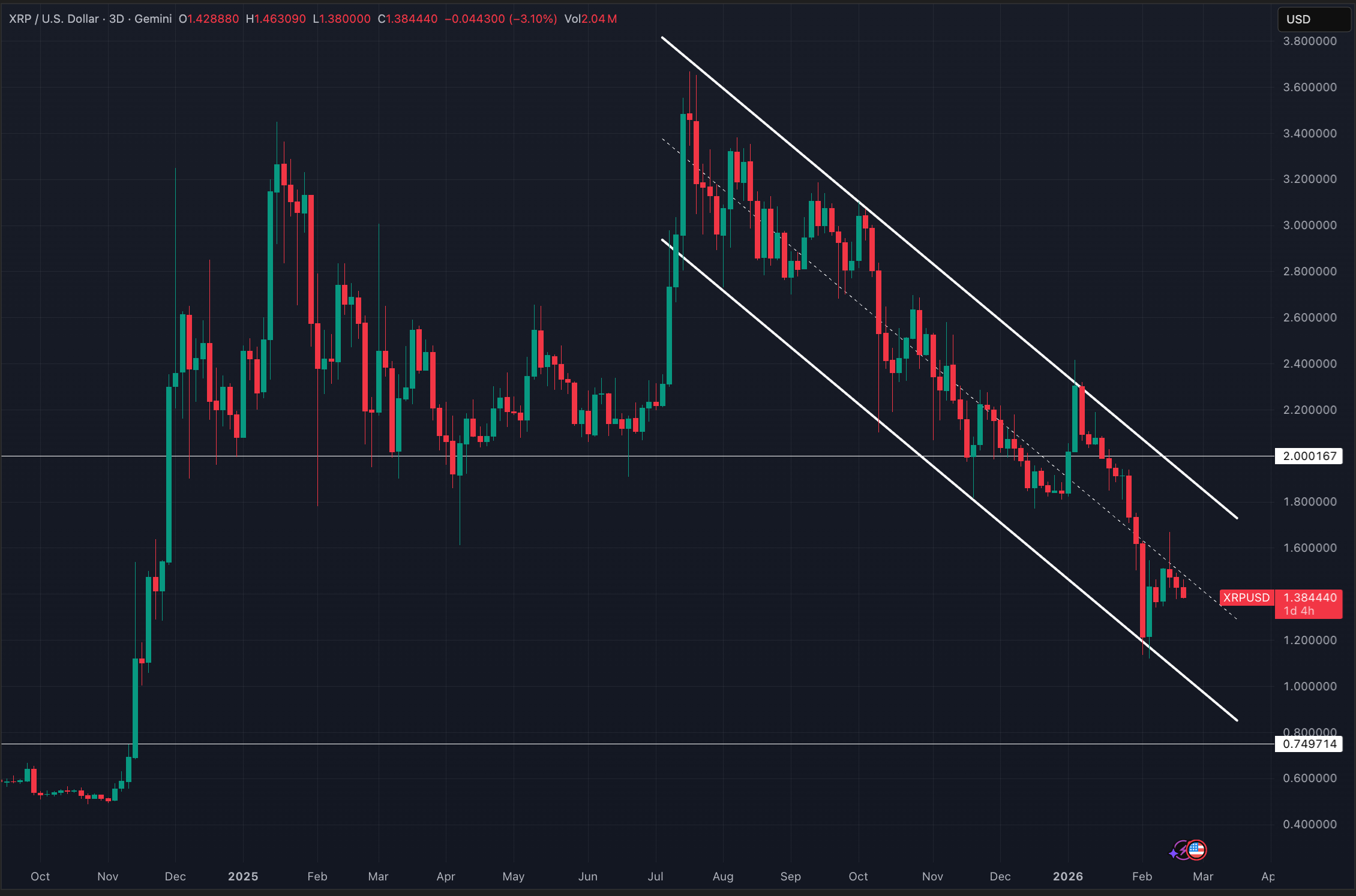
XRP is trading at $1.38 heading into the weekly candle close, which would mark the lowest weekly close since the week of November 11, 2024. Zoom out to the 3-day chart and the picture is clear: we’re in a downtrend. Lower highs, lower lows. We called this bear market many months ago when it wasn’t popular, and nothing on this chart has changed that view. The trend is your friend until it breaks, and it hasn’t broken.
You can see the descending parallel channel that’s been guiding price action since the July 2025 highs near $3.80. XRP is currently sitting right around the midline of that channel. Getting back above the upper boundary and reclaiming $2.00 would be the first real sign that the trend is shifting. Until that happens, every bounce is just a potential lower high until proven otherwise.
Every pump in this channel has faded. Every single one.
And that’s the trap. Yes, we can get sudden upswings. A squeeze back toward $1.80 or even $2.00 is entirely possible within this structure. But the people who get hurt in downtrends are the ones who mistake a bounce for a reversal. Be careful assuming this time is different without the chart confirming it.
The trend continuing means lower prices are on the table:
Below $1.00 is not off the table
If we break $1.00, the next major support sits around $0.75, lining up with the lower channel boundary and late 2024 structure
That doesn’t mean we get there, but being prepared for it is how you survive bear markets
All my shorter-term levels from last week still hold. If you want the specific support zones, bounce areas, and the levels where I’m looking to add to my long-term bag or take a trade, go back to last week’s newsletter. Sometimes it’s good to zoom out and look at the bigger picture. This is that chart.
All live entries are posted in real time for premium Substack members.
Poll
Last Week’s Results
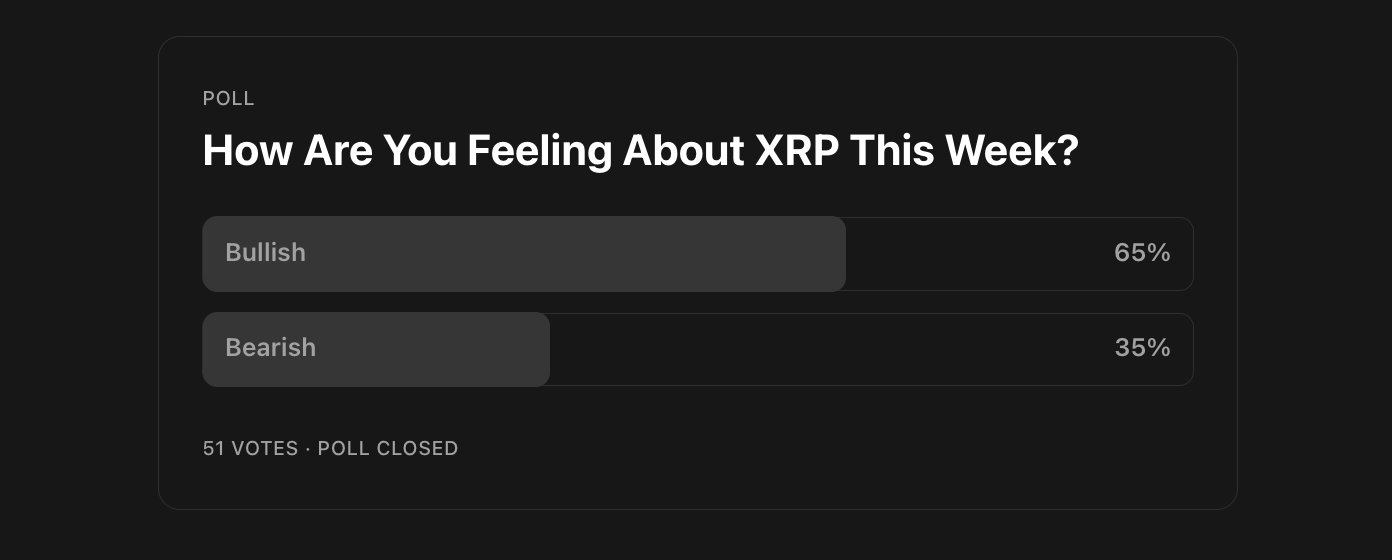
❌ 65% of you were Bullish, but from last Monday to today XRP is down ~7%.
Please do keep voting, it will be interesting to analyze this data in the future and see if we can draw any trends from this.
The Ripple Effect
$1.8 Trillion Bank Just Put Its Euro Stablecoin on the XRP Ledger
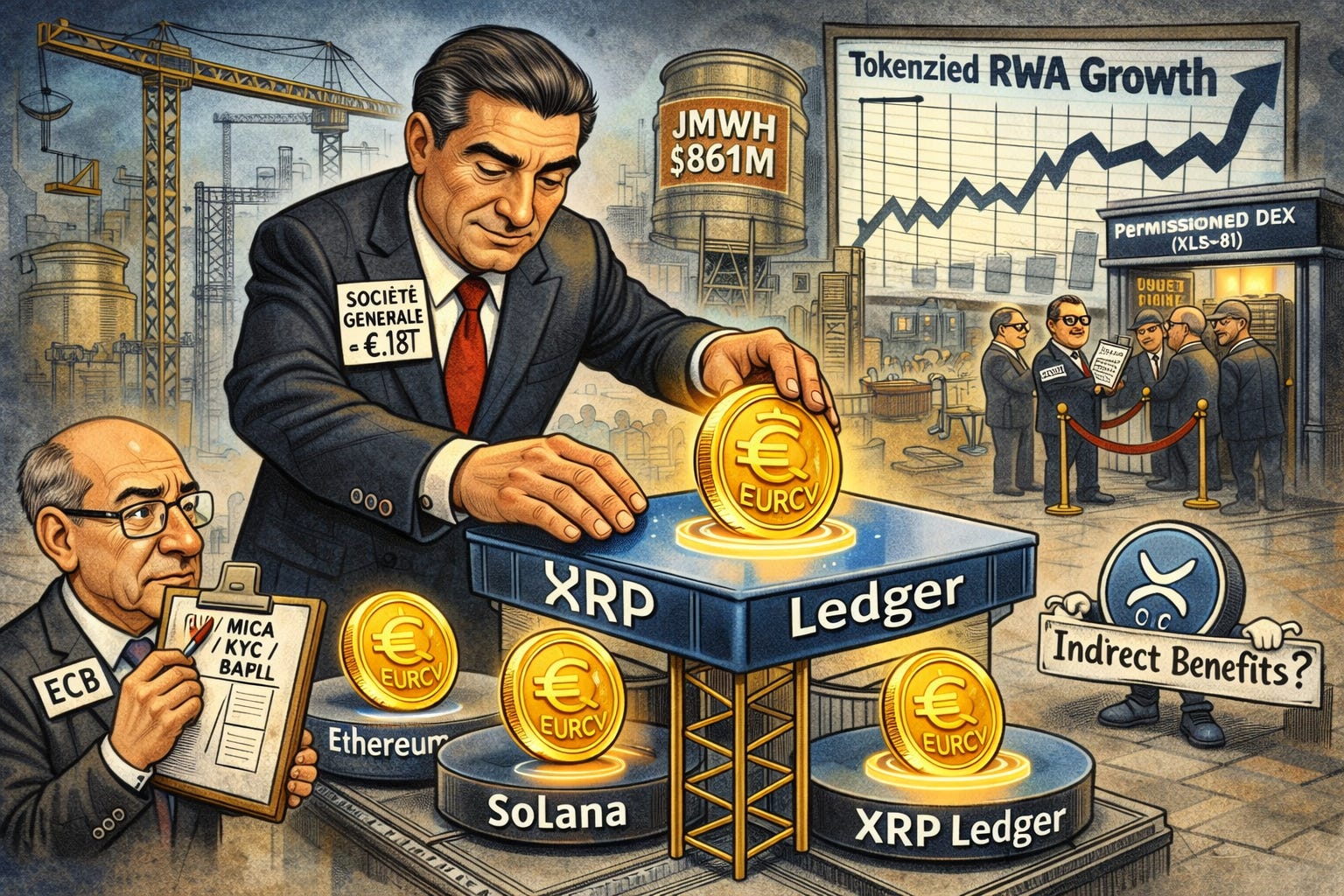
Société Générale, one of Europe’s largest banks with approximately $1.8 trillion in assets, has deployed its MiCA-compliant euro stablecoin EUR CoinVertible (EURCV) onto the XRP Ledger. EURCV was already live on Ethereum (since April 2023) and Solana (since June 2025), with a partial deployment on Stellar also announced in early 2025, making XRPL either the third or fourth chain depending on Stellar’s current operational status. SG-FORGE CEO Jean-Marc Stenger said the launch “reinforces our commitment to offering next-generation, compliant crypto-assets that promote transparency, security, and scalability.” Access is restricted to onboarded institutional clients who pass SG-FORGE’s KYC/AML checks. EURCV’s total issuance currently sits at approximately €65.8 million ($77.7 million).
The launch lands in the middle of a significant growth period for tokenised real-world assets on XRPL. By mid-February, the ledger had welcomed approximately $1.3 billion in tokenised RWA in 2026 alone, already surpassing all of 2025. Total RWA value on the network reached roughly $2.33 billion (including stablecoins) by February 19, outpacing Solana, Polygon, and Avalanche in 30-day growth rate. Worth noting: a single tokenised energy commodity (JMWH on Justoken) contributed $861 million in January alone. That’s meaningful growth, but not yet diversified growth.
A systemically important European bank choosing to deploy a regulated stablecoin on XRPL is a credibility signal that goes beyond crypto-native adoption. SG-FORGE is the digital assets arm of a bank that answers to the ECB and French regulators. That said, EURCV does not use XRP as backing, collateral, or a bridge asset. The benefits to XRP are indirect: more institutional-grade assets on the ledger increase network usage, transaction volume, and the case for XRP as on-ledger liquidity in future trading and settlement flows. Particularly now that the XLS-81 permissioned DEX (see below) gives regulated institutions a way to actually trade these assets on-chain.
XRPL Activates Permissioned DEX for Institutional Trading
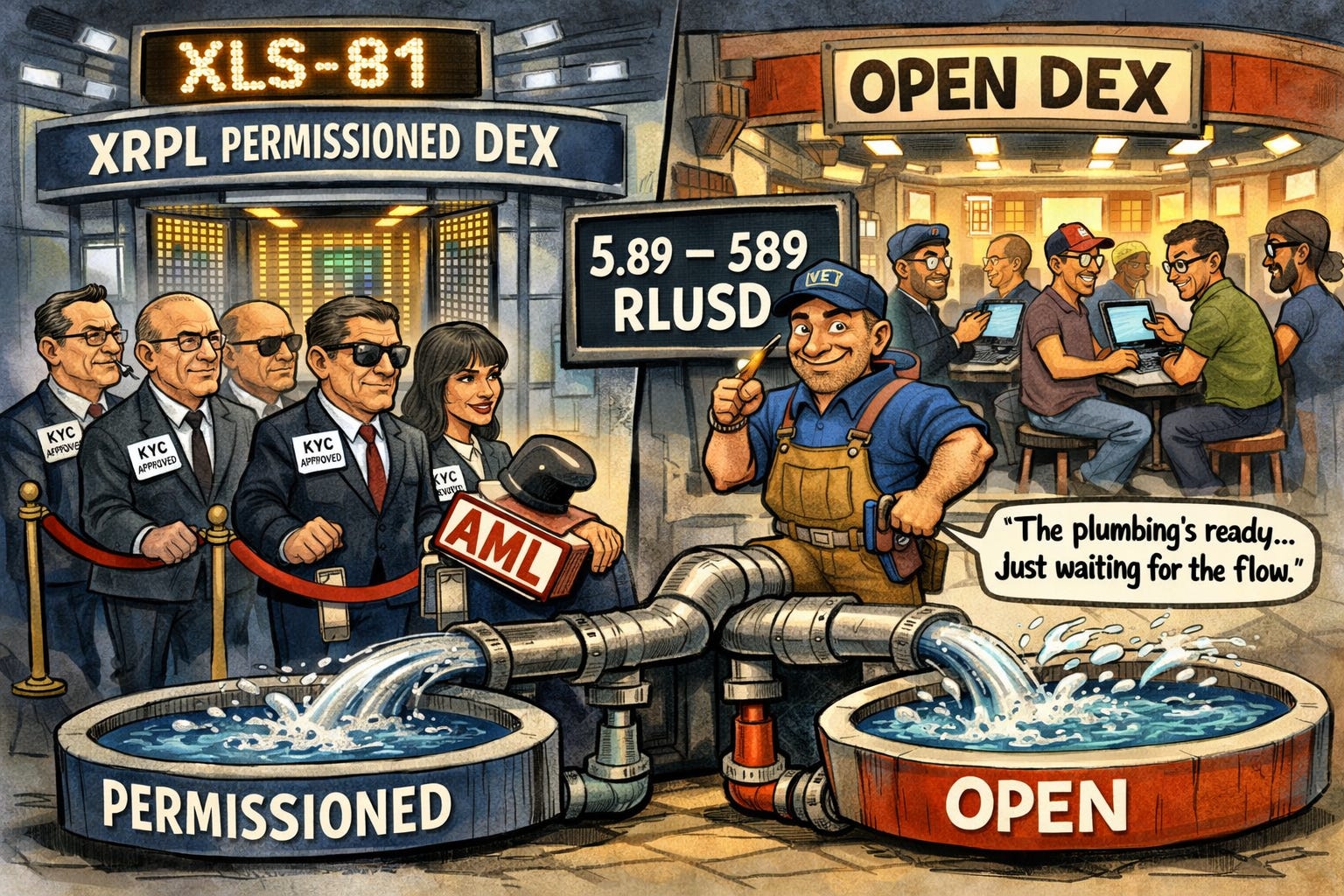
The XRP Ledger activated the XLS-81 “Permissioned DEX” amendment on 18 February at 10:58 UTC with 82.35% validator approval, roughly 28 of 34 validators clearing the 80% supermajority threshold. This creates credential-gated order books inside XRPL’s native decentralised exchange, where only KYC/AML-verified participants can place and accept offers. The first permissioned offer went live seconds after activation: 5.89 XRP for 589 RLUSD, a symbolic nod to the community’s “589” meme placed by XRPL validator “Vet.” It was not a genuine institutional trade.
XLS-81 works in tandem with two amendments that activated earlier in February. XLS-80 (activated 4 February) introduced “permissioned domains,” allowing administrators to create on-chain identity zones. XLS-85 “Token Escrow” (activated 12 February with 88% consensus) extended XRPL’s native escrow from XRP-only to all Trustline-based tokens, including stablecoins and tokenised real-world assets. All three activated within 14 days. Three offer types now exist on the DEX: open (unchanged, fully public), permissioned (restricted to verified participants), and hybrid (can match in both). The existing open DEX remains completely untouched for retail users.
This is the infrastructure banks and brokers actually need to trade on-chain while remaining compliant. Without permissioned trading venues, most regulated institutions simply cannot participate in on-chain markets. That’s not a choice, it’s a legal constraint. XLS-81 removes that barrier on XRPL, positioning the ledger as a serious alternative to private blockchain solutions. It’s directly relevant to entities already deploying assets on XRPL: Société Générale’s EURCV, Dubai’s tokenised property tokens, and future products like Aviva’s tokenised funds all need somewhere compliant to trade. Legitimate concerns exist around liquidity bifurcation, as splitting order flow between permissioned and open pools could thin both sides. The plumbing is now in place; the water hasn’t started flowing yet.
SBI Holdings Launches ¥10 Billion Blockchain Bond With XRP Rewards
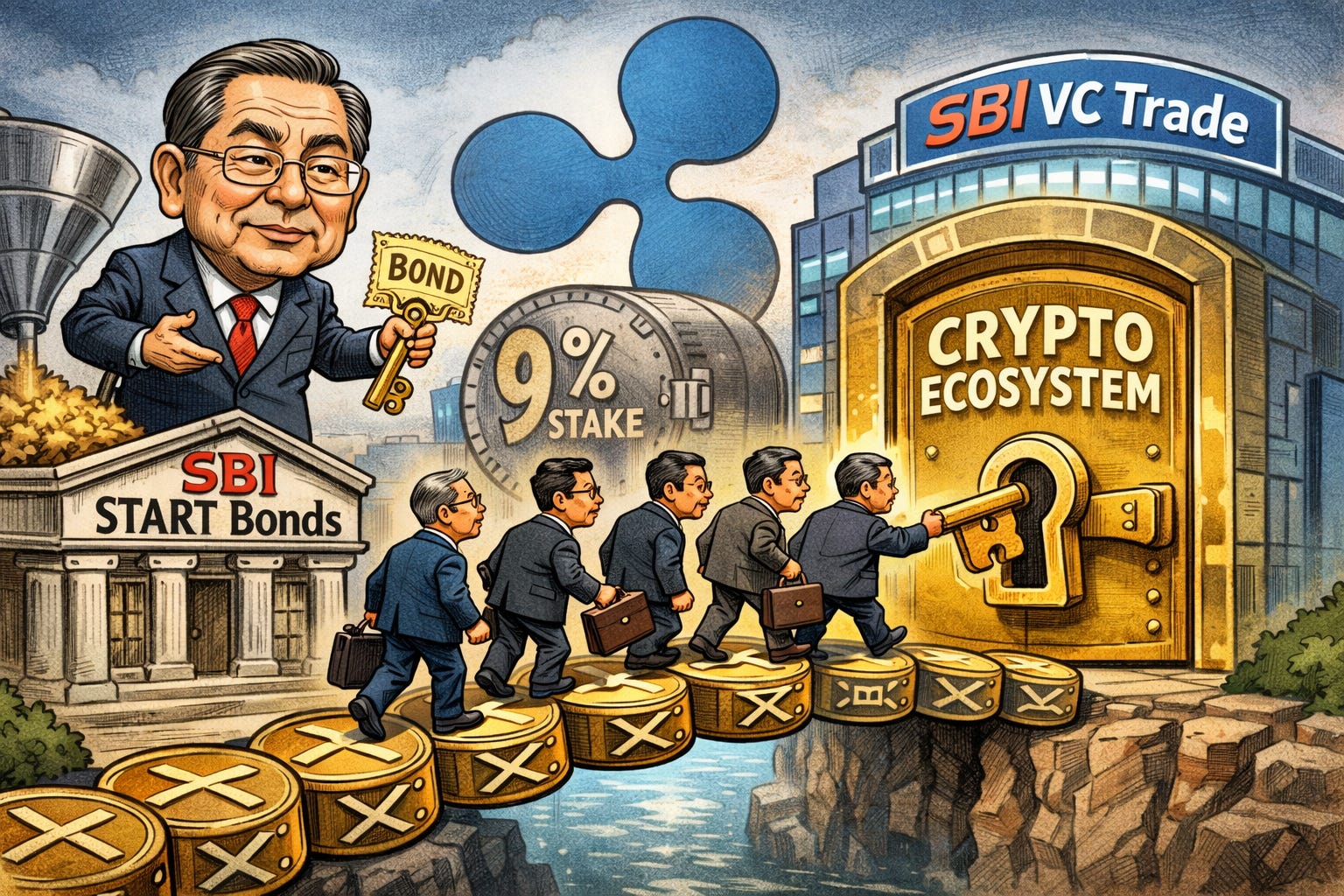
Japanese financial conglomerate SBI Holdings has announced its first security token bond, the “SBI START Bonds,” with a total issue amount of ¥10 billion (~$64.5 million). The three-year debt instrument offers an annual interest rate of 1.85-2.45%, with interest paid semi-annually and a credit rating of A- from R&I. The bonds are built on BOOSTRY’s “ibet for Fin” blockchain platform. Pricing is set for 10 March, issuance on 24 March, and secondary market trading begins 25 March on the Osaka Digital Exchange’s “START” system.
The XRP angle: investors who hold at least ¥100,000 (~$650) and maintain an account with SBI VC Trade (SBI’s crypto exchange) will receive XRP token rewards of approximately ¥200 worth of XRP per ¥100,000 invested, distributed at issuance and on each interest payment date through 2029. At XRP’s current price of roughly $1.42, that’s approximately 1 XRP per distribution event at the minimum investment level. Even if the entire ¥10 billion issuance is fully subscribed, total XRP distributed per payment event would be roughly $129,000 against XRP’s $1.4 billion in daily trading volume.
The XRP rewards are not the story. The story is the onboarding funnel. Requiring a crypto brokerage account at SBI VC Trade to receive the rewards is a deliberate strategy: SBI is using a conservative, regulated bond product to open the door between traditional Japanese retail investors and the crypto ecosystem. Once inside SBI VC Trade, those investors can be cross-sold spot trading, staking, and other services. SBI’s chairman Yoshitaka Kitao recently confirmed the company holds approximately 9% of Ripple Labs’ equity, a stake worth roughly $4.5 billion at Ripple’s estimated ~$50 billion valuation. Between the Ripple equity stake, the SBI Ripple Asia joint venture, the shareholder XRP perks programme, and now this bond product, SBI is systematically building bridges between traditional finance and the XRP ecosystem. The individual numbers are small; the strategic direction is consistent and long-term.
Seen on X
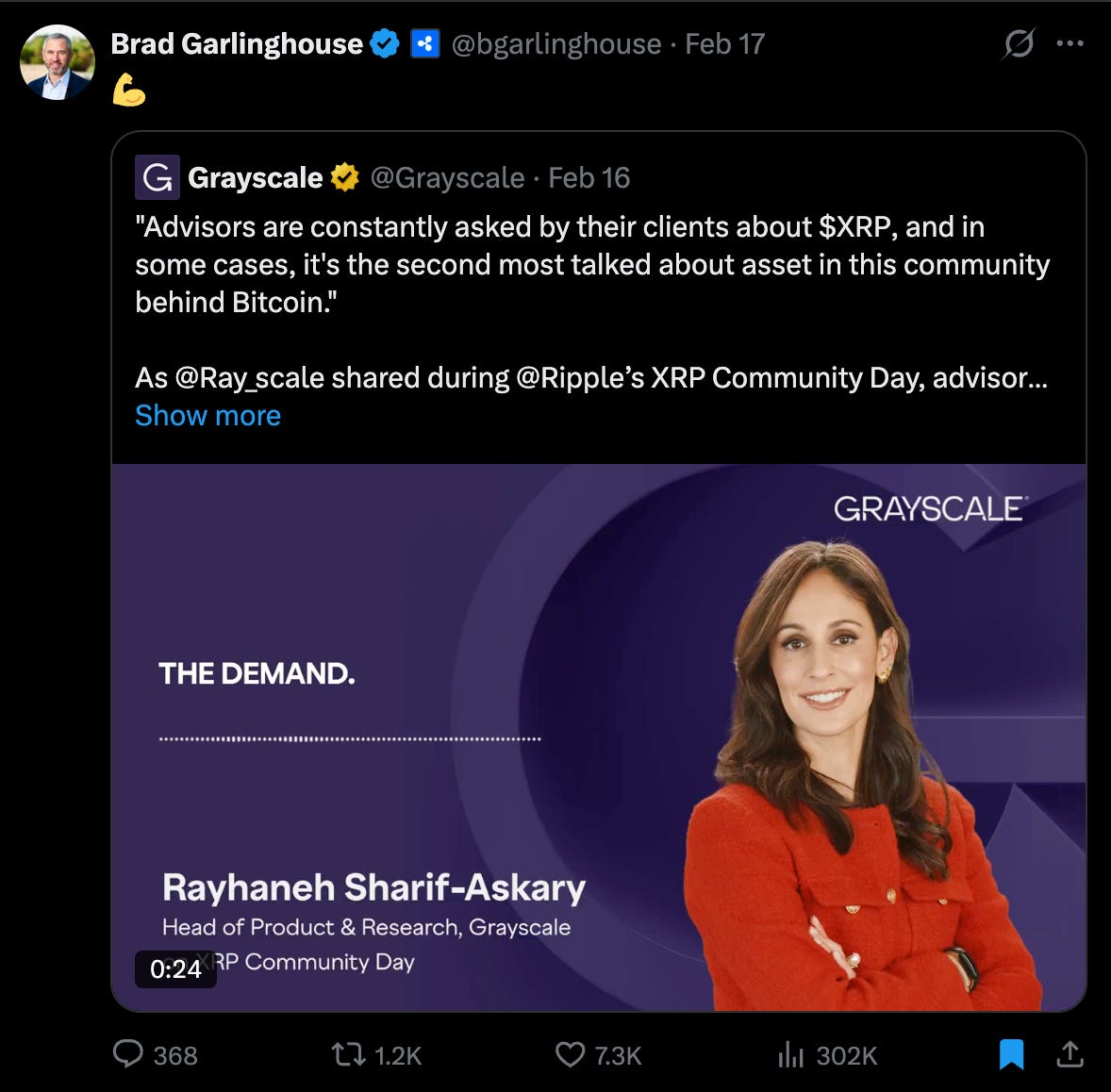
Sensei’s Insight: Grayscale's Head of Product and Research, Rayhaneh Sharif-Askary, saying at Ripple's XRP Community Day that advisors are constantly being asked about XRP by their clients, and that in some cases it's the second most talked about asset behind Bitcoin, is worth sitting with. This isn't a crypto Twitter personality talking their book. This is a senior executive at the largest digital asset manager in the world describing what financial advisors are hearing from their clients on the ground. Garlinghouse reposting it with a flexed bicep tells you Ripple sees this as validation of exactly where they want XRP to be positioned: not as a speculative altcoin, but as the asset that sits right behind Bitcoin in the institutional conversation. When the people managing the money are telling you the demand is there, pay attention.

Sensei’s Insight: This one isn't crypto news, but it matters for markets. The USS Gerald R. Ford carrier group moving through the Strait of Gibraltar toward the Mediterranean as part of a U.S. military buildup around Iran is the kind of geopolitical event that shakes risk assets. If tensions escalate, expect volatility across crypto, equities, and commodities. Oil prices spike, risk appetite contracts, and tokens like XRP can sell off hard regardless of how strong the fundamentals are that week. We just covered three major institutional developments for the XRPL ecosystem, but none of that matters in the short term if the macro picture turns ugly. Keep an eye on this. The best time to be paying attention to geopolitics is before it hits the price chart, not after.
Debunked
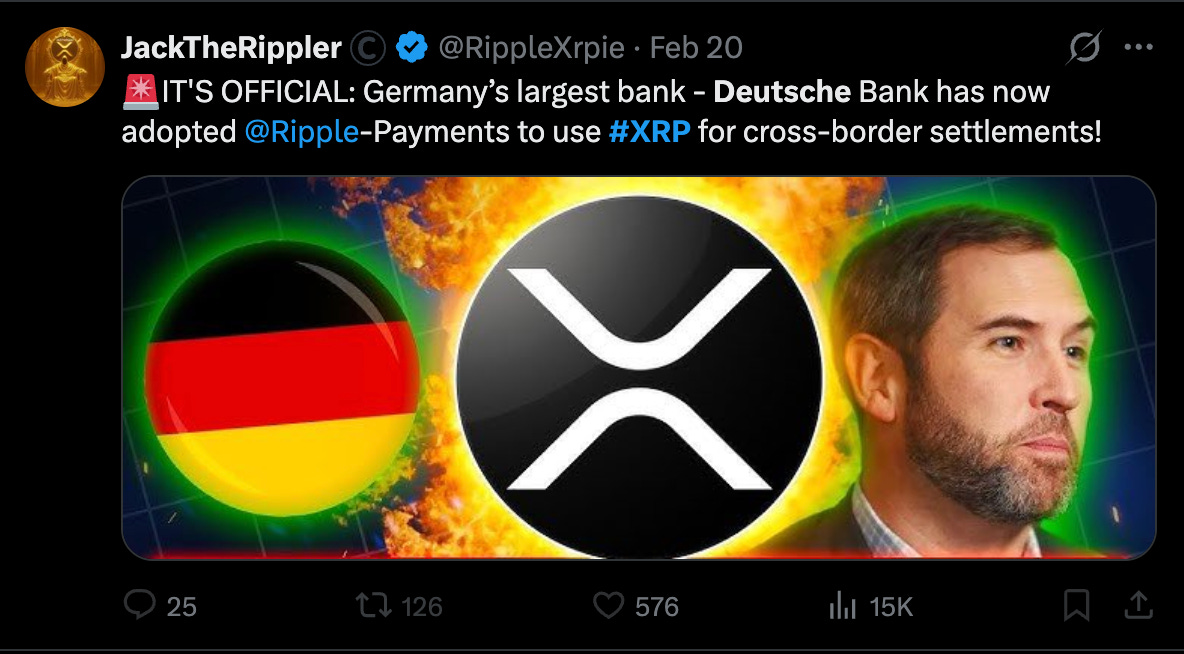
This claim is wrong on multiple levels. First, nothing is "official." Neither Deutsche Bank nor Ripple has issued a press release, joint announcement, or formal statement confirming this. The entire story traces back to a single Der Aktionär article which described Deutsche Bank as "increasingly relying on Ripple technology" based on publicly observable actions, not an official partnership announcement. Second, Deutsche Bank is not using XRP. Multiple outlets that covered the story, including U.Today, Analytics Insight, and CoinTrust, all confirmed the bank is exploring Ripple's software stack for faster messaging, payment routing, and liquidity management, not the XRP token. Deutsche Bank's confirmed blockchain strategy involves completely separate projects: Partior for cross-border euro payments, an Ethereum L2 called "Dama 2" using ZKsync, and SWIFT's new blockchain ledger built with Consensys. Posting "IT'S OFFICIAL" when there isn't even a confirmed partnership, let alone XRP usage, is misinformation. The Deutsche Bank story may develop into something meaningful over time, but as of today it is unconfirmed and does not involve XRP.