

Before we get into the XRP weekly, there is a macro development out of Japan that could move every major market, including equities, bonds, FX, and crypto.
🇯🇵 Breaking: Japan Intervention Risk Is Back on the Table
Japan is back on currency intervention watch.
Over the weekend, Prime Minister Sanae Takaichi warned that authorities are prepared to step directly into FX markets if the yen continues to weaken in what she described as “abnormal or speculative” ways. That language is deliberate and historically used just before intervention.
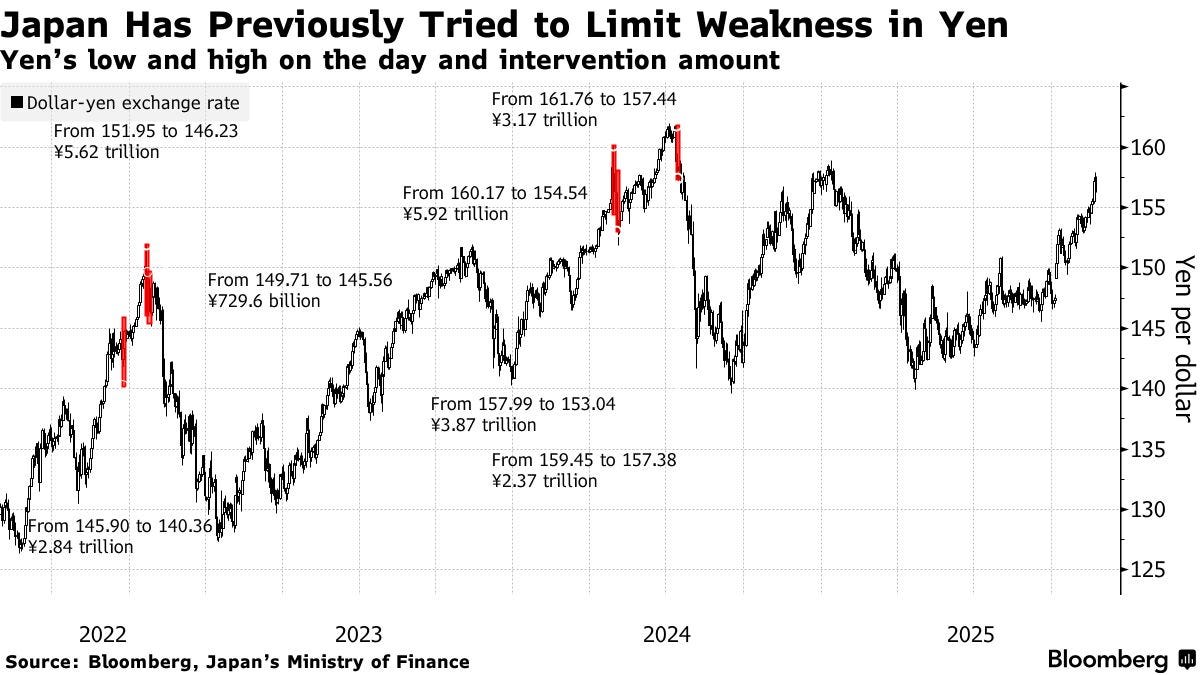
The yen is now trading close to ¥160 per dollar, a level markets widely see as Japan’s informal red line. In 2024, every push into this zone triggered direct action, with Tokyo spending over ¥10 trillion to slow the move.
What escalated the situation late was this. Reports showed the New York Fed contacted major financial institutions to check current yen exchange rates. In market terms, this is known as a rate check. It is often one of the final signals before coordinated action. The last time the U.S. and Japan coordinated on FX intervention was in 2011.
Markets reacted quickly because this raises the risk of a sudden and disorderly yen move, not a slow grind.
Why this matters for global markets
This is not just an FX story.
For years, near zero rates in Japan made the yen the cheapest currency in the world to borrow. Investors borrowed yen and deployed that capital into higher yielding assets like U.S. equities, bonds, and crypto. This is known as the yen carry trade.
As long as the yen stays weak, that trade works.
If Japan intervenes and the yen strengthens sharply, the trade breaks. Positions are forced to unwind. Stocks get sold. Bonds get sold. Leverage comes off. Liquidity is pulled out of the system very quickly.
This is why sharp yen moves often trigger global risk off events, even when nothing else appears to have changed.
With the FOMC decision coming on Wednesday, this adds another layer of risk. A hawkish surprise from the Fed alongside yen intervention risk is exactly the kind of mix that catches markets wrong footed.
I will publish a full deep dive tomorrow on what intervention could look like this time and where the real spillover risks sit. Today’s note is about awareness.
Premium is now open. 60 percent off for one week.
This week marks the biggest upgrade this newsletter has ever had.
Premium members get full access to my research process, my portfolio, and the tools I actually use to navigate volatile markets.
What Premium includes
• Daily premium newsletter and deep dives
• Daily charts with clear levels and momentum explained simply
• Full access to my live portfolio and portfolio framework
• Community access and one on one direct help from me
• Full technical analysis chart training course
• Debt planner and budget planner app
• Event coverage and prep for high volatility releases like CPI, FOMC, and BOJ
This is not about hype or trade calls. It is about being positioned and prepared before volatility hits, not after.
The offer
• 60 percent off your first year
• Available for 3 more days only
• Limited capacity
📊 Bloomberg chart
What this chart proves
The chart shows USD/JPY during past Japanese FX interventions.
The red markers highlight moments when Japan stepped in to support the yen.
Each time Japan intervened, USD/JPY dropped sharply, meaning the yen strengthened fast.
These moves were sudden, not gradual, which is exactly what stresses markets.
Why this supports the carry trade risk
The global carry trade relies on a weak or stable yen.
When Japan intervenes, the yen moves higher very quickly.
That forces anyone who borrowed yen to buy it back at worse prices.
To do that, they must sell risk assets, including stocks, bonds, and crypto.
To mark the biggest upgrade the newsletter has ever had, there is a limited time, limited capacity offer of 60% off your first year. Click below to access.
The Consensus
🎁 Claim 60% newsletter discount: Save on premium research and live portfolio challenge with this limited time offer.
🇯🇵 Japan shifts crypto regulations: New laws reclassify XRP like stocks, slashing taxes to 20% and unlocking institutional pension investments.
🚨 XRPL 3.0.0 goes live: Mandatory network upgrades resolve scaling issues, while new permissioned domains enable compliant institutional asset trading.
🇪🇺 Davos highlights infrastructure shift: Ripple focuses on global settlement plumbing as tokenized assets on the ledger surpass $1 billion.
The Chart Watch
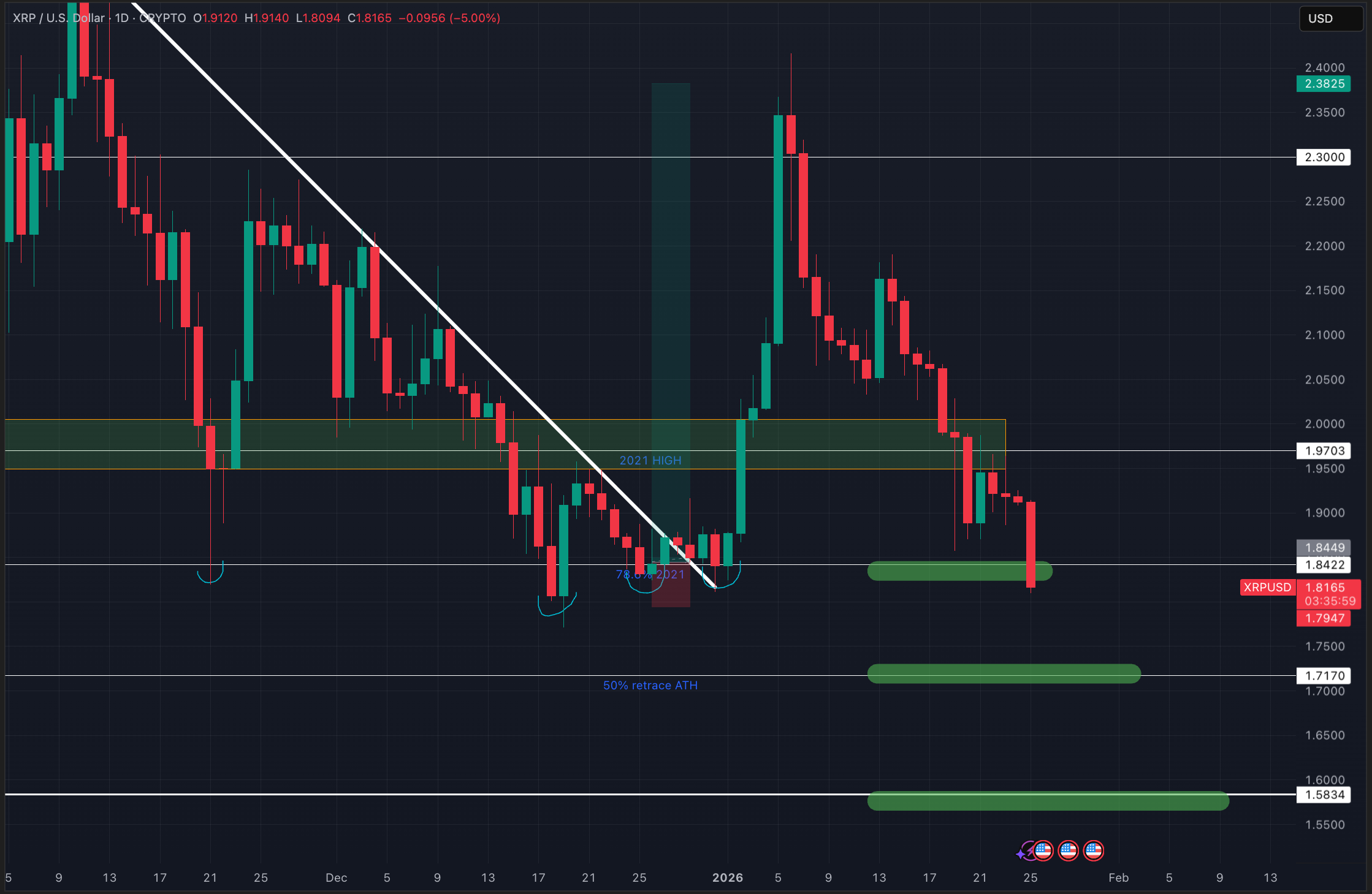
The current market structure centers on the 1.84 level. This area could serve as a primary interest zone for long-term investors looking to add to their holdings. However, for traders tracking the immediate trend, the recent bounce from 1.84 to 2.30 appears to have been a lower high rather than a trend reversal. This move provided a specific trading window, but the overall price action suggests it was merely an opportunity to trade within a broader descending pattern.
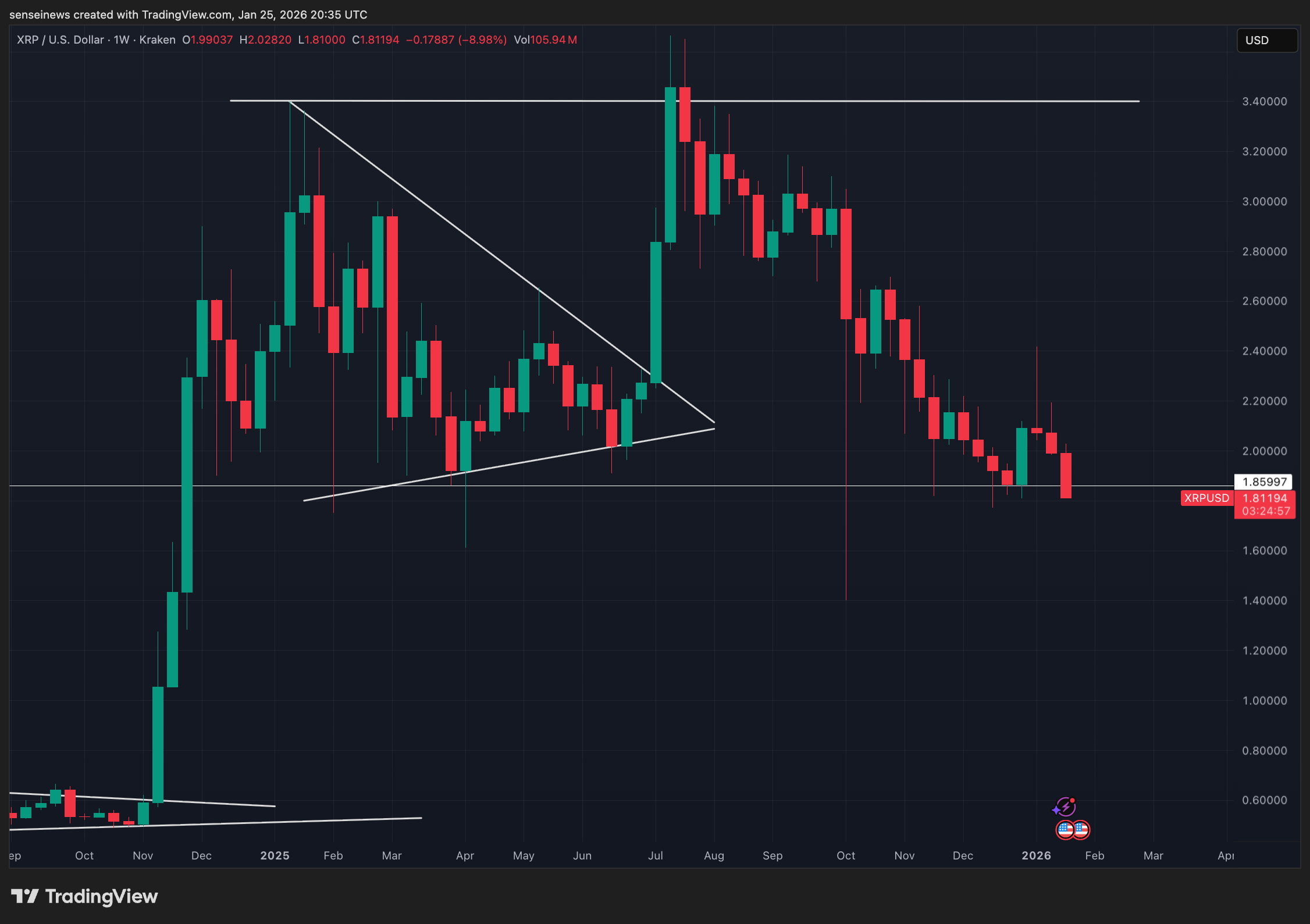
Market participants are now focused on the upcoming weekly candle close. A settlement near the 1.80 mark would represent the lowest weekly close since November 2024. This would potentially confirm a structural shift toward a sequence of lower highs and lower lows. If the current support levels fail to hold, the price could see a move toward the 1.71 level. A further breakdown might lead to a test of the 1.58 zone as the trend remains bearish until a decisive shift occurs.
Weekly Chart:
Poll
Last Week’s Results
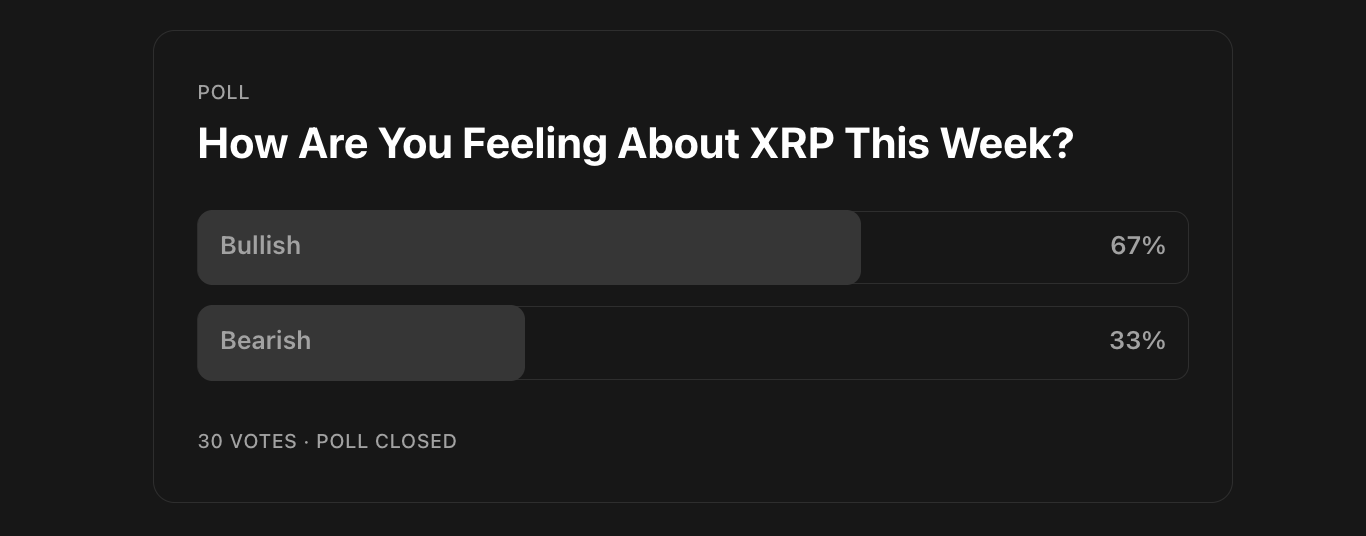
❌ 67% of you were bullish, however from last Sunday to today XRP is actually down ~7%.
Please do keep voting, it will be interesting to analyze this data in the future and see if we can draw any trends from this.
The Ripple Effect
🇯🇵 XRP & Japan’s Regulatory Pivot: The Quiet Unlock
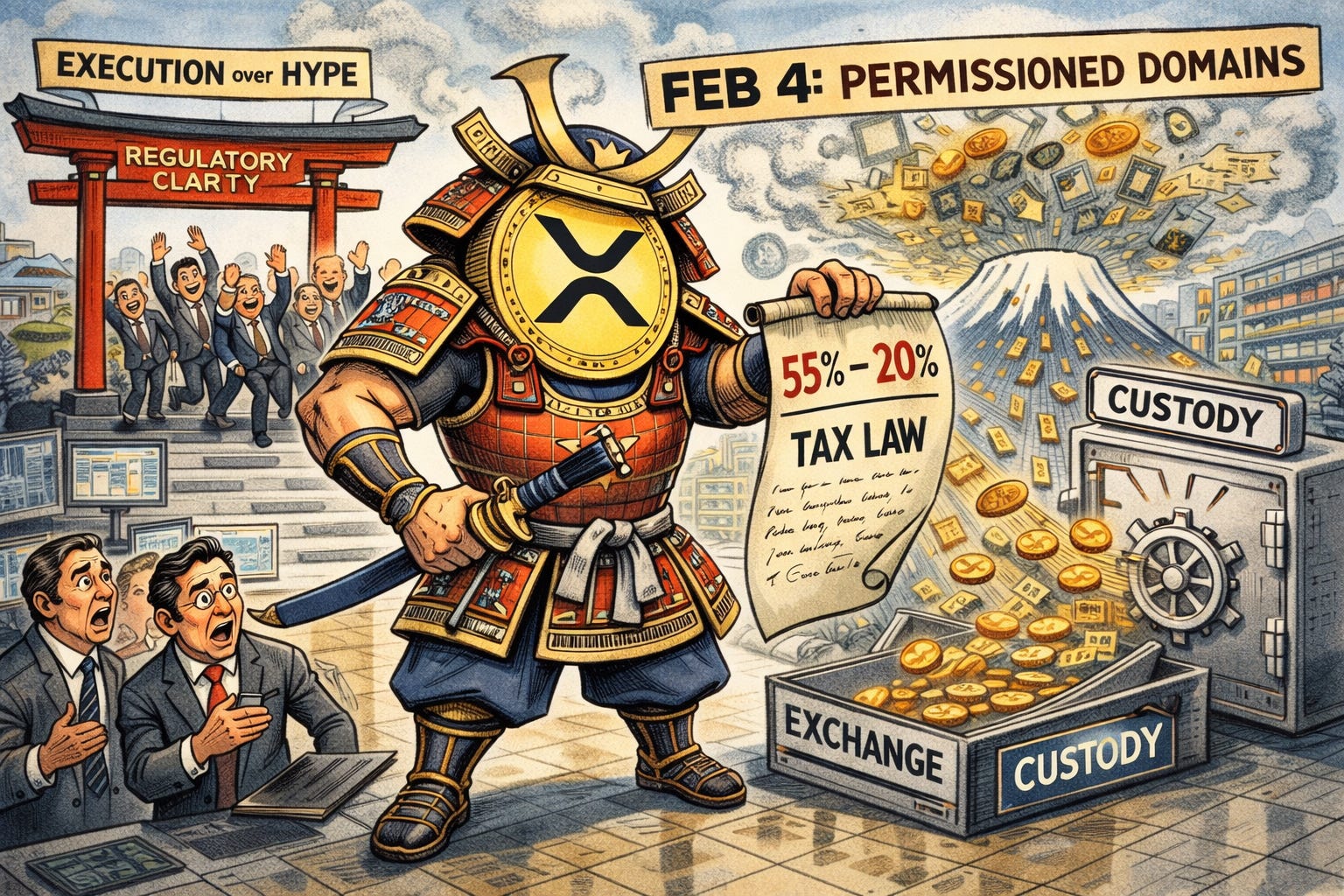
Japan is preparing one of the most important crypto regulatory shifts globally. The Financial Services Agency plans to reclassify 105 cryptocurrencies (including XRP) under the Financial Instruments and Exchange Act by 2026, moving them out of the “miscellaneous income” bucket and into the same framework as stocks. That means a tax cut from 55% to 20%, proper institutional protections, and—crucially—legal permission for pensions, insurers, and asset managers to allocate. Headlines focus on XRP, but the truth is more interesting: XRP isn’t being “chosen,” it’s already embedded. This regulation simply formalises infrastructure that has been live in Japan for years.
Where XRP stands apart is execution. Japan already accounts for ~40% of global XRP trading, XRP dominates JPY on-ramps with $21.7B in volume, and SBI Remit has been using it in production to move money across major corridors like the $36B Philippines remittance market. At the same time, XRP exchange balances have collapsed 57% (4B → ~1.7B) as tokens move into custody and utility. With the XRPL now processing 1.8M daily transactions and hosting $1B+ in tokenised real-world assets, Japan’s regulatory shift removes the final compliance barrier for a $9.65 trillion banking system that is already testing the rails.
Why this matters for holders:
Tax clarity: 55% → 20% is a 2.75× after-tax improvement
Institutional unlock: pensions, insurers, and asset managers can now legally allocate
Supply squeeze: fewer XRP on exchanges as demand rises
Utility flywheel: more banks + tokenisation = more settlement demand
Key catalyst: Feb 4 Permissioned Domains launch, enabling compliant institutional access at scale
If institutional capital follows regulatory clarity (as it historically does) XRP enters the next phase driven by scarcity, compliance, and real utility, not speculation. Execution and timing matter, but the setup is real.
🚨 XRPL 3.0.0: Institutions Are Finally Here
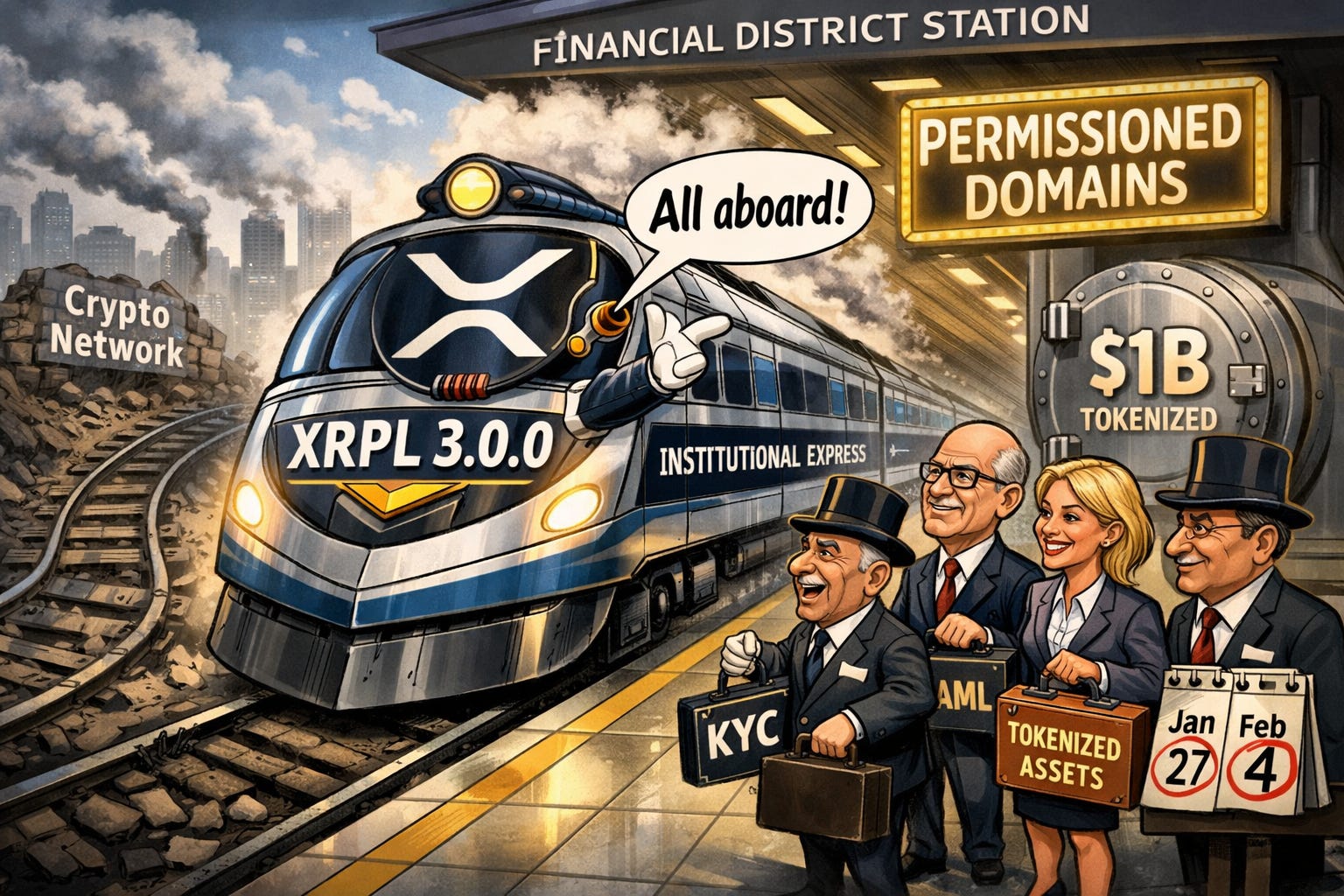
Over the next 10 days, the XRP Ledger completes the final transition from “crypto network” to institutional financial infrastructure. On January 27, XRPL 3.0.0 activates, rolling out five mandatory fixes that resolve precision, escrow, oracle, and AMM issues that only show up at institutional scale. These weren’t theoretical bugs. They’re the kind banks hit when testing real money. That’s why node operators were given a hard deadline: upgrade or get kicked off the network. You don’t force mandatory upgrades unless production deployment is imminent.
Then comes the real unlock. On February 4, Permissioned Domains go live. This is the compliance layer institutions have been waiting for. It allows banks, asset managers, and regulated firms to operate on the public XRPL while enforcing KYC/AML at the protocol level, without exposing private data on-chain. In simple terms: institutions can now issue, trade, lend, and settle tokenised assets on XRPL itself, instead of hiding in private chains or off-ledger systems.

Why this matters for XRP holders:
Compliance barrier removed: institutions can finally use XRPL without regulatory workarounds
$1B milestone crossed: XRPL just passed $1B in tokenised real-world assets.
Supply squeeze confirmed: XRP exchange balances are down 57%, tightening liquidity
🇪🇺 Davos 2026 Exposed the Real Crypto Divide - Ripple Is Building the Middle Ground
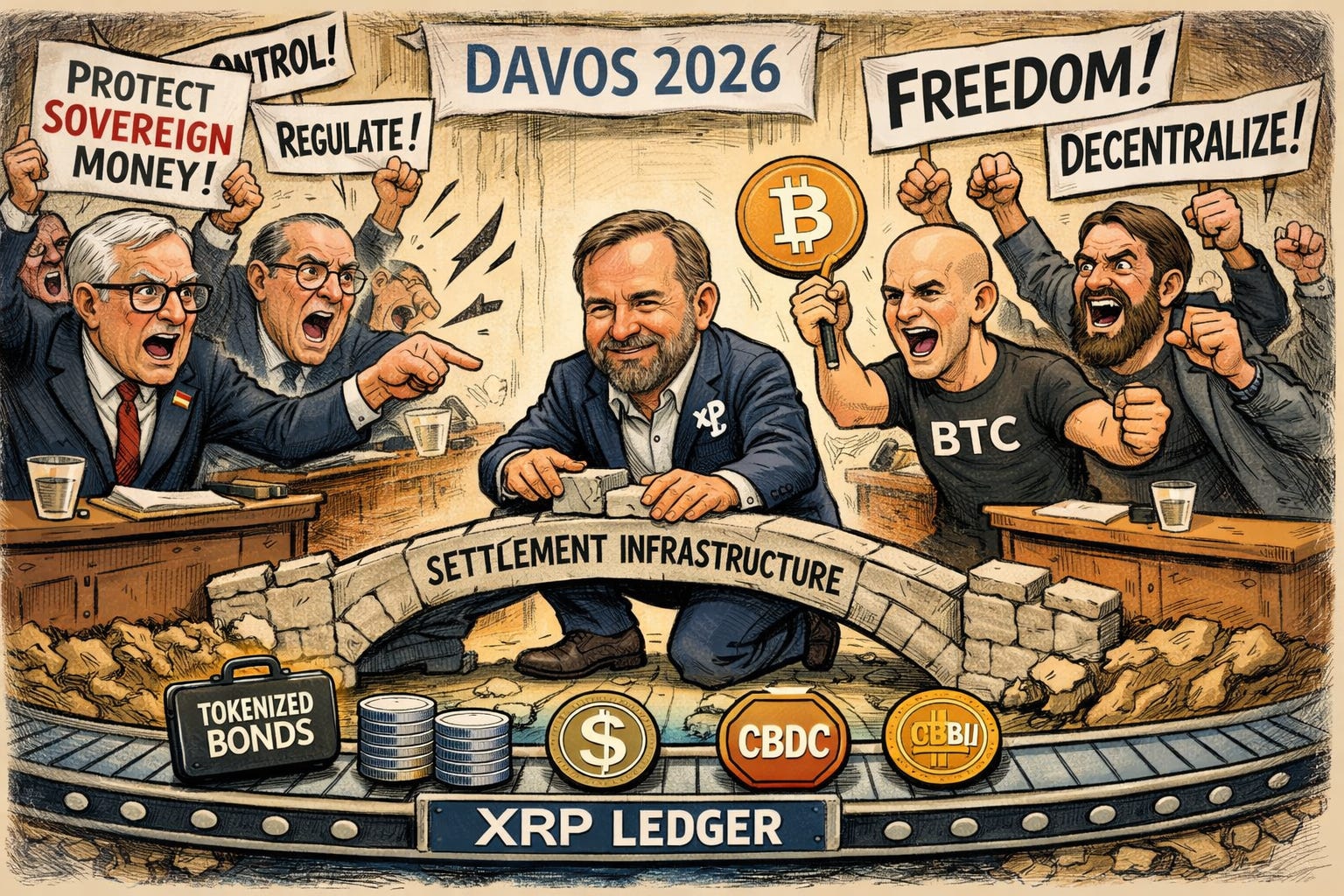
At Davos this week, the fight over digital money finally moved into the open. Central bankers warned that private crypto threatens democratic control of money, while crypto leaders argued decentralised systems are a necessary check on inflation and deficit spending. While Coinbase CEO Brian Armstrong and France’s central bank chief clashed over Bitcoin and stablecoins, Ripple CEO Brad Garlinghouse avoided ideology entirely. His focus was infrastructure. Institutions are already tokenising assets, settling on-chain, and cutting costs and they’re doing it now, not as a future experiment.
That positioning matters for XRP. Ripple isn’t trying to replace sovereign money or push a Bitcoin-style standard. It’s building settlement rails that work whether the asset is a tokenised bond, a regulated stablecoin, or eventually a CBDC. In 2025, tokenised assets on the XRP Ledger grew more than 2,000%, and firms like Archax have committed $1B to deploy on XRPL by mid-2026. Davos didn’t change the direction it confirmed it. The debate has shifted from whether digital money exists to who controls the plumbing.
What this means for XRP holders:
XRP is positioned as settlement infrastructure, not a political bet
Institutional tokenisation on XRPL is already live and scaling
Regulatory pressure is now about design and control, not banning crypto
Short-term price swings don’t change the long-term infrastructure build
Seen on X

Sensei’s Insight: Brad Garlinghouse being bullish on 2026 doesn’t mean prices go up in a straight line. Today XRP is down, Bitcoin is down, and that’s normal behaviour inside a broader bullish structure. Strong markets still pull back. In fact, they need to. Headlines like this often land during red days because price moves on positioning and liquidity, not CEO comments.
This is where process matters. I don’t buy every dip or every percentage drop. I buy levels, not emotions. When Bitcoin and XRP retrace together, it’s usually rotation and risk-off, not a breakdown in fundamentals. These moments can offer buying opportunities, but only if you’re patient and disciplined.
How I approach it: I buy on the way down, not all at once. I wait for key chart levels, not headlines Red days during bullish narratives are often where positions get built, not closed
Short-term pain doesn’t cancel long-term structure. It just tests whether you have one.

Sensei’s Insight: This post is about escalation risk, not an imminent strike. Iran naming a U.S. aircraft carrier and referencing hypersonic capability is a deliberate signalling move, designed to raise the perceived cost of action rather than trigger it. The key detail isn’t the threat itself, it’s the environment it appears in: carrier groups moving closer, regional airspace disruptions, and public messaging becoming more explicit. Markets don’t need missiles to react. They respond to uncertainty, miscalculation risk, and the possibility that trade routes or energy flows could be disrupted even briefly.
For markets, this keeps a mild risk-off bias in play: volatility spikes on headlines, energy prices stay sensitive, and liquidity thins. For XRP, that usually means short-term pressure followed by faster recovery if escalation remains rhetorical. Prolonged geopolitical stress reinforces the long-term case for neutral, always-on settlement infrastructure, but in the near term XRP still trades the headlines. This is a tension signal, not confirmation of war, and markets will continue to price it that way unless actions replace words.
Debunked

Posts like this are pure theatre. Declaring the “dollar era is mathematically over,” gold at $50k, silver at $1k, and XRP as “the exit” sounds confident, but confidence without structure is meaningless. There’s no model shown, no assumptions stated, no timeframe defined, and no mechanism explained. Just big numbers and emotional language designed to bypass critical thinking.
Markets don’t move because someone says they’re “programmed.” If gold were mathematically locked to $50k or XRP destined for $10k, the path would be observable through flows, balance sheets, policy decisions, and liquidity conditions. None of that is presented here. This is not analysis, it’s belief projection. The “lifeboat or drown” framing is the giveaway. Real macro transitions are slow, uneven, and full of drawdowns, not cinematic exits.
Conviction is not the same as intelligence. Intelligence explains how, under what conditions, and what would invalidate the thesis. This post does none of that. It offers certainty without accountability, numbers without logic, and fear as persuasion. That’s not how serious investors think, and it’s not how real capital moves.
The Horizon
MONDAY, JANUARY 26
U.S. Durable Goods Orders (November) (13:30 GMT / 08:30 ET):
Headline, ex-defense, and core capital goods orders provide an early read on U.S. manufacturing momentum entering year-end. A rebound would ease recession concerns and support risk assets, while continued weakness would reinforce expectations that higher rates are biting into capex and industrial demand.
TUESDAY, JANUARY 27
U.S. Consumer Confidence (January) (15:00 GMT / 10:00 ET):
Confidence data offers a forward-looking gauge of household spending intentions. Deterioration would underscore pressure on consumption as excess savings fade, while resilience would support the soft-landing narrative ahead of the Fed decision.
Bank of Japan Monetary Policy Meeting Minutes (23:50 GMT / 18:50 ET):
The minutes provide detail on the internal balance of risks following the BoJ’s recent hawkish shift. Any emphasis on wage-driven inflation persistence could revive speculation of further tightening and drive volatility in JPY and global rates.
WEDNESDAY, JANUARY 28
Federal Reserve Interest Rate Decision & Press Conference (19:00–20:00 GMT / 14:00–15:00 ET):
The Fed is expected to hold rates steady, placing full focus on guidance and Chair Powell’s tone. Signals on inflation progress, labour-market slack, and the timing of potential cuts will set the trajectory for rates, equities, and the dollar into Q1.
THURSDAY, JANUARY 29
U.S. Initial Jobless Claims (13:30 GMT / 08:30 ET):
Weekly claims remain the most timely indicator of labour-market conditions. A sustained rise would reinforce the case that employment is cooling, strengthening expectations for Fed easing later in 2026.
Tokyo CPI (January) (23:30 GMT / 18:30 ET):
Tokyo inflation acts as a leading indicator for Japan’s national CPI. Further moderation would ease pressure on the BoJ to tighten again, while stickiness would keep the risk of additional policy normalization alive.
FRIDAY, JANUARY 30
U.S. Producer Price Index (December) (13:30 GMT / 08:30 ET):
PPI offers insight into upstream inflation pressures feeding into consumer prices. A soft print would support the disinflation narrative and rate-cut expectations, while upside surprises would challenge the market’s easing bias.
Chicago PMI (January) (14:45 GMT / 09:45 ET):
A regional snapshot of U.S. manufacturing activity and an early signal for national ISM trends. Continued contraction would reinforce growth concerns, while stabilization could temper recession fears heading into February.